Has the Fed's favorite inflation gauge been rewritten by Wash? Will the "underestimation of inflation" in 2021 repeat?
The new Fed Chair, Waller, is trying to shift the central bank's policy anchor to a more moderate alternative inflation indicator. This significant shift in the underlying framework has sparked market concerns that the Fed may repeat the mistakes of 2021 and once again underestimate potential price pressures.
Current inflation data is presenting two very different pictures. The latest data released by the US Department of Commerce shows that after excluding the more volatile food and energy items, the traditional core PCE rose to 3.3% over the past year, the fastest pace since 2023.
However, as previously mentioned by Wall Street News, the trimmed mean PCE inflation compiled by the Dallas Fed was only 2.3% year-on-year in April.
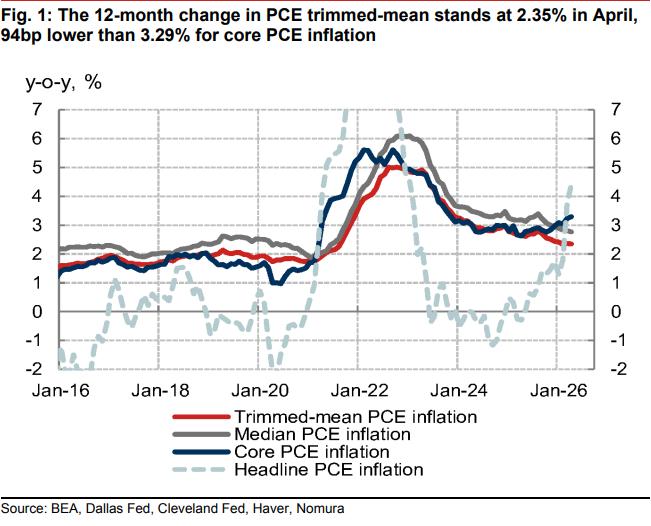
Nick Timiraos, a Wall Street Journal reporter known as the "Fed whisperer," pointed out in his latest article that this statistical divergence directly influences the Fed's interest rate path and the financial market's expectations for interest rate cuts.
Waller clearly expressed his preference for the trimmed mean PCE during the confirmation hearing in April, believing that it can better filter out one-time shocks such as tariffs and geopolitical events, thus supporting the dovish narrative that inflation is improving. In contrast, Fed Governor Lisa Cook publicly warned that the core inflation indicator "is clearly moving in the wrong direction."
For investors, the current focus is on which inflation gauge the Fed should trust. If Waller's policy framework gives more weight to the trimmed mean PCE, the logic for the Fed to maintain a loose policy or cut interest rates in the short term will be strengthened. However, if there are systematic biases in this indicator, this "false sense of security" may cause the Fed to fall behind the inflation curve again.
Core Disagreement: A Cooler Alternative Indicator to Hedge Traditional Inflation Concerns
For a long time, the CPI released by the US Labor Department has attracted wide public attention due to its early release time and its link to many contracts. However, Fed policymakers place more emphasis on the PCE price index released by the Department of Commerce, especially the core PCE.
However, Waller called the core PCE a "rough swag," believing that it retains too many one-time price distortion factors.
The trimmed mean PCE compiled by the Dallas Fed, which Waller favors, attempts to eliminate noise through a systematic filtering mechanism. Different from the core PCE, which always excludes food and energy, this indicator excludes the items with the largest price increases and decreases each month based on the price change range, and retains the middle part. According to researchers at the Dallas Fed, the trimmed mean inflation in April was 0.7 percentage points lower than the core PCE, mainly because this indicator reduced the weight of goods directly affected by tariffs.
In Waller's view, the current tariff policies, the AI investment boom, and the price increases caused by geopolitical shocks are short-term phenomena that need to be "looked through" and should not trigger policy tightening. The continuously cooling readings of the trimmed mean PCE provide direct data support for this policy stance.
Defects in Mechanism Design: Hidden Dangers of Repeating the 2021 Mistake
The trimmed mean PCE of the Dallas Fed has had a good prediction record in history, but its performance during the inflation surge in 2021 has raised widespread doubts.
At that time, as inflation rose significantly, the inflation growth rate shown by this indicator was far lower than the actual situation, and it once became the argument for policymakers to believe that inflation was "temporary."
This mistake stems from the underlying design of the indicator. From 1977 to 2009, the decline in US prices was usually greater than the increase. To eliminate the upward bias caused by this skewed distribution, the Dallas Fed designed its indicator to exclude the top 31% of items with the largest price increases in a given month, but only exclude the bottom 24% of items with the largest price decreases.
However, in 2021 after the outbreak of the pandemic, the historical pattern reversed, and the price increases began to exceed the decreases. By mechanically excluding more items with larger price increases, the Dallas Fed's index inadvertently underestimated the actual upward trend of inflation. Now, a similar divergence has reappeared, triggering discussions about whether the indicator will fail again.
Bias and Underestimation: How High is the Real Inflation?
Facing the widening data divergence again, both research institutions and the Fed have issued warning signals.
Tyler Atkinson, an economist at the Dallas Fed, suggested that one should not be overly optimistic about the current level of the trimmed mean PCE. He pointed out that the tariffs implemented by the Trump administration pushed up the prices of a large number of goods, resulting in price increases covering a wider range of goods. This may cause the existing trimming rules to exclude too many high-inflation items.
Nomura further quantified this bias in a recent research report. Nomura pointed out that after the pandemic, core commodity prices no longer stably provide deflationary forces. The AI investment boom's demand for computing and software, as well as the increase in the frequency of corporate price adjustments, have made the price change distribution more likely to skew to the right.
After adjusting for the bias, the current trimmed mean inflation is about 2.8%, which means that the official indicator may underestimate the potential inflation by about 48 basis points.
The data from the left-wing think tank Employ America also confirms this underestimation. A symmetric trimmed PCE indicator constructed by this think tank (i.e., excluding the same proportion from the top and bottom of the distribution) reached 3% in April, significantly narrowing the gap with the core PCE. Another indicator that excludes housing and imputed prices recorded 2.8% in April and has been rising year-on-year for 13 consecutive months.
Market Impact: Policy Framework Reshaping and the Risk of Falling Behind the Curve
Timiraos said in his article that Waller's preference adjustment for inflation indicators is essentially a reshaping of the Fed's framework for dealing with price shocks in the new era.
Riccardo Trezzi, a former Fed economist and the head of an inflation research company, bluntly pointed out that the key lies in whether "looking through" price fluctuations is a principled policy framework or just a means to downplay inconvenient inflation data when needed. Trezzi emphasized that since the entire price distribution has shifted upward in recent months, the evidence that inflation has not improved remains strong.
Other market institutions are also skeptical about the cooling signal released by the trimmed mean PCE.
Steve Englander and Dan Pan, analysts at Standard Chartered Bank, believe that from historical experience, this indicator is less effective than the core PCE in predicting future inflation, and it is difficult to prove that the current anti-inflation trend it shows is real.
Jason Furman, a Harvard economist, also expressed concerns. He pointed out that although it is not unreasonable to refer to alternative indicators, the real risk lies in whether these indicators are deliberately selected after the fact to suit a specific policy inclination.
For the financial market, this shift means that the narrative of interest rate cuts in the short term has obtained more favorable data points.
If these price shocks are indeed one-time factors, the trimmed mean PCE will provide a reason for the Fed to avoid tightening policies. However, if these alternative indicators mask broader demand pressures and structural inflation, over-relying on them will provide false comfort to the market and may force the Fed to take more aggressive tightening measures in the future.
This article does not constitute personal investment advice and does not represent the views of the platform. The market is risky, and investment should be made with caution. Please make independent judgments and decisions.
This article is from the WeChat official account "Wall Street News," written by Ye Zhen and published by 36Kr with authorization.