Surging for three years with over 60 billion yuan in sales, can sugar water replicate the milk tea myth?
In this issue, we turn our attention to a sweet business worth tens of billions - sugar water.
From traditional street shops to new Chinese-style social spaces, this traditional dessert from the Lingnan region has now become the "next high-growth dividend area" in the catering industry.
However, beneath the prosperity, the real situation of the sugar water category is far more complex than it seems. A large number of stores are concentrated in Guangdong Province, and the path for national expansion is narrow; the influence of leading brands is still relatively small, and the category has a low recognition in the northern market. Many problems are in front of us. In the future, the sugar water industry will bid farewell to the wild growth and enter a new stage of refined, brand-oriented, and globalized development. Brands that can survive the cycle must be those that deeply explore the essence of products, build a differentiated barrier, and accurately grasp market trends.
Tripled in five years, the sugar water market is booming
The sugar water market is experiencing an explosive growth.
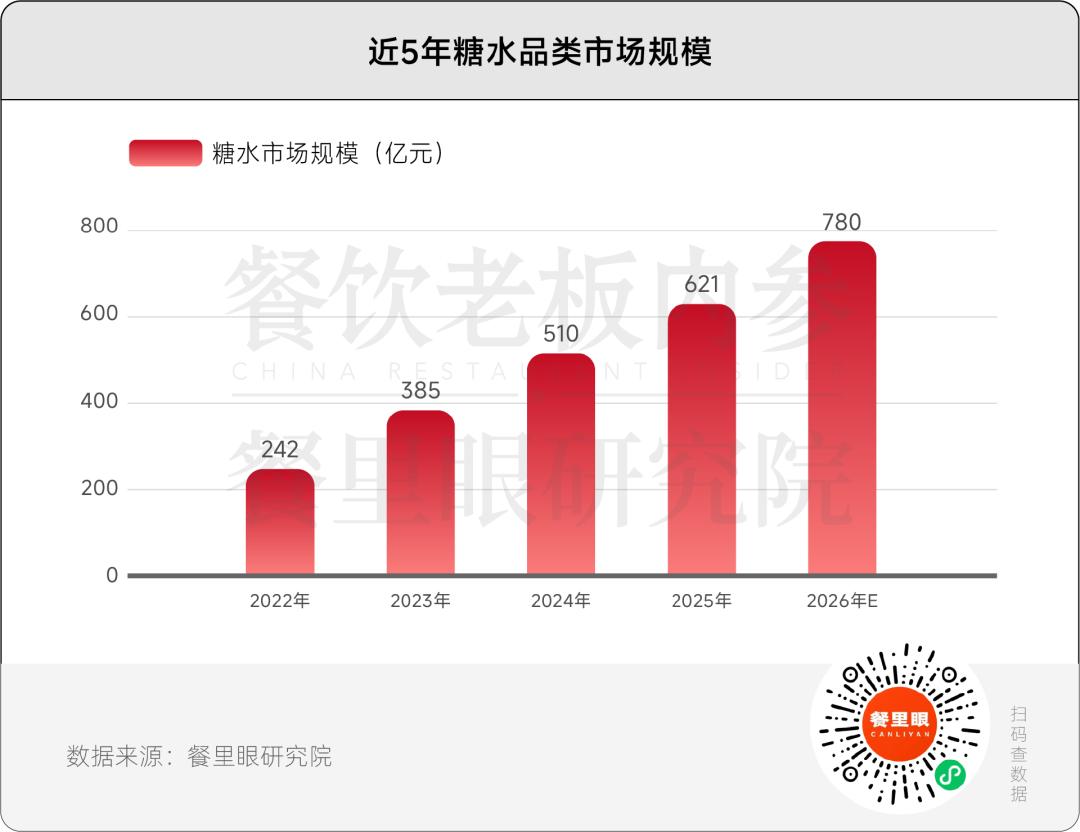
According to the big data of Canliyan, the market scale of the sugar water category soared from 24.2 billion yuan in 2022 to 62.1 billion yuan in 2025, and it is expected to directly break through the 78 billion yuan mark in 2026. This growth rate is quite impressive in the entire catering market.
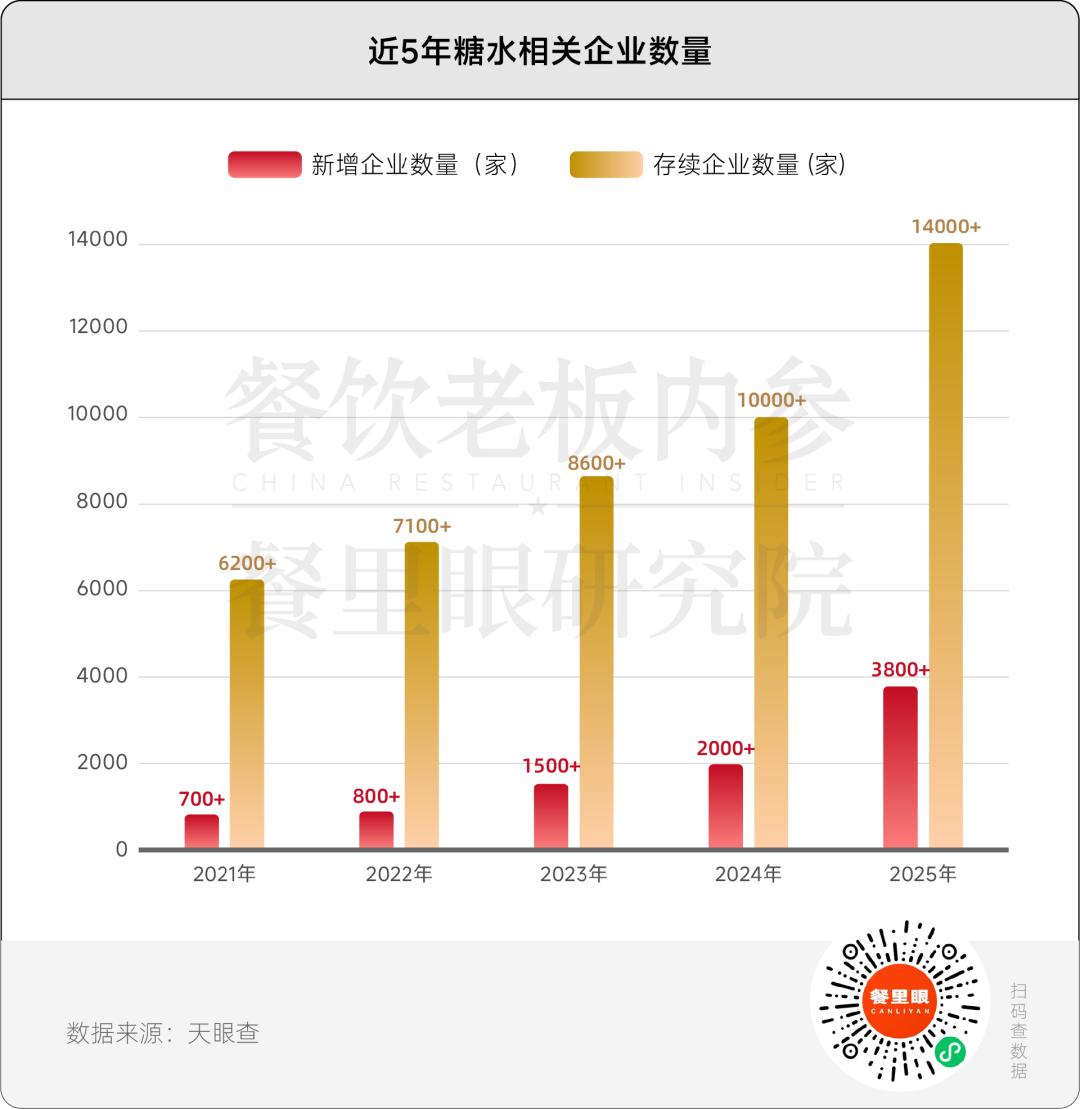
Behind this is the "crazy entry" of players. According to Tianyancha data, more than 9,000 new sugar water-related enterprises have been added in the past five years, accounting for 56.7% of the total in the industry. Especially in 2025, the number of new enterprises soared to more than 3,800. As of May 2026, there were already more than 16,000 surviving enterprises nationwide.
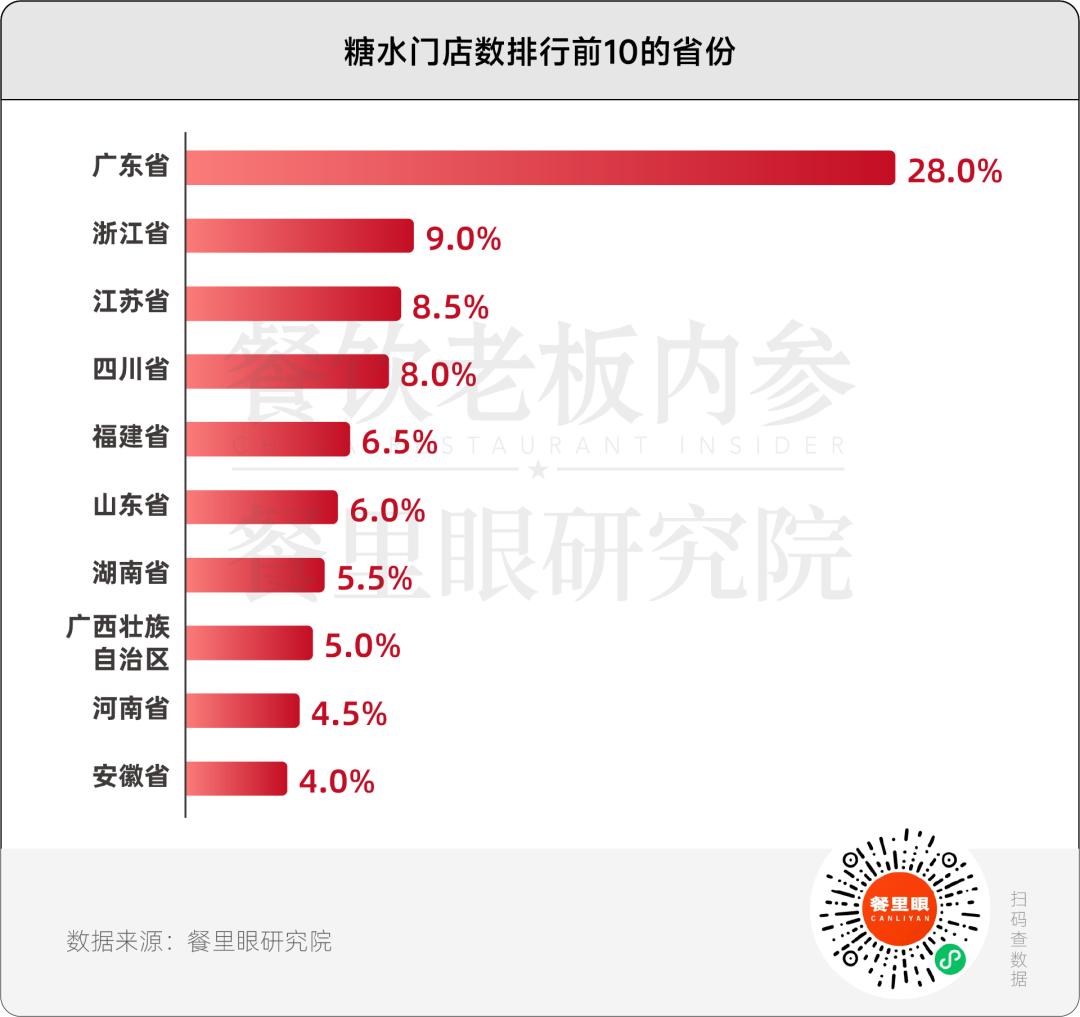
The sugar water business is naturally endowed with distinct "regional genes", but the current pattern has already broken through the Lingnan border. Guangdong alone accounts for nearly 30% of the market. As the birthplace, its profound sugar water cultural heritage gives it a leading position in the number of stores and consumption frequency.
But the real highlight lies in the second-tier. The number of stores in Zhejiang and Jiangsu accounts for 9% and 8.5% respectively. Relying on strong consumption power and the atmosphere of high-tier cities, the "innovative new Chinese-style sugar water" has quickly gained momentum.
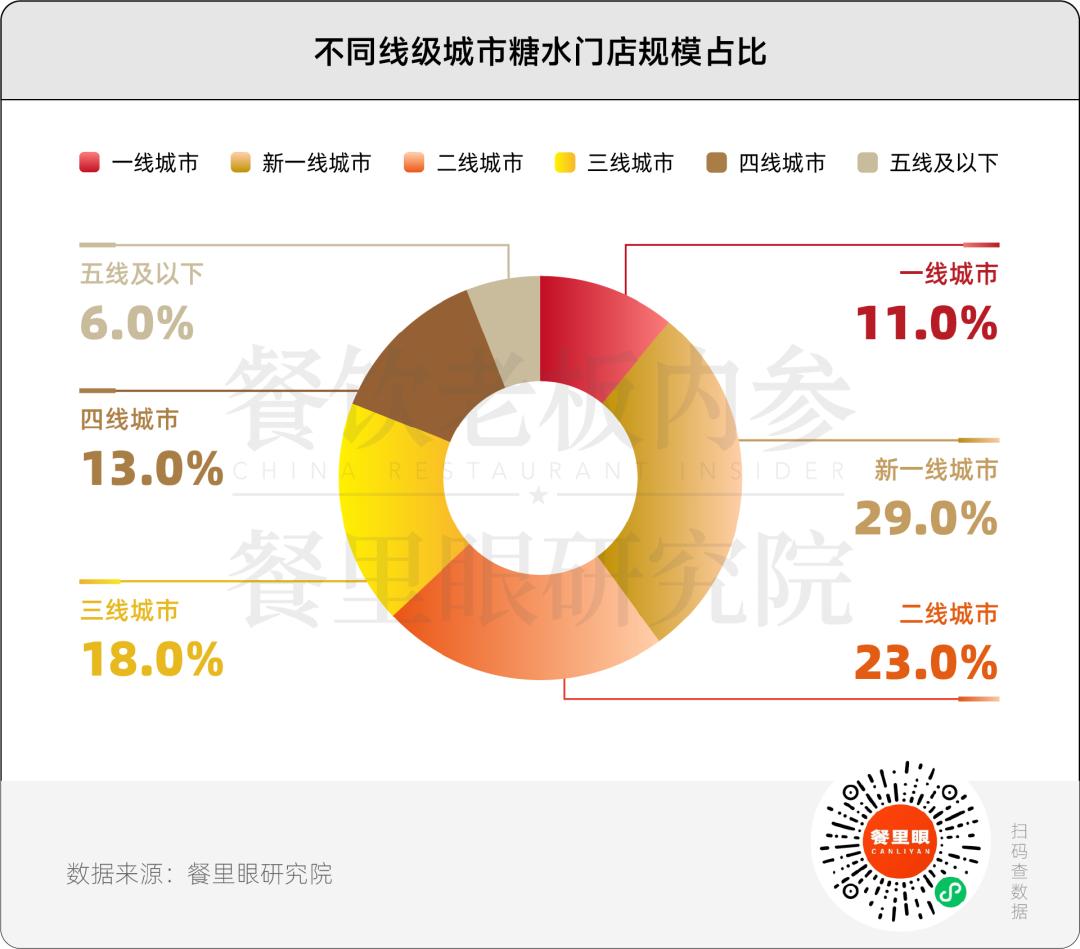
In terms of city distribution, new Chinese-style sugar water is highly concentrated in medium and high-tier cities. New first-tier cities, with a 29% share, are the absolute core force, followed by second-tier cities with 23% and first-tier cities with 11%. These areas have strong consumption power. Consumers prefer new-style sugar water with high appearance, novel styles, and a focus on healthy Chinese style. The dine-in leisure and social check-in scenarios are mature, and the average customer price and profit level are generally higher.
It is worth noting that the overall share of the sinking market is only 37%. Among them, third-tier cities account for 18%, fourth-tier cities account for 13% and are developing steadily, and fifth-tier and below cities only account for 6%, with a relatively low market penetration rate. The sinking track will become the core breakthrough point for the future store expansion and performance growth of the sugar water industry.
The industry as a whole presents a pattern where small brands are clustered and large-scale chains are scarce. Currently, there are three forces dominating the competition in the sugar water industry:
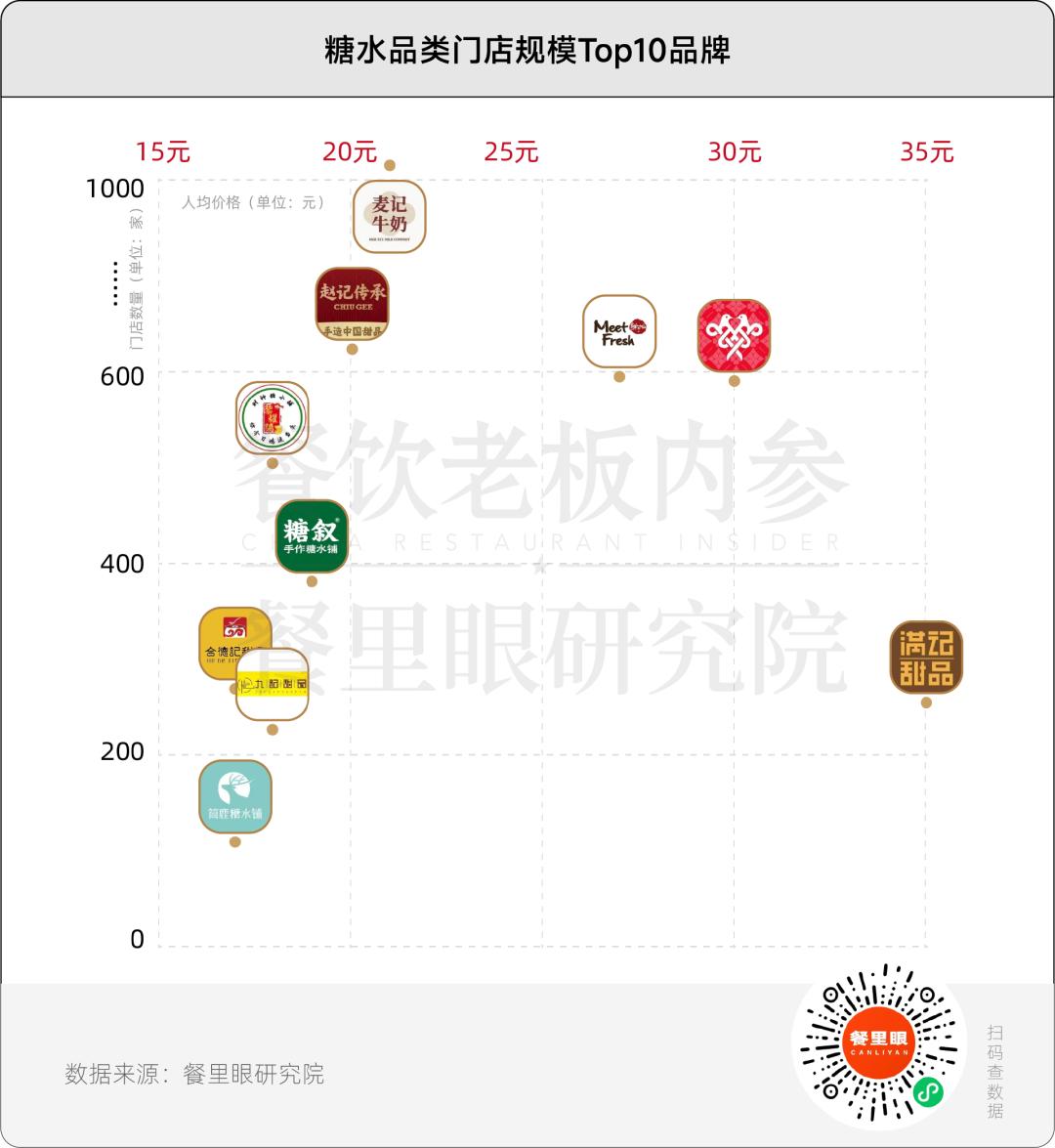
Firstly, new sugar water power brands. Among them, Mak's Milk Company became the champion of annual expansion with more than 1,000 stores; Zhaoji Inheritance broke through with the intangible cultural heritage ginger milk curd craft and Cantonese-style innovative sugar water, with more than 650 stores; Gong Xiaoyan targets the mid - to high - end female health preservation market, focusing on freshly stewed bird's nest and hot drinks for female nourishment.
Secondly, established dessert players. Mangojack has about 250 stores, focusing on the transformation to a younger - oriented scenario; Fresh Oven has about 650 stores and restarted its national expansion after being acquired by the CFB Group.
Thirdly, cross - border entrants. In the new tea - drinking camp, Guming and Cha Baidao launched sugar water products, and Cha Yan Yue Se launched the Sushan Sugar Water Shop in the form of a store - within - a - store; Jidong Burning Grass Jelly directly transformed into a "tea + sugar water" model; Tangxu was invested and incubated by the tea - drinking brand Qingchali, founded in Jiangxi in 2022, and now has more than 381 stores.
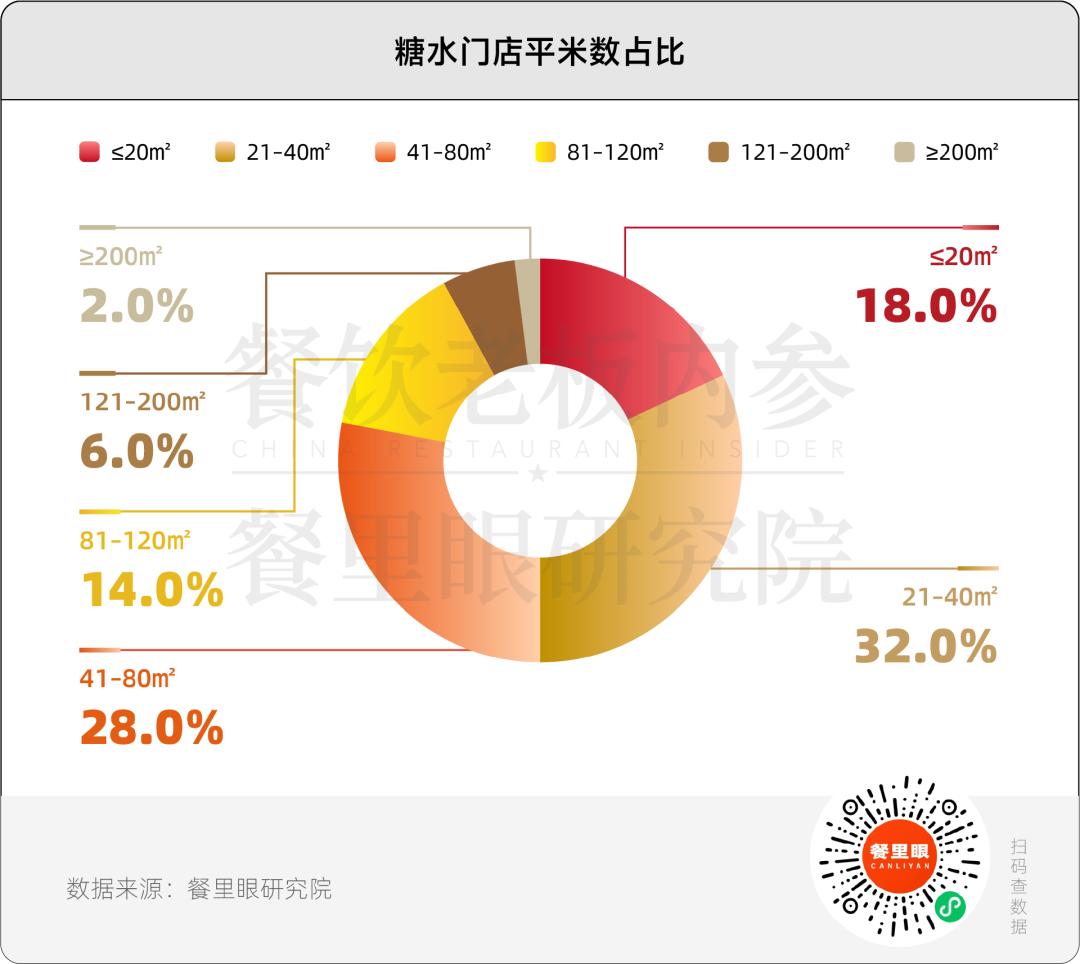
From the data of store area distribution, the sugar water industry is mainly composed of small and medium - sized store models. Stores with an area of 21 - 80 square meters account for 60% in total. Among them, small community stores of 21 - 40 square meters have become the main force in the market with low cost and high repurchase rate. Standard stores of 41 - 80 square meters take into account both dine - in and take - out, with the most balanced profit structure. The proportion of large - area stores over 80 square meters is relatively low. Most of them are located in commercial areas and follow the experience - social route. The volume of super - large comprehensive internet celebrity stores is extremely small, and the heavy - asset investment also makes their business risks significantly higher.
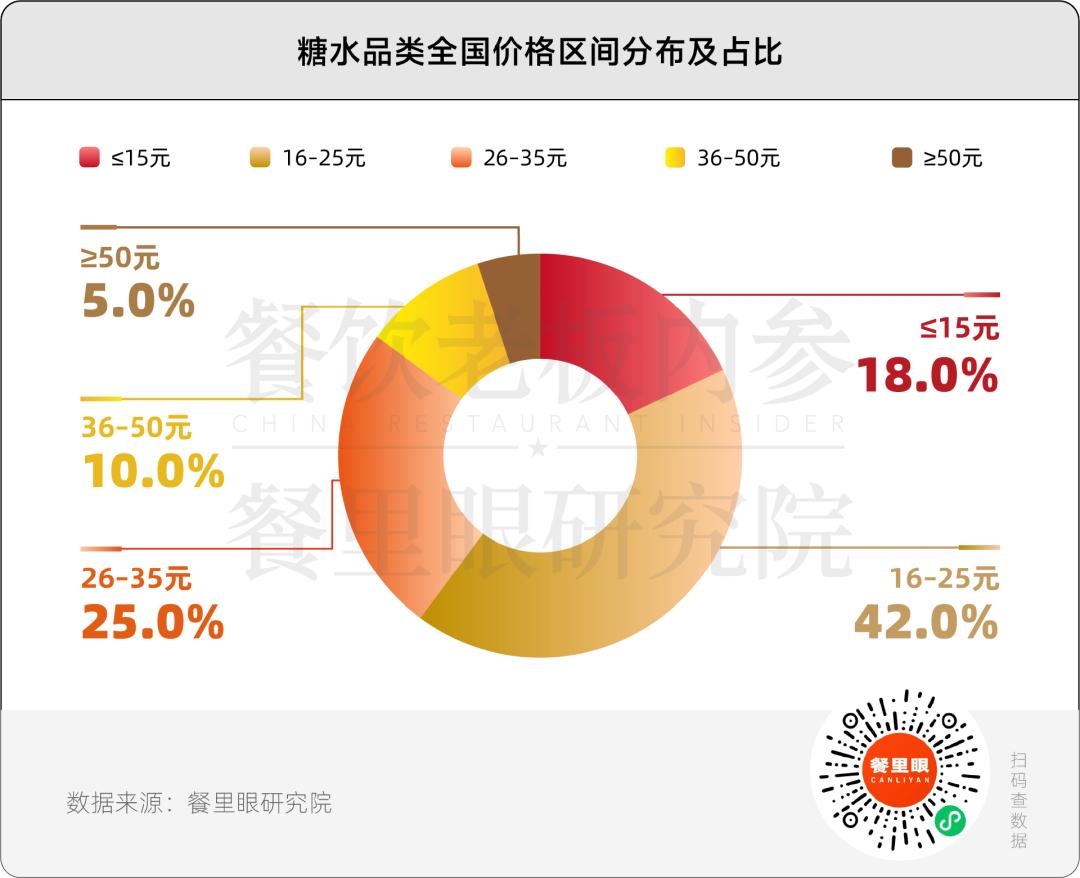
In terms of price - band distribution, the mass - affordable track of sugar water has the largest market base, the best profit and expansion space, and is also the absolute main force for the layout of chain brands.
According to the big data of Canliyan, orders in the mainstream price range of 16 - 25 yuan account for as high as 42%, which is the core consumption market of the industry. Affordable and necessary products under 15 yuan account for 18%, relying on community stores to serve the daily needs of neighbors; mid - to high - end new Chinese - style products in the range of 26 - 35 yuan account for 25%, relying on their delicate appearance and health - preservation attributes to penetrate shopping malls and meet the social check - in needs of young women; high - customer - price products above 36 yuan have a relatively low overall share (15%), and the target audience is relatively niche.
The more first - tier the city, the less "sweet" the preference. Sugar water becomes the favorite of young women
Since the national penetration of the sugar water category has accelerated, the consumer group of the sugar water category has also undergone a structural change: from "local Cantonese in Guangdong" to "young women across the country".
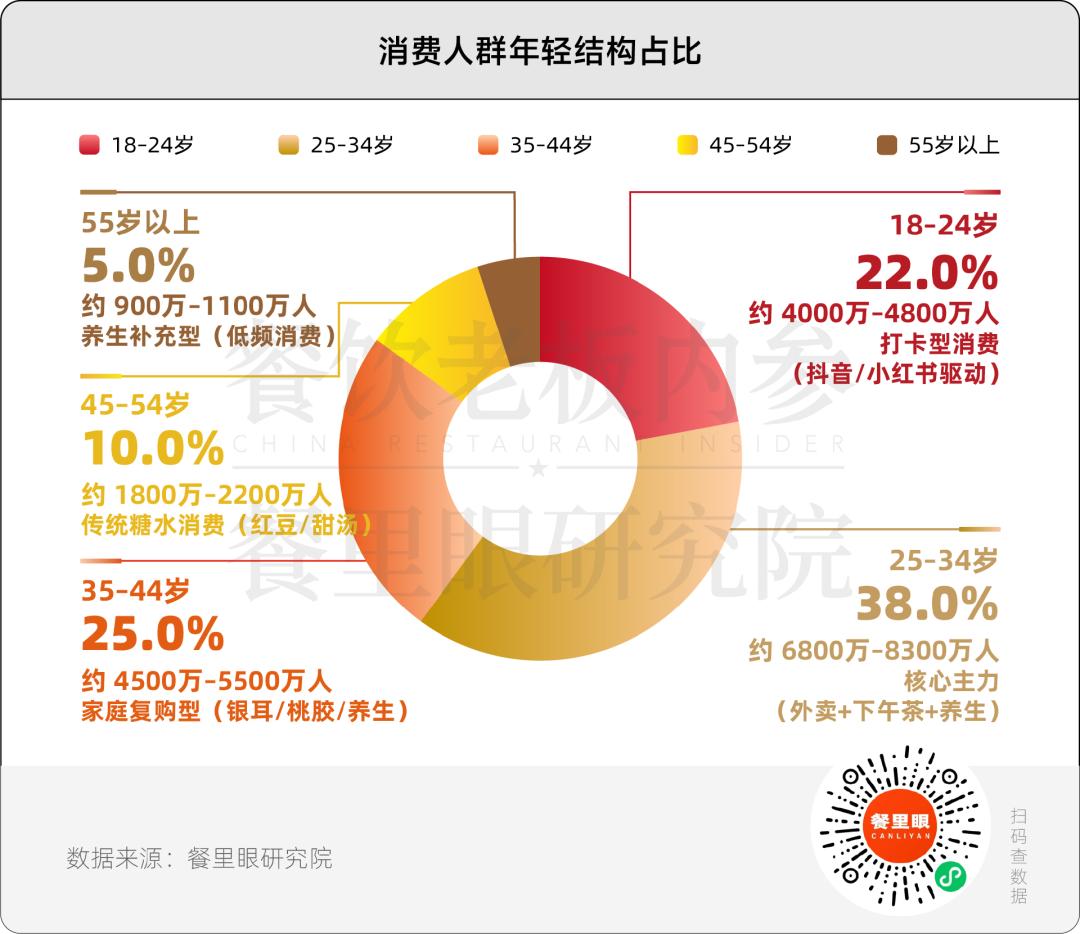
Divided by the age structure of the consumer group, the current main consumers of the sugar water category are mostly concentrated in Generation Z (referring to those born between 1995 - 2009 in this article) and Generation Y (referring to those born between 1981 - 1995 in this article). Among them, the young group aged 25 - 34 is the core force of sugar water consumption, with the strongest consumption ability and higher brand loyalty, and is the core asset for brand operation.
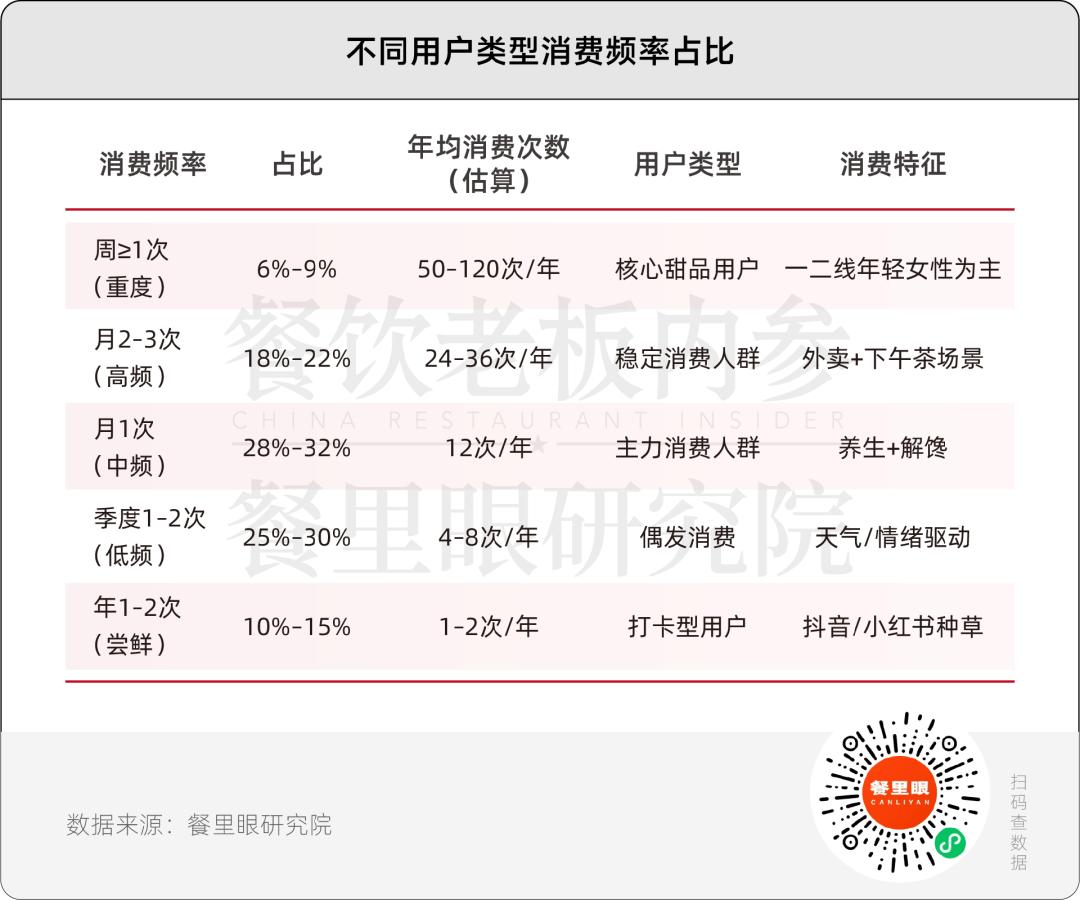
From the consumption frequency data, the proportion of medium - to high - frequency users who consume once or more a month reaches 50% in total. Among them, medium - frequency users (consuming once a month, 12 times a year) are the main group, followed by high - frequency users (consuming 2 - 3 times a month, 24 - 36 times a year). The overall consumer group is stable, and they mostly consume in the take - out + afternoon tea scenarios.
Meanwhile, heavy - consumption users, mainly young women in first - and second - tier cities, consume more than once a week, with a maximum annual consumption of 120 times.
This means that sugar water is upgrading from a "random shopping consumption" scenario to an "active daily consumption" scenario. More than half of the consumers have formed a stable consumption habit. The proportion of take - out during the afternoon tea time is gradually increasing, and the "functional" attribute of sugar water is becoming more and more prominent.
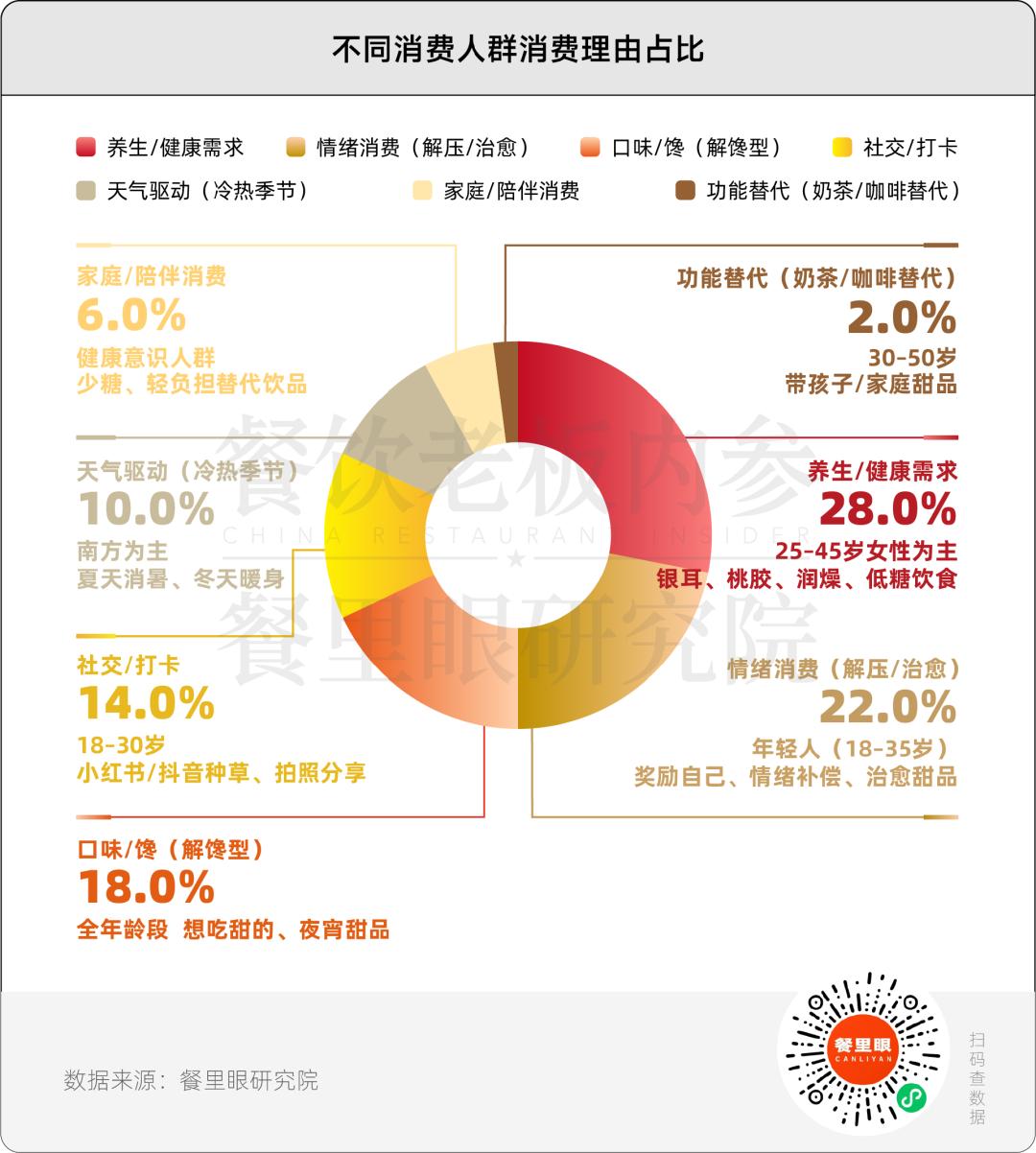
In terms of consumption reasons, most consumers pay more attention to health - preservation, health, and emotional consumption needs when purchasing sugar water products. The main consumer group, mainly young women, pays more attention to low - sugar products containing healthy ingredients such as tremella and peach gum.
Currently, the main consumers of the sugar water category no longer choose products just for "satisfying their cravings", but more for "emotional comfort" and "health - preservation needs".
Meanwhile, "social check - in" has also been an important consumer demand for various catering categories in recent years. For sugar water brands, store design, product appearance, and topic - worthiness are still the key points to attract young customers.
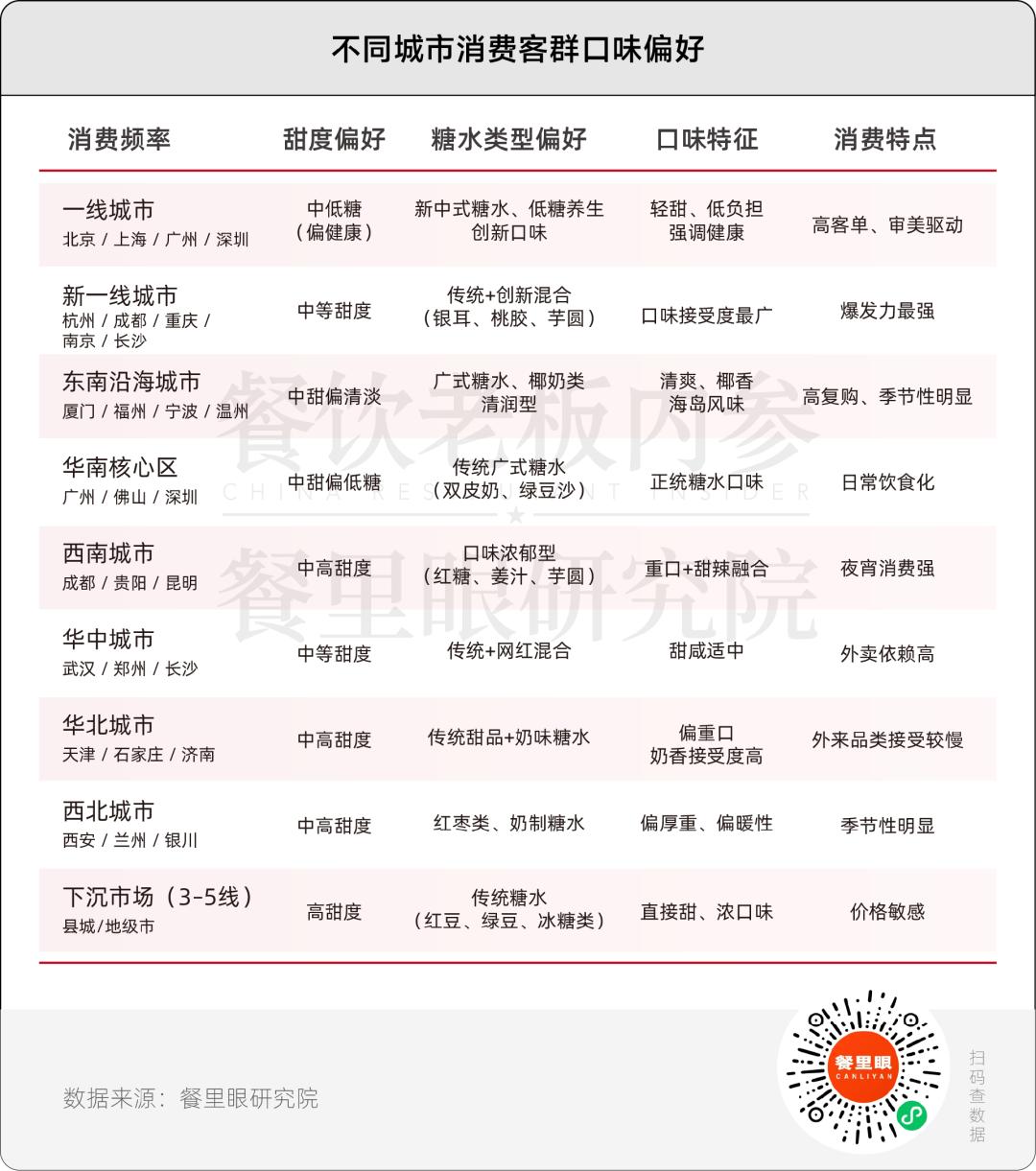
In terms of product preference, according to Canliyan data, from first - tier cities to the sinking market, consumers' taste preference for sugar water products shows a "decreasing sweetness" gradient: the demand for low - sugar products leads in first - tier cities, while high - sweetness products are the mainstream in the sinking market.
In first - tier and new first - tier cities, consumers are more willing to pay a premium for labels such as "low - sugar", "0 - calorie sugar", "innovative products", "appearance", and "health";
In the sinking market, consumers are more willing to pay for products such as "good value for money", "basic styles", "strong/rich flavors", and "direct sweetness";
It is worth noting that in the core areas of South China and coastal cities in the southeast, where sugar water originated, "authenticity and tradition" are the product choices that consumers prefer more. Especially in cities such as Guangzhou, Foshan, and Shenzhen, traditional Cantonese sugar water such as double - skin milk and mung bean paste is almost a part of "daily diet".
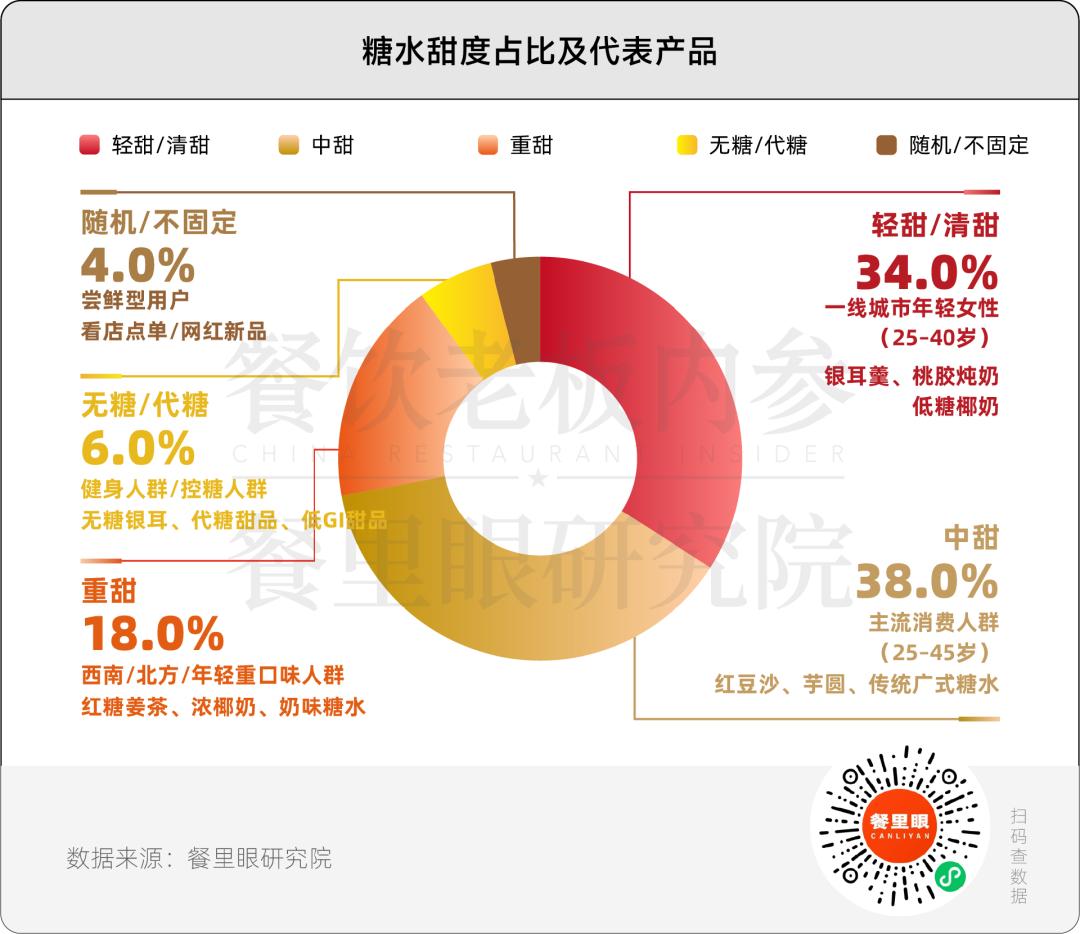
Overall, to meet the product preferences of young women, the mainstream consumer group of the current sugar water category, the product system of sugar water brands in the national layout will still focus on light - to medium - sweet products.
The sugar water track is becoming more segmented, healthy, and integrated
In 2026, sugar water is no longer just for afternoon tea. It is experiencing a full - scale explosion in four dimensions: segmentation, health - orientation, integration, and Chinese - style transformation.