Exchanges in the AI Era (Part 1): Trading Data as a Competitive Edge

David Schwimmer, the Chief Executive Officer (CEO) of the London Stock Exchange, was interviewed by the Nikkei.
In the London Stock Exchange's operating income of approximately £8.9 billion, the data business, such as providing trading information, accounts for 40%. The profit from the traditional exchange business, which charges fees based on IPOs or stock trading volumes, is only about 4%...
Against the backdrop of the strengthening upward trend in global stock markets, stock exchanges are also facing changes. The traditional model of helping companies go public, providing trading platforms, and earning fees is breaking down, and the source of growth has now shifted to the data business. At the forefront is the London Stock Exchange Group in the UK, which earns 40% of its revenue from data.
In a world where artificial intelligence (AI) is shaking up all businesses, the Nikkei has tracked the front - line of exchange business.
In late February, Elliott Management, a well - known American activist investor, acquired a 5% stake in the London Stock Exchange for the first time, which shocked the City of London.
"Will they finally demand the spin - off of the exchange business?" This was the voice of financial professionals gathered in a bar in London.
In fact, Elliott's demands seem to be things like stock buybacks. Nevertheless, market participants' speculation about the spin - off of the exchange business, which should be the core business, has emerged. The background is that the actual state of the London Stock Exchange is infinitely close to that of a data technology company.
The most obvious evidence is the profit structure. The financial report of the London Stock Exchange for the fiscal year 2025 (ending December 2025) shows that in the operating income of approximately £8.9 billion, the data business that provides trading information in the sales market accounts for 40%, and the rest is earned through index business and clearing business. The profit from the traditional exchange business, which charges fees based on initial public offerings (IPOs) or stock trading volumes, is only about 4%.
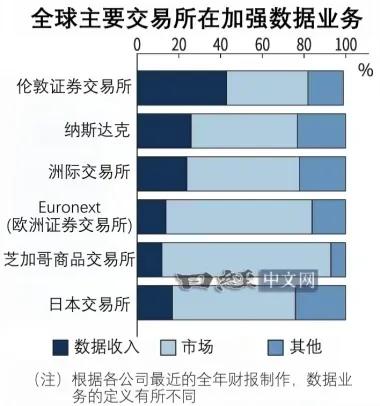
The proportion of the data business significantly exceeds 24% of the Intercontinental Exchange (ICE) in the United States, which focuses on commodities and foreign exchange futures, 26% of NASDAQ in the United States, and 17% of the Japan Exchange Group (JPX), and is also very prominent among global exchanges.
The inclination towards data management is even more obvious in terms of talent.
"Recruiting software engineers and data analysts." Browsing British recruitment websites, one can see that the recruitment advertisements of the London Stock Exchange are listed alongside those of Revolut, a representative of British fintech, hedge funds, and IT consulting firm Capgemini.
Currently, more than half of the 26,000 employees of the London Stock Exchange globally, 14,000 people, are engaged in the data business. In the competition for talent, it competes head - on with technology companies.
However, in the simple data provision and sales, there may be a "SaaS death" phenomenon sooner or later, where the progress of AI takes away the revenue of software companies and data providers. The goal of the London Stock Exchange is to collect all the "raw" trading data of global exchanges and financial institutions at once, and to become a so - called exchange platform provider.
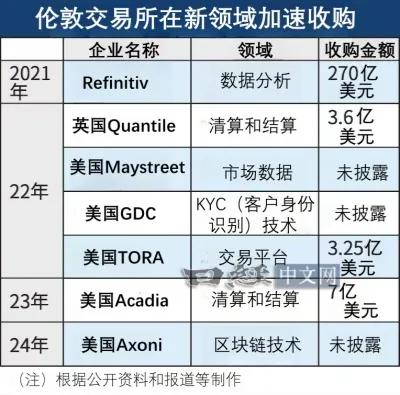
The foundation for this is Refinitiv, a global financial information service giant that underwent business integration in 2021. The company collects "raw" data from more than 40,000 financial institutions and traders it has as customers and has established a mechanism to provide this data to investors through a subscription (flat - rate fee) model.
In addition, from 2023 to 2024, in the fields of blockchain (distributed ledger) technology companies and settlement and clearing, the London Stock Exchange has continuously acquired American companies, accelerating the collection of raw trading data. By getting involved in comprehensive services that provide investment risk analysis based on the acquired data, it is expanding its sources of profit.
David Schwimmer, the CEO of the London Stock Exchange, said in an interview with the Nikkei, "Data is generated during exchange trading, and this data is used for the next trading decision, forming a virtuous cycle where trading further increases and more data is generated." He also said, "About 90% of our data revenue comes from in - house data and solutions," dispelling concerns about profit reduction due to AI.
Currently, it is collaborating with Microsoft in the United States to promote development, such as adding functions for AI to analyze data. Schwimmer said, "In the few years after the cooperation, we will invest £250 million to £350 million."
Against the backdrop of exchanges promoting the diversification of profit sources, the data business has always been at the forefront. In a situation where the risk of losing profit sources to AI in the alternative data field is increasing, collecting unique and hard - to - imitate raw trading data from exchanges and improving comprehensiveness has become a watershed for success or failure.
Although exchanges have the nature of infrastructure enterprises that provide free trading venues, it is also a fact that they must have profitability to survive as private enterprises. The role of stock exchanges is to reflect the growth strategies and enterprise support policies of various countries in regulations and rules to protect the capital market. In fulfilling this mission, a competitive data business is more important than ever.
This article is from the WeChat public account "Nikkei Chinese Net" (ID: rijingzhongwenwang), author: Ryuta Minabata. It is published by 36Kr with authorization.