Why has Gaode's Street Scanning List "vanished without a trace" after nine months of its launch?
On May 15th, Jensen Huang appeared at a zhajiang noodle restaurant called "Fangzhuanchang No. 69" in Beijing's Nanluoguxiang. He ordered a bowl of noodles, finished eating, and casually gave a positive review.
In the following ten days, the restaurant received hundreds of new reviews on various platforms. Some people flew in specifically to check it out, and some queued for three hours just to take a photo at the same table. According to statistics from "New Position", in the ten days after Jensen Huang's visit, the restaurant received more than 52 new reviews on "a certain review platform"; while the number of new check-in reviews on Gaode's Street Scanning List during the same period was only 11.
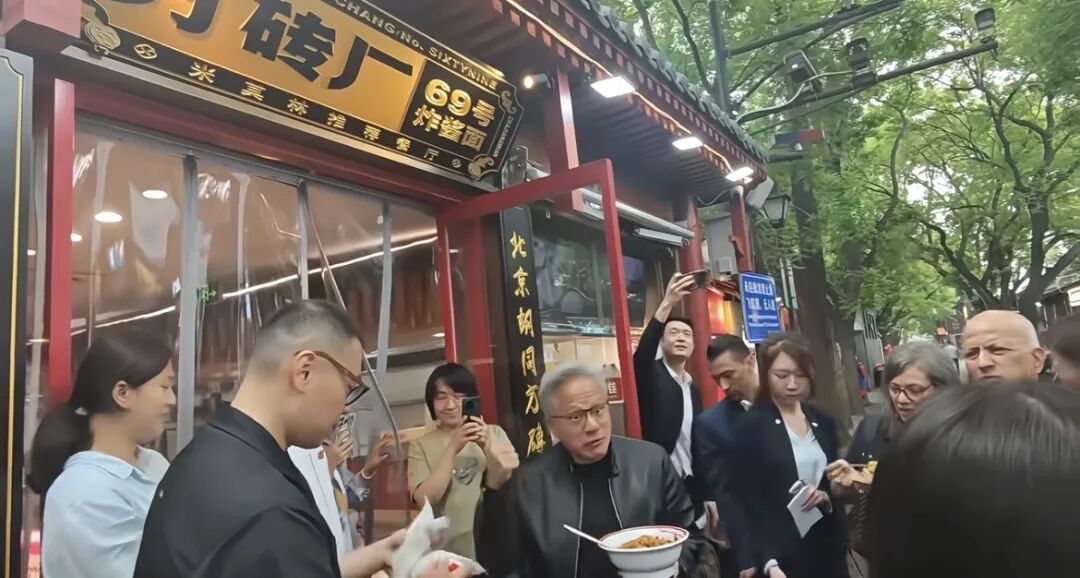
On May 15th, when the event was at its hottest, a video note with the highest comprehensive popularity on "a certain book" had a total interaction volume of more than 7,000 likes, collections, and comments. Its AI assistant summarized that from May 15th to 25th, there were at least thousands of posts on "a certain book" about "Fangzhuanchang No. 69 Zhajiang Noodle Restaurant and Jensen Huang".
During the same period, for the same restaurant and the same popularity brought by Jensen Huang's visit, the conversion effects on "a certain review platform" and "a certain book" were much higher than those on the Street Scanning List. This comparison more directly illustrates the current situation of the Street Scanning List than any promotional copy.
In terms of the figures on the books, the achievements of the Street Scanning List are worthy of being written into Alibaba's annual report. 23 days after its launch, the number of users exceeded 400 million; 100 days after its launch, the number of users exceeded 660 million. When Gaode CEO Guo Ning announced these figures at a press conference in January this year, his tone was filled with uncontrollable excitement. However, immediately afterwards, data from QuestMobile gave another judgment: 83% of Gaode users still define this app as a "navigation tool" rather than a lifestyle service platform. The traffic has come in, but the users' perception has not kept up.
The Street Scanning List is Alibaba's most formal statement on its in-store business to date. CFO Xu Hong once publicly stated that Alibaba will spend two to three years moving the service industry onto the platform, aiming to leverage a "new service industry e-commerce" market worth over one trillion yuan. Gaode is highly expected in this process and is to be "cultivated into an offline entrance comparable to Taobao". In January 2026, Wu Yongming listed the Street Scanning List, Taobao Flash Sale, and Qianwen App as the three highlights of 2025 in his New Year's letter to employees.
Nine months have passed since the Street Scanning List had nearly one billion monthly active users and 660 million users on the list. In the core narrative of Alibaba's local lifestyle business, the Street Scanning List still seems non-existent. This has nothing to do with the quality of the product, nor is it a problem of strategic direction. What the Street Scanning List faces is a structural dilemma that Alibaba Group has been facing for the past two decades: Whenever the local lifestyle in-store business requires the most important resource support from the entire group, the group's resources always go to another more important battlefield.
The latest shareholder letter released by Alibaba on May 20th made the priority clear enough: In the next five years, Alibaba will take "AI + Cloud" as its new core growth driver, with the goal of promoting the commercialization revenue of cloud and AI, including MaaS, to exceed $100 billion, approximately 690 billion yuan. To achieve this goal, Alibaba's future investment in AI infrastructure will even far exceed the previously promised 380 billion yuan.
That is to say, at the group level, the most important funds, technology, organizational, and management attention are being clearly directed towards AI and cloud computing. Even though the local lifestyle in-store business has nearly one billion monthly active entrances and 660 million users on the Street Scanning List, it is difficult to become the real main battlefield in such a resource allocation pattern.
The lag in market timing, combined with the periodic shift in internal resource priorities, has given the Street Scanning List a strategic-level story but failed to secure a strategic-level position to match it.
Chapter 1: The Real Meaning of "All Other Businesses"
According to a report by "LatePost", at the end of June 2025, Guo Ning actively applied to the group's management and only then obtained the approval to initiate the Street Scanning List project.
For a platform with nearly one billion monthly active users, the top leader needed to actively apply to start a strategic product with high expectations. Guo Ning personally took charge of the project, and the team consisted of less than 100 people, who carried out closed development in Building C4. A few months later, Qianwen App was launched on the third and fourth floors of the same building, and hundreds of engineers were urgently transferred from Beijing and Guangdong. Although they were in the same building, the organizational resources that could be mobilized for the two projects were not on the same level.
The real position of the Street Scanning List in Alibaba's current organizational structure determines the upper limit of the resources it can access. And this upper limit has been written into the organizational logic since the day of its establishment. In the organizational structure adjustment in 2025, Gaode was moved out of the "Lifestyle Service Sector" and was placed in the category of "All Other Businesses" along with DingTalk, Youku, and Hema. This is not a glorious position in Alibaba's history.

From 2025 to 2026, when Alibaba took "AI-driven" as the core strategic keyword, Gaode's core functions such as voice broadcast and merchant services were self-developed and did not form an effective linkage with Alibaba's AI resources. This hardly attracted any external attention but was another silent signal internally. In contrast, according to reports, the management clearly stated to Taobao Flash Sale that "there should be no burden of losses in three years" and encouraged the team to "continue to boldly develop the flash sale business".
Guo Ning is a typical "old Gaode" employee who joined before Gaode was acquired by Alibaba. After Yu Yongfu handed over the position in 2024, Guo Ning took over as CEO, and Liu Zhenfei took over as Chairman. Some media interviewed insiders at Gaode, and they believed that Liu Zhenfei was the "spokesperson", and the real power was in Guo Ning's hands. However, there is an invisible boundary to Guo Ning's "real power": Alibaba clearly stated that Gaode would not be merged into Taobao, and Taobao did not participate in the Street Scanning List project from beginning to end. The statement seems to be protecting Gaode's independence, but the structural implication is only one: the Street Scanning List cannot mobilize the core resources within Jiang Fan's e-commerce system.
The absence of Jiang Fan and Taobao Flash Sale is most directly manifested in the break in the transaction link on the user side. According to reports, after Gaode launched its group-buying business, part of the supply came from Taobao Flash Sale, but the distribution network of Flash Sale was not fully integrated with Gaode's local lifestyle services. There is an obvious interruption in the path from "seeing the recommendation on the Street Scanning List" to "completing the order and enjoying the fulfillment" for users.
If a list that focuses on "real in-store experiences" can only complete discovery and recommendation but fails to connect transactions, distribution, after-sales service, and repurchase, it will be difficult to compete directly with platforms such as Meituan, Dianping, and Douyin Group Buying, which already have a complete transaction link. The Street Scanning List brings in users but fails to retain transactions; it increases traffic but cannot precipitate platform assets. Every user who is recommended by the Street Scanning List and finally places an order on Meituan is helping the competitor build a data barrier.
This break is not caused by Guo Ning, nor is it a problem unique to the Street Scanning List. Every time Alibaba makes a move in the local lifestyle in-store track, it follows the same pattern: Endorsement from senior management, entry of resources, break in the link, and handover to the next person. Koubei was incorporated into the Alibaba system in 2006 and went through four stages: Taobao, Alipay, Ele.me, and Gaode. Each migration was accompanied by the expectation that "this time will be different".
Chapter 2: Alibaba Has Tried to Solve the Same Problem Six Times
The Street Scanning List inherits not a blank market but an old problem that Alibaba has repeatedly handed over and never truly solved. To understand this judgment, we need to go back twenty years.
In 2006, Alibaba invested in Koubei.com and made its first entry into the local lifestyle track. Two years later, Koubei was officially incorporated into the Alibaba system and was successively merged into Yahoo China and Taobao. However, in 2011, Koubei.com suspended its external publicity. The apparent reason was that the mobile Internet was not yet mature, and the deeper reason was that at that time, Alibaba's strategic center was to build a revenue narrative for its IPO, and the local lifestyle business required long-term tolerance for losses, which did not match the group's priorities.

The second round of offensive took place from 2012 to 2013. With the advent of the mobile Internet wave, Meituan, Dianping, and Ele.me emerged one after another, and O2O became the hottest narrative in the capital market. In September 2013, Alibaba launched "Laiwang", and at the end of the year, it launched "Taodian Dian" focusing on catering O2O. These two, together with Taobao Mobile, were known as the three major mobile business pillars of Alibaba. The characteristic of this round was multi-front operations and dispersed priorities: it was necessary to use Laiwang to defend against WeChat's penetration into the social field and use Taodian Dian to enter the catering in-store market.
In June 2015, Alibaba and Ant Financial each invested 3 billion yuan, a total of 6 billion yuan, to restart "Koubei" with a grand slogan: to build a digital business operation platform for merchants. At that time, Meituan and Dianping had merged, and Ele.me had established a firm foothold in the home delivery market. Koubei tried to find its own position in a market with a set competitive pattern but ultimately failed. In April 2018, Alibaba merged Ele.me and Koubei to establish a local lifestyle service company, which received more than $3 billion in investment from Alibaba, SoftBank, etc.
Of course, this merger did not solve the profitability problem.
From FY2022 to FY2024, Alibaba's revenue from local consumer services increased from 44.8 billion yuan to 59.8 billion yuan. However, during the same period, the adjusted EBITA showed losses of 20 billion yuan, 13.1 billion yuan, and 9.8 billion yuan respectively. Although the revenue increased by nearly 15 billion yuan in three years, it only narrowed the loss, and the main driver of the loss reduction was the improvement in the efficiency of the home delivery business, rather than the profit contribution of the in-store business.
In the development of Gaode's local lifestyle services, Yu Yongfu is a name that cannot be bypassed. The first thing he did when he took over Gaode was to stop the O2O business and let Gaode return to its core of maps and navigation. This decision increased Gaode's DAU from 30 million in 2015 to over 100 million in 2021, firmly ranking first in the industry. Restraint was his core weapon in winning the navigation war.
In addition to restraint, Yu Yongfu also managed to secure an organizational condition that is not common today for Gaode. According to reports at that time, Gaode applied to the group to establish an "Alibaba - Gaode Innovation Economic Special Zone", which would have a relatively independent organizational culture and business approach within a three - year cycle, and signed an agreement with the group to "achieve 200 million daily active users in three years". The group would not provide additional capital support, and Gaode would bear the cost of exploring new businesses on its own.
According to a report by Sina Finance, Gaode established a project team of a hundred people, many of whom were already at the P9 level in Alibaba, and set up a performance bet. The goals, boundaries, costs, and rewards were all clearly defined in advance, giving the project a clear sense of pressure. This pressure later became an easily overlooked part of Gaode's growth story.
For a tool - type app to penetrate users' minds, it often requires not only an entrance and traffic but also a person who can strive for space and take responsibility for the results within the group system. The Street Scanning List is facing the same problem today, but the organizational conditions it has are far from what they were before.
In 2021, Alibaba integrated Gaode, local lifestyle services, and Fliggy into the Lifestyle Service Sector, which was under the unified management of Yu Yongfu. At the brand launch conference, he announced Gaode's transformation and upgrading to an "open service platform for a good life when going out", emphasizing that "a single map covers all aspects of daily life". At the end - of - year investor conference, he also elaborated on Gaode's strategic evolution from "Where am I and how to get there" to "Where should I go".
This narrative is logically complete and clear, but there is an underestimated implementation obstacle: When he led Gaode to win the navigation war in 2016, it was precisely through restraint, focusing on LBS data and navigation experience and not engaging in O2O. When he started to promote Gaode's expansion towards "where to go", in essence, he was asking a product built on the efficiency mindset of "use and leave" to undertake consumption decision - making scenarios that require users to stay for a long time and make repeated comparisons. These are two completely different product logics.
In 2025, when Gaode CEO Guo Ning initiated the Street Scanning List project, it was like the sixth retelling of the same story. The carrier changed from Koubei to a list, from Taodian Dian to navigation data, but the underlying proposition remained the same: How can Alibaba establish a sustainable user mindset and a commercial closed - loop in the local lifestyle in - store scenario?
However, the conditions required for the answer have never been met simultaneously within Alibaba.
Chapter 3: The Dilemma of the Street Scanning List, an Old Problem of Alibaba
The Street Scanning List did not receive a "three - year no - accounting" permit like Taobao Flash Sale. Under Alibaba's current organizational structure, products classified as "All Other Businesses" face an unwritten logic: Either prove their independent commercial value or accept the fate of being integrated or sold.
This means that the Street Scanning List must prove two things simultaneously: that the list is valuable to users and that Gaode can independently run through the in - store business model. It must find a self - circulating closed - loop among transaction conversion, merchant supply, user revisit, and commercial monetization.
The core differentiation of the Street Scanning List is the "real visit ranking driven by navigation data". When a user navigates to a restaurant, stays at the door for a sufficient amount of time, and then visits multiple times, this set of data constitutes a "behavioral authenticity" that is different from inflated reviews and paid promotions by merchants. The cost of faking GPS data is high, and multiple people traveling together can generate multiple data cross - verifications on Gaode. These are the real advantages of the Street Scanning List's methodology.
