A loss of 1 billion yuan fails to stop the stock price from skyrocketing by 1300%. Can "short dramas + AI" propel Chinese Online forward?
The short drama stories of Chinese Online are still being written.
On May 25th, Chinese Online disclosed two minutes of institutional communication (hereinafter referred to as the "Announcement"), which detailed the company's current AI short drama layout and development achievements.
The data in the "Announcement" shows that in the first quarter of 2026, the production of Chinese Online's AI short dramas increased by more than 300% year-on-year. Currently, the AI short drama department has built multiple production lines to expand production capacity, and the monthly output will further increase on a month-on-month basis in the future. It is expected that by the end of 2026, the annual production capacity of the company's high-quality AI short dramas is expected to reach 3,000 episodes.
Based on the release of production capacity, Chinese Online continues to focus on AI short dramas. The company is trying to build a complete industrial production chain for AI short dramas and accelerate its progress towards an "AI short drama factory." This shift is based on the company's optimistic expectations for future development. The "Announcement" states: "We believe that the future overseas short drama business, including the AI short drama business, has huge potential. In the long run, it will be several times larger than the domestic short drama and AI short drama markets, and will also continuously contribute high-quality financial returns to the company."
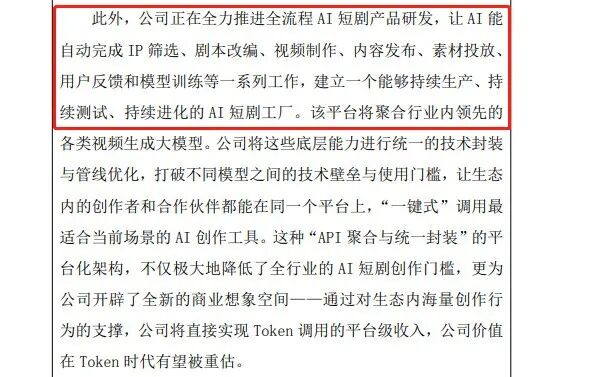
Description of the "AI short drama factory" in the "Announcement"
However, the "high-quality financial returns" mentioned by Chinese Online remain to be seen. For now, the company's development expectations need more support. Neither the overseas short drama nor the AI short drama has brought real profits to the company yet, and the expected business inflection point for Chinese Online has not arrived.
The stock price soars by 1269%, but the loss gap is getting wider
Although Chinese Online remains optimistic about its long-term performance, so far, the market has only seen one loss-making financial report after another. People can see from these reports that there has been a serious inversion between the company's performance and its stock price for a long time. Among them, the layout of short dramas is a key turning point.
Around 2020, Chinese Online began to explore the short drama business and was one of the first domestic companies to enter this field. In 2021, Chinese Online already had short drama projects in operation.
It is worth noting that at that time, the film and television industry was in a critical stage of defoaming. As the industry as a whole declined, the stock price of Chinese Online fell to the bottom, once hitting a record low of 3.2 yuan per share. At this time, focusing on short dramas, with their good business prospects, directly became the driving force for the company's stock price to recover.
Soon, the short drama market entered a period of rapid development, and Chinese Online naturally became one of the first to benefit. Tong Zhilei, the founder of the company, once said in public that the short drama model created by Chinese Online detonated the Chinese market in 2022, with a monthly revenue of nearly 100 million yuan, attracting more than 100,000 enterprises to enter the field.
Also in 2022, Chinese Online accelerated its pace of expanding into the overseas short drama market. ReelShort, its live-action short drama platform, became one of the first short drama platforms to explore the overseas market. Its daily downloads once exceeded those of TikTok, topping the iOS App Store list. Public data shows that as of 2025, the global downloads of ReelShort exceeded 250 million, and the global paid user base exceeded 100 million. In 2025 alone, the platform added more than 50 million new users, and the monthly active users exceeded 70 million.
As a result, Chinese Online told a new story in the capital market. The company's stock price gradually recovered after 2020 and entered a period of rapid growth in 2022. The stock price once soared to 43.8 yuan per share, and the market value once exceeded 30 billion yuan, a surge of 1268.75% compared with the previous trough.
However, this round of sharp rise was mainly due to the overall explosion of the short drama market, rather than the company's own performance. Its focus on short dramas and exploration of the overseas market coincided with the current industry trend.
Visibly, since 2020, Chinese Online's financial reports have not been impressive. The company has long been in a dilemma of increasing revenue but not profit. By the first quarter of 2026, Chinese Online had accumulated losses of more than 1 billion yuan since it started the short drama business. In 2025 alone, the company's net loss reached 671 million yuan, a year-on-year increase of 176%. Obviously, the company's performance and stock price are almost going in opposite directions, and the loss gap is still widening.
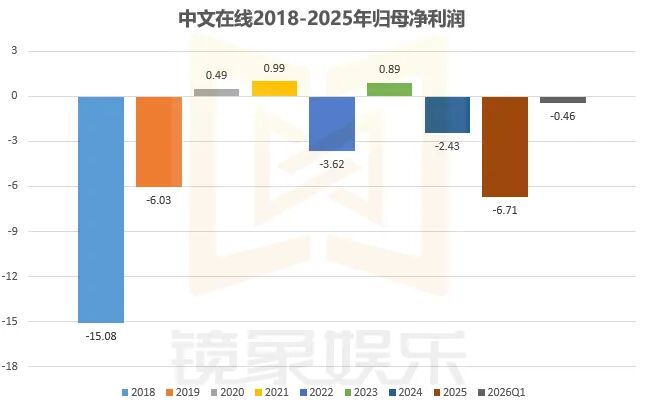
Cash-strapped Chinese Online "divests" ReelShort and turns to the Hong Kong stock market
It is also the short drama business that has led to Chinese Online's long-term losses.
The reason is that although the short drama market has shown strong momentum, operating a short drama platform in the overseas market requires large-scale investment in user acquisition. Especially as more and more players enter the overseas short drama market and the growth of overseas short drama users gradually reaches its peak, the customer acquisition cost of short drama platforms is constantly increasing. Reflected in the financial report data, in 2025, Chinese Online's sales expenses reached 953 million yuan, a year-on-year increase of 105.02%, mainly due to the increase in annual overseas business promotion expenses.
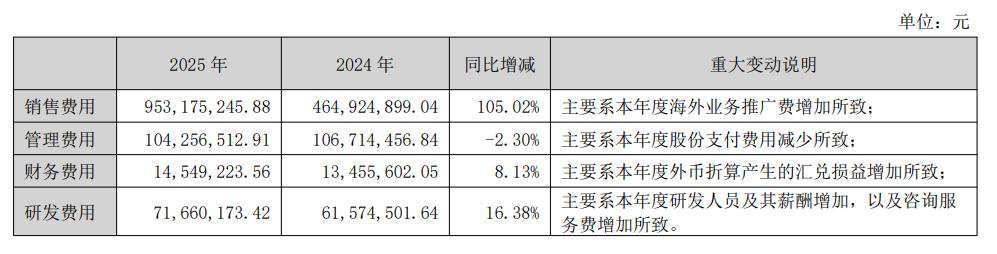
Chinese Online is well aware of this. In fact, in order to make its financial report look better, the company once voluntarily gave up control of ReelShort. Originally, ReelShort was a product developed by Maple Interactive (CMS), which was once a wholly-owned subsidiary of Chinese Online. In April 2023, Maple Interactive completed a board restructuring, and Chinese Online's shareholding ratio in it dropped to 49%. After this adjustment, Maple Interactive changed from a controlled enterprise of Chinese Online to an associated enterprise, and the performance of ReelShort under its umbrella was no longer included in the consolidated statement.
This round of adjustment also had a direct impact on Chinese Online's performance. In 2023, the company turned losses into profits. However, this approach only addressed the symptoms rather than the root cause, and the company's profitable situation did not last long. In 2024, Chinese Online fell into losses again.
The key lies in the fact that "spending money to buy traffic" is the main strategy for short dramas to expand overseas. Not only Chinese Online, but also iReader Technology in the same field is facing the situation of increasing revenue but not profit. In 2025, iReader Technology's sales expenses reached 2.079 billion yuan, of which more than 95% was for promotion expenses, mainly used for traffic placement, platform promotion, and channel cooperation in the short drama business.
Since Chinese Online started focusing on short dramas, the company's overall focus has shifted to the short drama market. In 2025, the short drama revenue of Chinese Online accounted for more than 50%, becoming the company's largest source of income. This determines that Chinese Online is deeply bound to the business model of overseas short dramas, and this is also the reason why the company's loss gap continued to widen during the year. In this year, FlareFlow, another short drama platform launched by Chinese Online, became the main source of performance losses. During the reporting period, FlareFlow's annual revenue was 352 million yuan, and the net loss was 473 million yuan, accounting for more than 70% of the total loss.
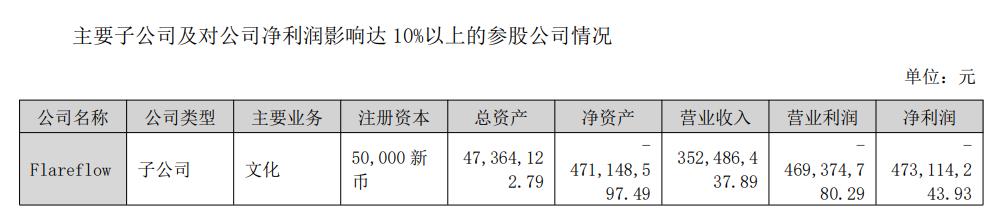
The company's long-term performance pressure not only increases its cash flow pressure but also gradually erodes the trust of the capital market. In 2026, the overall trend of Chinese Online's stock price began to decline. In just three months, the company's market value has dropped by more than 10 billion yuan.
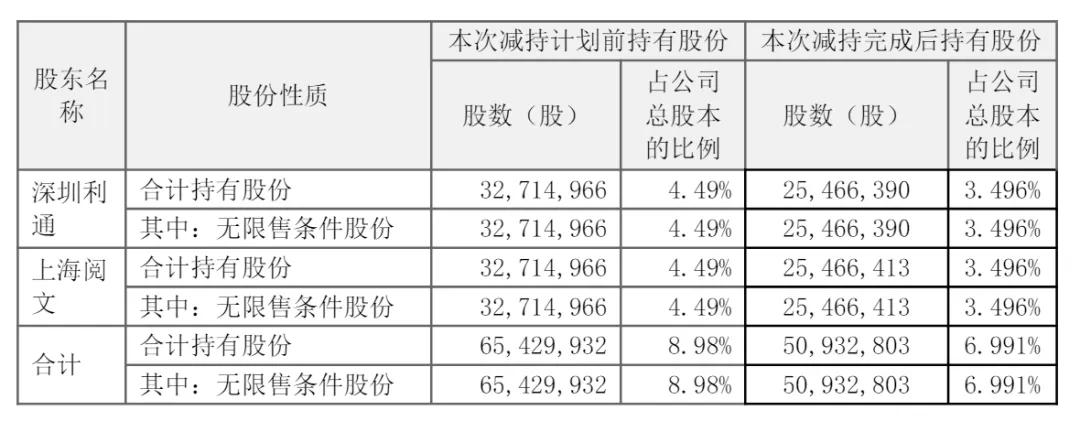
On the other hand, the company's shareholders also began to withdraw. In November 2025, Shenzhen Litong (a wholly-owned subsidiary of Tencent) and Shanghai Yuewen chose to reduce their holdings of Chinese Online's shares. The total shareholding ratio of the two decreased from 8.98% to 6.991%. Calculated at the then stock price, this round of share reduction cashed out more than 400 million yuan in total.
In such a situation, if Chinese Online wants to maintain its high-investment strategy of "spending money to buy traffic," it needs more healthy cash flow support. At present, the company's approach is to turn to the Hong Kong stock market. In February this year, Chinese Online submitted a prospectus to the Hong Kong Stock Exchange, trying to open up a new fundraising path and change its current passive development situation.
The evolving "AI short drama factory" is expected to have an annual production capacity of 3,000 episodes
It is reported that if Chinese Online successfully lists in Hong Kong, the newly raised funds will be used for AI technology R & D (40%), overseas short drama ecosystem construction (35%), debt repayment, and working capital replenishment (25%).
Obviously, from the use of funds, "short dramas + AI" has become the top priority of Chinese Online's layout, which is in line with the content disclosed in the latest "Announcement": Chinese Online is trying to apply AI capabilities to more links in short drama creation and distribution. Its goal is to "build an AI short drama factory that can continuously produce, test, and evolve."
In this direction, Chinese Online focuses on the performance of FlareFlow.
Compared with ReelShort, which mainly features live-action short dramas, FlareFlow simultaneously expands AI comic dramas and AI simulated human dramas. More importantly, the platform capabilities that FlareFlow is trying to build further point to the industrial production of AI short dramas. That is, relying on the "Chinese Xiaoyao" large model and matching the company's self-developed creative engine FlareFlash, AI can automatically complete a series of tasks such as IP screening, script adaptation, video production, content release, material placement, user feedback, and model training, realizing full-link empowerment.
If this exploration direction can be implemented, the production capacity of short dramas will be further released. The company estimates that by the end of 2026, the annual production capacity of its high-quality AI short dramas is expected to reach 3,000 episodes. At present, with the help of AI technology, the production cost per minute of Chinese Online's 3D animations has decreased by more than 75%, and the content placement efficiency has increased by more than 20 times compared with the traditional non-AI process.
In addition, the "Announcement" also points out that as Chinese Online's self-produced female-oriented comic drama "I'm Crazy in the Interstellar After the Awakening of the Otome Game System" refreshed the record of Chinese AI short dramas going overseas, the company has successfully received a large number of downstream orders. "From a financial perspective, the company's AI short drama business has completed a commercial closed-loop and achieved healthy financial returns."

Some popular AI comic dramas produced by Chinese Online
However, it is still unknown whether the corresponding financial returns can offset the performance losses, and improving AI capabilities requires Chinese Online to continue to increase R & D investment. But from the financial report data, in 2025, Chinese Online's R & D expenses were 71.66 million yuan, the lowest in the past three years, and the investment ratio was also far lower than that of sales expenses. This reflects to some extent that under long-term performance pressure, Chinese Online has had to narrow its R & D investment, and the company's vision of an "AI short drama factory" also depends on the funds raised after a successful listing in Hong Kong.
It is also worth noting that even if Chinese Online successfully obtains this capital, the current market environment is very different. Facing the rapid development of "short dramas + AI," Chinese Online's first-mover advantage has disappeared.
Firstly, in terms of creation, the AI capabilities that FlareFlow is trying to build overlap to some extent with Douyin's Seedance 2.0, Kuaishou's Keling AI, and Alibaba's Happy Horse, which have stronger capital strength.
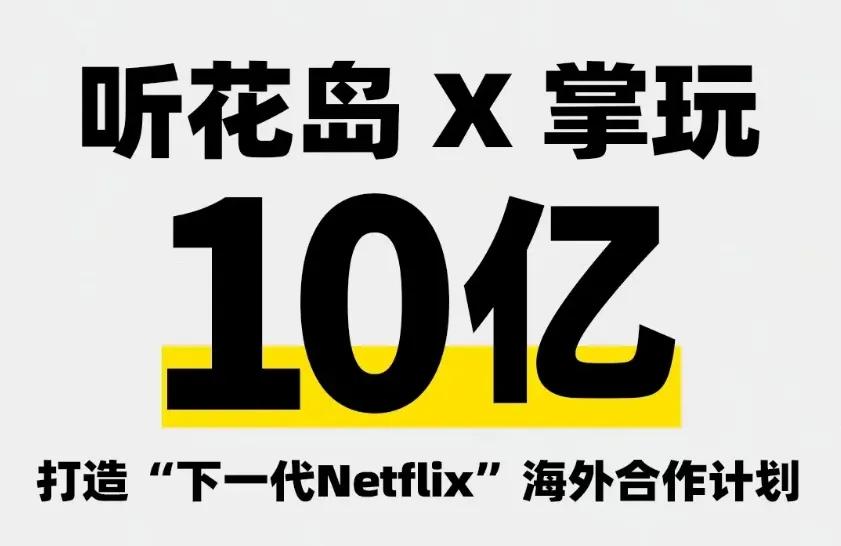
Secondly, in terms of distribution, there are more and more players in the short drama market. On the one hand, there are more competitors in the same field. For example, StoReel is also trying to develop self-developed AI tools. Currently, the platform has completed a financing of $34 million, and its founder Eric once led the short drama segment of Lemonade Pictures; Tinghuadao is also gradually focusing on AI short dramas. Its cooperation with the overseas short drama platform FlickReels of Zhangwan even aims to create the "next Netflix"...
On the other hand, super-head platforms are also strongly entering the market. Yuewen recently launched the overseas comic drama platform ToonScroll and plans to launch a thousand works this year. In addition, in the first quarter of this year, the total share of TikTok's AI short dramas exceeded $2 million, and ByteDance is also trying to replicate the successful business model of Hongguo to the overseas market...
It is not difficult to see that Chinese Online is facing a more complex competitive environment. Whether the company can break through with the help of AI needs time to verify. However, in the overseas market where the "buying traffic" strategy still prevails, it is highly likely that Chinese Online's loss situation will not change in the short term. In the first quarter of this year, the company suffered another loss of 45.83 million yuan. Under continuous performance pressure, it is