Solving problems offline, Claude Mythos overturns Erdős' 80-year-old conjecture, with a solution shorter and more elegant than OpenAI's.
[Introduction] OpenAI used a 125 - page chain of thought to crack open the door of Erdős' 80 - year - old conjecture, and now Mythos has found a shorter and more elegant way. The most astonishing part is that it stopped after getting the first feasible solution - even AI gets nervous when facing a world - famous open problem.
The speed of AI in doing mathematics has completely "gone out of control"!
Just after OpenAI overturned a 80 - year - old mathematical conjecture, Anthropic quickly presented a proof. In the same week, DeepMind also solved 9 similar difficult problems at once.
Just now, Anthropic researcher Levent Alpoge posted ten tweets on 𝕏:
OpenAI spent 125 pages to solve it, and he just casually tried with Mythos over the weekend.
Not only did it solve the problem in minutes, but the path was also shorter and more concise!

Isolated from the Internet, Mythos starts testing
This Levent Alpoge has an impressive background.
He was born in 1992, graduated from Harvard with a perfect 4.0 GPA, completed Cambridge Part III, and obtained a doctorate from Princeton (his supervisor is Fields Medalist Manjul Bhargava). In 2015, he won the Morgan Prize (the highest award for undergraduate mathematical research in the United States), became a Harvard Junior Fellow, and solved the generalization of Hilbert's Tenth Problem over all number fields.
When GPT - 4 was released in 2023, he was immediately impressed.
For me, it instantly became the most interesting thing ever created by humans. Back to CS!
Immediately afterwards, he joined Anthropic.

After OpenAI solved the Erdős problem this week, Levent did an "obvious thing" - let Mythos have a try.
To ensure fairness, the test conditions were very strict.
Multiple Claude Code instances worked independently, and the network was disconnected throughout the process to eliminate the possibility of "copying answers" from OpenAI's public solution.

As a result, the model found solutions similar to OpenAI's more than once, but it preferred another completely different and more concise path.
What's more interesting is that although the model had already found a solution to overturn the conjecture, it stopped at the first feasible answer.
It could have taken one more step to get a stronger result. But Mythos was too nervous!
Facing this world - famous open problem, it couldn't believe its own conclusion and conservatively stopped at the first feasible solution.
Seeing this, Levent couldn't help laughing: "All mathematicians understand this feeling!"

Currently, Opus 4.7 has completed the typesetting of the full proof:
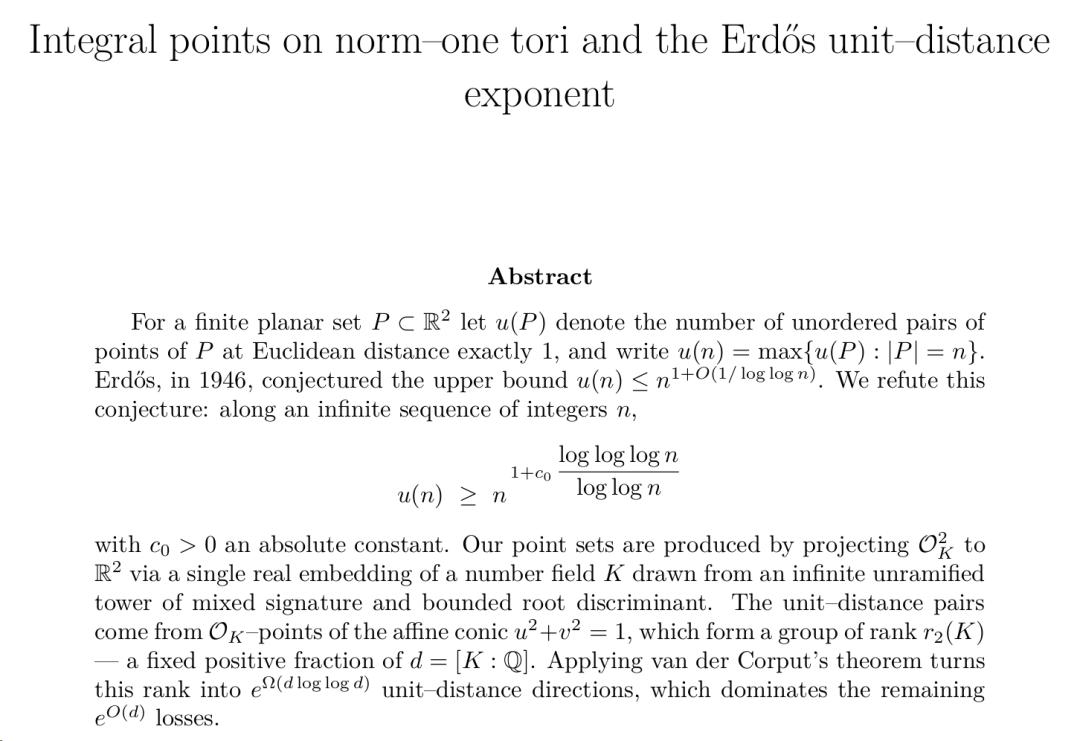
https://www-cdn.anthropic.com/files/4zrzovbb/website/ca35f196125c899a5ad11f011080202a652aef02.pdf
An 80 - year - old bet that no one has won
Let's go back to 1946.
Hungarian mathematician Paul Erdős posed a seemingly very simple question: Given n points on a plane, what is the maximum number of pairs of points with a distance of exactly 1 between them?
For example, if you place 100 coins on a table, and if the centers of every two coins are exactly one coin diameter apart, it counts as a pair of "unit - distance" points. How many such pairs can 100 coins form at most?
Erdős himself gave an answer: Arrange the points in a square grid. After appropriate scaling, the number of unit - distance pairs is approximately n^(1 + c/log log n).
That is, 100 coins can form a little more than 100 pairs.
Then he made a bet, claiming that this was the limit and no one could do better.
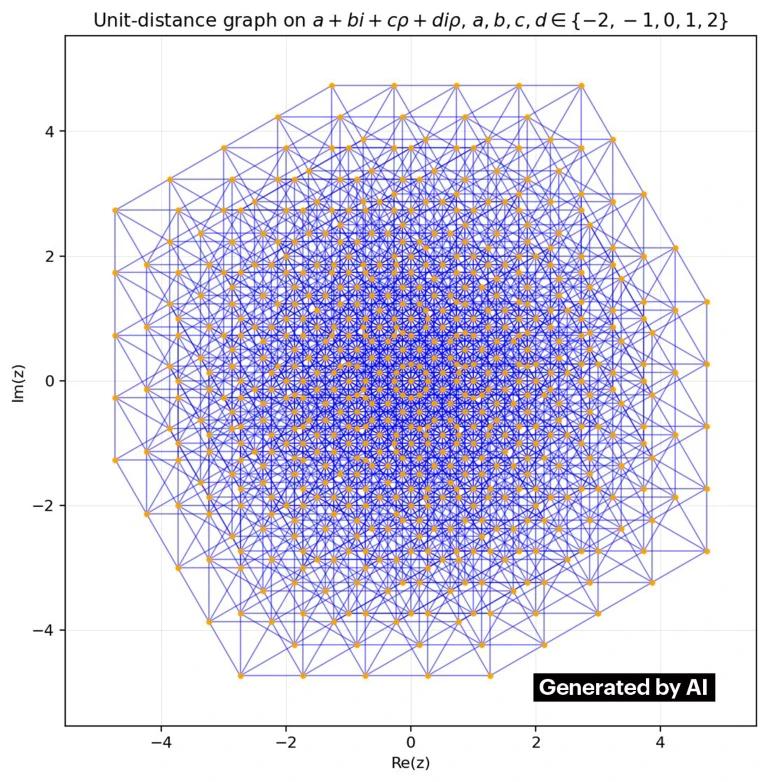
He was so confident because there was a key bottleneck - the Gaussian integers Z[i].
Erdős' square grid depends on this number system, and the number of ways a fixed norm can be factored in Z[i] depends on the divisor function, with an upper limit of approximately exp(O(log n / log log n)).
This is the "little extra" ceiling.
For 80 years, everyone has been stuck within this framework.
Heavy artillery from number theory delivers a crushing blow to geometry
For human mathematicians, the inherited intuition is that "the answer should be found in the Gaussian integers Z[i]."
Mythos is unaware of this tradition and immediately replaces Z[i] with the ring of integers O_K of a number field K with a degree much larger than 2.
It sounds like "using a cannon to swat a fly," but this kind of interdisciplinary brute - force approach has broken the 80 - year deadlock.
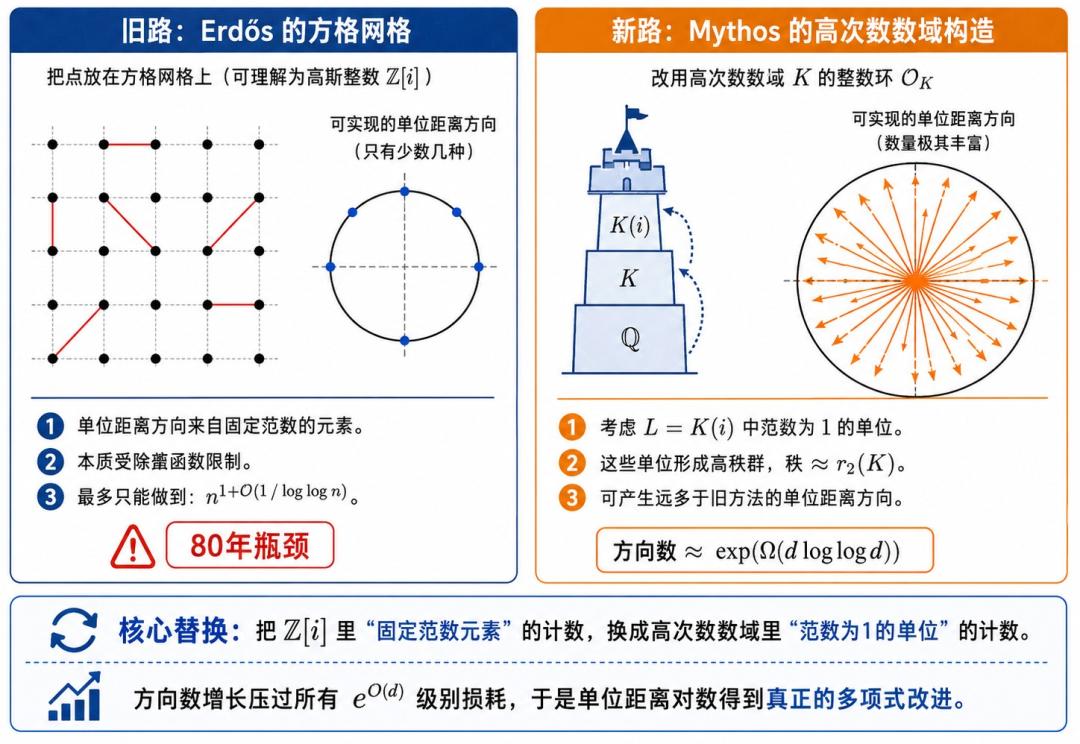
The method is to first use the Golod - Shafarevich criterion to build an infinitely tall "tower of number fields" K₀ ⊂ K₁ ⊂ K₂ ⊂... over a quadratic field.
Then, for each layer K_n, take a fourth - root extension F_n = K_n(D^(1/4)) with degree d_n.
The reason this tower works lies in a key property:
No matter how tall the tower is built, the "complexity density" of the number field is always bounded, and the structure is always controllable. Once the parameters are large enough, geometric counting can be initiated.
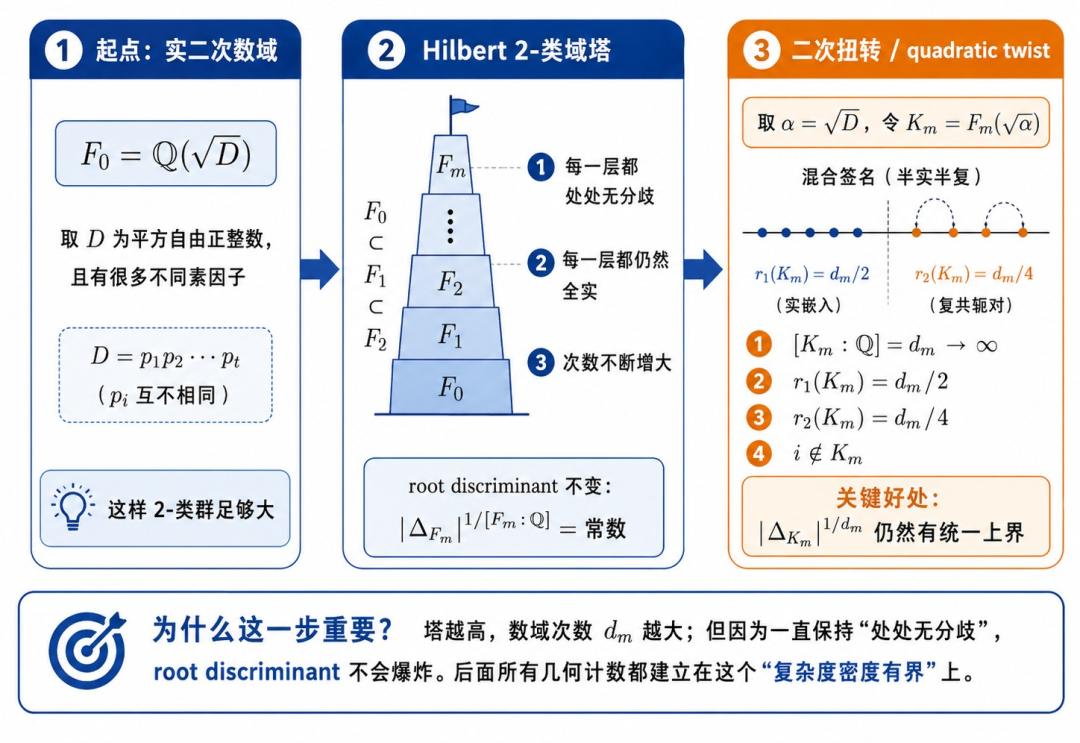
Next is the core of the entire proof.
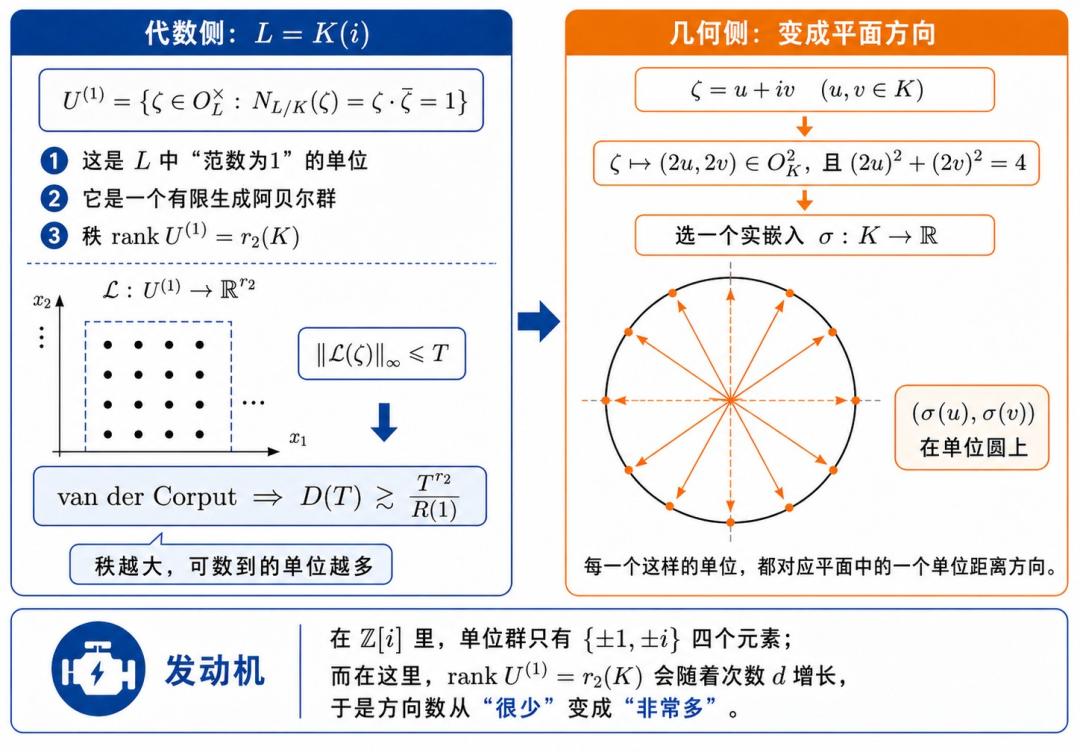
In Erdős' Z[i], the unit group has only four elements {±1, ±i}. There are only a few "unit - distance directions" that can extend outward, which are directly restricted by the divisor function.
However, in a high - dimensional number field, the rank of the unit group increases with the dimension, and van der Corput's theorem directly converts the rank into the number of directions.
As a result, the 4 directions become an explosive growth with the dimension.
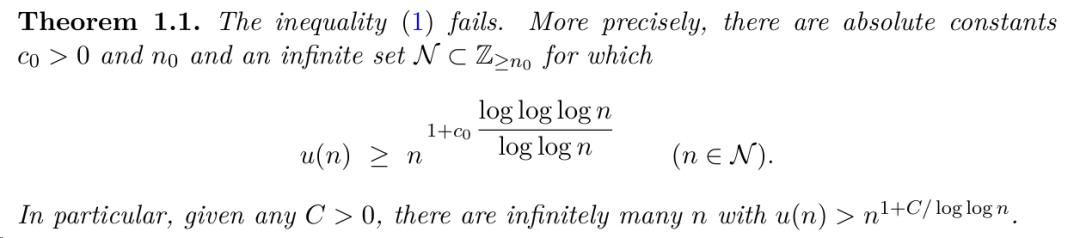
It doesn't matter if you don't understand this part. Just remember one thing -
Erdős was trapped in a room with only 4 exits, and Mythos tore down the walls.
Next is the specific construction.
First, choose a real embedding to project these numbers onto the plane, and we get the point set P.
Then, translate these points by a unit vector. The distance between the old and new points is exactly 1.
Because the number of directions grows extremely fast, the number of point pairs that meet the conditions far exceeds Erdős' upper limit.
Multiplying the two together, we get a polynomial gain.

More intuitively:
The number of unit - distance directions grows as exp(Ω(d log log d)), while all other losses are of the order exp(O(d)). d log log d dominates d.
Erdős' conjecture was thus overturned.
The entire argument has no analytical complexity. Compared with OpenAI's 125 - page path, it is much more concise.

In Levent's own words:
From a high - level perspective, this is essentially still Erdős' original construction plus a class field tower.
It's just that here we're doing the most straightforward thing - adding points with a size no more than half the radius to units with a size no more than half the radius.
And the reason it works is that the geometric counting of the class field tower grows extremely fast.

Three breakthroughs in a week, each cracking a problem
The timeline of the past week has an incredibly high information density.
On May 20th, OpenAI officially announced that a general reasoning model with an undisclosed name independently refuted Erdős' unit - distance conjecture.
On the same day, Princeton professor Will Sawin posted a manually improved version on arXiv, increasing the exponent from 6×10⁻³⁸ to 0.014. That's a difference of 10³⁵ times.
Tom Trotter, a mathematician from the Georgia Institute of Technology and a collaborator of Erdős himself, sighed: "If Erdős were still alive, he would be extremely excited."
On May 21st, DeepMind stepped in. AlphaProof Nexus solved 9 Erdős problems at once, with a maximum reasoning cost of only a few hundred dollars for each problem.
On May 26th, Anthropic also announced an independent proof, with a much shorter path than OpenAI's 125 - page proof.
The three approaches are completely different, but the results all converge to the same point.

From a joke to the Annals of Mathematics
You know, seven months ago, AI doing mathematics was a joke.
In October 2025, Kevin Weil, then the VP of OpenAI, claimed on 𝕏 that GPT - 5 had solved 10 Erdős problems.
After seeing the tweet, mathematician Thomas