E Fund is also experiencing a change.
In the technology bull market, there are both theoretical innovations, such as Huawei's Tao's Law reconstructing the Moore era; there is also a renaissance, such as the older generation of E Fund's growth fund managers collectively staging a performance like "The Gallant Brothers", comprehensively outperforming their peers in the liquor - related funds.
The E Fund Kexiang managed by Chen Hao has a return rate of 118.69% in the past year. Since he took over as the fund manager of Kexiang in May 2014, the annualized return during his tenure has risen to over 21%, ranking in the top 2% among similar funds.
The E Fund Information Industry managed by Zheng Xi has a return rate of 259.62% in the past year. Since he became the fund manager of this product in September 2016, the annualized return during his tenure is over 24%, ranking first among 434 funds.
The E Fund Ruixiang managed by Wu Yang has a return rate of 310.78% in the past year. Since he took over as the fund manager of this product in December 2017, the annualized return during his tenure has reached over 30%, ranking second among 1394 similar products.
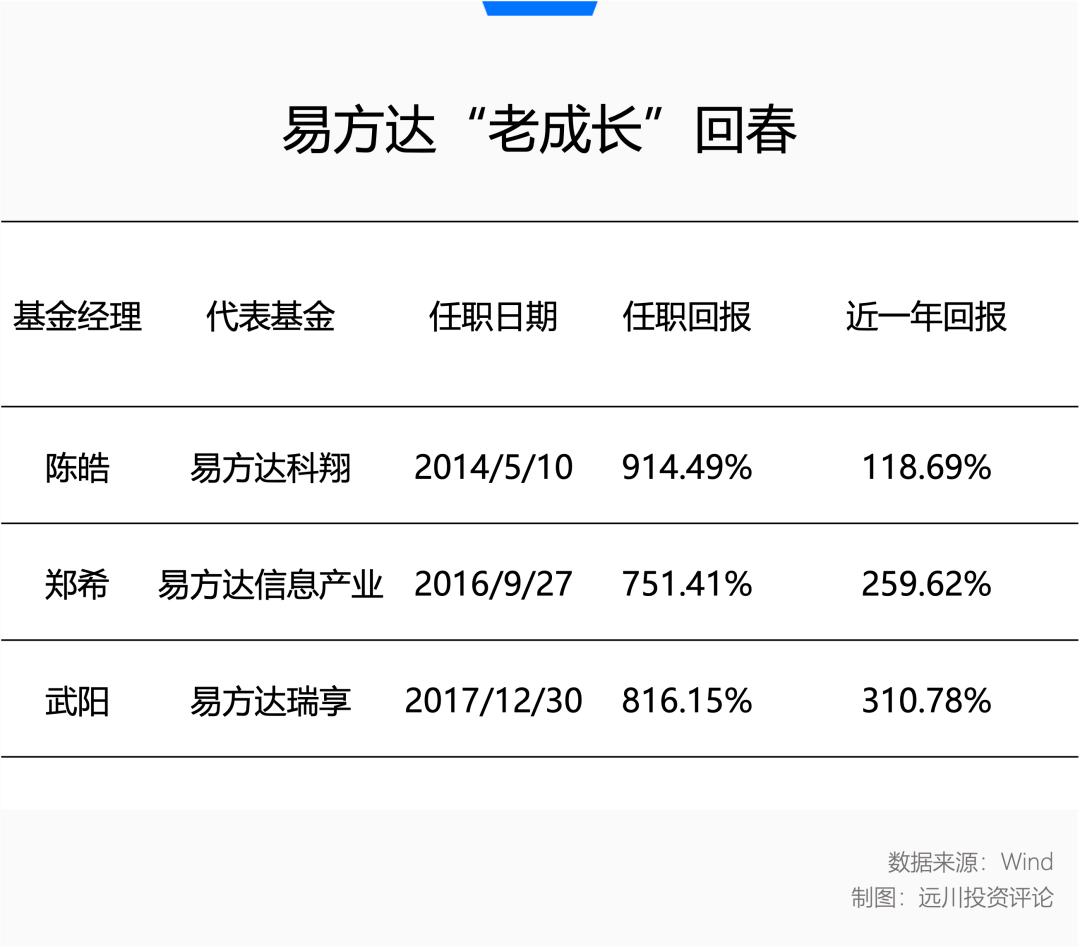
Data as of May 26, 2026
Different from the so - called "young" fund managers in the general sense, they are all fund managers with over 10 years of investment experience. In particular, Chen Hao and Zheng Xi are veterans who have personally experienced the roller - coaster ride of the 2015 dual - innovation bull market. They witnessed their colleague Song Kun win the championship in 2015 and become famous. There was once a rumor that his year - end bonus was 60 million yuan [8]. They also saw him step down dejectedly in 2019 and disappear ever since.
Just when Song Kun left the stage, E Fund's active equity funds iterated to a new version of the twin stars. The Song Kun of that era was replaced by Zhang Kun of this era.
Zhang Kun and Xiao Nan, who were in the cold during the dual - innovation bull market, became extremely popular during the consumer stock bull market. With their own efforts, they lifted E Fund to the status of a "Chinese winery" in the hearts of retail investors.
However, the times are also a strict judge.
Since the second quarter of 2021, in the years when they shared the same fate with the performance of the consumer goods industry, Zhang Kun's managed assets decreased by 9.28 billion yuan, and Xiao Nan's decreased by 3.7 billion yuan. Those funds named Asia Select, Blue - chip Select, High - quality Select, Consumption Select, and High - quality Strict Select have been renamed "Random Select" by fund investors one by one.
Now, Zhang Kun is deeply involved in Wuliangye's financial skills and Futu's A4 - paper - related issues. The announcement of appointing additional fund managers has left the market full of speculation. Xiao Nan, without violating the bottom line of the product contract and performance benchmark, has turned to embrace technology and abandon liquor in some of the funds he manages.
Zhang Kun wrote in the regular report that the domestic demand is facing cyclical difficulties. In fact, the profession of fund managers is not much better.
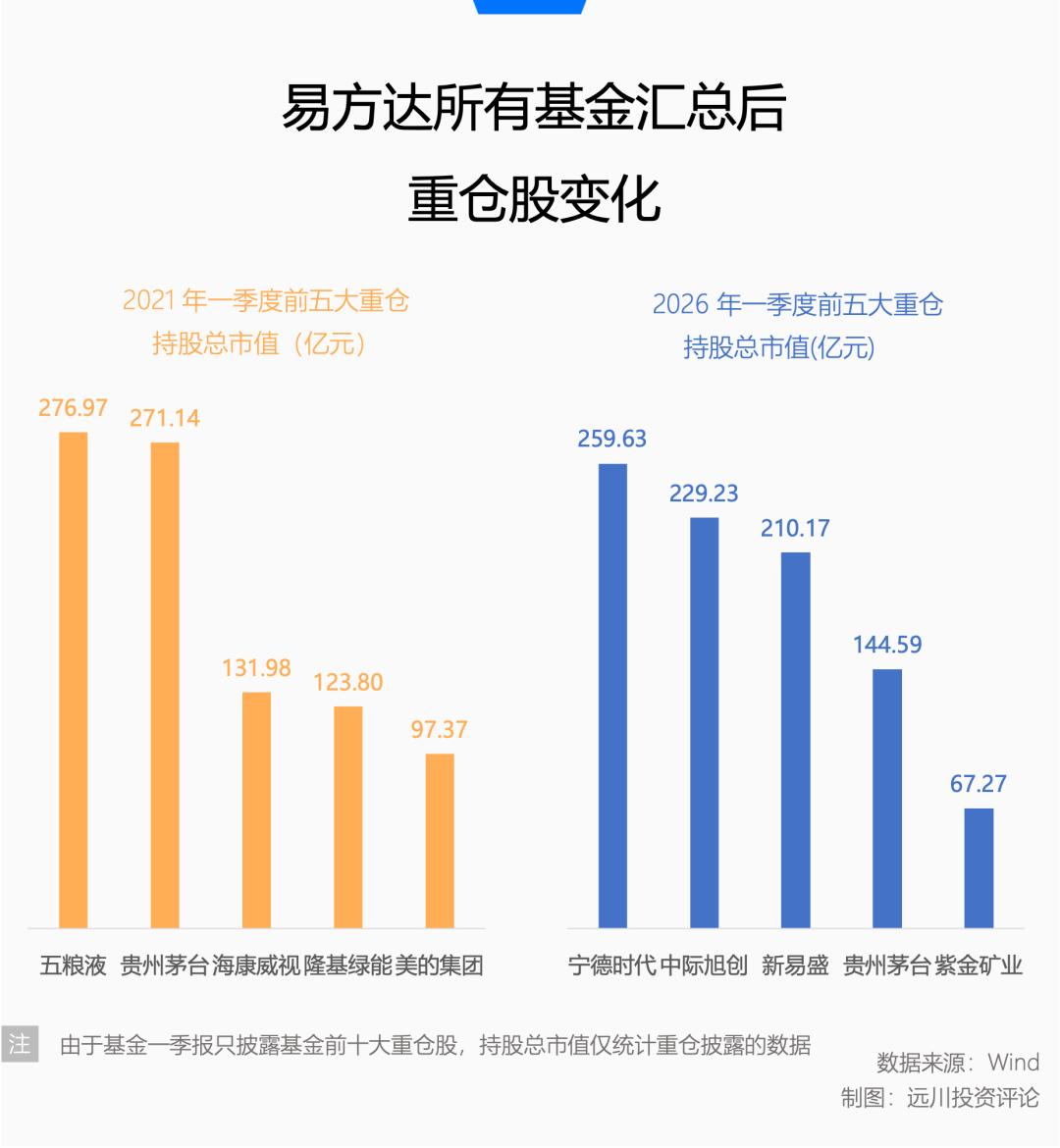
Also in Optics Valley
Chen Hao is more willing to write about the pain of the ebbing tide than Zhang Kun.
As Chen Hao, who was once popular during the dual - innovation bull market, his last Golden Bull Award was in 2016, which should also be one of the unforgettable turning points in his career.
After experiencing the madness and collapse of the leveraged bull market in 2015, the net value of Kexiang dropped by 45% in just over a month. The circuit - breaker mechanism at the beginning of 2016 added insult to injury. In the investment notes of that month, Chen Hao wrote:
"It's hard to imagine that there is any other profession in life where professionals have to face objective tests without any room for man - made intervention every day, bear the gains and losses, joys and sorrows of their own decisions, and face the ruthless exposure of their own character weaknesses. Vanity, face, and subjective will are all stripped bare in front of the market [9]."
Perhaps the extreme roller - coaster experience at that time has been engraved in his muscle memory. When Chen Hao first saw this round of AI market, he was somewhat hesitant.
At the beginning of 2023, ChatGPT became a global sensation, fully triggering the AI market for the first time. However, Chen Hao cautiously believed that the rapid rise of AI - related stocks did not conform to his concept of buying assets with higher expected returns at a relatively reasonable price [6].
After that, although he made a small - scale position in PCB and optical modules and gradually increased his position in the domestic substitution chain of semiconductors, his portfolio still mainly consisted of cyclical and pharmaceutical stocks.
By the end of 2024, when other "young" fund managers had made "Yizhongtian" one of their top three heavy - holding stocks, Zhongji Xuchuang accounted for less than 1% of his portfolio. In the first half of 2025, when Zhongji Xuchuang's stock price had a significant correction, he took the opportunity to increase his position. It was not until the second half of the year that Zhongji Xuchuang's stock price continued to rise and "passively" became a heavy - holding stock.
Xinyisheng entered his portfolio even later. It was not until the 2025 annual report was disclosed that Xinyisheng first appeared and directly jumped to the fourth - largest heavy - holding stock. Just after a short quarter, in this year's first - quarter report, both Zhongji Xuchuang and Xinyisheng disappeared from his heavy - holding portfolio.
Not standing firmly in the light has also led to his performance since 2026 far lagging behind that of Zheng Xi and Wu Yang, another two "old - growth" fund managers of E Fund.
Zheng Xi, who has fully embraced the AI industry chain since 2023, has seen his fund's net value skyrocket continuously. The expressions often seen in his quarterly reports are that the fundamentals of the AI industry are clear and the valuations are reasonable.
The advantage of getting in early is that when others are still in a dilemma, many of his funds have issued purchase - restriction announcements.
Since May 11, the E Fund Information Industry, which is long on the A - share AI chain, has restricted subscriptions, with a daily limit of 100,000 yuan. The E Fund Global Growth QDII, which is long on the global AI industry chain, has also restricted subscriptions, with a daily limit of 20 yuan.
Chasing the light doesn't always depend on who comes earlier.
For example, Wu Yang, who was still struggling with airline stocks in 2024, fully turned to AI in 2025. Although his pace was a bit slower than Zheng Xi's, Wu Yang's portfolio has a higher concentration, and the rise of his fund's net value is more rapid.
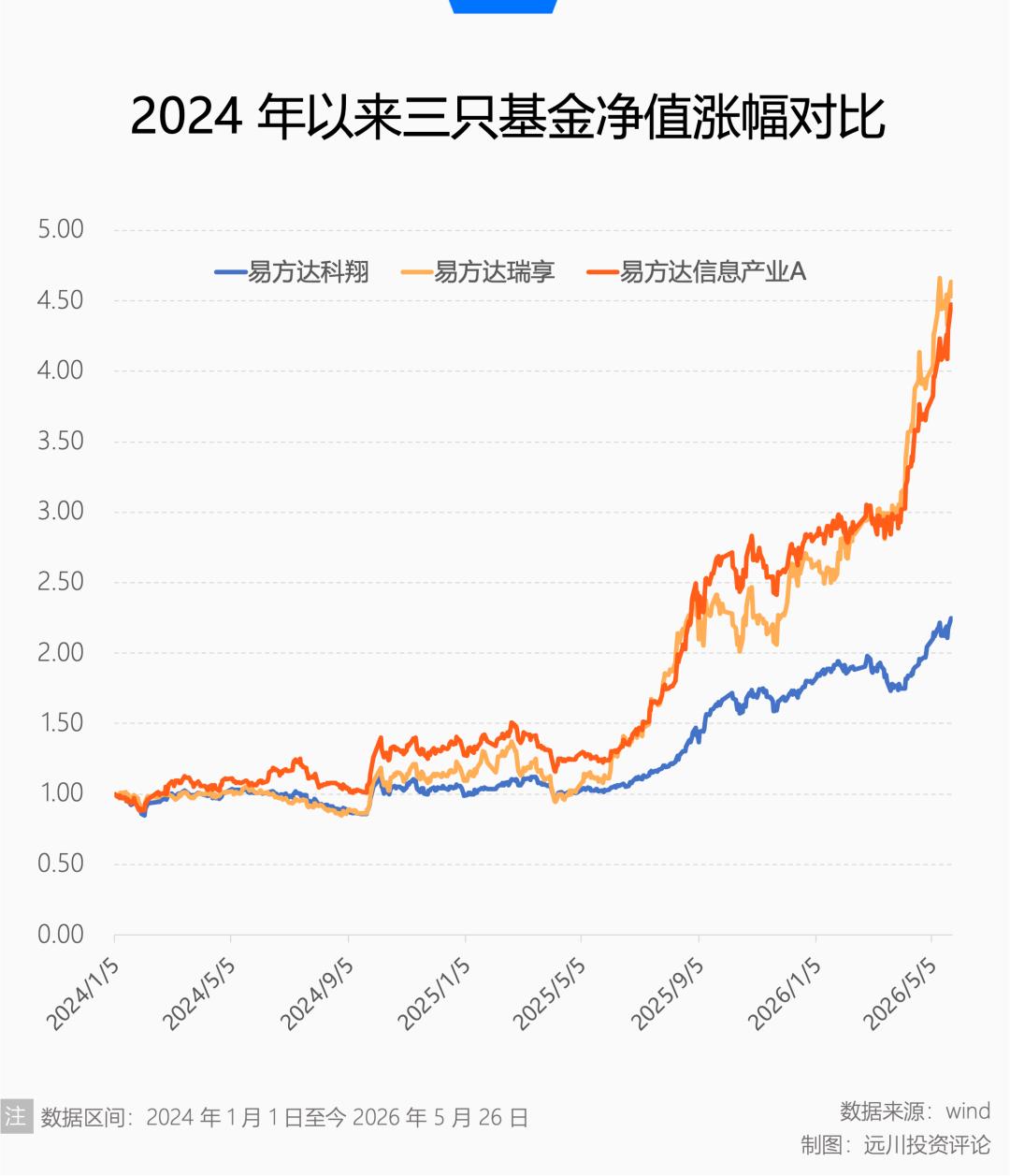
Compared with Chen Hao's relative caution and Zheng Xi's relative diversification, Wu Yang believed in AI later but more deeply. In the first - quarter report of 2026, he wrote: "The wheels of history roll forward. We can't stop them. We can only act in accordance with the trend."
Xiao Nan also acts in accordance with the trend.
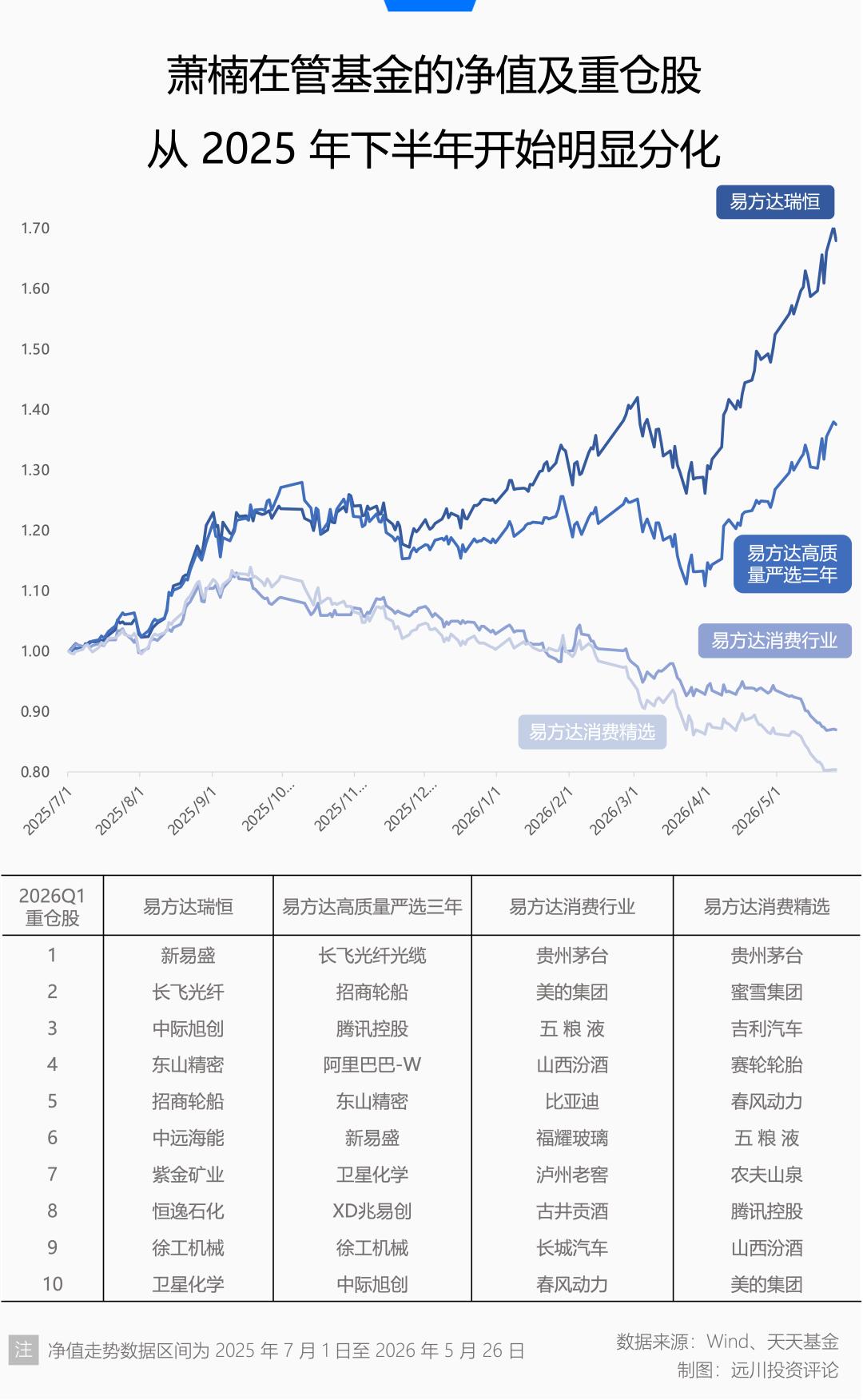
Since the second half of 2025, there has been an obvious differentiation in the positions of the four funds managed by Xiao Nan. The E Fund Consumption Industry and the E Fund Consumption Select are still heavily invested in liquor, while the E Fund Hengrui and the E Fund High - quality Strict Select have gradually abandoned "Maotai, Wuliangye, and Luzhou Laojiao" and stood in the optical communication field.
The bad news is that the two consumption - themed funds he manages, even though their performance benchmarks are the relatively weak CSI Consumption Index, have still lagged behind the benchmark since this year. On the other hand, the big market of optical modules has directly helped the E Fund Hengrui and the E Fund High - quality Strict Select significantly outperform their respective performance benchmarks.
Zhang Kun is left alone, waiting and bearing silently.
The Life - and - Death Benchmark
Speaking of performance benchmarks, this round of drastic reforms in public funds, which uses performance benchmarks as the guiding stick for investment research compensation, has largely affected the trend of active equity in public funds.
Excluding He Yicheng and Yang Siliang, who were newly appointed as fund managers of the E Fund Blue - chip Select, Chen Hao, who ranks second in terms of the managed assets among all active equity fund managers of E Fund, has experienced both the baptism of the cycle and the difficulty of the benchmark.
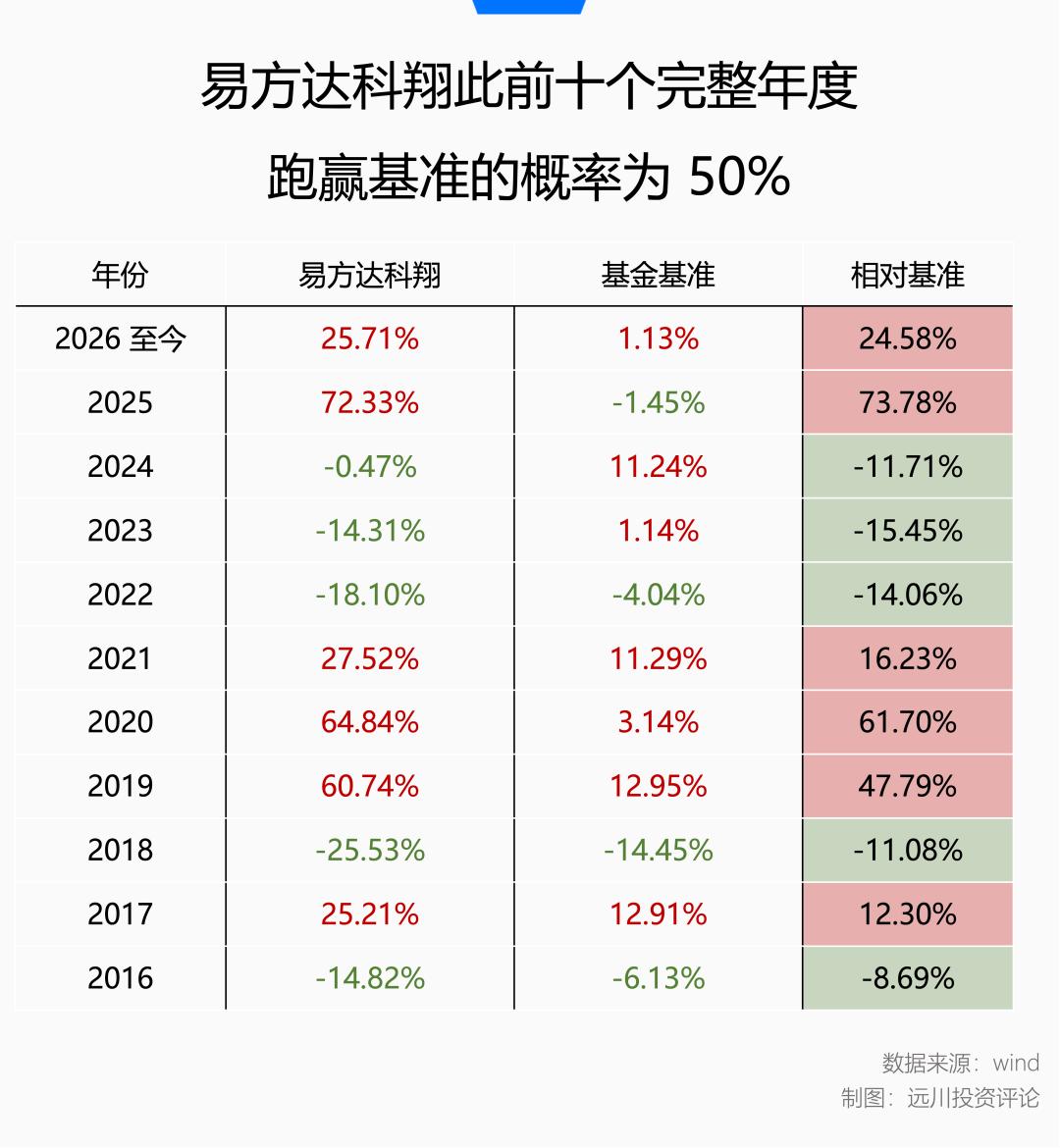
A little - known fact is that although the E Fund Kexiang has the word "science" in its name, its performance benchmark is 80% of the CSI Dividend Index return rate + 20% of the ChinaBond Composite Index return rate.
It should be noted that the new public fund assessment regulations attach unprecedented importance to performance benchmarks. Although Chen Hao's increase this year is far less than that of his other senior colleagues in the technology field, since the benchmark of Kexiang has only increased by a little over 1% this year, he has achieved an excess return of 24% in less than half a year.
As is well - known, in the A - share market, dividends and growth are somewhat incompatible.
From 2022 to 2024, under the pessimistic profit expectations of the entire market, growth stocks were continuously sold off, and dividend stocks were bought. Chen Hao underperformed the benchmark for three consecutive years. It's really hard for him to be at ease when he is making money from AI growth on one hand and dragging a benchmark that is almost in a hedging relationship on the other.
However, the one really in big trouble under the performance benchmark assessment is Zhang Kun.
In April this year, the China Securities Regulatory Commission officially issued and implemented the "Guidelines on Performance Appraisal and Compensation Management of Fund Management Companies". One of the provisions clearly states that if the performance of a fund product in the past three years is more than 10% lower than the performance benchmark and the fund's profit margin is negative, the performance - based compensation of the fund manager should be significantly reduced compared with the previous year, with a reduction of no less than 30%.
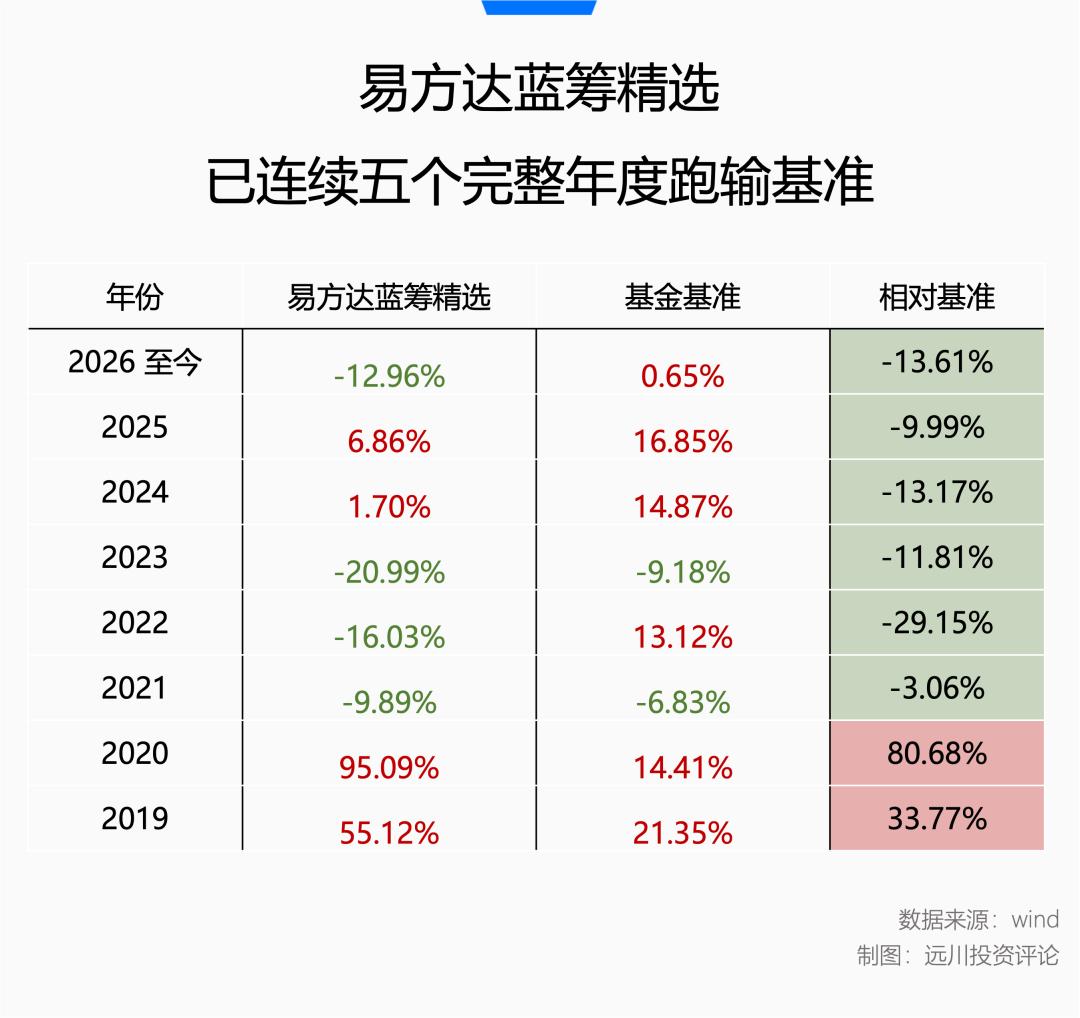
If strictly following the provisions of the guidelines, three out of the four funds under Zhang Kun's name have performed so poorly in the past three years that he is facing a salary cut of at least 30%.
The only fund that can be taken out, the E Fund Asia Select, has no "alcohol content" and has a large position in many global AI leaders. However, as the saying goes, bad news travels fast. The heavily - held Futu is now in the spotlight, showing its insensitivity to policies again.
On the other hand, the total return of the E Fund Blue - chip Select, the fund with the largest managed assets under Zhang Kun's name, is still relying on the achievements of 2019 and 2020. After underperforming the benchmark for five consecutive full years, it has lagged behind the benchmark by more than 13 points this year.
As a fund manager who has earned strong excess returns in the domestic demand era, Zhang Kun obviously does not agree with the market's pessimism about domestic demand.
He asked in this year's first - quarter report: "Do we still believe that each generation of Chinese people will live better than the previous generation?" If the answer is yes, then the current difficulties are cyclical, not structural. The next generation of Chinese people will buy higher - quality and larger - quantity goods and services throughout their lives [7].
However, there is obviously another question in investors' minds that he has not answered: Does living better necessarily mean drinking more liquor?
Epilogue
In June 2021, we wrote an article titled "One Version, One God: The Ups and Downs of the 'King of Public Funds'", reviewing the super - star fund managers in public funds who have attracted national attention in the past 20 - plus years. At that time, it was the peak of the previous round of core - asset bull market. Zhang Kun took over from Wang Yawei, Ren Zesong, and Chen Guangming to become the new "king" and the first active equity fund manager in the history of public funds to manage assets exceeding 100 billion yuan.
However, just like the saying "The hero of the era is not always in the era of heroes", the active equity of public funds has gone through many ups and downs, and the dominant players are constantly changing.
E Fund is still the E Fund with the largest active equity assets in the market, but Zhang Kun's managed assets are shrinking and being distributed.
After Futu Securities was hit hard by an "A4 - paper" incident and its stock price plummeted by 27% overnight last week, coincidentally, the next day, the E Fund Blue - chip Select issued an announcement on the change of fund managers, appointing He Yicheng and Yang Siliang to jointly manage this fund under Zhang Kun's name, which has assets of over 2.6 billion yuan.
Judging from their professional backgrounds, He Yicheng switched from Shenwan to E Fund, completing the career transformation from a seller to a buyer. He is also a fund manager cultivated by E Fund himself, with a background in TMT, clearly aiming to supplement the technology field. Yang Siliang is a fund manager poached from Baoying. He has the same consumer - related background as Zhang Kun. This overlap in the scope of expertise has also left the market full of speculation about this appointment announcement.
There is often no ever - green "king" on a large platform, and Zhang Kun won't be the last one.
However, in any case, the space for public active equity to prove that it has not only beta but also alpha is indeed getting smaller and smaller.