The latest urban population map: It is the champion of growth.
Recently, the population data of major cities in 2025 have been successively released, and Guangdong has become the biggest winner ——
As of now, Shenzhen, Dongguan, and Guangzhou have taken the top three spots in population growth last year. Driven by both natural growth and the inflow of migrants, their population sizes have continued to expand.
Meanwhile, provincial capital cities such as Changsha and Jinan have continued to maintain strong population attraction. The increase in permanent residents last year exceeded 100,000 in both cities, and the growth has been stable with a slight upward trend. Looking over a longer period, the major provincial capital cities in central and western China have also been the core carriers of regional population agglomeration in the past five years, with the overall permanent population maintaining positive growth.
In addition, the population of cities such as Wenzhou, Ningbo, and Foshan has further increased last year, collectively approaching the 10 - million mark.
Population is the foundation of urban development and a direct reflection of urban vitality. Facing the trends of low birth - rate and aging population, urban population growth increasingly depends on the inflow of migrants. From "attracting people", "retaining people" to "cultivating people", what is ultimately tested is the long - termism of urban development.
01
The Biggest Winner
On May 25th, the latest statistical data released by Shenzhen showed that at the end of 2025, the permanent population of Shenzhen reached 18.2485 million, exceeding 18 million for the first time. It increased by 259,000 compared with the end of the previous year, ranking first among the major cities with released data.
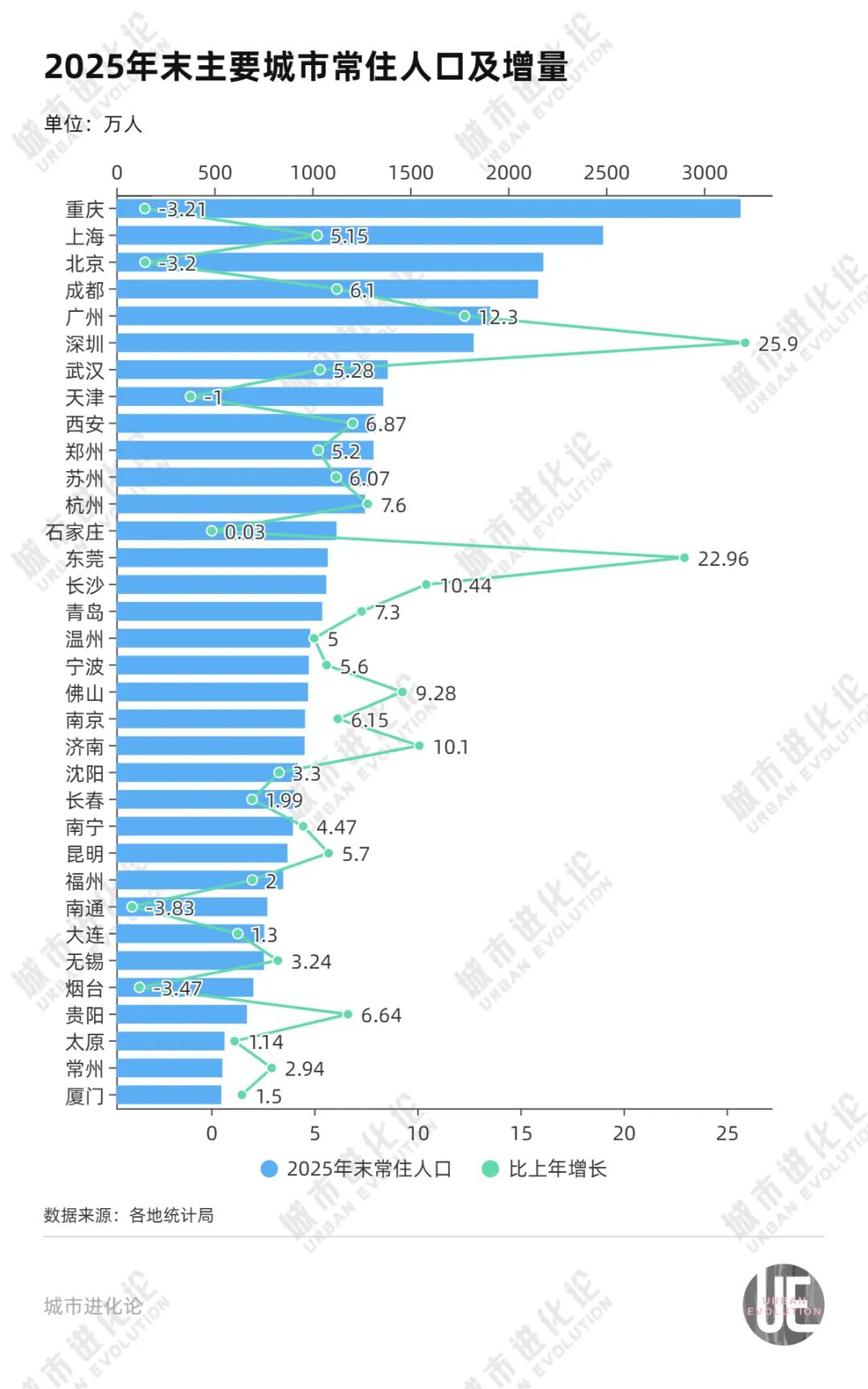
Moreover, Shenzhen's high - population growth has obvious continuity. This is already the fourth consecutive year that it has achieved a population increase of over 100,000. From 2010 to 2020, the permanent population of Shenzhen increased by 7.136 million, ranking first in the country in terms of population increase.
Compared with Shenzhen's steady and high - growth, Dongguan's growth is more explosive. In 2025, the permanent population of Dongguan reached 10.8004 million, an increase of 229,600 compared with the end of the previous year, setting the largest annual increase since the permanent population exceeded 10 million in 2020.
Guangzhou has also maintained a strong population growth rhythm. At the end of 2025, the net increase in population compared with the end of the previous year was 123,000, and it has maintained a population increase of over 100,000 for three consecutive years.
If we broaden our perspective, Foshan and Huizhou also achieved steady population growth last year, with increases of 93,000 and 76,200 respectively, even higher than those of star provincial capital cities such as Hangzhou (76,000) and Chengdu (61,000) during the same period, highlighting the strong population competitiveness of the Pearl River Delta urban agglomeration.
Digging deeper into the logic of Guangdong's continuous high - population growth, the core lies in the dual - wheel drive of natural growth and the inflow of migrants.
The fertility dividend is the basic support for the steady population growth of Guangdong's cities. In 2025, the number of births in Guangdong was 1.003 million, remaining the "fertility champion" in the country for six consecutive years.
The mechanical growth of the migrant population is the core driving force for the explosive population growth of Pearl River Delta cities and the key for Guangdong's cities to lead the country in population increase.
Taking Dongguan as an example, data shows that in 2025, the number of births in Dongguan was 32,500, the number of deaths was 11,100, and the natural increase in population was 21,400. By calculation, among the population increase in Dongguan last year, the mechanically increased population (i.e., the net inflow of population) reached 208,200.
This is closely related to Dongguan's active population policy. In 2025, Dongguan released the revised "Implementation Measures for the Household Registration of In - service Talents in Dongguan City", comprehensively relaxing the age limit for academic - type talents and including more talent groups in the new policy. The effect of talent agglomeration is remarkable. At the end of 2025, the registered population of Dongguan reached 3.4528 million, an increase of 183,300 compared with the end of the previous year.
Yang Chenggang, the vice - president of the China Population Association and a professor at the Institute of Social Development of Southwestern University of Finance and Economics, analyzed to Urban Evolution Theory and pointed out that the inflow of migrants ultimately stems from the industrial attraction of Guangdong. The rapid population growth of non - core cities in the Pearl River Delta such as Dongguan, Foshan, and Huizhou is not only due to their own advantages in industrial upgrading and urban quality improvement but also largely benefits from their geographical locations close to Shenzhen and Guangzhou.
This judgment can be confirmed by the high - frequency inter - city commuting pattern in the Greater Bay Area. According to the data of the Guangzhou Transportation Planning and Research Institute, in 2024, the inter - city commuting population among the nine cities in the Guangdong - Hong Kong - Macao Greater Bay Area (excluding Hong Kong and Macao) was about 1.29 million, a 3.1% increase compared with 2019. Among them, the inter - city commuting populations in the Guangzhou - Foshan - Zhaoqing and Shenzhen - Dongguan - Huizhou regions reached 418,000 and 407,000 respectively, accounting for about two - thirds in total.
02
The Provincial Capitals Remain Strong
Looking back over the past five years, before Shenzhen "took the crown" last year, the position of the city with the largest population increase was alternately held by provincial capital cities in central and western China.
Tracing back, the context of population changes is traceable:
In 2021, Wuhan, which recovered from the epidemic, saw a sharp increase of 1.2 million in population within a year. Its population size surpassed that of Zhengzhou at one stroke, making it the largest city in central China in terms of population.
In 2022, the population increase in Changsha reached 181,300, setting a new record for local population growth. At the same time, it ranked first in both the economic growth rate and the increase in permanent population among trillion - level cities.
In 2023, Hefei, known as the "venture - capital city", created a large number of employment opportunities through emerging industries and strongly attracted migrants. It added 219,000 people in a year, becoming the focus of the whole country.
In 2024, Guiyang outperformed Shenzhen with a permanent population increase of 199,600, ranking first in the country in terms of population increase, demonstrating a population attraction far beyond its urban economic scale.
Looking at the overall performance during the "14th Five - Year Plan" period, a group of provincial capital cities in central and western China have shown strong population agglomeration ability.
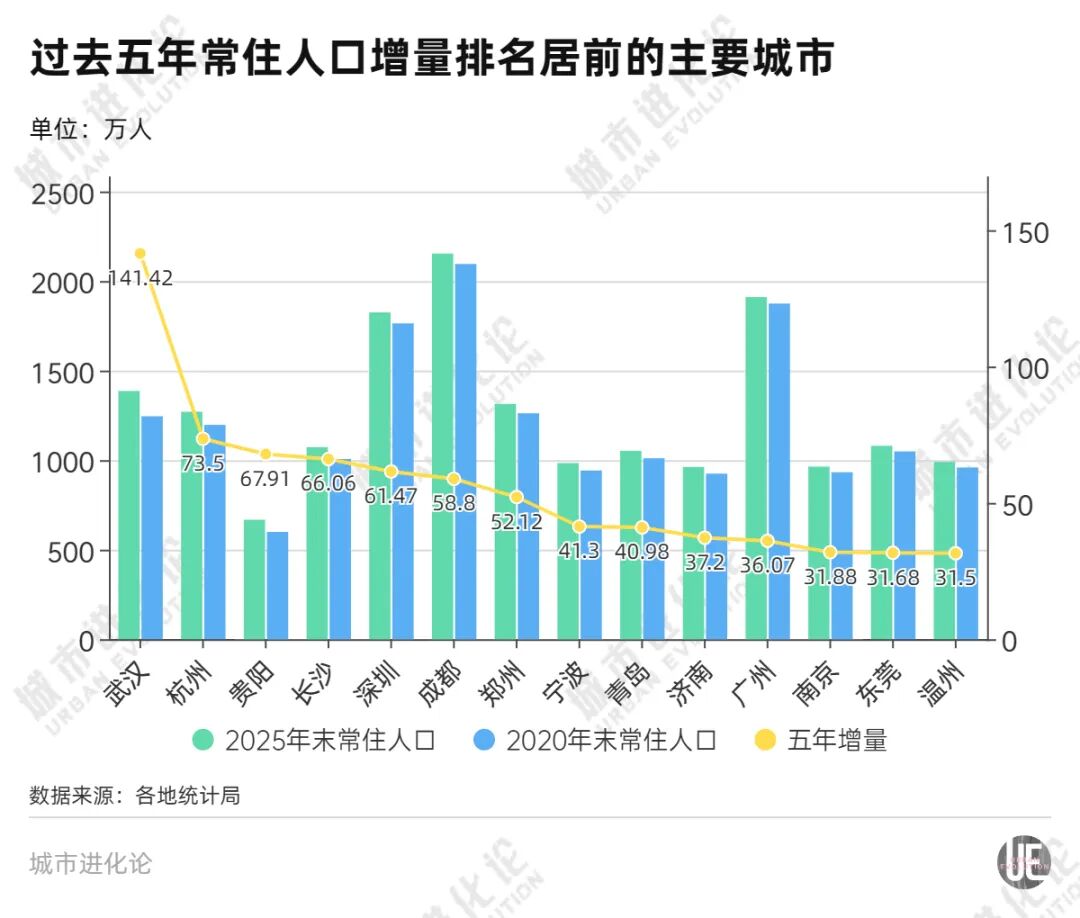
In the past five years, among the cities with a population increase of over 500,000, except for strong eastern cities such as Shenzhen and Hangzhou, they are all provincial capital cities in central and western China, including Wuhan, Guiyang, Changsha, Chengdu, and Zhengzhou. At present, Hefei and Nanchang have not released last year's population data. Judging from the development trend, both places are also expected to join this list.
"The population change trend that balances development costs and development benefits conforms to the growth law of China's urban population." Yang Chenggang believes that compared with first - tier cities, the development costs of provincial capital cities in central and western China are more affordable. Within the province, their employment opportunities and public services are unparalleled by other cities, so they have become a rational choice for young and high - quality talents to develop.
Of course, a prerequisite for the free migration of the population between cities is a relaxed institutional environment. Since the "14th Five - Year Plan", large population cities in China have continuously optimized talent - related policies and continuously lowered the thresholds for household registration and employment. Attracting the youth group is the core direction of policy efforts in various places.
For example, Chengdu issued ten measures to attract and gather talents last year. Among them, it provides a maximum credit loan of 10 million yuan for the entrepreneurship of talents from category A to F, and selects about 300 young scientific and technological talents at home and abroad every year, giving each of them a subsidy of 100,000 yuan. During the "14th Five - Year Plan" period, Chengdu attracted more than 2.67 million young talents and was rated as the "Best City for Talent Introduction in China" for many consecutive years.
Currently, various places are still intensifying their efforts in talent introduction. This year's government work report of Zhengzhou mentioned that it will create a development environment where people "can come in, stay, live comfortably, and succeed in their careers", and strive to attract and retain 200,000 young talents in Zhengzhou.
03
Sprinting Towards Ten Million
As of now, the cities in China with a permanent population of over 9.5 million and continuous growth are Wenzhou, Ningbo, Foshan, Nanjing, and Jinan. They are all in a critical window period of striving to reach a population of 10 million.
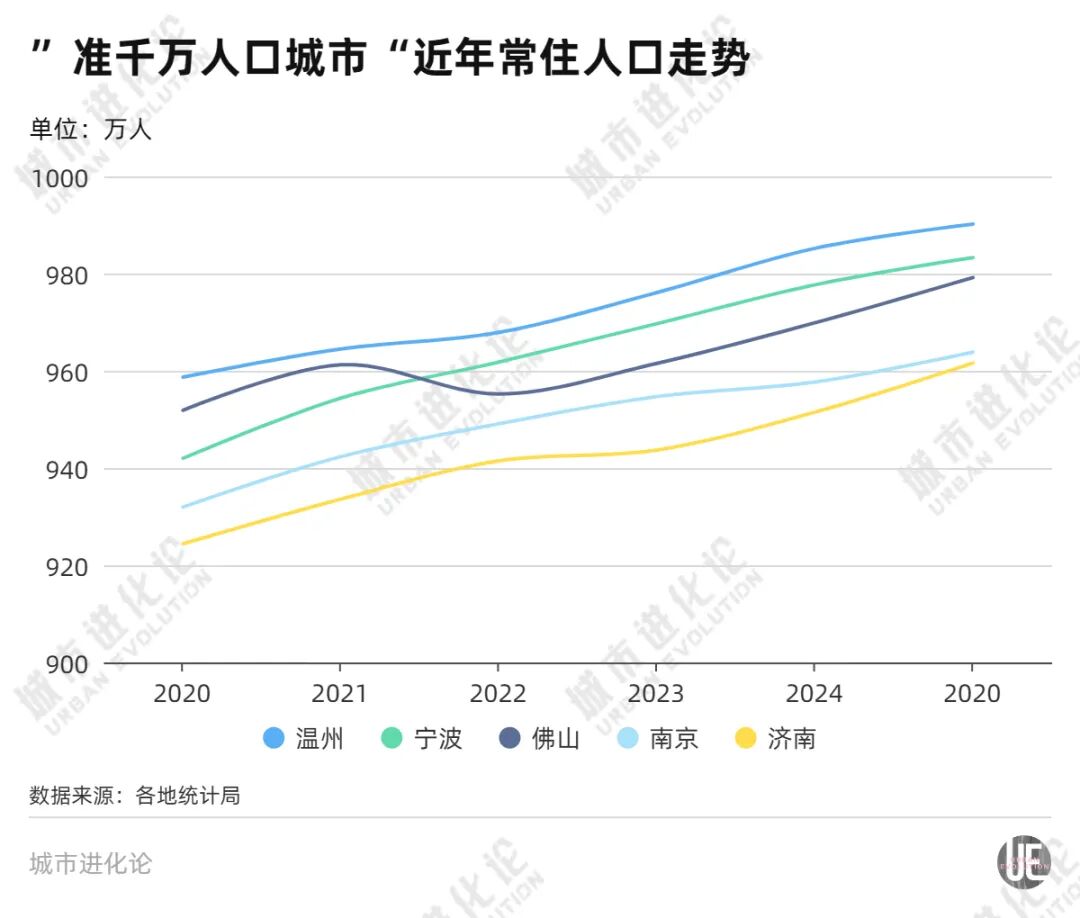
Among them, Jinan had the strongest growth momentum last year. In 2025, against the background of a significant population decrease of 370,000 in Shandong Province, Jinan still achieved a population growth of 101,000, setting a new high in the past five years. This is also the second consecutive year that Jinan has outperformed Qingdao (73,000) and ranked first in Shandong in terms of population increase. As of the end of 2025, the permanent population of Jinan reached 9.616 million, accelerating its sprint towards the 10 - million population mark.
Nanjing, also the provincial capital of an economic powerhouse, is also working towards the goal of a 10 - million population. At the end of 2025, the permanent population of Nanjing reached 9.6385 million, an increase of 61,500, setting a new high in recent years. The "15th Five - Year Plan" outline of Nanjing proposes to strive to have a total permanent population of over 10 million by the end of the "15th Five - Year Plan" period.
Among the above - mentioned cities, Wenzhou is the closest to the 10 - million population mark. At the end of 2025, the permanent population of Wenzhou increased to 9.902 million, an increase of 50,000 compared with the previous year, only one step away from becoming a city with a population of 10 million.
If we examine the population growth over a five - year period, Ningbo had the strongest growth, with a total increase of 413,000 people. At the end of 2025, the permanent population of Ningbo increased by 56,000 to 9.833 million. Its population size follows Wenzhou closely and is steadily sprinting towards the 10 - million population mark.
In the fierce competition for the existing population, which city can be the first to become the next city with a population of 10 million?
Yang Chenggang believes that these cities have all developed well in recent years. According to the development experience of other cities before, they have the opportunity to reach the 10 - million population goal in about three years.
Yang Chenggang especially emphasized that the population competition among domestic cities has entered a new stage. The short - term policies for attracting people in various places have basically been exhausted, and the policy effects have also basically been released. In the future, the population competitiveness of cities will no longer depend on short - term policy dividends but will more test the systematic ability to attract and cultivate talents.
Under this logic, cities should continuously optimize industrial policies and population policies, create a good business environment, and create more employment opportunities to support population absorption.
In addition to industrial empowerment, Yang Chenggang further added that cities should also incorporate the layout of the public service system into long - term strategic planning to achieve the long - term goal of attracting, retaining, and cultivating people with a better education, medical, and parenting environment.
This article is from the WeChat public account "Urban Evolution Theory", author: Liu Xuqiang. Republished by 36Kr with permission.