The three giants of mobile phone chips are trapped in the AI era.
In 2026, when the demand for AI computing power reached a record high, the three giants in the mobile phone chip industry each made an unusual move: Qualcomm and MediaTek quietly withdrew a total of 20,000 - 30,000 wafer orders from TSMC; Apple, for the first time, handed over the foundry of some self - developed chips to Intel. TSMC's best production capacity is no longer prioritized for mobile phones. How will the mobile phone chip giants enter the AI era?
TSMC's Tight Production Capacity: Mobile Phone Chips Are Not a Priority Anymore
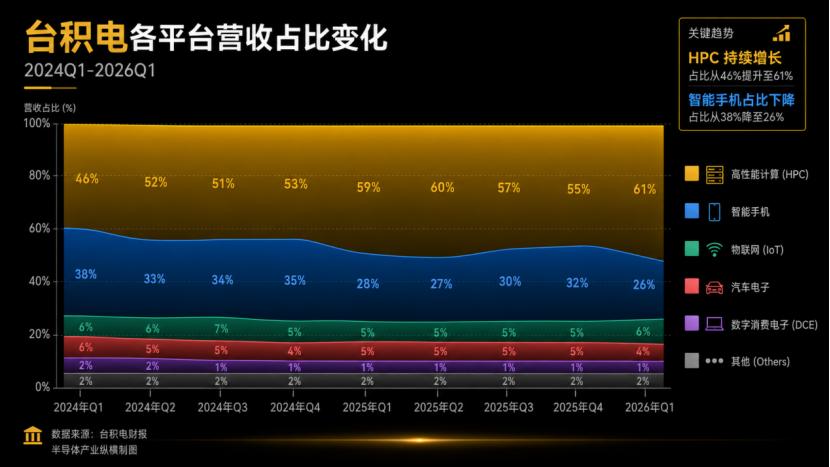
In the past two years, TSMC's revenue structure has undergone a complete structural shift. The revenue share of the mobile phone chip business has been continuously declining, and the industry focus has completely shifted. In the first quarter of 2024, the revenue share of the smartphone business in TSMC's total revenue was 38%, while that of the HPC (High - Performance Computing) business was 46%. By the first quarter of 2026, the revenue share of the HPC business climbed to 61%, and that of the smartphone business dropped directly to 26%. In just two years, the revenue share ceded by the mobile phone chip business was basically entirely occupied by AI computing - power - related businesses. The scale of revenue growth brought by the AI computing - power business far outpaced the recovery of the mobile phone chip business. The shipment volume of mobile phone chips remained basically stable, which directly led to the continuous dilution of its share in TSMC's overall revenue and the gradual decline of its industry status.
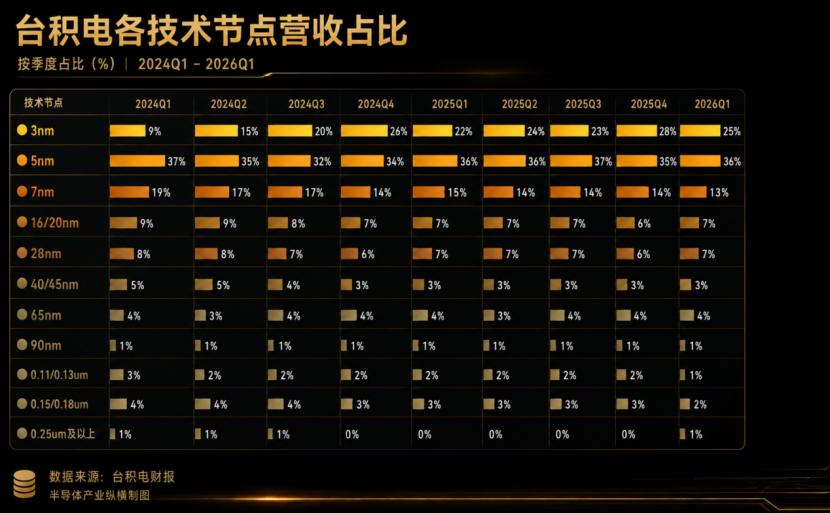
From the revenue layout of TSMC's core process nodes, we can more intuitively see the direction of the shift in its production - capacity resources, which also confirms the marginalization trend of the mobile phone chip business. The revenue share of the 3nm advanced process increased steadily from 9% in the first quarter of 2024 to 28% in the fourth quarter of 2025, and the upward trend remained strong. The 5nm process has long stably occupied the core position in revenue. The two high - end processes together accounted for more than 60% of TSMC's revenue in the first quarter of 2026. Most of the customers with high - value - added computing power, such as NVIDIA's AI chips, Apple's self - developed chips, and cloud - based AI computing - power chips, hold the production capacity of high - end and advanced processes. These customers are willing to pay a premium to lock in the top - notch production capacity and have become TSMC's core service targets at this stage.
TSMC's scarce high - end and advanced production capacity is tilting towards the AI computing - power track. In terms of production - capacity priority, supply scheduling, and resource allocation, mobile phone chip foundry customers have fallen far behind AI computing - power chip customers.
Qualcomm and MediaTek's reduction of foundry orders is a concession made by the two companies in line with the current production - capacity pattern. TSMC's high - end production capacity is in short supply. If they continue to hoard a large number of advanced - process wafers without getting high - quality production capacity, it will only increase the capital pressure and inventory risk. How can mobile phone chip manufacturers find solutions under the background of limited production capacity?
The three mobile phone chip giants each have their own solutions.
MediaTek: Systematic Transfer of Resources
MediaTek chose to transfer resources from mobile phone SoCs. In 2026, the overall global shipment volume of mobile phone SoCs will show a downward trend. According to data from Counterpoint Research, in the first quarter of 2026, the global smartphone SoC shipment volume decreased by 8% year - on - year, and the shipment volumes of both Qualcomm and MediaTek showed double - digit year - on - year declines. Counterpoint said that affected by the storage - chip crisis, MediaTek faced great pressure in the entry - level market.
Facing such challenges, MediaTek's mobile phone business actively shrank its scale and fully shifted its core growth focus to new tracks. At the beginning of 2026, MediaTek clearly stated in its legal statement that mobile phones remain the core business, but the company's positioning will be transformed from a mobile phone chip manufacturer to an AI chip company. Google's new - generation TPU is planned to be mass - produced in the second half of 2026, and MediaTek will undertake part of the ASIC design and I/O subsystem. Reports from multiple institutions said that MediaTek's revenue from data - center AI ASICs will exceed $1 billion in 2026 and reach a scale of "billions of dollars" in 2027.
At MWC 2026, MediaTek demonstrated a series of AI applications "from mobile phones, tablets, IoT to edge servers", showing a complete layout in edge - side AI. In the field of automotive electronics, MediaTek cooperated with Denso, one of the world's largest parts suppliers, to develop ADAS customized chips, which are expected to bring significant automotive revenue growth to MediaTek starting in 2026. Combined with MediaTek's existing in - vehicle communication and in - vehicle entertainment solutions, it will gradually expand from in - vehicle connectivity/information entertainment to automatic assisted - driving SoCs.
Qualcomm: Moving Forward Towards the AI Full - Platform
In the Q2 financial report of fiscal year 2026 (from January to March 2026 in the natural year), Qualcomm lowered its guidance for mobile phone chip revenue in that quarter to about $6 billion, a year - on - year decrease of about 13%, and warned that the price increase and supply shortage of storage chips led OEMs to reduce inventory and compress the shipment of mid - and low - end models. Counterpoint estimated that Qualcomm's smartphone SoC shipment volume will decrease by about 8.8% year - on - year in 2026, with a slight decline in market share, but the flagship and sub - flagship segments will still maintain growth. Similar to MediaTek, Qualcomm is also facing a structure of "stable high - end and shrinking mid - and low - end".
Qualcomm's management admitted that mobile phone shipments are under pressure, attributing the shrinkage of mid - and low - end models to the price increase of storage chips, the extended replacement cycle, and OEMs' inventory reduction. They no longer have strong expectations for the "return of overall mobile phone SoC shipments to high growth". Qualcomm positions flagship and sub - flagship mobile phones as "personal AI entrances", and maintains high - end ASP and differentiation by strengthening NPU, local large - model capabilities, and the intelligent - agent ecosystem. In the mid - and low - end market, it ensures profitability through platform reuse and cost optimization.
At MWC 2026, Qualcomm demonstrated the premium version of the wearable platform, the X105 modem, and the Wi - Fi 8 chip, all of which are upgrades around AI and connectivity capabilities, expanding the Snapdragon brand from mobile phones to multiple terminal forms such as wearables, PCs, XR, and vehicles.
Similar to MediaTek, Qualcomm is also making efforts in AI chips. In 2026, Qualcomm confirmed that it had won a customized - chip order from the first hyperscale cloud customer to enter the cloud - based AI accelerator field. Qualcomm said that the ASP and gross profit of such customized - chip orders are significantly higher than those of traditional mobile phone SoCs, which will become an important growth pole to hedge against the fluctuations in the mobile phone cycle.
Qualcomm has accumulated considerable platform capabilities in automotive chips, which has also become an important growth market for Qualcomm in 2026. Qualcomm claims to have won more than $30 billion in Design - Wins in total, and it is expected that the automotive business will maintain double - digit growth in the next few years to offset the fluctuations in the mobile phone and IoT markets. Qualcomm has listed the automotive business as one of the key growth engines in its financial reports several times.
Different from MediaTek, Qualcomm focuses on the data connection and interaction between personal AI products and has made efforts in products such as wearables and PCs. Qualcomm CEO Cristiano Amon predicted that the market scale of "wearable AI products" is expected to exceed 100 million in the next few years and may even reach the scale of one billion.
Apple: Reusing Mobile Phone Chips and Finding Backup Production Capacity
Apple used to be TSMC's most important customer, and its A - series/M - series chips have long locked in TSMC's most advanced process nodes. Now, for the first time, Apple clearly stated that it will hand over the foundry of some chips to Intel. Handing over part of the production capacity to Intel is Apple's way to diversify risks under the tightening supply from TSMC. To spread the increasing cost of chips, Apple's answer is cross - category reuse. Supply - chain data reveals that the estimated cost of a single A20 or A20 Pro chip carried by the iPhone 18 Pro series is $280, a significant increase compared with the previous - generation A18 and A19 chips. Coupled with the more than - doubled increase in memory cost, the high - end version of the iPhone 18 is facing the most severe overall material - cost pressure in recent years.
The A - series chips can be used across devices, mainly relying on the homologous development ecosystem of iOS and macOS, with highly unified software - hardware adaptation. Apple uses the A18 Pro mobile chip in the MacBook Neo model. The same SoC can be adapted to both smartphones and thin - and - light laptops. The emergence of the MacBook Neo simplifies the R & D expenditure on chips and also shows Apple's barrier in the chip ecosystem: relying on a unified chip design to cover multiple terminal products, sharing R & D costs through a large overall shipment volume, and maximizing the use of TSMC's foundry production capacity.
The New Story of Mobile Phone Chips in the Agent Era
In 2026, the new actions of mainstream mobile phone manufacturers in AI mainly focus on "AI agents", "system - level large - model integration", and "terminal - cloud collaboration". These changes have directly raised the requirements for mobile phone chips in terms of computing power, energy efficiency, memory bandwidth, and AI engine architecture.
Qualcomm CEO repeatedly emphasized the same judgment at the Web Summit 2026 and the Davos Forum: The AI competition will be decided at the "edge" - where devices, data, and users meet. When an AI model can process requests locally on your mobile phone instead of routing them to a cloud server, it brings lower latency, better privacy protection, and no cloud bills.
Counterpoint Research predicts that the shipment volume of smartphone SoCs supporting Agentic AI will grow at a compound annual growth rate of 281% (from 2025 to 2027), and the penetration rate will rise to 32% by 2027. Currently, the penetration rate is only 4%. Counterpoint Vice - President Peter Richardson said: "We expect that one in every three smartphones shipped in 2027 will have Agentic AI capabilities, covering the high - end (above $600) and mid - high - end ($250 - $600) price segments." Analyst Shivani Parashar added that MediaTek has taken the lead in launching the Dimensity 8400, 8450, and 8500 chips supporting Agentic AI and has a first - mover advantage in expanding to mid - end models.
OpenAI is collaborating with Qualcomm and MediaTek to develop a smartphone centered around AI agents, with the goal of achieving an annual shipment volume of 300 - 400 million units by 2028. The architecture design of this device is as follows: Lightweight tasks (context awareness, memory management, small AI models) are processed locally, and complex reasoning tasks are offloaded to the cloud. This device will be redesigned from the bottom up to support continuous, low - power local AI reasoning, rather than simply adding an NPU to the existing chips.
Mobile phone SoCs are gradually losing their central position in the core narrative of the semiconductor industry, but mobile phones are still the smart terminals with the largest global shipment volume, and the demand for edge - side AI reasoning is also increasing. How can mobile phone chip companies find new growth points? The answer may lie in the development context of AI agents. AI has pushed mobile phone chips out of TSMC's priority list, but AI agents need to run locally, and ultimately, they still have to rely on mobile phones for computing power. A Counterpoint report points out that the penetration rate of mobile phone chips supporting Agent AI was only 4% at the end of 2025, but by 2027, it is expected that one in every three mobile phones will have this capability, and the penetration rate in high - end models will exceed 80%.
The AI - enabled mobile phones bring an upgrade from a single - performance selling point to an AI platform + ecological products. What has been taken away by AI this time may come back in another form.
This article is from the WeChat official account “Semiconductor Industry Perspective” (ID: ICViews). Author: Liu Qian. Republished by 36Kr with permission.