Token's 370-fold increase in five years: Who is refueling the "money printer" of AI companies?

Text by | Wei Linhua
Edited by | Liu Junhong
Don't fear losing money, but fear missing out. Throughout May, the valuations of AI companies skyrocketed.
The doubling of valuations and record - high single - round financings have enabled some companies to secure 2 - 3 rounds of financing before even half of the year has passed:
DeepSeek, which was previously adamant about not seeking financing, suddenly raised 50 billion RMB in a single round, and its valuation may exceed 350 billion RMB. Dark Side of the Moon completed three rounds of financing in less than half a year, with a cumulative financing of over $3.9 billion, and its latest post - investment valuation exceeded $20 billion. One day later, Step Star was reported to have completed nearly $2.5 billion in financing, with a post - investment valuation approaching $10 billion. This year, Mianbi Intelligence and Shengshu Technology have also completed two consecutive rounds of financing. Shengshu Technology's valuation exceeds $2 billion, and although Mianbi Intelligence has not disclosed its specific valuation, it has crossed the unicorn threshold (over $1 billion).
Globally, the capital frenzy is even more intense.
In the first quarter of 2026, global artificial intelligence startups raised a total of $255.5 billion, exceeding the total amount of AI venture capital investment in 2025. However, two - thirds of this $255.5 billion came from three super - deals, totaling $172 billion.
In March 2026, OpenAI announced the completion of a $122 billion financing round, jointly led by Amazon, Nvidia, and SoftBank. Just a few weeks earlier, in February, Anthropic also announced a $30 billion Series F financing, with top - tier institutions such as Singapore's sovereign wealth fund GIC, UAE's MGX, BlackRock, Blackstone, and Morgan Stanley on the investor list.
Global capital is concentrating on the top players.
The increasing enthusiasm for financing is because AI is truly making money, and there is even hope of turning a profit.
Take Anthropic as an example. Its CEO, Dario Amodei, said at an overseas event that in Q1 this year, the company's revenue increased 80 - fold year - on - year. In addition to the doubling of revenue, it is expected to achieve its first quarterly profit in Q2 this year. While its Q2 revenue soars to $10.9 billion, it is expected to record an operating profit of $559 million.
When the valuations of AI companies soar beyond expectations, the theory of an AI bubble sweeps in again, and a core question emerges: Are the valuations of these companies reasonable pricing or a bubble waiting to burst?
Hundred - fold PS, the sky - high valuations of AI companies
To determine whether the current valuations of AI companies are a bubble or reasonable, let's start with how the market measures company valuations.
How has the valuation logic of AI companies changed in the past three years? Guangzhui Intelligence sorted out the financing information of four AI companies over the past three years and found some patterns.
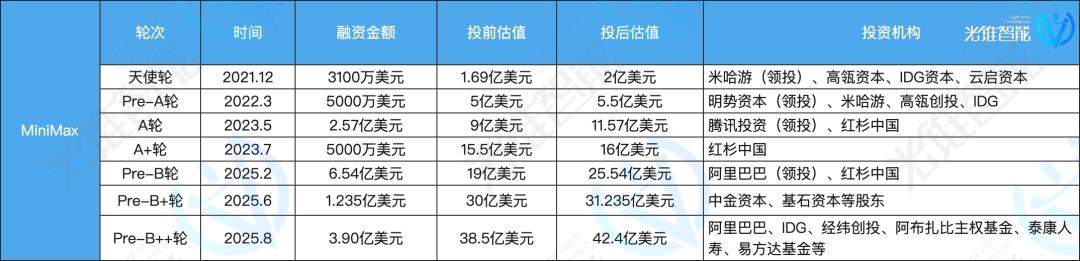
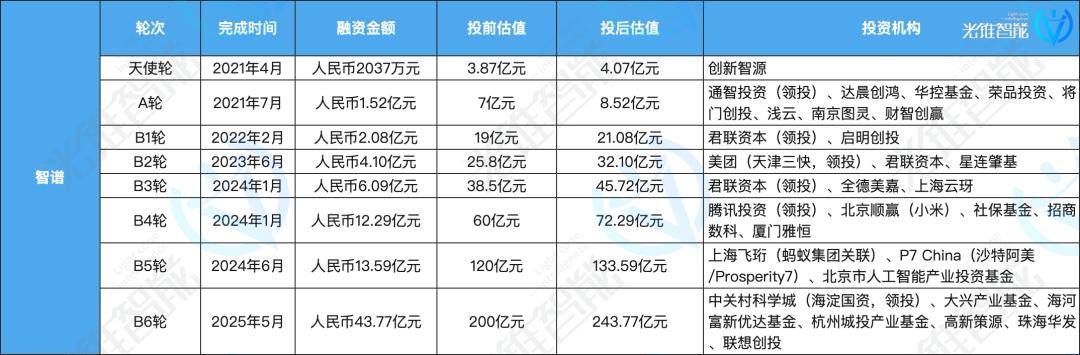
As early - established companies, MiniMax and Zhipu were both founded before the popularity of ChatGPT, and their listing dates were only one day apart. By comparing the multiple rounds of financing and post - investment valuations of these two companies before listing, we can see some similarities.
Before going public, both MiniMax and Zhipu were given a price - to - sales ratio (PS) of around 60 times, indicating that in terms of future market space calculations, capital providers had similar expectations for the two companies:
Calculated by the price - to - sales ratio (PS), Zhipu's annual revenue in 2024 was 312 million RMB, corresponding to a pre - investment valuation of 20 billion RMB in the Series B6 round in May 2025, with a PS of approximately 66 times. MiniMax's annual revenue in 2024 was approximately $30.52 million, and its pre - investment valuation in February 2025 was $1.9 billion, with a PS of approximately 63 times.
A valuation of around 60 times PS indicates that the market has extremely high expectations for AI companies.
Part of the investors' confidence is supported by the continuous increase in the revenue of leading companies in the industry, and the growth rate is accelerating.
Take OpenAI as an example. In 2024, the company's annual revenue reached $3.7 billion, more than doubling year - on - year. In 2025, OpenAI's revenue is expected to be $12.7 billion, a year - on - year increase of 243%. Anthropic's annual recurring revenue (ARR) also increased nine - fold from $1 billion in 2024, and it is expected to reach $9 billion in 2025.
During the same period, domestic AI startups also maintained a doubling - growth trend year after year. Take MiniMax as an example. According to its prospectus, its annual revenue in 2024 reached $30.5 million, a year - on - year increase of 782%. In the first three quarters of 2025, its revenue was $53.437 million, a year - on - year increase of 174.7%.
With the high growth potential of the industry, AI has proven to be a business with decent profit returns. To some extent, it can support high - valuation expectations, whether from the perspective of business implementation or revenue growth.
Take API revenue as an example. According to MiniMax's prospectus, in the first nine months of 2025, the gross profit margin of API revenue was as high as 69.4%. As the model inference cost decreases, there is still room for improvement in the business gross profit margin. The growth rate of the AI industry far exceeds that of the traditional software industry, leaving more room for imagination for investors. For example, Zhipu's revenue in 2025 was 724 million RMB, a year - on - year increase of 131.9%, and it has maintained a doubling - growth in revenue for three consecutive years.
From the perspective of the composition of investors, these two companies have received funds from different institutions according to their different business directions.
Zhipu has attracted mostly local funds and received investments from several state - owned investment capitals. In return, it has completed the task of implementing models in various regions. MiniMax, on the other hand, started its overseas market layout from the very beginning, and a large amount of funds from the Middle East, such as Abu Dhabi, flowed into its cornerstone capital. This international background adds a premium to its valuation.
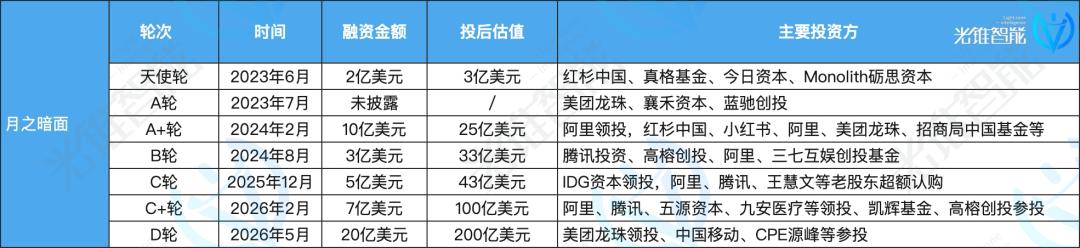
If the valuation models of Zhipu and MiniMax still follow the industrial logic, and the company's pricing can be broken down into business implementation. In contrast, the valuation method of Dark Side of the Moon, which started commercialization later, is quite different, and its PS (price - to - sales ratio) is much higher than that of its "predecessors".
Before 2026, the investors of Dark Side of the Moon were mainly traditional VCs and internet giants - Meituan, Tencent, and Alibaba took turns investing, and established capitals such as Sequoia China and IDG provided support.
However, with the "money - pouring" from internet companies and the popularity of the long - text AI assistant Kimi, Dark Side of the Moon was able to expand its valuation space. According to LatePost, Dark Side of the Moon, which was seeking investment from Xiaohongshu at a valuation of $900 million at the end of 2023, successfully raised its pre - investment valuation to $1.5 billion after Alibaba's investment of $800 million.
Subsequently, in February 2024, when Dark Side of the Moon further launched its long - text function and the popular product Kimi successfully broke through the circle through advertising and word - of - mouth, the valuation of Dark Side of the Moon skyrocketed, and its post - investment valuation increased to $2.5 billion.
Although Dark Side of the Moon was the last to start commercialization among these companies, its valuation is higher than that of its competitors in the same period. In January 2024, Zhipu's post - investment valuation was 7.2 billion RMB, only half of that of Dark Side of the Moon.
Although Dark Side of the Moon did not disclose its specific revenue in the early stage, based on the fact that its ARR revenue exceeded $100 million one month after the release of the K2.5 model in 2026 and its revenue exceeded that of the whole year of 2025 20 days after the release, we can roughly estimate that its revenue in 2025 was about $8.33 million (1/12). Even if calculated based on the post - investment valuation of $3.3 billion in the Series B round in August 2024, the PS of Dark Side of the Moon was close to 400 times - much higher than that of Zhipu and MiniMax at that time.
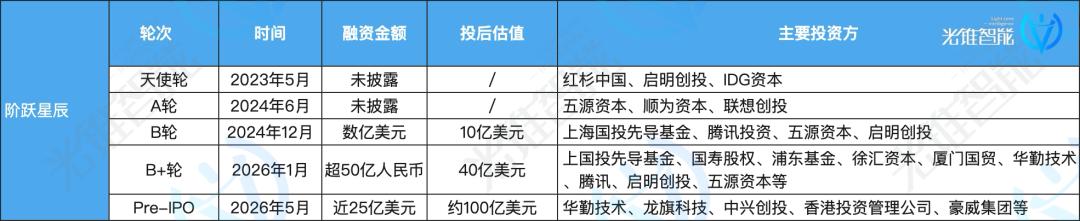
In contrast, Step Star, which "shifted" its company development strategy, saw its PS value first soar like a roller - coaster, approaching that of Dark Side of the Moon at around 200 times, and then returned to a PS range similar to that of Zhipu and MiniMax in the early stage after adopting the B - to - B strategy.
Initially, focusing on the "super model + super application", Step Star received hundreds of millions of dollars in financing from companies such as Shanghai State - owned Investment and Tencent Investment, and its valuation reached one billion dollars. Based on the media - reported annual revenue of 30 million RMB in 2024, Step Star's PS at that time was as high as 233 times, closer to that of Dark Side of the Moon.
However, since the beginning of 2025, when Step Star shifted to the B - to - B market and focused on the layout of Agent in intelligent terminals, the company's PS began to decline to a level closer to that of Zhipu and MiniMax. Calculated based on the post - investment valuation of $4 billion at the beginning of 2026 and the annual revenue of 500 million RMB in 2025, Step Star's PS dropped to around 56 times. This valuation multiple is in the same range as that of Zhipu and MiniMax before going public.
Looking back at the valuation situations of these four companies, it can be said that there was a certain consensus in the early market's investment logic for AI companies. Although there was a model of sky - rocketing valuations, according to the upper limit of the business valuation logic, it was probably around 60 times PS.
However, after 2026, the valuation model of AI model companies seems to have changed significantly.
DeepSeek + Clawdbot, the valuation leap of AI companies
From the similar valuation logic of AI companies in 2024 to the current "soaring" situation, the new changes in these two stages have rewritten the financing methods of AI companies.
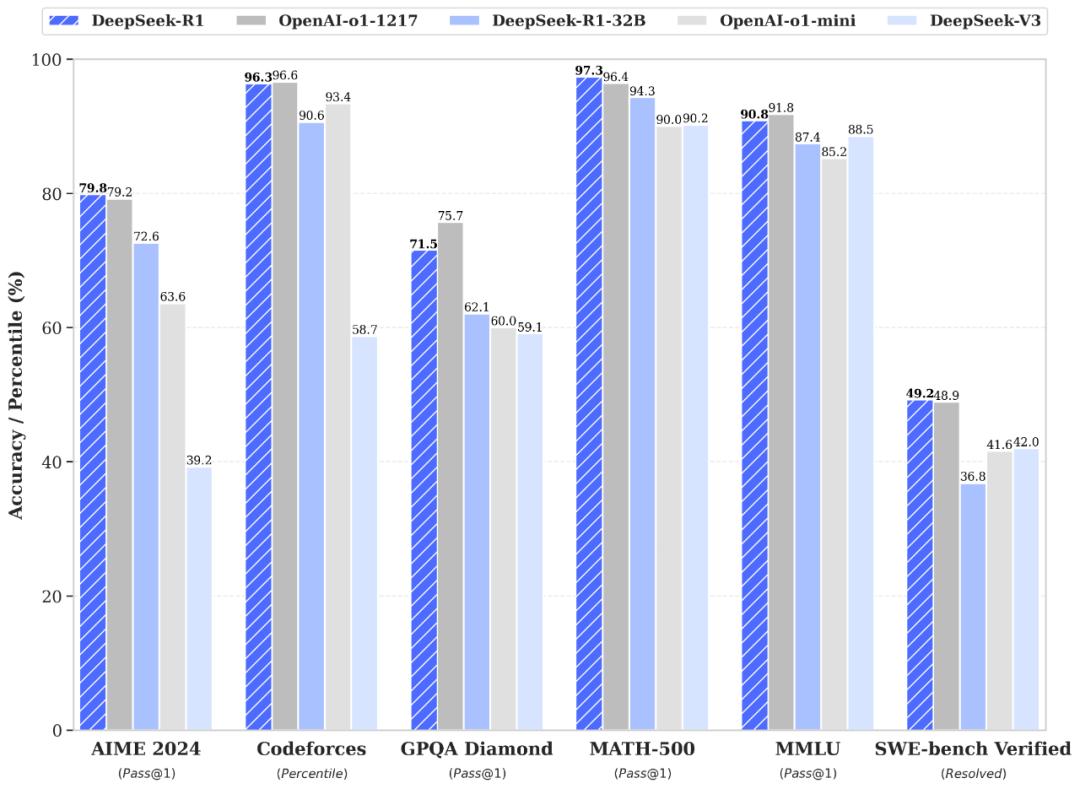
The first stage was DeepSeek in 2025, which stood out with its R1 model comparable to overseas ones. Its emergence was not simply a positive or a pressure but a combination of both.
On the one hand, it brought AI startups struggling in commercialization since the end of 2024 back to the thinking of technology - first, and DeepSeek proved the existence of technological dividends. Not only did DeepSeek's AI assistant product achieve popularity without advertising, but it also indirectly encouraged domestic users to try other AI products, completing the market education.
On this basis, some companies with faster commercialization, such as MiniMax and Zhipu, began to accelerate financing and aim for IPOs based on their initial revenue growth. The other two companies, which were slower in commercialization, focused more on model R & D this year, such as Dark Side of the Moon's K2.
On the other hand, DeepSeek, with its high cost - effectiveness, made the market see the possibility of accelerating the implementation of the AI application closed - loop. However, at that time, more money flowed into AI product companies led by Agent enterprises rather than large AI model companies.
When the capabilities of in - depth thinking models reach maturity, models require more engineering - based product intervention to ensure that the models can stably execute multiple - round tasks, changing from just providing answers to truly helping people do things. Thus, the trend of Agent has blown into all industries.
"The emergence of DeepSeek has indeed made the financing environment for large models more bottlenecked," Hu Shuo, a partner at Gaorong Capital, once said in public.
This year, Dark Side of the Moon and Step Star experienced a financing "blank period" of more than one year. Dark Side of the Moon announced the completion of a new round of financing in December 2025, 16 months after the previous round. Step Star also had a 12 - month blank period in financing, which was in contrast to the previous situation where the financing frequency could be maintained at 3 - 6 months.
Fortunately, the second key node arrived one year later. In 2026, the popularity of Clawdbot completely detonated the logic of Token consumption.
From the release of "Clawdbot" on January 19th to its popularity at the end of the month, and then from the Spring Festival to the present, various domestic platforms have launched Clawdbot.
Compared with traditional conversations, where users ask a question and the