Reconstructing Growth with AI: The Practice of New Oriental Education Group | 2026 AI Partner · Beijing Yizhuang AI + Industry Conference
Ma Yawei, the founder of ShinTong Education, candidly shared the transformation journey of the past five years - from digital infrastructure construction to the requirement of AI adoption by all employees (AI Must), from integrating AI into all aspects (AI in All) to launching new AI-native businesses. Her practice has proven that for traditional enterprises embracing AI, the most difficult part is not the technology, but translating the strategy from the boardroom to the front line.
Ma Yawei divided the AI transformation into four progressive stages:
First stage (2021 - 2022): Digital Infrastructure Construction. Complete the consolidation of underlying data and system architecture to lay a solid foundation for AI applications.
Second stage (2023 - 2024): AI Must - Strategy Implementation. Popularize the awareness through company-wide public lectures, incubate benchmark groups to set examples, and validate products at Harvard and Stanford to transform AI from a "command" into a "consensus".
Third stage (2025): AI in All - Deep Integration. Integrate AI into all key business processes, build an "AI ecosystem" and a digital employee system covering the entire value chain, and achieve a double leap in efficiency and user experience.
Fourth stage (2026): AI Native - Native Innovation. Open up new business tracks with an AI-native mindset and complete a qualitative change from "tool empowerment" to "genetic reshaping".
Core insight: True AI transformation is not about piling up technologies, but about building organizational consensus and penetrating strategic will.
The following is the content of the speech, edited by 36Kr:
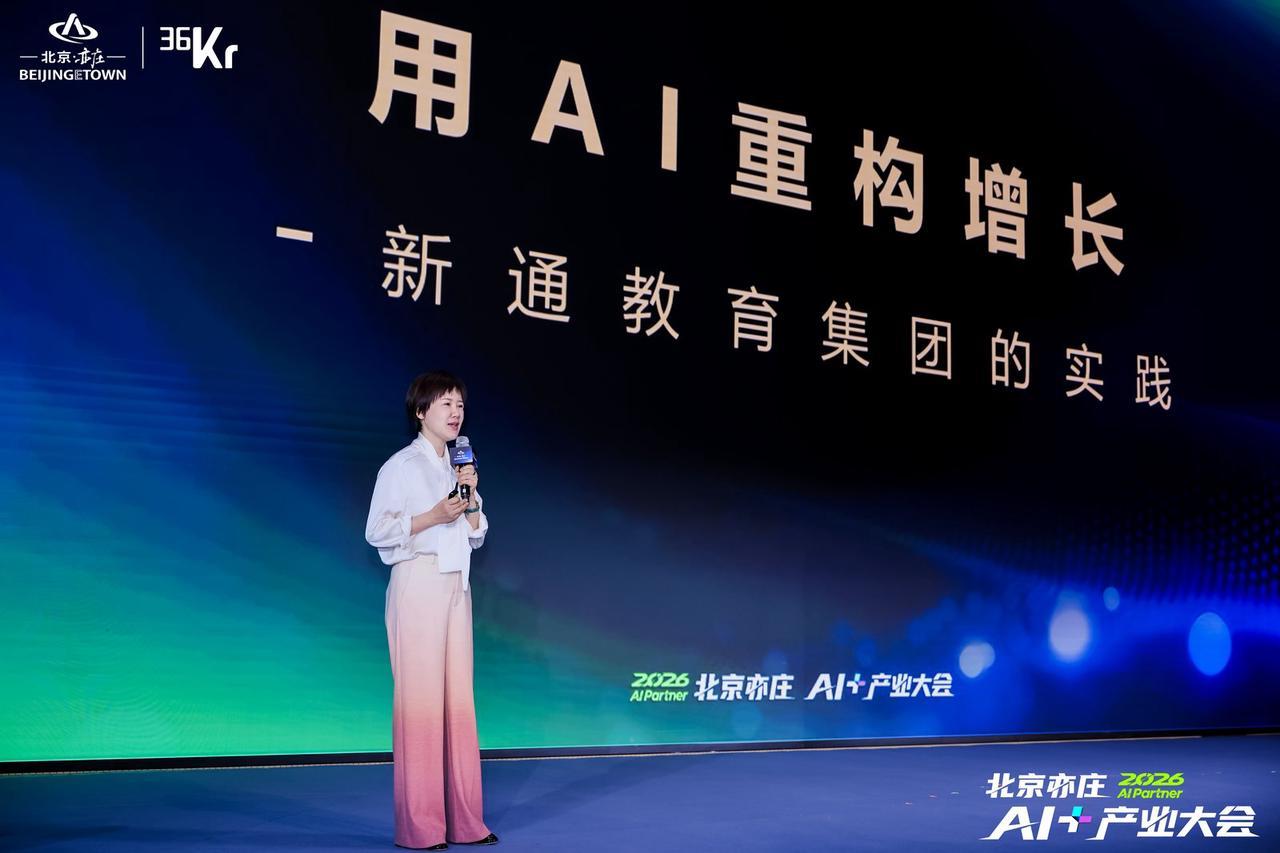
Ma Yawei | Founder & Chairman of ShinTong Education Group
Good afternoon, everyone. I'm very glad to be invited by 36Kr to share with you how our education group is using AI to restructure growth in the traditional education field.
This is my first time at a 36Kr event. It's quite different from previous sharing scenarios. Today, I see a lot of entrepreneurs. There are two obvious differences among entrepreneurs. First, you may wind up your business model and your company, turn it into money, and then use the funds and resources to face the AGI challenge and start a new business or explore a new track. Second, as founders of enterprises, while facing the AGI challenge and seeking new growth, we still have a relatively heavy burden - over the past decade, two decades, or even longer, we have accumulated traditional resources, products, teams, and organizations during China's economic growth. This is a problem that most entrepreneurs or continuously successful entrepreneurs will definitely encounter. It's unlikely that you'll start one thing only after finishing another.
The theme today is "Using AI to Restructure Growth". I hope to share two aspects with you. First, if you, like me, are seeking more efficient growth in your ongoing traditional business, what can we do? Second, if we don't want to give up exploring new growth opportunities in an AI-native way, what exploration methods might we use? These are the two things I want to share.
36Kr has gathered a large number of high-tech and technology companies. ShinTong Education may not be a well-known name to many. This year marks the 30th anniversary of ShinTong Education. In the past 30 years, we've mainly focused on the international growth path of China's high - and middle - net - worth individuals, offering services such as college admission planning, career planning, and the introduction of overseas international courses. Since 2021, as the new technological wave approached, we were among the early adopters of organizational digital transformation in the industry. That's why we have the opportunity to share our exploration results with you at this 36Kr event.
Looking at ShinTong Education Group from another perspective, we are a relatively large organization with more than 30 subsidiaries across China and the world and over 2,000 employees. For an organization pursuing growth in the face of the AGI wave, the first prerequisite is not just talking about growth or exploring products, but rather a change in organizational culture. That's where my sharing today begins. Before that, let me talk about the results of our exploration in the past few years. First, we achieved growth in revenue and labor efficiency without increasing or even reducing the number of employees. Second, in 2025, we truly explored a second growth curve, formed a certain revenue scale, and gained market validation. Third, in 2025, we won the Annual Outstanding Enterprise Digital Transformation Award from Harvard Business Review, standing alongside more technology - driven companies like SenseTime and Cainiao, rather than traditional - track enterprises.
In May this year, we participated in the 2026 World Digital Education Conference organized by the Ministry of Education. Three of our products - "Learn IELTS Effortlessly", "HSK Chinese Goes Global", and "Study in China" - were selected for the results exhibition at the 2026 World Digital Education Conference. These are the results we've achieved in the past few years. If we look back and summarize these results, the transformation of a relatively large organization is a growth process. Looking back at the digital transformation of ShinTong Education Group and the phased results of the AI + education part since last year, we've gone through several stages: One, from 2021 to 2022, we spent two years completing digital infrastructure construction. Two, from 2023 to 2024, we implemented the AI Must strategy across the organization, making AI a necessity. Three, in 2025, we integrated AI into all key organizational processes. When we launched new businesses this year, instead of integrating AI into existing processes, we built new processes in an AI - native way. After going through these four stages, the 2026 journey is not even halfway through, and we still need more time to verify the results we've achieved from organizational strategy to final revenue growth.
For most traditional enterprises that are not in the technology industry, how is digital infrastructure built? Briefly, we transformed the fragmented and uneven "provincial roads" of digital systems into high - speed roads for AGI. This was the initial work. After the initial work, the more important work was completed from 2023 to 2024. There are many founders here today. For founders, it's not that difficult to make a decision and find a direction for future trend exploration. The challenge lies in how to translate your decisions and strategies from the boardroom to the front line. This is a common challenge for everyone.
In this regard, ShinTong Education Group took several measures. If you're also in the process of a traditional - track enterprise embracing AGI, you may find these measures useful for reference. First, we introduced external experts to diagnose, evaluate, and initiate the transformation of the entire organization. Second, we encouraged all employees to share their experiences. Any employee who had used AI in traditional business could share their stories with other members of the organization. Third, we incubated benchmark groups in the organization to pilot fully AI - managed products. Fourth, we took our products to Harvard and Stanford, the forefront of education and technology, to test if our products were in the right direction and had sufficient competitiveness. These were a lot of seemingly basic tasks from 2023 to 2024, which gradually spread the AI Must public lectures among thousands of employees in the group, showing that the AI strategy was not just a top - down command but also the real experiences of colleagues around. In 2023, when our "Learn IELTS Effortlessly", a fully AI - managed language learning product, was still in its infancy, we took the product prototype to Harvard and Stanford. The biggest feeling we got was not fear or threat, but greater confidence: With decades of language learning data accumulation, ShinTong Education Group has unique advantages in the development and application of these vertical products.
In 2025, we shifted the strategic organizational transformation to AI in All, where AI must be integrated into the key processes of the organization. The "AI ecosystem" in the picture is very familiar to all colleagues in ShinTong Education Group. They have their own AI partners, various digital employees, as well as intelligent tools and platforms. When many of our colleagues encounter a problem to solve, their instinct is not to think about how to do it themselves, but how to let AI do it. This is a very important transformation.
We built a full - chain service system centered on intelligence. Looking back at the process from AI infrastructure to AI Must and AI in All, there are three very important challenges for traditional organizations, especially large - scale ones, in the process of implementing the AI strategy.
First, how to solve the problem of front - line and ordinary employees being indifferent, and how to make the strategy reach the front - line employees and be accepted and implemented. In my personal experience, commands, lectures, or simple incentive tools cannot solve the problem of indifference. To make employees feel involved, more careful design is needed. When we held public lectures, the external experts usually only gave opening reports, and most of the sharing came from front - line employees. This allowed employees to see the threshold. With the support of AI, there was both knowledge equality and technology equality, which smoothly solved the problem of transferring the strategy from the boardroom to the front - line employees.
Second, incubate our own "seed players" in the organization to make them feel involved. When we use AI to transform core scenarios, where should we start? The selection criteria are as follows: First, choose the scenarios with the largest number of employees involved. Second, choose the scenarios that take the most time. Third, choose scenarios that are not directly facing users but are used as internal efficiency - improvement tools. When the scenarios are properly selected, every employee can see the benefits brought by AI, which is a very important driving force for the entire organization to carry out AI transformation.
We spent a lot of time and effort building a holographic user portrait. In consulting and teaching services, it's very troublesome to superimpose and statistics the various personalized needs of users. It's like a doctor who only has three minutes to see a patient but needs half an hour to write a complete medical record. We used the AI holographic model and AI tagging to greatly save employees' time in this regard. We have many AI assistants. During the interaction between employees and AI, whether through phone calls, WeChat, or other means, most of the customers' needs and characteristics are captured and turned into a more concrete, vivid, and complete portrait for employees to continue providing services to customers.
ShinTong has sent more than 500,000 students abroad for study over the decades. We've created hundreds of thousands of global intelligent cases, which record all the students' trajectories - admission, non - admission, and employment. These cases will become a great technological support for future students in their major planning, just like a doctor having an infinitely large case center.
We have digital employees that can help front - line employees with basic and repetitive work. As an education company, our token usage increased from 300 million in 2024 to 12 billion last year, and this year the number is even more astonishing. This also shows, from a side perspective, the penetration rate of our team in the AI transformation process.
Regarding the third growth curve, we opened up new businesses in an AI - native way. First, we launched "Learn IELTS Effortlessly", a fully AI - managed product that can be found on the mini - program. It was officially launched in July 2024, and so far, there are 300,000 learners using it across the network.
In addition, by the end of 2025, we had 300,000 users, and the single - product track achieved 20 million in revenue, indicating the basic feasibility and commercial viability of the product. At the beginning of this year, we launched "Chinese Goes Global", also a fully AI - managed product.
To summarize our experiences in the AI transformation process of traditional enterprises: In terms of talent, on one hand, we seek external talent, but more importantly, we develop internal talent. We use the law of attraction rather than commands within the organization. In the process of AI innovation, we also need to have appropriate alignment and allow for appropriate waste. We set up an incubation fund within the organization to help the most outstanding colleagues in the organization use AI + industry - industry is still a very important keyword - to conduct more new explorations.
As an education enterprise, what we're concerned about is that in the future, our education service enterprise can also help the world cultivate more outstanding people. Our goal is to help various industries in the future cultivate talents who can use AI naturally, collaborate with AI in learning, and continue to grow in the process of creation. This is what we want to do.
That's a brief sharing of ShinTong Education Group's practice and exploration in embracing AI for organizational transformation in the past five years. Like all entrepreneurs, when we face more and more problems and challenges, we hope to keep pace with the times and progress together with AI.
Thank you!