Ningde is "forced" by OEMs to invest in DeepSeek.
The rumored backer of DeepSeek now includes CATL.
On May 23rd, according to The Information, people familiar with the matter revealed that CATL plans to participate in DeepSeek's first - round financing. Additionally, JD.com and NetEase are also in negotiations to invest in DeepSeek.
Regarding the valuation and financing scale, it was previously reported that DeepSeek would raise 50 billion RMB, and after the financing is completed, its valuation will exceed 350 billion RMB.
Previously, CATL rarely invested in such cross - border projects. If the investment in DeepSeek becomes a reality, it will also be its first direct participation in the equity financing of a general - purpose large - scale model enterprise.
If the news is true, why does CATL want to join the competition for DeepSeek? As the "double champion" in the global power battery and energy - storage battery fields, what hidden motives does CATL have?
01
Investing in Zhongheng and buying shares in 21Vianet, what kind of game is CATL playing?
Actually, CATL's desire to get involved with AI is not a recent thing.
In April, Zhongheng Electric announced that CATL invested 4.1 billion RMB in its shareholder to acquire a 49% stake and will be deeply involved in the company's governance.
Who is Zhongheng Electric?
Simply put, the electricity in AIDC cannot be supplied by just plugging in a power strip. When thousands of graphics cards run simultaneously, the power fluctuates rapidly. An ordinary power supply system cannot handle it. Zhongheng Electric is the leading enterprise in solving this problem.
Zhongheng Electric holds two "keys": HVDC (High - Voltage Direct Current Power Supply) and Panama Power Supply.
The core function of HVDC is to convert the unstable alternating current from the power grid into a safer and more efficient direct current that servers can directly use, ensuring a stable power supply when thousands of graphics cards are in operation. The Panama Power Supply is an integrated version of HVDC, which integrates transformers, rectifier modules, and power distribution units into a standard cabinet. High - voltage electricity of tens of thousands of volts enters at the input end, and usable direct current comes out at the output end. It's a one - stop solution.
In 2025, its market share in the domestic HVDC market for intelligent computing centers was 31%, ranking first. In Alibaba Cloud's HVDC system, its share is about 50%, and in the Panama Power Supply market, it accounts for over 90%.
That is to say, if large - scale data centers want to expand, they can't avoid Zhongheng Electric.
In mid - May, CATL made another move. This time, it spent 6.4 billion RMB to acquire a 38.1% stake in 21Vianet, becoming the largest shareholder directly.
What role does 21Vianet play in this?
You know, for large - scale model training and inference, besides having graphics cards, there also needs to be a place to put them. But building an AI computer room is not just about stacking and connecting servers in a warehouse.
In an intelligent computing center, the power density per cabinet is 5 to 10 times that of a traditional computer room. A single cabinet starts at 30 to 50 kilowatts, and some can reach over 100 kilowatts. This is equivalent to concentrating the electricity consumption of a household into one cabinet, and thousands of such cabinets run simultaneously.
With such high power consumption, the electricity supply is crucial. The power load of a large - scale intelligent computing center is equivalent to that of a small county. Any problem in the power grid connection, backup power supply, or peak - valley regulation can cause tens of thousands of graphics cards to stop working.
What 21Vianet does is the construction and operation of such high - density computer rooms. As of the end of 2025, it had more than 50 data centers with an operating capacity of 889 megawatts.
However, just the "computer room construction" might not be the main reason for CATL to take an interest in 21Vianet. Perhaps, a bigger business is driving this deal.
Shortly before CATL's investment, 21Vianet just signed a large order: to provide about 500 megawatts of computing power capacity to ByteDance. This single order directly increased its operating scale by more than half. But this 500 megawatts is just the tip of the iceberg. In the next few years, the total power load of the intelligent computing centers that ByteDance plans to build is equivalent to that of several counties. The two biggest pain points for AIDC implementation are exactly electricity and space.
CATL can solve the electricity problem. Energy storage, peak - valley regulation, and backup power are all CATL's specialties. For the space, someone needs to build the computer room, deploy liquid cooling, and handle the power grid connection, which is what 21Vianet does.
So, most likely, the three parties will reach an agreement: ByteDance places the order, 21Vianet builds the computer room, and CATL provides energy storage. Once the computer room is built, ByteDance can put in the graphics cards purchased from Cambricon and Huawei, and CATL can install its batteries. Each party makes its own profit.
CATL's acquisition of the largest shareholder position in 21Vianet with 6.4 billion RMB is not a whim. After reaching an agreement with ByteDance, it steps in to lock in the partner responsible for the site. In this way, every time ByteDance builds an intelligent computing center, CATL's relevant energy - storage and power systems will be involved.
This is not just an investment; it's about buying a direct line to ByteDance's Doubao.
Looking at it comprehensively, by investing in Zhongheng Electric, CATL gets the "plug" for the AIDC power supply system; by investing in 21Vianet, it locks in the "space" for the AIDC computer room; and by investing in DeepSeek, it directly ties up the biggest power - consuming customer.
CATL is playing a big game. It wants to become the power supplier for large - scale AIDC, covering everything from power supply equipment to energy - storage systems to computer room space.
However, no matter how large the AIDC market is, it is just an incremental story for CATL. The reason why CATL is so "eager" to develop new businesses is that automobile manufacturers are gradually reducing their dependence on CATL. AI is a battle that CATL must win.
02
Automobile manufacturers are no longer hiding their intentions and want to break away from CATL
Automobile manufacturers no longer want to be tied to CATL.
From the real start of the automobile industry in 2020 to the fierce competition in 2026, automobile manufacturers have been working harder and harder. Although the industry's total revenue increased from 8.23 trillion RMB in 2018 to 11.18 trillion RMB in 2025, the profit margin dropped from 7.3% to 4.1%.
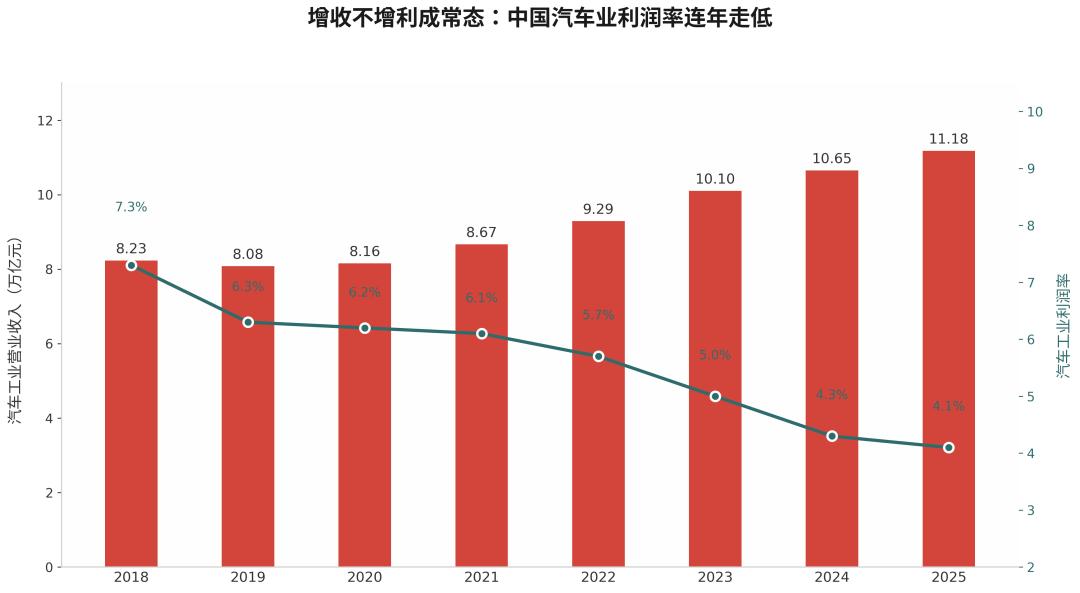
With a market size of over 11 trillion RMB, the actual profit is only over 400 billion RMB. The cost is rising faster than the revenue. The more cars are sold, the harder it is to make a profit.
CATL's 2025 financial report shows that its net profit was 72.2 billion RMB, a year - on - year increase of 42%, and the net profit margin was 18.12%. The combined profits of several leading automobile companies such as BYD, Geely, Great Wall, SAIC, and Changan are about the same as that of CATL alone.
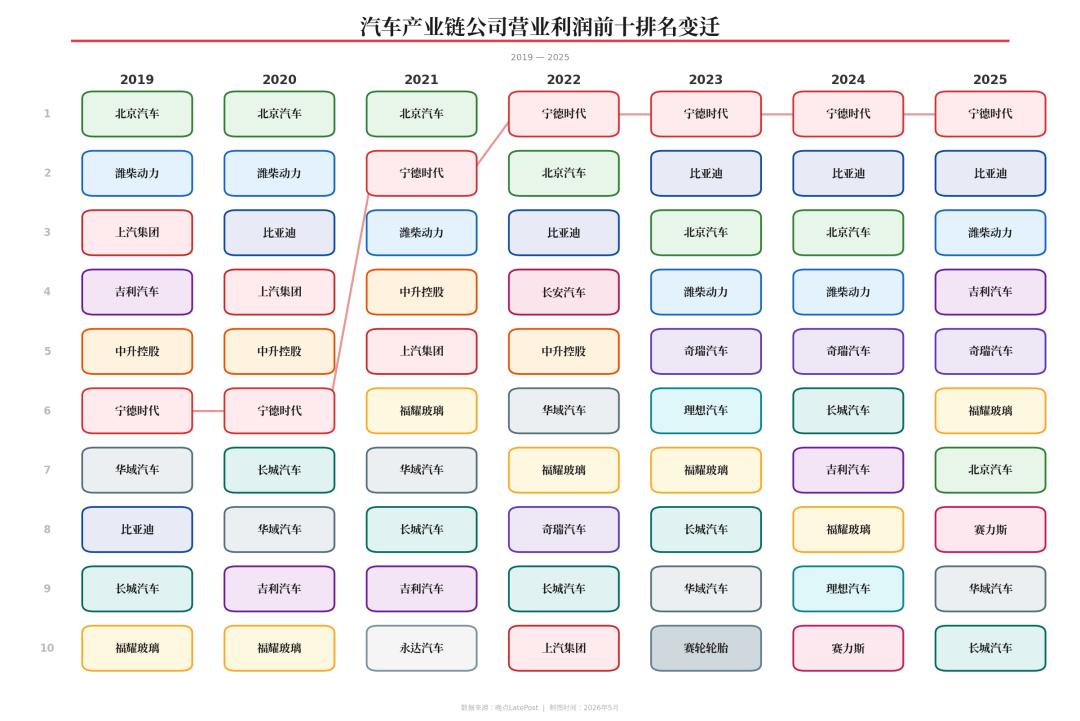
So, there is a saying in the industry that automobile manufacturers are fighting in the front, while CATL is counting money in the back.
This is not because CATL deliberately raises prices. As the absolute leader in technology and scale among battery manufacturers, its business model determines all this. Batteries account for 30% - 40% of the total cost of a vehicle, and the pricing power is not in the hands of automobile manufacturers. So, when selling an electric vehicle worth about 100,000 RMB, the automobile manufacturer may earn less than 10,000 RMB, while CATL makes a lot of money from each battery.
The problem was that there was no other choice before. CATL dominated the market, with its share reaching over half at its peak. Without buying CATL's batteries, the production capacity couldn't be increased. However, the rapid development of the industry in recent years has given automobile manufacturers more options.
BYD has long started producing its own batteries. Fudi Battery now ranks second in the domestic installed capacity. Besides using them for its own vehicles, it also sells them to others. Geely has integrated Yaoning and Weirui and started purchasing battery cells from external battery manufacturers for self - packaging. Great Wall has always had Honeycomb Energy. Although its listing has not been smooth, its production line is real and the output is increasing. GAC Aion cooled its relationship with CATL early on and supported CALB instead.
Among new - energy vehicle startups, NIO, Li Auto, and XPeng also no longer put all their eggs in one basket. NIO has invested in Weilan New Energy to develop semi - solid - state batteries. Li Auto has cooperated with Sunwoda and Honeycomb Energy. Even XPeng, which has the largest sales volume, has adopted a multi - supplier strategy. It doesn't mean they don't buy from CATL at all, but the proportion is decreasing, clearly indicating that they don't want to be solely dependent on one supplier.
The reason for automobile manufacturers is quite simple: they can't afford the cost. CATL's gross profit margin has long been over 20%, much higher than that of most automobile manufacturers. Automobile manufacturers work hard to produce a whole vehicle but earn less than BYD does from a single battery.
In addition, the scene of being restricted by the battery shortage in the previous two years is still fresh in their minds. Automobile manufacturers are really scared. At that time, whoever had batteries could produce vehicles, and those without batteries had to stop production lines. For example, the XPeng P5 460 model was delayed in delivery due to the insufficient supply of lithium - iron - phosphate batteries.
Most importantly, the battery technology gap is gradually narrowing. Although CATL used to have a technological lead, now second - tier manufacturers such as CALB, Sunwoda, and Honeycomb Energy have caught up. The performance difference is not significant, and the prices are much lower. Automobile manufacturers have every reason to consider other options.
It is also obvious that CATL's market share in the power - battery market has dropped from about 55% at its peak to just over 40% in 2025, and the decline rate is accelerating.
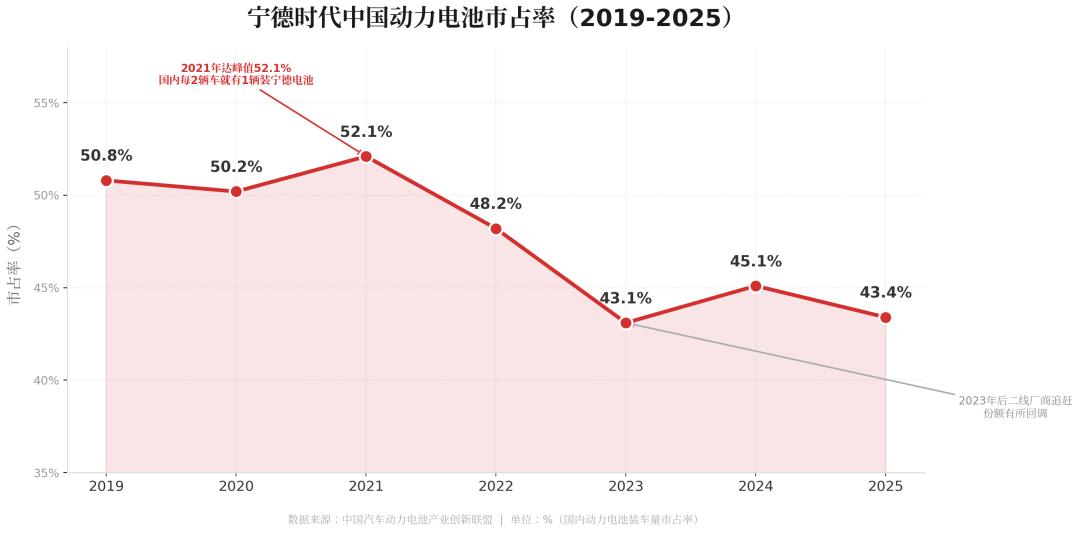
From a market perspective, this is a very reasonable behavior. Diversifying the supply chain, reducing costs, and reducing dependence on a single giant are what any normal manufacturing company would do. But for CATL, this has become a big problem.
This forces CATL to do two things.
The simplest one is to retain its existing large customers. Whether it's renewing a long - term contract with Tesla, signing a new order with BMW, or going overseas to lock in more automobile manufacturers in other markets. However, these large customers are also learning from domestic automobile manufacturers. While buying CATL's batteries, they are also supporting second and third suppliers. CATL's share in these orders is also decreasing year by year.
In addition to "maintaining the status quo", CATL also needs to find a new, large - scale, and rapidly growing new track to support its growth.
So, looking back at CATL's investments in Zhongheng Electric, 21Vianet, and now its plan to invest in DeepSeek, the logic becomes clear.
Since automobile manufacturers don't want CATL to make money from the vehicle batteries, CATL stops competing with them and turns to make money from AI. The power demand of intelligent computing centers is rigid, 24 - hour continuous, and has extremely low price sensitivity. ByteDance needs to run Doubao, Baidu needs to run Wenxin, Tencent needs to run Hunyuan, and DeepSeek also needs to continue training its next - generation models. All this computing power requires electricity.
And electricity is exactly what CATL is good at. Energy storage, peak - valley regulation, backup power, and high - voltage direct - current power supply all match CATL's technological reserves. By investing in Zhongheng Electric, it gets the "plug" for the power supply system; by investing in 21Vianet, it locks in the "socket" for the computer room space; by investing in DeepSeek, it directly grabs a big customer that is consuming electricity like crazy.
CATL's investment in DeepSeek is less of an active move and more of a result of being forced by automobile manufacturers to enter the AI arena.
This article is from the WeChat official account "Super Focus foci", author: Sean. It is published by 36Kr with permission.