Another popular fruit has fallen from grace, but consumers are no longer able to feel sorry for fruit farmers.
In an industrial community where all share in honor and disgrace, a single bad apple can really spoil the whole barrel. Preventing incidents like "medicated bayberries" from happening again is the responsibility of the entire industry; moreover, eradicating illegal operations is the foundation for the healthy development of the industry.
"In May, bayberries fill the forest; at first, one might think a single fruit is worth a thousand gold pieces." In previous years, bayberries would claim the top spot among fruits as early as May, but now their reputation has taken a hit.
More than a week ago, according to a report by the "First Help Group" program on Fujian TV, in the main bayberry - producing areas such as Baishui Town and Fugong Town in Longhai District, Zhangzhou City, there were illegal irregularities at many purchasing points. Workers at the purchasing points illegally used the prohibited preservative sodium dehydroacetate to soak fresh fruits and also added unlabeled sweeteners with no production date or ingredient information. The outer packaging of the sweetener clearly stated that "the sweetness can reach 8000 times that of sucrose." Some purchasing points bought, soaked, and sold thousands of catties of bayberries daily, and the workers revealed that "they wouldn't dare to take a single bite."
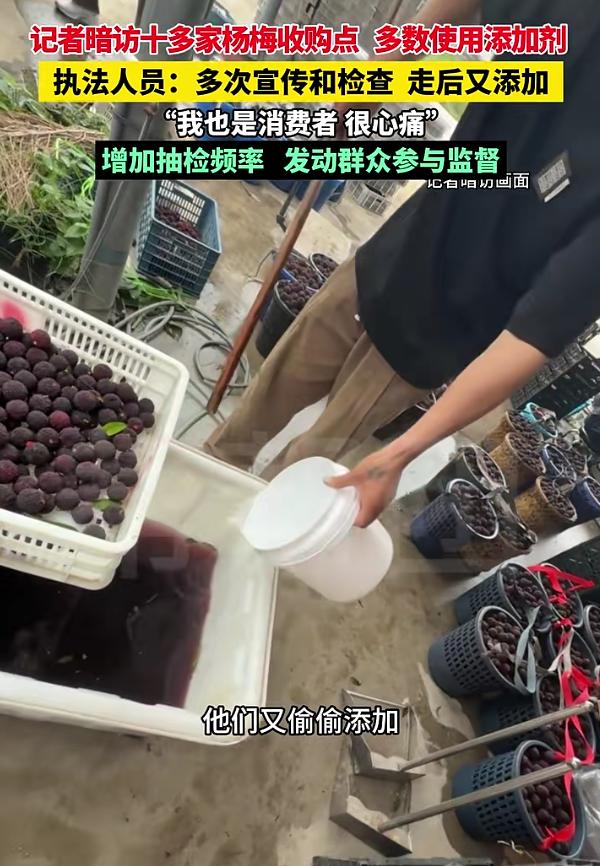
The "National Food Safety Standard - Standard for the Use of Food Additives" (GB 2760 - 2024) clearly states that the addition of sodium dehydroacetate to fresh fruits is prohibited. Long - term consumption of sodium dehydroacetate can cause harm to the human body, potentially damaging liver and kidney functions, and short - term consumption may irritate the stomach. (Photo/@First Help Group WeChat video account)
After the incident was exposed, it instantly sparked outrage across the internet, and people's trust in this popular fruit also crumbled.
Zeng Xinggui, the president of the Bayberry Association in Longhai District, Zhangzhou City, said in an interview with the media that the local bayberry orders had decreased sharply, and some channels had directly removed Fujian bayberries from their shelves. Some provinces even imposed a blanket ban on Fujian bayberries, and the goods that had already arrived were returned, resulting in a serious overstock of bayberries.
On May 20th, the Office of the Food Safety Committee of Zhangzhou City issued a situation report, stating that 540 kilograms of problematic bayberries had been retrieved, 20.1 kilograms of illegal additives had been seized, 12 administrative cases had been filed, 2 criminal cases had been filed, and 5 people had been detained. The seized problematic bayberries and illegal additives had all been destroyed.
The problematic bayberries can be destroyed, but the public's trust that has been shattered is difficult to rebuild quickly. The market's reaction is particularly direct. Currently, almost all the bayberries sold on the market are from Yunnan and Zhejiang, and Fujian bayberries are nowhere to be seen.

(Photo / Screenshot of the live - streaming screen on an e - commerce platform)
Zeng Xinggui said that this was the biggest crisis the local bayberry industry had ever faced. He insisted that "medicating" was not a common phenomenon in the industry and hoped that people would not dismiss the efforts of all fruit farmers. Many fruit farmers also expressed similar views on the internet: most fruit farmers were unaware of the individual cases of medicating, and one should not completely "boycott" an entire fruit category because of this.
However, this kind of complaining explanation quickly sparked more extensive controversy. The most - liked reply in the relevant video was:
"Isn't the most innocent party the consumers who spend a high price to buy 'toxic' fruits?"
01
Why are bayberries "medicated"?
Now, when searching for "bayberries" on online shopping platforms, most products are marked with the label "not medicated" in line with current events.
Actually, "medicated bayberries" are not a new invention. As early as 10 years ago, the market supervision bureau in a certain place in Zhejiang followed the clues of a video exposing "bayberries being soaked in an unknown liquid." After investigation, they found the soaking tools and suspected additives. The involved purchasing merchant admitted that this method was learned from other places. Sodium dehydroacetate is used for preservation, and cyclamate is used to increase sweetness. After adding these, not only can the freshness be maintained, but the taste can also be improved.
In 2024, during a food safety supervision and sampling inspection in Rongchang District, Chongqing City, the bayberries sold by a merchant were found to have problems. After sampling and testing, the content of dehydroacetic acid and its sodium salt (i.e., sodium dehydroacetate) in the bayberries did not meet the national standard and was judged to be unqualified.
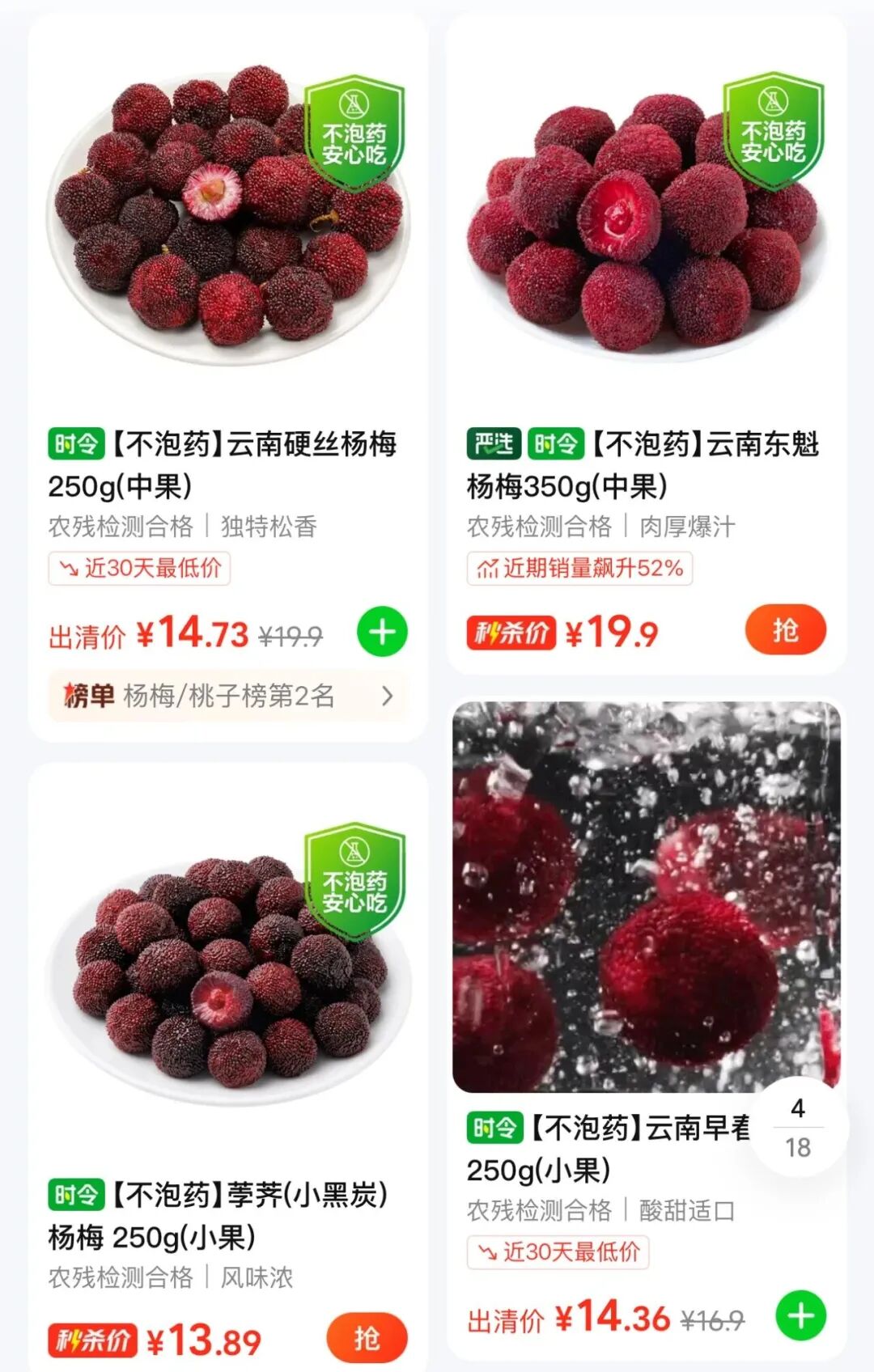
(Photo / Screenshot of an e - commerce platform APP)
Even the Zhangzhou bayberries that are now at the center of the storm have had problems before.
In June 2011, the Office of the Food Safety Committee in Cixi City, Zhejiang Province, issued a "Food Safety Warning No. 1," reminding consumers to be cautious when eating bayberries from Longhai, Zhangzhou, Fujian. After the Cixi Industrial and Commercial Branch, the Agriculture Bureau, and the Food and Drug Administration jointly sampled the Fujian Longhai bayberries on the Cixi market, they found 8 types of pesticide residues in 7 batches of bayberries. At that time, the Zhangzhou Agriculture Bureau, together with the Longhai Agriculture, Industry and Commerce, Quality Supervision, Food and Drug Administration, and Public Security departments, randomly sampled and inspected the Longhai bayberry market and responded that the Longhai bayberries were safe.
These incidents all show that the problem of illegal additives in bayberries has been a long - standing hidden disease in the industry. The process of each incident is also roughly the same: exposure, rectification, and then subsidence, until the next "collapse."
As for why some people take risks and violate the rules repeatedly, the reason is clear:
Bayberries are extremely delicate fruits. Bai Juyi wrote in "Preface to the Picture of Litchis" that "in one day, the color changes; in two days, the fragrance changes; in three days, the taste changes; after four or five days, all the color, fragrance, and taste are gone." This description is even more applicable to bayberries. A literati in the Ming Dynasty sighed that bayberries "rot as soon as they leave the orchard." Fruit farmers hundreds of years ago were already racing against time. When today's bayberry consumer market has expanded from local areas to the whole country, the cost of cold - chain logistics and the threshold of preservation technology are quite high for small and medium - sized purchasing merchants.

(Photo / "The Lychees of Chang'an")
Soaking bayberries in "cheap" and "efficient" potions has thus become the "optimal solution." This method not only solves the problem of preservation but also ensures the appearance and taste of bayberries: they do not change color or rot during long - distance transportation and are overly sweet, achieving a win - win situation in terms of appearance and taste.
Tong Wei, a senior agronomist at the Fruit Research Institute of the Chinese Academy of Agricultural Sciences, pointed out in an interview with "China Voice" that merchants are keen on using sodium dehydroacetate precisely because it is "odorless and not easily detectable."
In fact, even such delicate bayberries can be preserved without using such chemical means, but by relying on advanced physical preservation technologies. Tong Wei said that currently, the preservation of bayberries mainly relies on technologies such as facility cultivation, pre - cooling at the origin, low - temperature preservation, and cold - chain transportation, which can stably extend the shelf life of the products to 3 to 7 days.
Zhejiang is one of the main bayberry - producing areas, and bayberries in many places are generally transported by cold - chain. According to public reports, Xianju has specially issued two local technical regulations, refining the standards for the entire process of bayberry cultivation, picking, storage, and transportation to every step, providing a clear guide for practitioners; Lanxi has cultivated a professional technical team to guide farmers to adopt standardized cultivation and transportation from the source, getting rid of the dependence on illegal additives.
The bayberry industry associations in various places not only take the lead in formulating strict industry conventions and popularizing technical specifications but also establish a credit grading mechanism, linking trustworthy merchants with market access and brand selection.
This path is obviously much slower and more difficult than "soaking in potions," but it is a sustainable path, rather than a one - time overdraft of consumers' trust. When a region forms an industrial cluster centered around a certain product, consumers will remember regional labels like "Zhangzhou Bayberries" and "Wuchang Rice." The industrial agglomeration forms a community where all share in honor and disgrace.

Many tea - drink brands' new bayberry - related products have been affected. Some have changed the origin of their materials, while others have postponed the launch. (Photo/XiCha)
Therefore, once the black sheep are exposed, trying to distance oneself from them often won't help. The only way to repair the trust crisis is for the entire industrial chain to work together to drive out the profit - seeking bad elements, rebuild industrial trust from top to bottom, restore brand reputation, establish a truly binding self - discipline mechanism, transparent and traceable production specifications, and market exit rules that make violators pay a heavy price.
The reconstruction work after an industry scandal should never be about asking consumers to "forgive" merchants and producers, but about how to make consumers feel confident in giving their trust.
Zheng Fengtian, a professor at the School of Agricultural and Rural Development of Renmin University of China, once pointed out in an interview: "The industry has the ability to distinguish. Industry associations, in particular, need to play the role of purging the bad elements. If everyone clearly knows what illegal and irregular behaviors are happening but treats them as unspoken rules and fails to clean them up, once the scandal is exposed, the market and society will step in and clean up the entire industry."

(Photo / "My Own Swordsman")
03
The sweeter the fruit, the less flavor it has
In the bayberry scandal, the most shocking thing is the sweetener that is "8000 times sweeter than sucrose." Somehow, it seems that "sweetness" has become the only standard for fruits.
Sunshine Rose grapes are the most typical example. This once "Hermès in the grape world," a star variety with a retail price as high as 100 yuan per catty, has now dropped to a few yuan per catty, and the purchase price in some areas has even fallen below 1 yuan per catty. At the same time, many consumers have reported that the quality of Sunshine Rose grapes has significantly declined, with the taste, sweetness, and aroma not as good as before, leaving only a monotonous cloying sweetness.
As of 2025, the national planting area of Sunshine Rose grapes has exceeded 1.5 million mu, and the actual planting area may exceed 2 million mu. Some industry insiders believe that the "blind expansion" has brought about a chain reaction: the price has dropped, the yield per mu has increased, the flavor of the fruit has been lost, and rumors have been spreading... The industry has fallen into a vicious cycle of "high - yield - low - quality - low - price - even higher - yield."
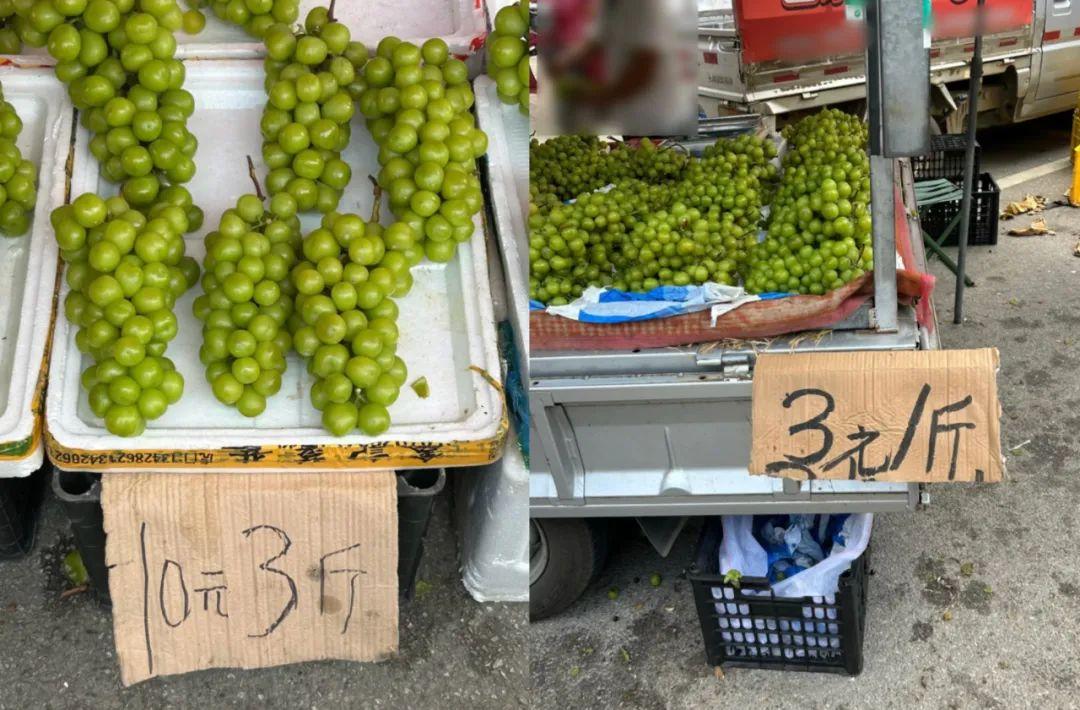
(Photo / @Xiaofang Returns to the Village)
This situation of bad money driving out good money is not limited to grapes.
At the end of 2025, a large number of pre - sale links claiming to be "Meishan Pipa Oranges" appeared on e - commerce platforms, with promotional slogans such as "picked and shipped immediately" and "juicy and extremely sweet." "The Pipa Oranges we usually refer to, also known as 'Chunjian,' means they can only be on the market in spring. It's impossible to sell them in winter. No matter where you pick them now, they are sour."
Industry insiders admitted that the so - called "Meishan Pipa Oranges" on the market are by no means naturally ripened fruits. Some are ripened with chemical agents, while others are simply imitations of foreign tangerines.
From bayberries to grapes to citrus, the sales methods may vary, but the underlying principle is the same: to produce products that meet the market's preferences in the fastest way and at the lowest cost. In every step, "sweetness" is the keyword that is repeatedly emphasized.
As for the things that form the unique "flavor" of fruits, such as taste, aroma, and texture, they have become optional add - ons.
Consumers who claim to love natural flavors are actually voting with their wallets for those out - of - season, high - sugar, non - perishable "perfect fruits" - available all year round, always looking good, always consistent, and always sweet. However, shifting all the blame to consumers is also a form of evasion. The market is never a pure individual choice but a "demand" shaped by capital, channels, marketing, and social networks.