WeChat Reading Skills have become popular. Learn this trick and make your reading worthwhile.
This week, the WeRead Skill entry trended on the hot search list.
After users connect their WeRead accounts, AI can access personal reading data to perform tasks such as searching for books, viewing the bookshelf, analyzing reading habits, organizing notes, and recommending books.

Functionally, WeRead Skill can be mainly divided into six categories.
- View Bookshelf: Browse your personal bookshelf to quickly understand the overall collection.
- Book Search: Search for books in the bookstore and obtain key information such as the book title, author, and rating.
- Reading Statistics: Analyze reading duration, reading days, and preferred reading depth to quantify reading habits.
- Book Details: View book details, chapter lists, and reading progress.
- Notes and Highlights: View highlights and thoughts, export notes, and review reading reflections.
- Good Book Recommendations: Provide personalized recommendations based on reading preferences or recommend similar books.
The installation process can be divided into two key steps: deploy the Skill to the AI assistant and then bind your WeRead account with an API Key.
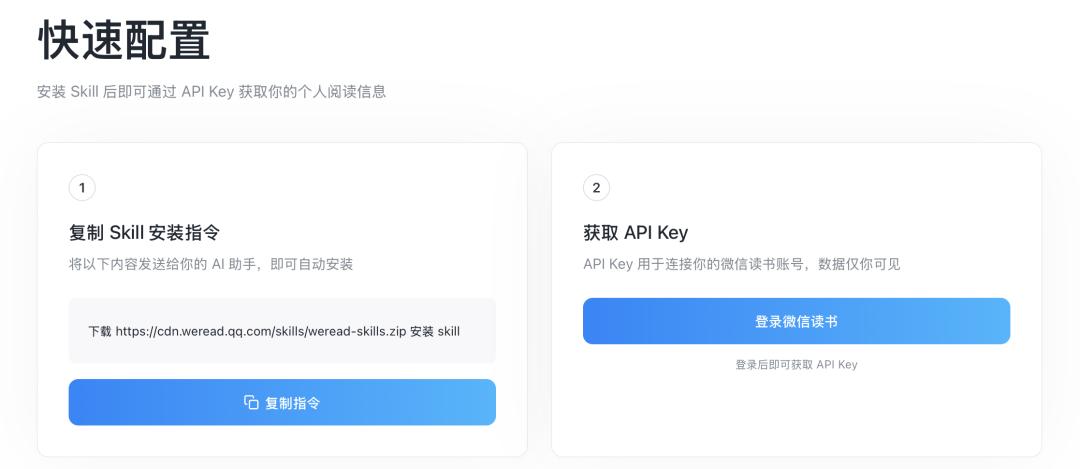
Step 1: Open the WeRead Skill page:
🔗 https://weread.qq.com/r/weread-skills
After entering the page, you can see the relevant instructions and installation files for WeRead Skill. Next, open tools such as Codex, Claude Code, and WorkBuddy. Considering the network environment suitable for domestic users, we choose Tencent AI assistant WorkBuddy here.
Step 2: Create a new conversation in WorkBuddy and send the following instruction to it in full:
Download https://cdn.weread.qq.com/skills/weread-skills.zip and install the skill
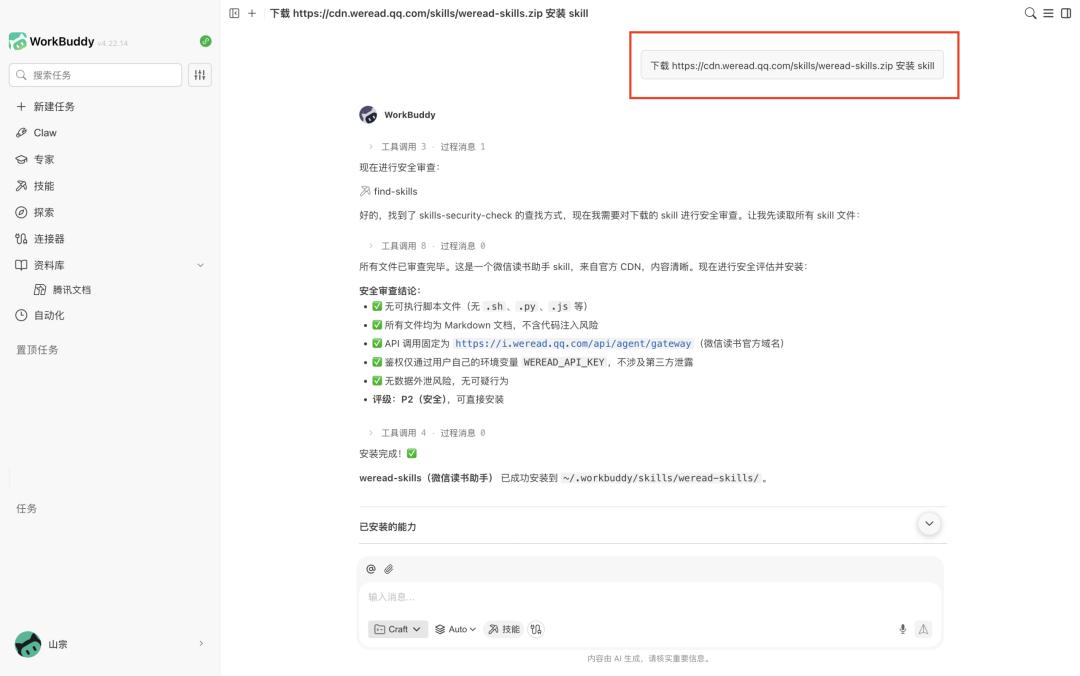
The purpose of this instruction is to let WorkBuddy download the Skill compressed package from the address provided by WeRead and complete the installation. After sending, wait for WorkBuddy to execute. Usually, it will prompt that the deployment is completed in a few minutes.
However, you can't use it directly after the deployment is completed. Since the AI needs to access the bookshelf, reading progress, and notes in the user's personal account, you also need to complete the authorization with an API Key.
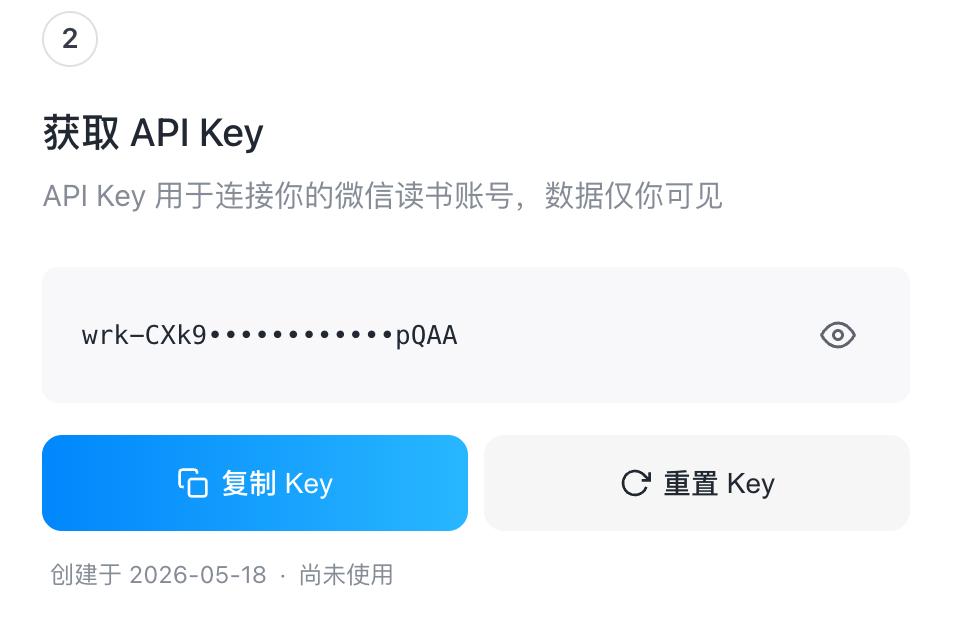
The API Key needs to be obtained by scanning the QR code to log in to WeRead. After users complete the QR code scanning and log in according to the page instructions, the system will generate a string of API Key. It is equivalent to the authorization certificate for connecting to the WeRead account. It is recommended not to publish it publicly or send it to untrusted places.
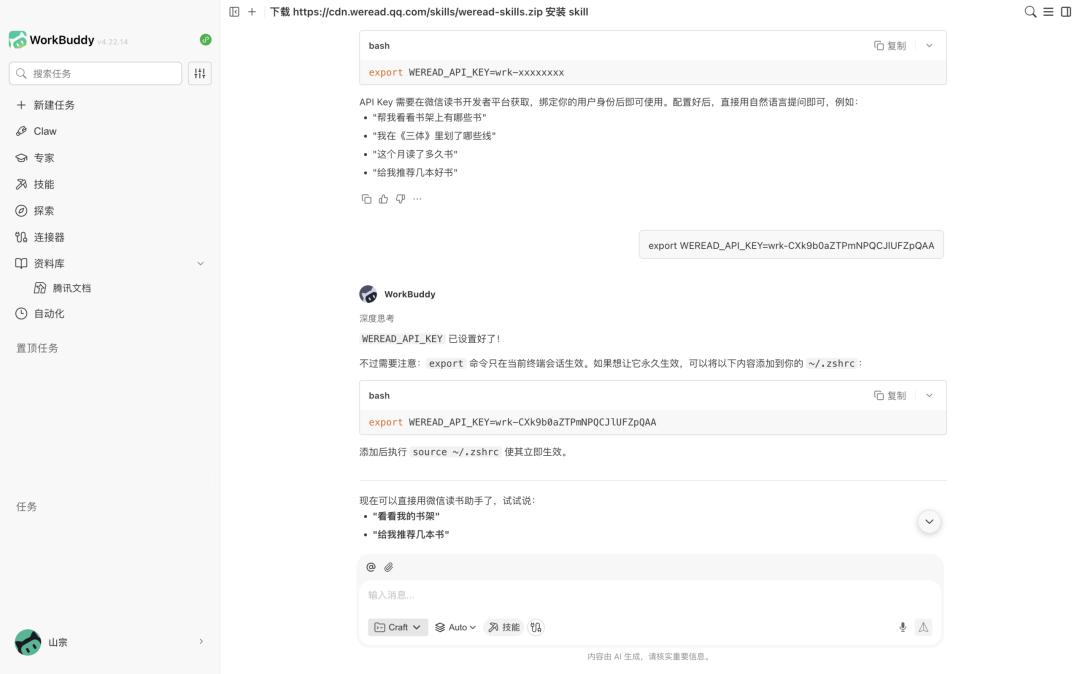
After getting the API Key, you can directly send it to WorkBuddy to complete the configuration, or you can configure it through environment variables:
export WEREAD_API_KEY=Copy the API Key you obtained
Here, you need to replace "Copy the API Key you obtained" with the real API Key generated after scanning the QR code and logging in. After the configuration is completed, WorkBuddy will recognize the authorization information and connect to the user's WeRead account.
After the installation and authorization are completed, you can test its availability with a simple question.
For example, check my WeRead bookshelf or find out which books I've read on WeRead this year. If WorkBuddy can return the bookshelf, reading records, or relevant statistics, it means that the WeRead Skill is ready for use.
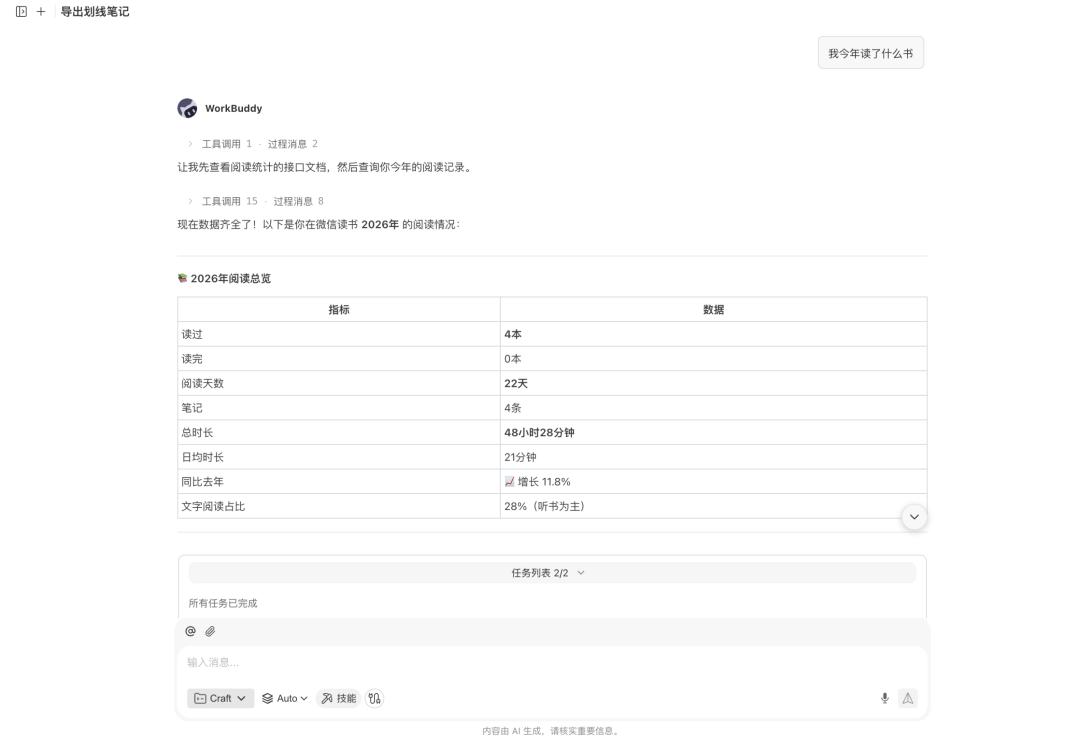
After completing the installation and authorization, we've also compiled some creative ways to use the WeRead Skill for you.
The first category is quantifying reading habits.
In the past, if users wanted to know what they read in a year and during which time periods they concentrated on reading, they often had to rummage through reading records or organize the information themselves. After connecting the Skill, these questions can be directly handed over to the AI, which can help you understand your reading status more intuitively.
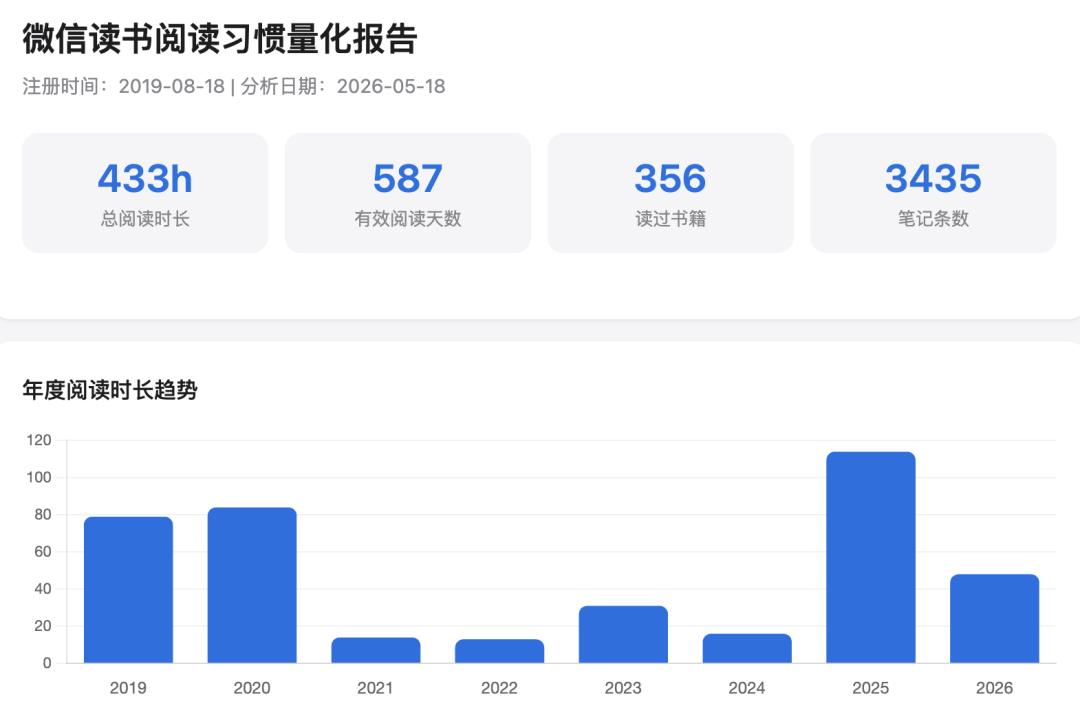
You can try these prompts:
- Which books have I read this year? Please organize them into a table by month, book type, and reading progress.
- Quantify my WeRead habits, including reading duration, reading days, frequently read types, and reading continuity.
- During which time period of the day do I mainly concentrate on reading? Please classify it into morning, morning hours, afternoon, evening, and late at night.
- For which book did I have the longest continuous reading period? Please tell me the corresponding time, reading days, and reading progress.
- Based on my reading records, analyze how my reading habits have changed in the past three months compared to this year as a whole.
The second category is personalized recommendations.
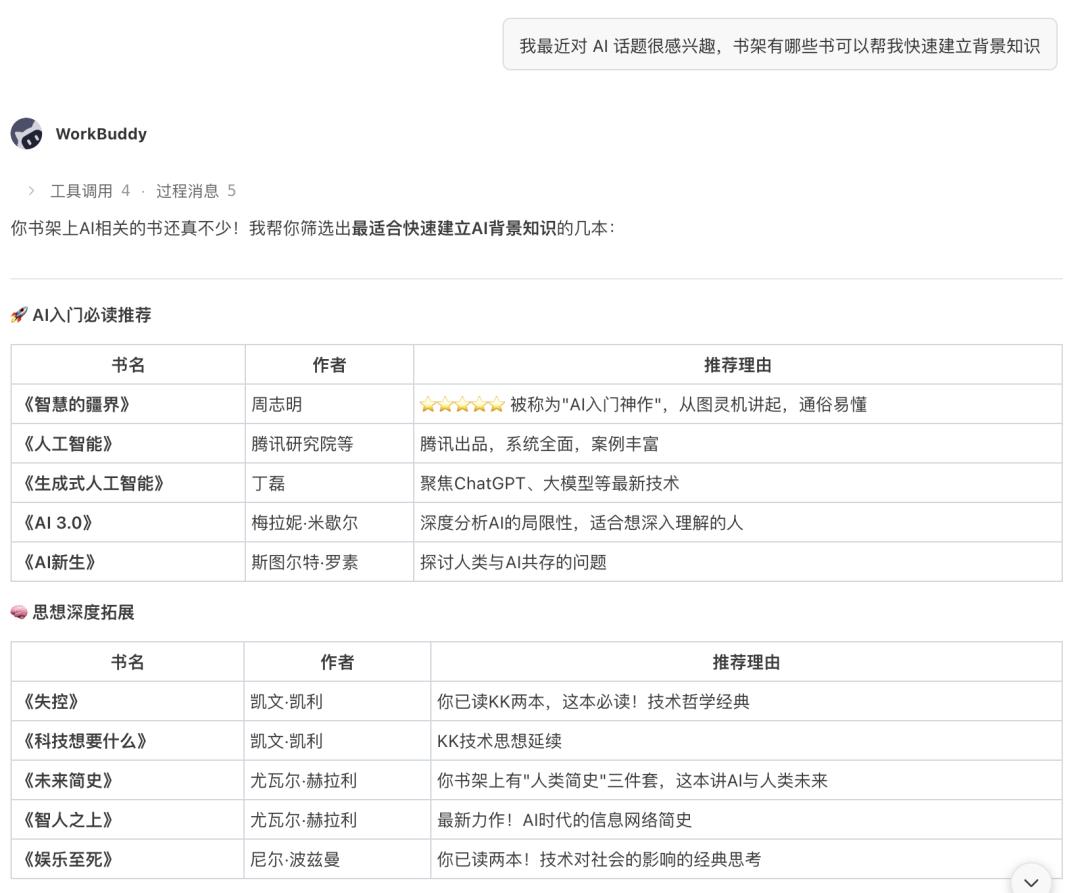
WeRead originally had a recommendation system, but the difference of the Skill is that it can generate more specific suggestions based on the user's own bookshelf and reading history. It doesn't just recommend popular books. Instead, it can further consider what you've read, your preferences, and what you've recently been interested in, and then provide a book list that is more tailored to your personal background.
You can ask like this:
- Based on my reading preferences, recommend 10 prose works that I might be interested in and explain the reasons for the recommendations.
- I want to read "The Taste of Life". Help me find the author, rating, category, publisher, publication time, and ISBN.
- I'm recently interested in AI topics. See which books on my bookshelf can help me quickly build background knowledge.
- Based on my reading records, recommend 5 works similar to the books I've recently read.
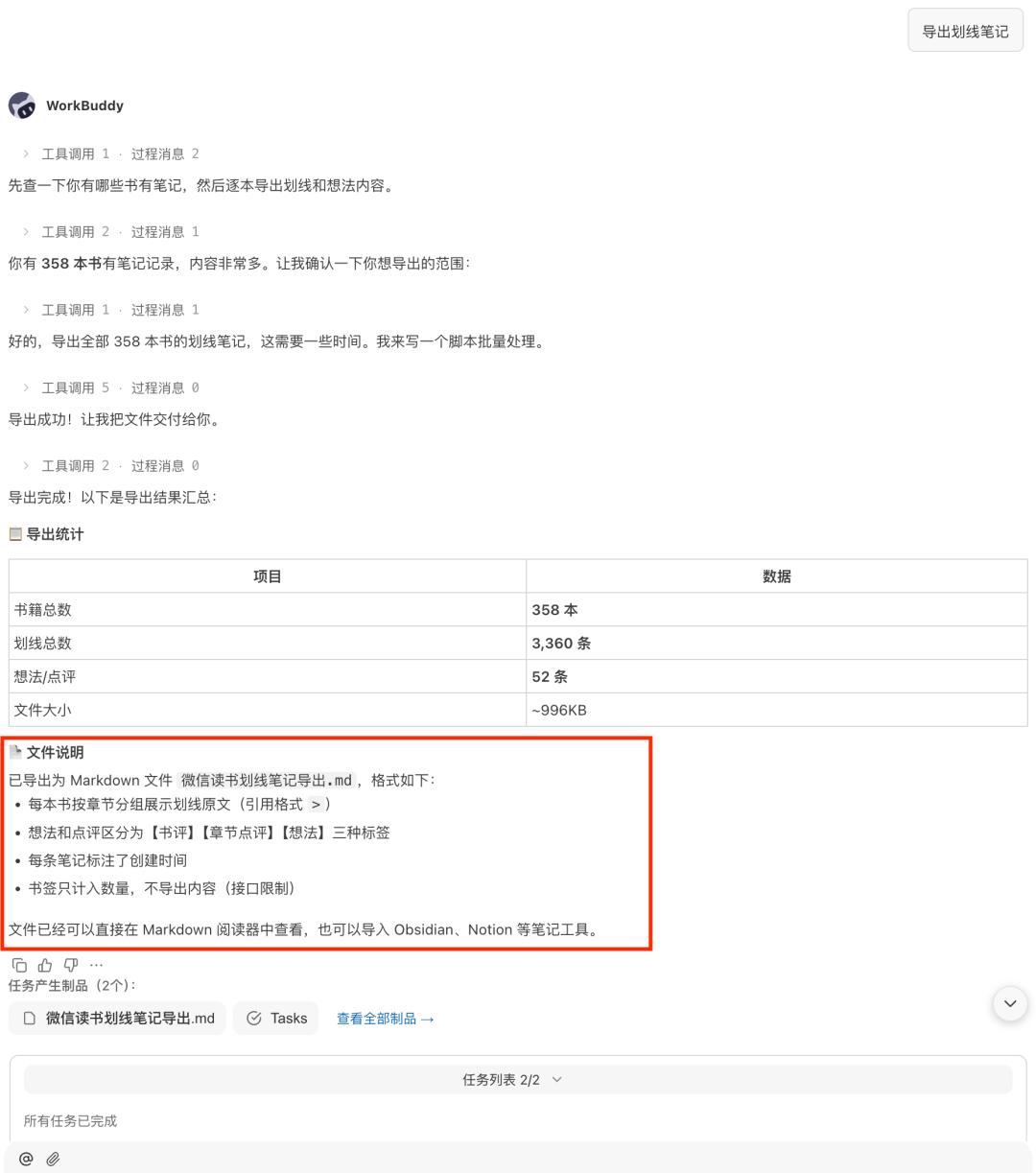
The third category is organizing notes and discovering cognitive blind spots.
For those who have been highlighting and writing thoughts in WeRead for a long time, the real problem is not the lack of notes, but that the notes are scattered in different books and rarely systematically organized. One of the values of the Skill is to reorganize these reading traces.
You can try these prompts:
- Export the highlighted notes of the three books I recently finished reading and organize them by book title.
- Export all the highlights of "A Certain Book", categorize them by topic, and extract 10 core ideas.
- Analyze whether I prefer to highlight facts, opinions, stories, methodologies, or emotional expressions when reading.
- Based on my highlighted content, determine whether I'm more concerned about problem analysis, experience summary, character narration, or value judgment.
- Export all the highlights of "A Certain Book", and then create 5 questions based on this content to test how well I've understood the book.
Finally, there is a more advanced scenario: discovering cognitive blind spots.
If you read the same content for a long time, you'll inevitably fall into an information cocoon. Therefore, instead of letting the AI continue to recommend content you're already familiar with, it can identify areas you've rarely touched based on your reading records and then recommend books that can supplement your knowledge structure.
For example, those who have been reading business books for a long time may lack a historical perspective; those who have been reading technical books may lack discussions on sociology and ethics; those who have been reading literature may lack knowledge related to economics, technology, and organizational management. You can not only let it tell you what you've read, but also analyze what you haven't read.
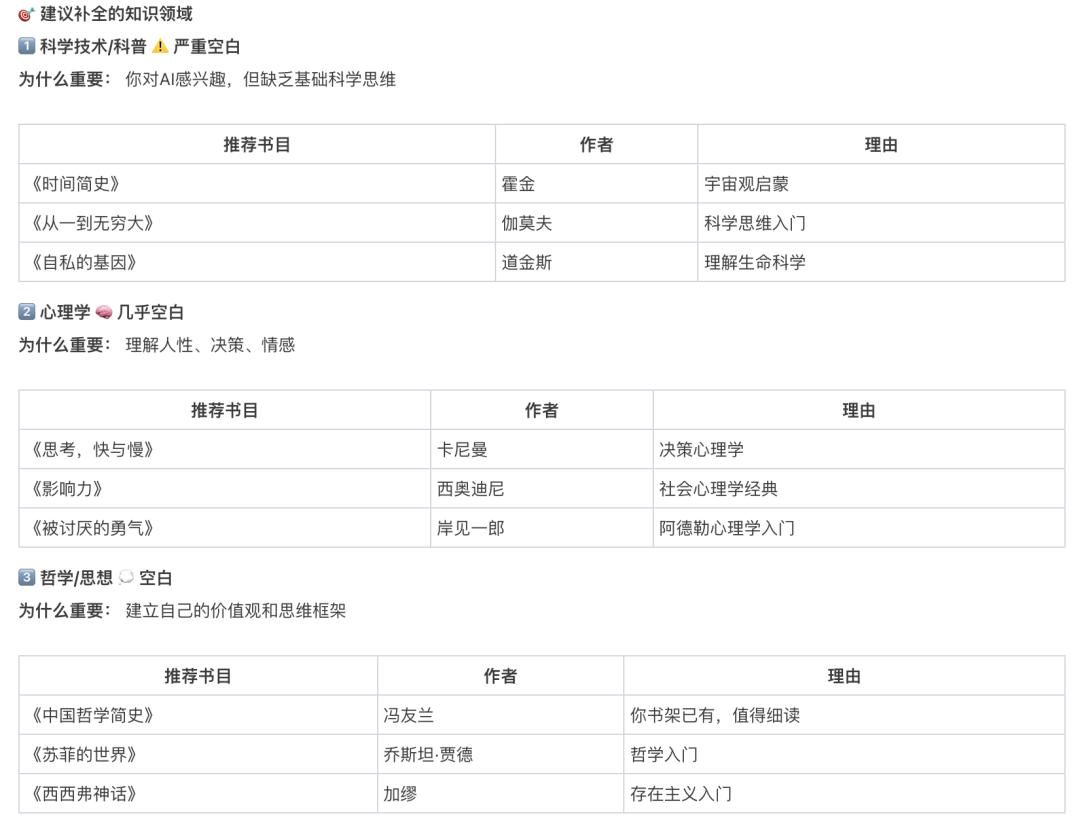
You can ask like this:
- Based on my reading history, determine which knowledge areas have obvious gaps for me.
- Based on my reading records, recommend which books I need to supplement to improve my cognition and avoid a narrow knowledge structure.
- Analyze my bookshelf and tell me which areas I've read more in and which areas are hardly covered.
- Based on my reading history, provide me with a knowledge - supplementing book list categorized by literature, history, technology, business, sociology, and philosophy.
- Combined with my recent conversation records, find out the areas I need to improve the most, and then locate specific books and specific chapters in my WeRead bookshelf.
The last prompt mentioned above is closer to the multi - method of targeted retrieval. Instead of making a general book recommendation, it connects your current problems, existing bookshelf, and specific chapters.
In short, the most notable aspect of the WeRead Skill is not that it helps you search for a few books or export a few notes, but that it transforms the user's years of accumulated reading traces into a knowledge index that can be read by AI.
The bookshelf, progress, highlights, thoughts... all these behavioral data that used to lie dormant in the app are now activated. Rather than saying that users are using a reading app, it's more like they're feeding a personal knowledge - base agent that continuously understands them.

Past reading products solved the problem of "where to read", and recommendation systems solved the problem of "what to read next". With the support of large models, the Skill begins to address a third, deeper question: How can the things we've read re - participate in our current thinking, writing, and decision - making?
Especially, for thousands of years, reading has been a one - way process for an individual. We immerse ourselves in the ocean of books, and how much we can remember and use depends entirely on our memory and understanding. The involvement of AI has turned reading into a real two - way interaction.
How wonderful it is!
This article is from the WeChat official account "ifanr". Author: ifanr, which discovers tomorrow's products. 36Kr is published with authorization.