Understand Starship's 12th Flight at a Glance: The Debut of the Third-Generation Starship, the "Ultimate Roadshow" Before SpaceX Goes Public
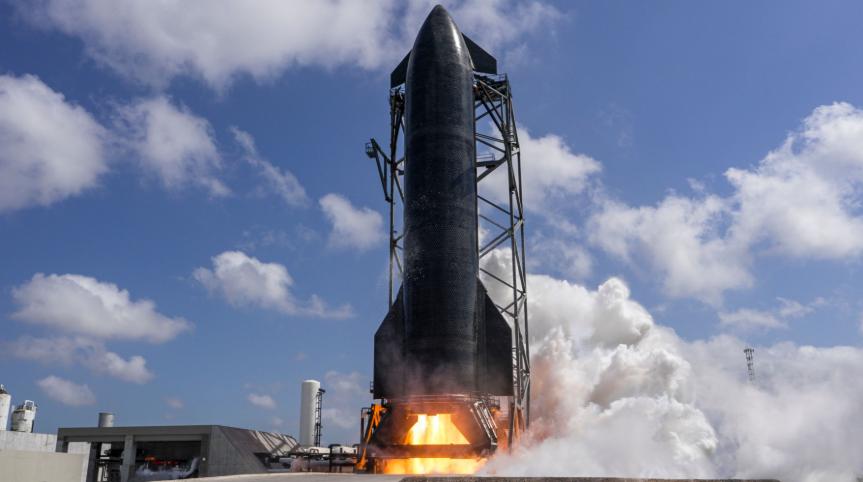
On May 23 Beijing time, SpaceX, owned by Elon Musk, conducted the 12th integrated flight test of the Starship (hereinafter referred to as the "12th flight"). This flight consisted of the Ship 39 spacecraft and the Booster 19 Super Heavy booster. It was not only the first appearance of the Starship V3 configuration but also the first activation of the Starbase Launch Pad 2 (PAD 2) specifically built for V3.
The total height of the Starship combination for this flight is approximately 124 meters. Among them, the Booster 19 Super Heavy booster is about 71 meters tall and is equipped with 33 Raptor 3 engines. The Ship 39 spacecraft is about 53 meters tall, and its propulsion system, avionics, and thermal protection have all been redesigned according to the V3 standard.
The entire mission flew along a sub - orbital trajectory and lasted for more than an hour. As per the scheduled plan, about 7 minutes after liftoff, the Super Heavy booster completed a controlled splashdown in the Gulf of Mexico. After deploying 22 simulated Starlink satellites, the upper stage of the spacecraft began to re - enter the atmosphere, executed the return procedure, and finally splashed down in the Indian Ocean waters near the western coast of Australia.
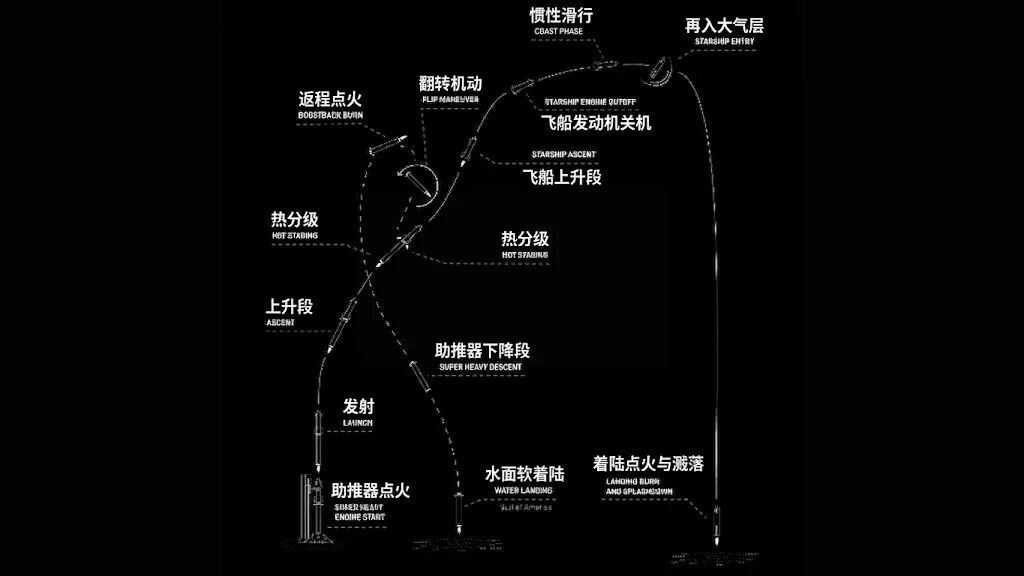
Schematic diagram of the main stages of the Starship V3 sub - orbital flight. Source: SpaceX
During the flight, the spacecraft also performed maneuvers to challenge the structural limits of the tail flaps and a dynamic tilt maneuver to simulate the flight trajectory for future landings at the Starbase. Every action is accumulating data for the final fully reusable form.
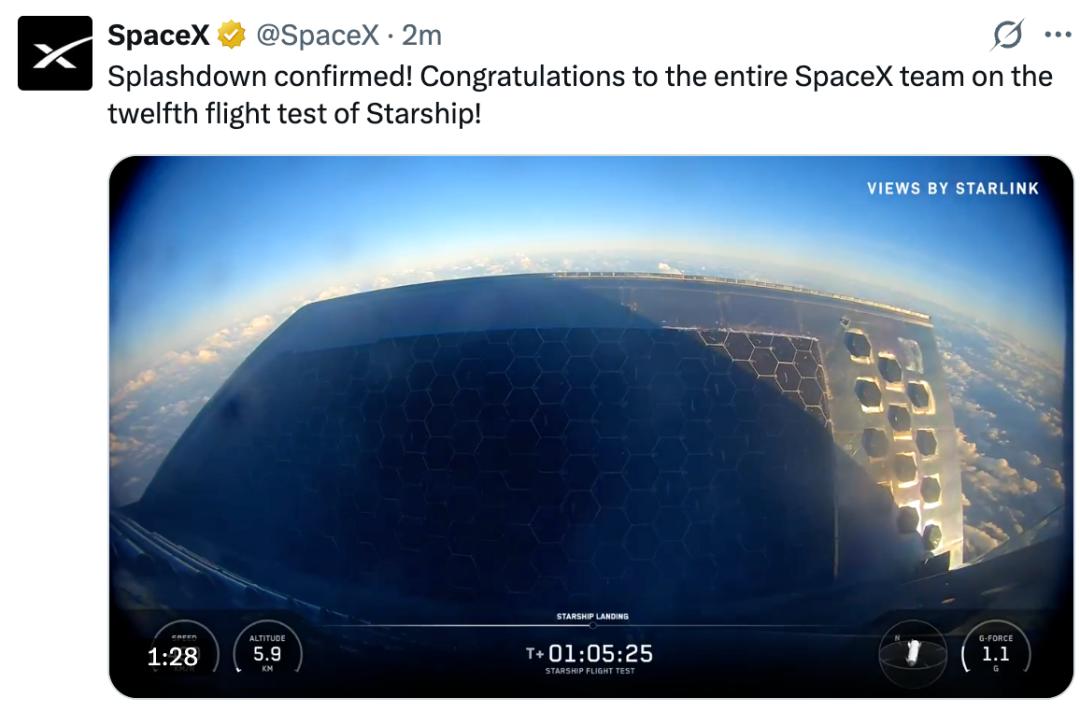
According to SpaceX's official statement, the upper stage of the spacecraft successfully splashed down and exploded.
01
Three new cards are played after a seven - month interval
The "12th flight" was almost seven months after the last Starship launch.
SpaceX played three new cards in this mission: the first is the Starship V3 spacecraft (Starship V3 Ship, i.e., Ship 39); the second is the Super Heavy V3 booster (Super Heavy V3 Booster, i.e., Booster 19), which is equipped with 33 brand - new Raptor 3 engines; the third is the newly rebuilt Starbase Launch Pad 2.
The combination of three brand - new systems for the first time in the same mission is extremely rare in the aerospace field. The propellant loading system has been completely renovated for this purpose.
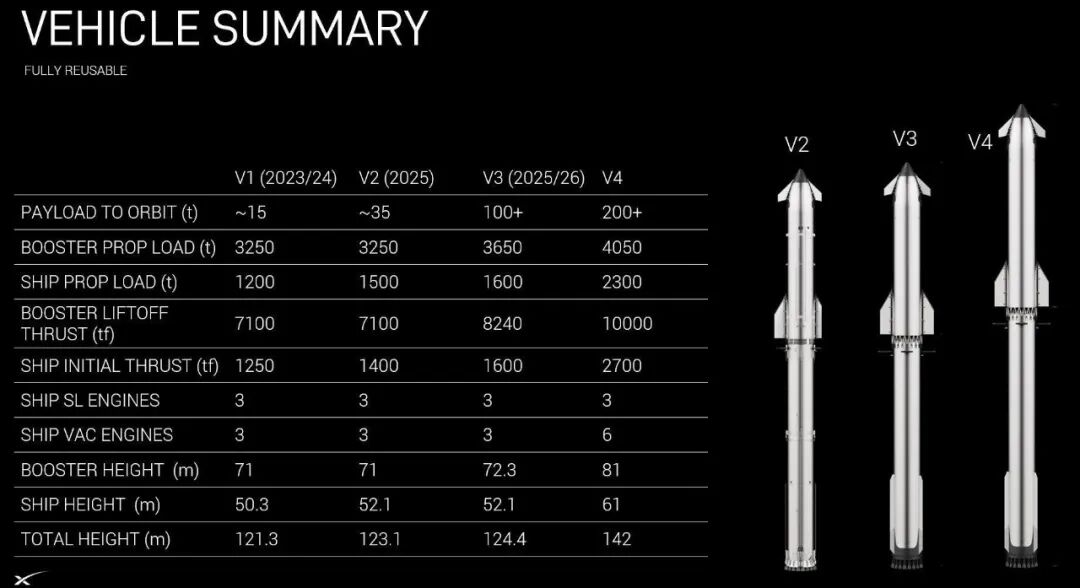
Parameter configurations of different versions of the Starship. Source: @elonmusk
SpaceX's mission description shows that the storage facility for cryogenic propellants has increased storage capacity and more pumps, enabling faster fuel loading into the rocket. The "chopsticks" capture arms on the launch tower have become shorter, allowing for faster movement. The main actuator has been changed from a hydraulic system to an electromechanical system, aiming to better track the spacecraft during future capture operations.
The structure of the launch pad base and the clamping device have been completely redesigned. A two - way deflector cone and a top - layer deflector are installed inside, aiming to completely eliminate the need for ablative refurbishment of the base after launch. On one side of the base, a reinforced bunker separates the oxygen and methane fluid systems of the booster into different fluid compartments, which not only shortens the distance to the rocket but also improves safety.
Since all systems are cooperating for the first time, SpaceX clearly stated before the mission that it would not attempt to capture and recover the rocket using the launch tower.
02
A "physical examination" drama unfolds in space
The thermal protection system has always been the biggest weakness of the Starship. Elon Musk admitted during a podcast in February 2025: "The biggest remaining problem with the Starship is making the thermal protection system reusable. No one has ever built a reusable orbital - class thermal protection system."
The "12th flight" addressed this issue in a rather "brutal" way. When the Starship took off, a thermal protection tile was deliberately removed to measure the difference in aerodynamic loads on adjacent tiles when a tile was missing. Several tiles on the spacecraft were also deliberately painted white as marker points for the onboard cameras to track changes during the flight.
During this flight test, the spacecraft will deploy 22 simulated Starlink satellites, a significant increase compared to the 8 or 10 satellites carried in previous missions.
According to SpaceX's mission description, among the 22 simulated satellites deployed, the last two undertake a special mission of inspecting the spacecraft. These two satellites are equipped with cameras. After they are deployed from the Starship's "PEZ dispenser", they will scan the entire thermal protection system of the Starship during the flight and transmit real - time images back to ground operators. This test aims to verify the method for assessing the integrity of heat - shield tiles in future missions.
The thermal protection system has not failed to complete its mission before. In earlier flights, SpaceX's spacecraft did successfully withstand the re - entry test and splash down in the ocean.
But Musk pointed out in the podcast that in previous flights, the spacecraft lost many tiles, which means it cannot be reused without a lot of maintenance work. In his words, "If you want to be able to land it, reload propellants, and fly it again, you can't do the tedious inspection of 40,000 tiles one by one."
03
The new Starship is redesigned from head to toe
The Starship V3 in the "12th flight" is different from its predecessors from head to toe. All these changes revolve around the same goal: to make reuse simple, cheap, and fast.
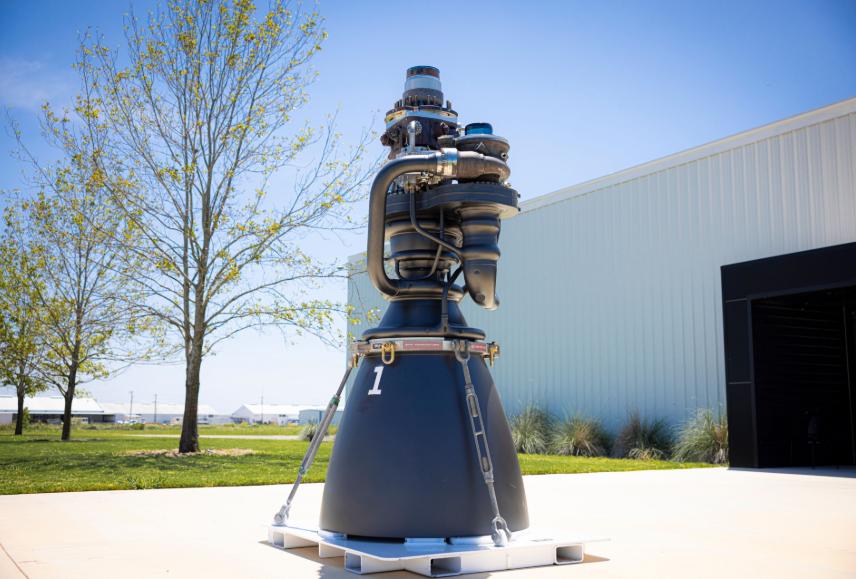
The Raptor 3 engine provides greater thrust. Source: SpaceX
First of all, the performance data of the Raptor 3 engine has been greatly improved. The thrust of the sea - level version has increased from 230 tons to 250 tons, and that of the vacuum version has increased from 258 tons to 275 tons. While the thrust has increased, the weight has decreased. The mass of a single engine has decreased from 1630 kilograms to 1525 kilograms.
More importantly, there is weight reduction at the spacecraft level. SpaceX's mission document explains that by simplifying the engine itself and the supporting hardware on the spacecraft side, about 1 ton of mass can be saved for each Raptor 3 engine installed on the entire spacecraft.
The sensors and controllers of the Raptor 3 are now integrated inside the engine and directly covered by the engine's thermal protection system. This means that neither the spacecraft nor the booster needs individual engine shrouds anymore, and all engines have been replaced with a redesigned ignition system.
On the booster side, the number of grid fins on the Super Heavy V3 has been reduced from four to three, but the area of each fin has increased by 50% and has been significantly strengthened. New capture points have been added to the fins, and their positions have been lowered to reduce the thermal exposure of the grid fins to the Starship's engines during hot separation. The shafts, actuators, and fixed structures of the grid fins have been moved inside the main fuel tank of the booster for better protection.
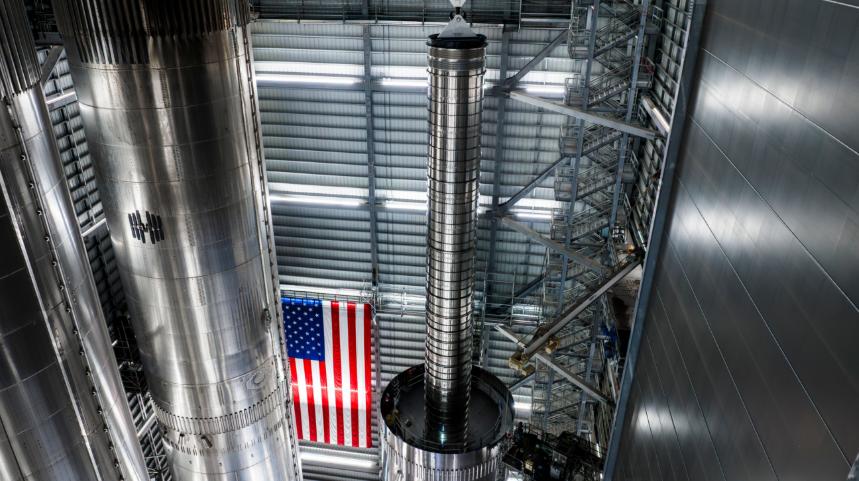
The grid fins, fuel delivery pipes, thermal protection system, etc. of the Super Heavy V3 booster have been improved. Source: SpaceX
An integrated hot - separation ring has replaced the previous disposable protective inter - stage. When the spacecraft's engines ignite, the flames directly impact the front top cover of the booster's fuel tank, and the internal fuel tank pressure and a non - structural steel layer work together to provide protection. The fuel delivery pipes have been completely redesigned to ensure that all 33 engines can start quickly at the same time.
The changes to the spacecraft are also systematic. The rear flap actuation system has been changed from two actuators per flap to one actuator with three motors, which not only improves redundancy but also reduces both mass and cost.
A high - power electrically driven cryogenic recirculation system has been installed, as well as a system specifically for managing the interaction between cryogenic propellants and engines during long - duration coasting. This is in preparation for long - term deep - space missions. Four conical deflector devices for docking and propellant delivery connections have been added to the leeward side of the spacecraft, which are hardware pre - installed for spacecraft - to - spacecraft docking and in - space propellant transfer.
SpaceX has comprehensively redesigned the propulsion system of the Starship V3 spacecraft. Source: SpaceX
The avionics system has also made a leap. There are about 60 customized avionics units on the spacecraft and the booster, which integrate batteries, inverters, and high - voltage power distribution into a single component. The entire spacecraft can provide a peak power of about 9 megawatts.
The multi - sensor navigation system supports precise autonomous flight at all stages of the mission. A new type of precision radio - frequency sensor is used to measure the propellant level in a microgravity environment, paving the way for future in - space propellant transfer. Cameras with 50 viewpoints cover the entire spacecraft, and real - time image transmission is provided by a 480 - megabit - per - second Starlink connection.
04
Put into practical use in the second half of the year?
Two days before the "12th flight" launch, SpaceX submitted a prospectus as part of its listing plan to the U.S. Securities and Exchange Commission, for the first time disclosing to the outside world the investment scale of the Starship project: the company has spent more than $15 billion on the Starship, including $3 billion in 2025 and nearly $900 million in the first quarter of 2026.
The prospectus points out the urgency of the V3's first flight in one sentence: "We expect the Starship to start delivering payloads to orbit in the second half of 2026."
SpaceX also made it clear that the current Falcon 9 and Falcon Heavy cannot deploy next - generation satellites. One Starship launch can carry 60 V3 Starlink satellites, each capable of providing a throughput of 1 terabit per second, or 50 V2 Mobile satellites, which will be launched in 2027 and provide more comprehensive direct - to - device services.

However, the prospectus also warns that any failure or delay in the Starship's large - scale development, achieving the required launch frequency, reusability, and subsequent capabilities "will delay or limit our ability to implement our growth strategy, including deploying next - generation satellites, global satellite - to - mobile device connections, and in - orbit artificial intelligence computing, which may have a significant adverse impact on our business, financial condition, operating results, and future prospects."
The document specifically points out that "large - scale deployment of artificial intelligence computing satellites requires the full reusability of the Starship to be economically attractive."
According to the prospectus, the Starship V3 can send up to 100 tons of payload into orbit, and future versions will increase this to 200 tons and achieve up to 1 million tons of launches per year. SpaceX even mentioned the prospect of using the Starship to mine rare materials such as helium - 3 on the moon, believing that these materials can be directly transported back to Earth at a lower cost, positioning the moon as a "strategic industrial and transportation node."
SpaceX calculated in the prospectus that once the Starship achieves stable and reliable operation, the cost of sending each kilogram of payload into orbit will be reduced to 1% or even less of the average cost of previous space launches.
05
The final kick before a trillion - dollar valuation
The time window of the "12th flight" happens to be at the most sensitive node before SpaceX's listing.
Franco Granda, a senior research analyst at research firm PitchBook, said: "SpaceX's initial public offering largely depends on whether the market buys into its future story. In our view, this flight is the most crucial catalyst before its listing."
The outside world's attention comes not only from investors. NASA's lunar landing schedule imposes a hard constraint on the Starship. According to the Artemis program to return to the moon, NASA has selected the Starship as the human - landing system and plans to send astronauts to the moon in 2028.
G. Scott Hubbard, a former director of NASA's Ames Research Center and a physicist, said bluntly before the launch that the risk was "huge." He explained that the government has handed over core tasks such as the human - landing system to enterprises for development through commercial contracts instead of directly operating them. Therefore, the contractors must now produce results that can stand the test.
Antoine Gellé, a partner and global head of the space business at strategic consulting firm Analysys Mason, commented before the launch: "If this launch goes without any problems, it will truly pave the way for more space infrastructure and lunar contracts."
Since its first flight in 2023, the Starship has reached the V3 stage after 12 flights. The significance of this flight does not lie in how impressive a single piece of data is, but in the fact that after SpaceX disassembled and rebuilt the entire rocket, it can still fly the whole journey steadily.
NASA's lunar landing contract is on a timer, the valuation of the IPO is waiting for verification, and the dream of colonizing Mars also requires a spacecraft that can take off and land repeatedly like an airplane.