Two female billionaires with a net worth of over 100 billion have emerged from the "Apple supply chain".
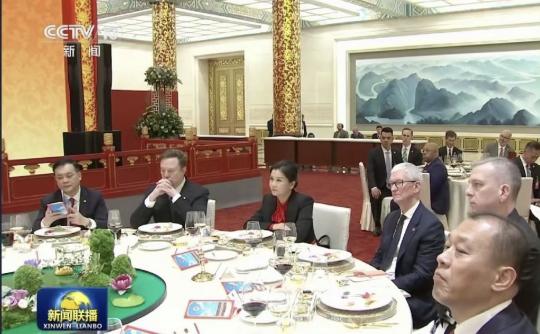
Not long ago, at a state banquet, Zhou Qunfei, as the only female entrepreneur, was seated between two tech giants, Elon Musk and Tim Cook.
Behind Cook is Apple, the most generous benefactor in the global consumer electronics supply chain. Behind Musk is Tesla, a giant in the automotive and robotics industries, representing the next wave of imagination for AI hardware. Sitting in the middle, Zhou Qunfei is the founder of Lens Technology, a Chinese manufacturer that emerged from the Apple supply chain and is now venturing into the automotive and AI hardware sectors.
The three entrepreneurs sitting together symbolize, to some extent, the future of high - end manufacturing.
Recently, another "female billionaire from the Apple supply chain" has stepped into the spotlight of the capital market: Wang Laichun.
Since early April, the stock price of Luxshare Precision has risen by more than 55%. On May 11, its market value exceeded 554.2 billion yuan, reaching a record high. With an 18.75% stake, Wang Laichun's net worth has exceeded 100 billion yuan, making her the fourth female billionaire in China.
If Zhou Qunfei is responsible for the "face" of Apple's hardware, Wang Laichun is in charge of the "skeleton" and assembly of Apple's hardware.
Luxshare Precision started with connectors, cables, and acoustic components and later entered the manufacturing chain of Apple's core products such as AirPods and iPhones. Its story is about a systematic ability to stably produce complex hardware.
Both Zhou Qunfei and Wang Laichun emerged from the most unnoticed parts of Chinese manufacturing. One went from being a glass factory worker to the "Queen of Apple Glass," and the other went from the Foxconn assembly line to the core of Apple's assembly.
A piece of glass, a pair of headphones, and a mobile phone may seem like just parts of Apple's products. But behind these products lies the most real ability of Chinese manufacturing: the ability to stabilize complex processes, boost huge production capacity, and repeatedly prove their delivery capabilities in front of the world's most demanding customers.
They are not supporting roles in the Apple supply chain.
They are two indispensable Chinese entrepreneurs behind Apple's hardware empire.
A
In 1970, Zhou Qunfei was born in a small mountain village in Hutian Town, Xiangxiang, Hunan.
Her life was pushed forward by poverty at an early age. Her mother passed away when she was five. Her father lost his sight and two fingers in an accident while making explosives in the 1960s. Life at home was tough, and her older brothers and sisters dropped out of school early to support the family. Zhou Qunfei also had to leave school after the second year of junior high school.
In 1985, at the age of 15, Zhou Qunfei went south to Guangdong.
At first, she guarded a shed in Shaoguan. A few months later, she went to Shenzhen and worked at Aoya Optical, making watch glass. Her daily wage at that time was 7 yuan.
Making glass is not a glamorous job. When working in a factory, there's not much to be picky about. Watch glass is small, but the processes are fragmented, including cutting, grinding, polishing, silk - screening, and inspection. Each step requires eyesight, a good sense of touch, and patience.
For the young Zhou Qunfei, this job was hard, repetitive, and boring, but it also allowed her to truly understand the details of manufacturing for the first time.
Fate often plants its seeds inconspicuously. Many years later, when Zhou Qunfei sat between Cook and Musk, she might still remember the workshop where she first polished watch glass.
During the day, she worked in the factory. At night, she attended evening classes.
She learned everything, including accounting, computer skills, customs declaration, driving, and fire - fighting. Many things didn't seem directly related to her job, but she was constantly building up her capabilities. She wasn't the type who just waited for her paycheck. She wanted to know how the factory operated, where the orders came from, how the goods were shipped, and how the accounts were calculated.
In the first few years of working, Zhou Qunfei didn't have any legendary stories. She just observed a little more, asked a little more, and learned a little more than others. Her glass - making skills were honed through such repetitive work.
Then, an opportunity came.
Aoya Optical planned to expand a new factory, but the project ran into problems midway, and the boss wanted to withdraw the investment. Zhou Qunfei volunteered to give it a try.
At that time, she was young, without a prominent resume or a capital background. All she had was the technology she had learned in the factory over the years and her familiarity with the production line. She applied screen - printing technology to watch glass for printing words and engraving patterns, and gradually got the new factory up and running. Later, this factory became one of the most profitable in the company.
But it was also during this process that she saw the limitations of working for others.
No matter how capable a person is, as long as they are in someone else's system, there will always be an invisible ceiling. She couldn't really make decisions on how to improve the process, how to accept orders, or how to use the workforce.
In 1993, at the age of 23, Zhou Qunfei left her original factory and started her own business.
At first, a few relatives got together, rented a three - bedroom apartment in Bao'an, Shenzhen, and invested 20,000 Hong Kong dollars to take on some small glass surface - processing orders. That apartment served as both a dormitory and a workshop. There weren't many machines, the space was cramped, and the orders were small. The main business was still watch glass, which Zhou Qunfei was most familiar with.
The Lens Technology, which later had a market value of tens of billions, started from such a rented apartment.
In the early days of her entrepreneurship, she still focused on small pieces of glass. She would do whatever the customers asked for. When there were problems with the products, she would lead her team to improve the process.
It was the mobile phone that really pushed her into a larger market.
Around 2001, TCL approached her, hoping to solve the problem of the easily scratched panels of flip - phones. At that time, many mobile phone panels were made of acrylic, which was light but not very wear - resistant. Zhou Qunfei applied her experience in making watch glass to mobile phones and replaced acrylic with scratch - resistant glass.
In 2003, Zhou Qunfei founded Lens Technology in Shenzhen. This was just the right time for the mobile phone industry to shift from feature phones to a more lightweight, appearance - and screen - experience - oriented direction. Her process capabilities accumulated from making watch glass and mobile phone panels finally found a larger market.
Soon, the Motorola V3 project became a crucial battle for Lens Technology.
This classic mobile phone, which later sold hundreds of millions of units, required a piece of glass that was thin, hard, transparent, and could pass the drop test. Zhou Qunfei led her team to conduct repeated tests, adjust the materials and processes, and finally solved the problem.
After the V3 became a hit, more international customers noticed Lens Technology. Manufacturers such as Samsung, Nokia, and Sony Ericsson came one after another. Zhou Qunfei's small pieces of glass were connected to the main channel of the global consumer electronics industry.
In 2007, the first - generation iPhone was launched, marking the beginning of the smartphone era. The glass screen changed from a component to the center of the entire product experience. Apple had extremely high requirements for the glass panel: it had to be thin, wear - resistant, transparent, and capable of large - scale and stable delivery.
And Lens Technology provided this glass.
Since then, Zhou Qunfei has been deeply tied to Apple. Lens Technology has become an important supplier to Apple, and its revenue has been growing steadily.
In 2015, Lens Technology was listed on the Growth Enterprise Market. Zhou Qunfei's net worth skyrocketed, and she became the richest woman in China.
Many rags - to - riches stories end here, but this was just the version from a decade ago. In the year of its listing, Lens Technology was already a star company in the Apple supply chain. While Apple made Lens Technology known to the world, it also firmly labeled Lens Technology as part of the "Apple supply chain."
If a manufacturing company relies too much on a single major customer, its fate is likely to fluctuate with the customer's product cycle. When iPhones sell well, it soars; when iPhone sales slow down, it will be questioned by the market. Moreover, the Apple supply chain has never been an easy place. Price, yield, delivery, confidentiality, and production capacity are all pushed to the limit.
After 2015, Zhou Qunfei didn't stay at the position of the "Queen of Apple Glass." She continued to expand Lens Technology.
Beyond glass, Lens Technology started working with materials such as metal, ceramic, sapphire, plastic, and carbon fiber. Beyond mobile phones, it entered the fields of smart wearables, tablets, laptops, automotive cockpits, XR headsets, and other smart terminals.
The most obvious new direction is the automotive industry.
After the rise of smart cars, central control screens, dashboards, B - pillar components, in - car decorative parts, and smart cockpit interactive interfaces have all become new "glass businesses." Lens Technology's 2025 annual report states that its smart automotive customers include Tesla, CATL, BMW, Mercedes - Benz, Volkswagen, Li Auto, NIO, and BYD.

Another new direction is AI hardware.
AI glasses, XR headsets, smart wearables, robots, servers, and commercial space are all redefining the concept of "terminals." When Lens Technology applied for a listing on the Hong Kong Stock Exchange in 2025, its prospectus showed that the company's revenue no longer came only from mobile phones and computers but also from precision manufacturing solutions for smart cars and cockpits, smart headsets and wearables, and other smart terminals.
These "new hardware" products may seem to be in different fields, but they all have similar manufacturing requirements at the core: complex materials, precise structures, functional modules, lightweight designs, high - strength appearance parts, and large - scale and stable delivery.
Apple made Lens Technology known to the world, but Apple is not the end. What Zhou Qunfei has truly preserved is the manufacturing ability to continue growing beyond Apple.
She started with a piece of watch glass and finally created a path to a broader hardware world.
B
Wang Laichun didn't start in the capital market. She has a more "grass - roots" background, working her way up from Foxconn to the core of Apple's assembly.
In 1967, Wang Laichun was born in an ordinary rural family in Chenghai, Shantou, Guangdong.
She has two older brothers. Her parents made a living by farming, and the hard work in the fields couldn't bring prosperity to the family. Wang Laichun grew up mostly with her second - oldest brother, Wang Laisheng. Later, to earn money to support the family, Wang Laisheng dropped out of school and went to work in Shenzhen.
In 1988, at the age of 21, Wang Laichun also went to Shenzhen, just in time for Foxconn to build a factory there.
According to public information, Wang Laichun is often described as one of the earliest mainland workers at Foxconn.
Foxconn back then was not the behemoth it is today. Even now, the workshop is not a place for romantic stories. The assembly line means repetition, discipline, speed, and standards. Every day, workers face components, processes, production lines, yields, and delivery deadlines. The days are dull and boring.
But Wang Laichun stayed there for more than a decade, working her way up from an ordinary female worker to a team leader, a line supervisor, and finally a section chief.
Zhou Qunfei learned about materials, processes, and the sense of touch in the glass factory. Wang Laichun learned another set of abilities at Foxconn: how to break down complex manufacturing into processes, how to make many people work towards the same standard, how to boost production capacity in a short time, and how to turn customer requirements into stable delivery.
This is not a theoretical management course but practical experience gained by standing beside the production line day after day.
The most important characteristic of Wang Laichun comes from this experience. She went from being a front - line worker to a manager in the world's largest electronics manufacturing system. She knows where the difficulties in manufacturing lie.
If one part is unqualified, the entire assembly process may be affected. The standards set by customers translate into countless details in the workshop: size, material, temperature, precision, efficiency, loss, and rework rate.
These details may seem trivial, but they determine a company's most core delivery ability.
In 1997, Wang Laichun left Foxconn. Two years later, she and her brother Wang Laisheng pooled their money to buy the shares of Hong Kong Luxshare. In 2004, they established Luxshare Co., Ltd. through Hong Kong Luxshare, and Wang Laichun became the chairperson.
At the beginning of its entrepreneurship, Luxshare focused on connectors, connecting wires, and cable assemblies. These products may not seem very imaginative and are quite low - key. They are not as sought - after as chips, nor are they as visible to consumers as finished products.
But in electronics manufacturing, connectors and cables are the most basic parts. How the current flows, how the signals are transmitted, and how the devices are connected are all hidden in these small components.
This also fits Wang Laichun's approach. She didn't start by telling grand technological stories. Instead, she began with the most familiar components, processes, and delivery in the Foxconn system, focusing on making small, unassuming things well before moving on to more complex areas.
In the early days, Luxshare was, to some extent, a manifestation of Wang Laichun's understanding of manufacturing from her time at Foxconn.
It's not about making a single product but about building a set of capabilities: the ability to accept orders, manage the factory, ensure quality, control costs, and deliver according to customer requirements.
At the beginning, Luxshare's business basically replicated the Foxconn model, but it was not a competitor to Foxconn. Instead, Luxshare's business could help Foxconn handle some connector and cable orders during peak seasons and bear its own operating pressure during off - seasons. For Foxconn at that time, Luxshare was a close - fitting supporting supplier. For Luxshare, it was the most practical way to start.
Later, Luxshare entered the Apple supply chain, which changed its valuation method.
Apple has extremely strict requirements for its suppliers. As mentioned before, price, quality, yield, confidentiality, production capacity, and delivery are all pushed to the limit. Being able to enter the Apple supply chain is a form of screening in itself. Being able to move up in the Apple supply chain means that the manufacturing ability is continuously verified.
What really made Luxshare known to the outside world was AirPods.
AirPods may seem like just a pair of