The Feast of Token Sellers: From Grassroots to Celebrities, Why Does Everyone Want to Be an AI Transfer Station?
In the first week of May 2026, three things happened almost simultaneously in the same business.
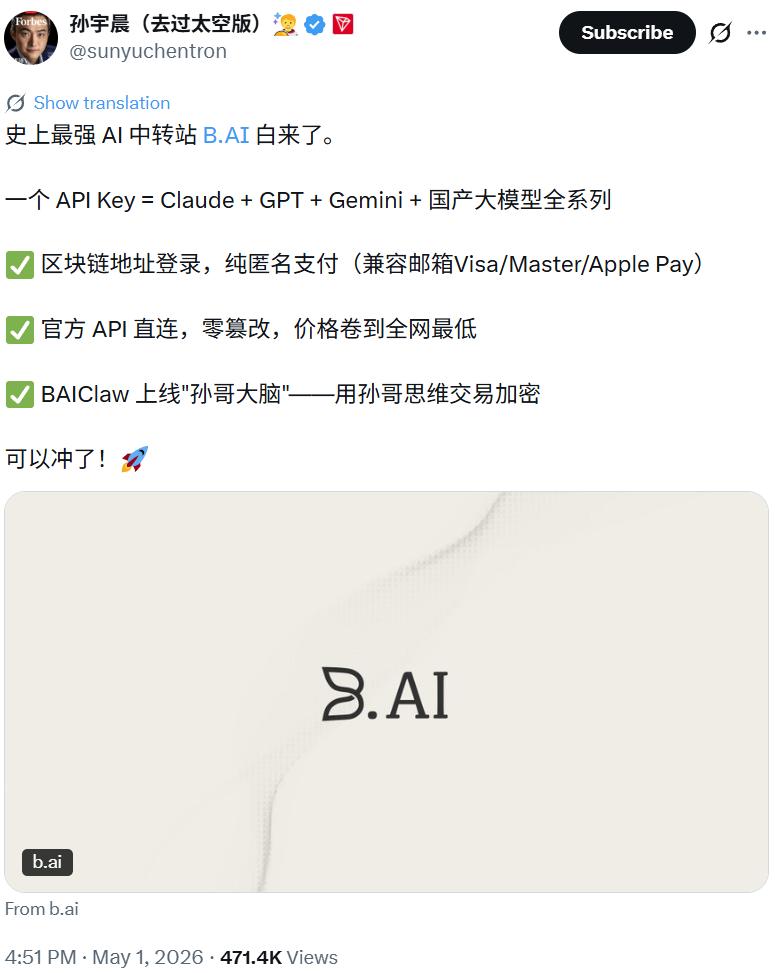
On May 1st, Justin Sun posted on X: "The strongest AI transfer station in history, B.AI, is here for free. One API Key = Claude + GPT + Gemini + the entire series of domestic large models. Blockchain login, pure anonymous payment, zero tampering, and the lowest price in the whole network." This man who has been to space personally promoted the product.
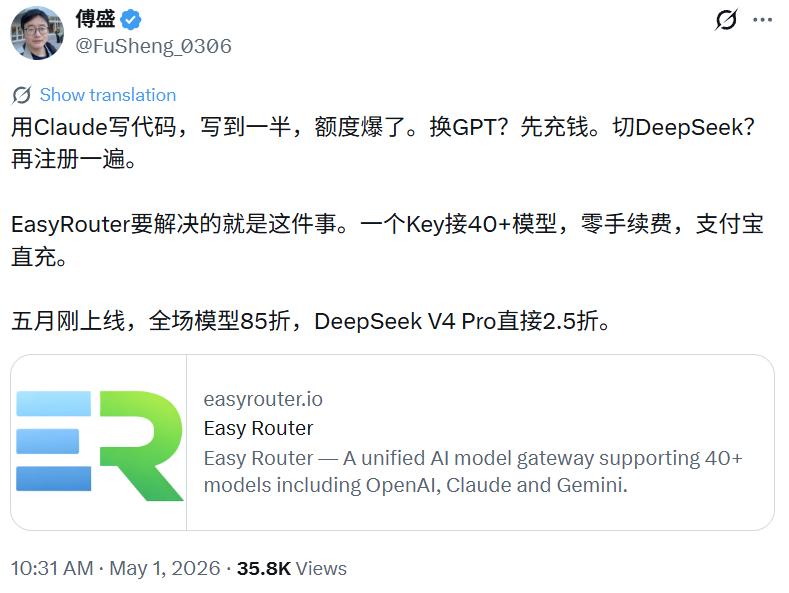
Fu Sheng, the CEO of Cheetah Mobile, also announced the launch of Easy Router with the slogan "85% off the whole store". He claimed that one Key can call more than 40 mainstream large models with zero platform fees and zero mark - up.
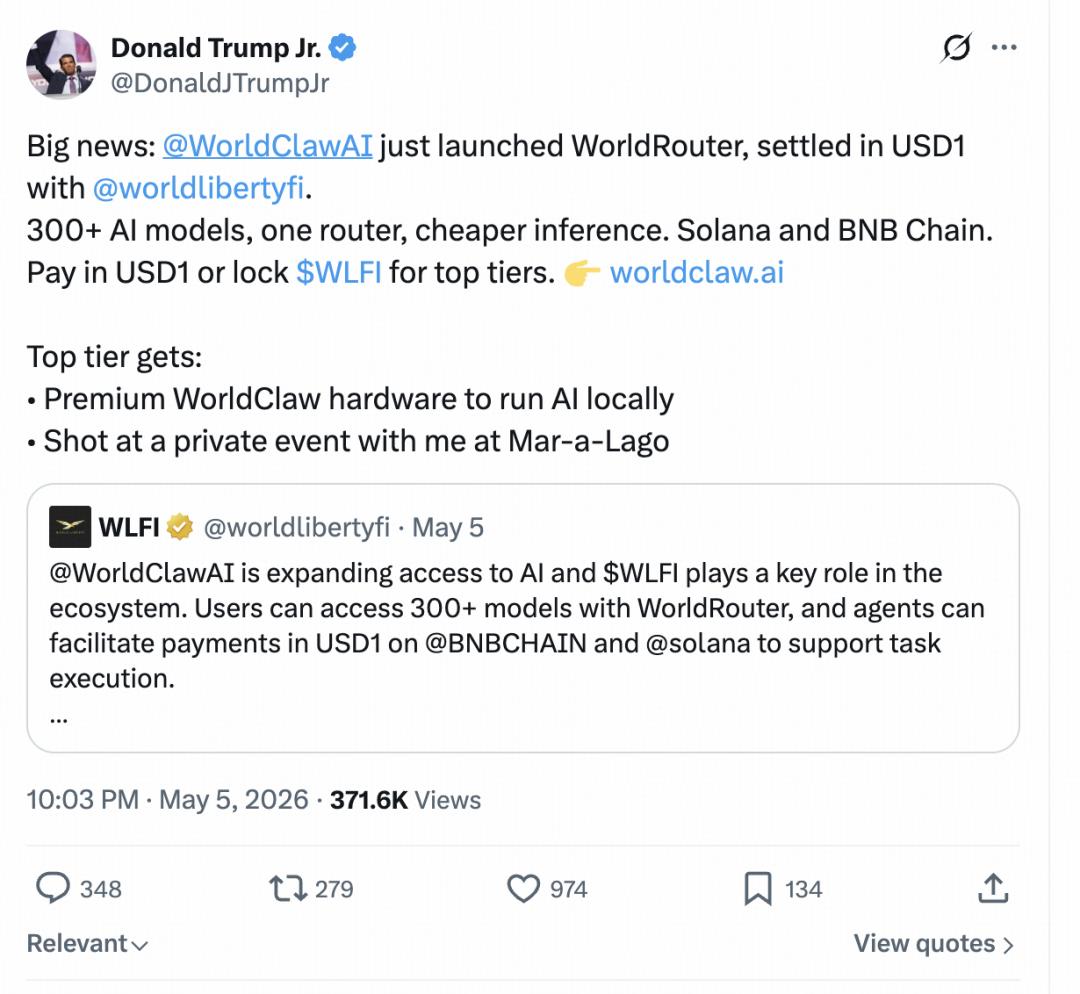
On May 5th, the cryptocurrency project WLFI, which is deeply tied to the Trump family, reposted a new product called WorldClaw. Its highest - tier package is priced at $9,999. After purchasing, you will get 1 million AI credits, a hardware device, and a lottery ticket for a chance to attend a private dinner at Mar - a - Lago and have dinner with Donald Trump Jr.
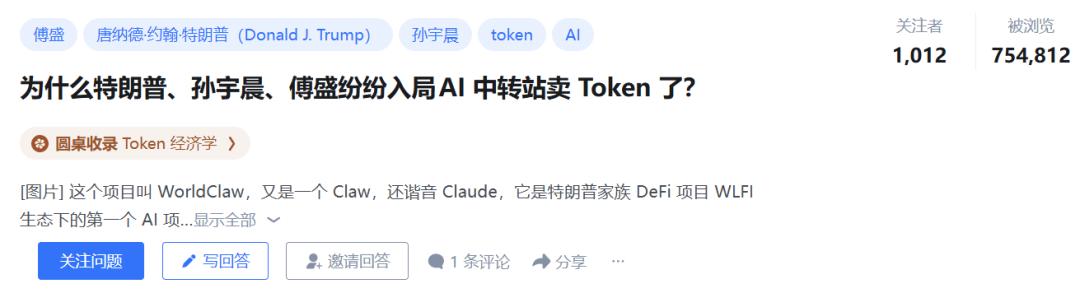
In the same week, in the same field, there were three very different names. On Zhihu, the question "Why have Trump, Justin Sun, and Fu Sheng all entered the AI transfer station business to sell Tokens?" quickly received over 750,000 views.
AI transfer station, this gray - area business, which is called "AI middleman" or "Token importer", suddenly stepped into the center of the public eye. The reason is simple: it is profitable enough.
This business is not new
To understand the AI transfer station, recall the Internet around 2000.
In that era, the most profitable ones were not portal websites like Yahoo or Sohu, but those unremarkable people: those who laid optical fibers, sold server racks, and provided IDC hosting services. Content was just a decoration, while infrastructure was the money - printing machine. The AI transfer station played the same role as those people in 2024 and 2025.
Technically, it is a reverse proxy layer between users and AI model providers. Users send requests to the transfer station, which then forwards them to the servers of OpenAI or Anthropic, retrieves the results, and delivers them back to the users. It may seem just an intermediary, but due to several real - world conditions, it has become a truly profitable business.
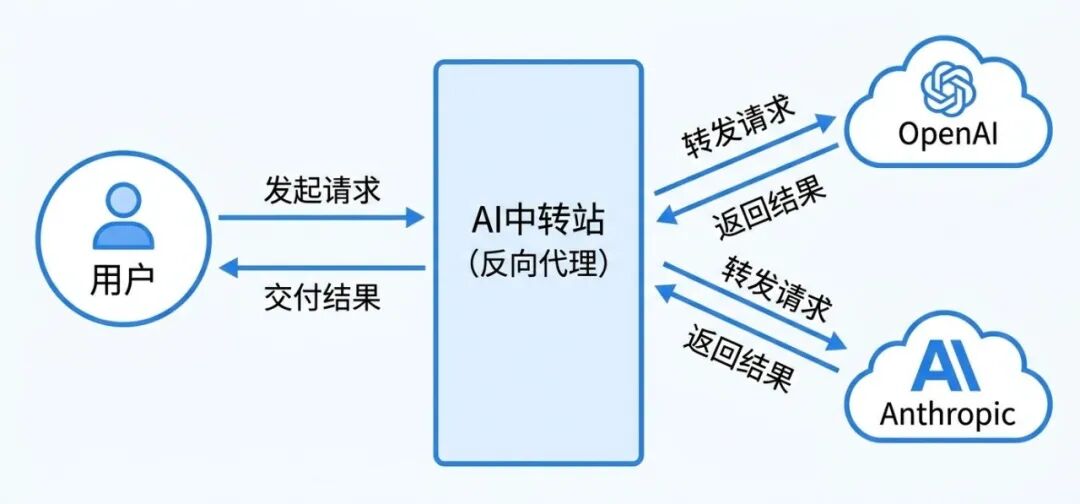
The first condition is the price disparity, and the gap is extremely large.
Take OpenAI as an example: subscribing to the Pro package costs $200 per month, which includes a large usage quota. However, if you pay by usage through the API directly, the cost for the same amount of usage could be as high as thousands of dollars per month, a difference of up to a hundred times. The situation with Claude is even more extreme: for a Claude Max subscription account, the monthly fee is about $200, but the API usage it can support, when calculated according to the official API pricing, could be worth $400 to $600. There is a very significant profit margin in the price difference.
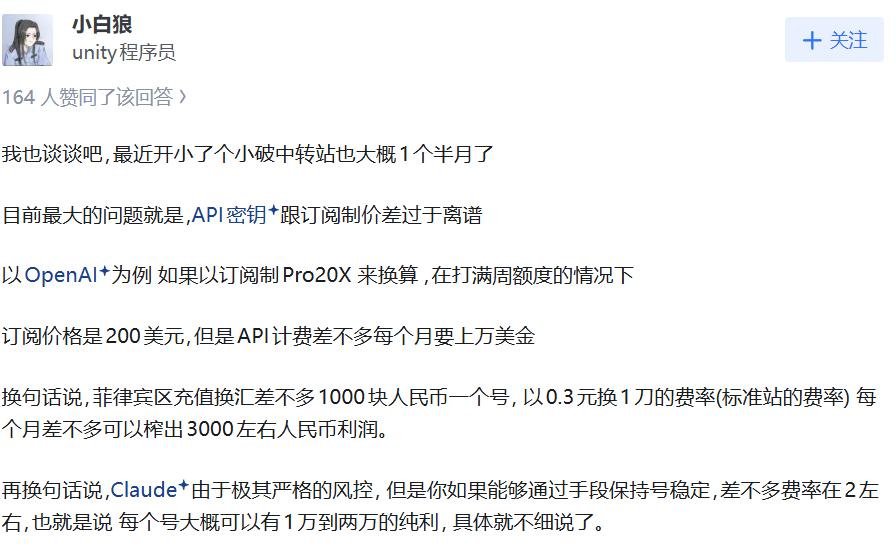
Image source: Zhihu @Xiaobailang
This price difference is not accidental from the start. AI providers use the high API pricing as a "price anchor" to make the subscription packages seem more cost - effective. However, many people don't need a subscription and just want to make temporary calls. This gap is the logic behind the existence of transfer stations.
The second condition is the access barrier, especially for users in China and the Global South.
For domestic developers, directly purchasing the API of overseas AI models faces three obstacles: payment channels (no way to bind overseas bank cards), network access (need a stable proxy environment), and corporate compliance (unable to obtain formal invoices for accounting). For most small AI application companies, it is more cost - effective to purchase from transfer stations directly rather than maintaining their own account pools. Transfer stations can even provide official invoices.
For a wider range of users in the Global South, not having a Visa card, a US - region account, or blocked bank channels means they are completely blocked from the most advanced AI tools by the official providers. The needs of these people are real and have been long - ignored.
The third condition is that the technical threshold is extremely low, so low that the entry cost can almost be ignored.
The open - source community has contributed almost complete infrastructure to this industry in the past two years. One API (with over 33,000 stars on GitHub, written in Go) supports almost all mainstream models such as OpenAI, Claude, Gemini, and DeepSeek. It is fully compatible with the OpenAI standard API format and can be deployed with a single Docker command. Even with a database and cache, the configuration only takes a dozen lines. Based on this, the New API, which is a secondary development, provides more comprehensive commercial functions and has become the de - facto underlying framework for many transfer stations.
The market scale has grown rapidly. According to the industry directory TokenNav, as of 2026, there are at least 92 similar products in operation at home and abroad. Practitioners generally believe in public forum discussions that the leading projects are highly profitable.
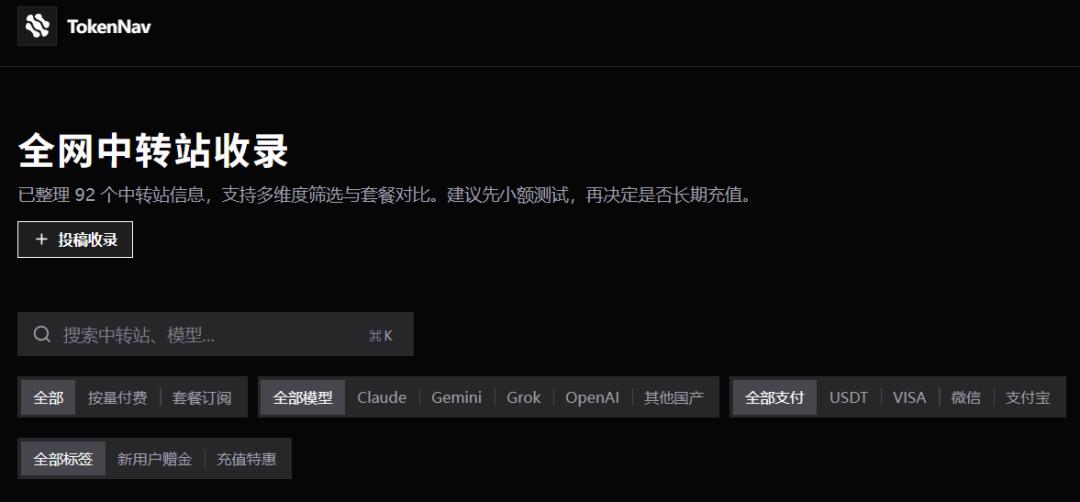
This is not something new. It's just that in May 2026, it finally attracted big players.
Three people, three different businesses
If you only look on the surface, Fu Sheng, Justin Sun, and the Trump family are doing the same thing: selling AI Token transfer agents. However, if you dig deeper, you will find that their motivations, logics, and target users hardly overlap.
In a nutshell: Fu Sheng sells convenience, Justin Sun sells the pipeline, and the Trump family sells tickets.
Fu Sheng: A listed company needs a new story
Cheetah Mobile was once a representative in China's Internet for removing rogue software. After the PC dividend faded, Fu Sheng led Cheetah to transform into the robotics and overseas tool markets, but failed to create a real second - growth curve.
The emergence of EasyRouter is logically clear: as a certified partner of Google Cloud and AWS, Cheetah Mobile has an advantage in cloud procurement discounts and can pass on some of the benefits to users. Fu Sheng also emphasized this point in a later explanation. The 85% discount across the board is not a gimmick but a part of the channel price difference feedback.
Justin Sun: Integrate TRON into every micro - payment in the AI field
Justin Sun's B.AI may seem like a transfer station on the surface, but inside it is a set of payment infrastructure built for the AI Agent era.
The core selling point of B.AI is not the discount but "identity - free": log in with a TRON wallet, settle with USDT, no need to register an account, no need for a credit card, and no need for KYC (identity verification). This directly meets two major demands: users in the Global South who cannot pay through conventional channels and AI Agents that need to complete tasks and payments autonomously on the blockchain.
As of April 2026, the TRON network has accumulated over 376 million accounts, with a USDT circulation volume of over $86 billion and a daily transfer volume of over $23 billion. This scale means that B.AI doesn't need to build its own payment network - TRON is already a mature global stable - coin settlement layer, and B.AI just connects the AI model as a new consumption scenario to this pipeline.
The drama lies in Justin Sun's situation. Just around the time of B.AI's release, on April 21st, he sued WLFI (the Trump family's cryptocurrency project) in the U.S. District Court for the Northern District of California for fraud, breach of contract, and unjust enrichment, accusing the other party of freezing about 2.9 billion tokens he held through a hidden blacklist function in the smart contract. The value of these holdings was over $100 million when frozen and had shrunk to about $75 million by the time of the lawsuit as the price of WLFI dropped. On May 4th, WLFI counter - sued for defamation in Miami - Dade County, Florida. While the two sides were in a lawsuit, on May 5th, WLFI's WorldClaw was launched - a product with almost the same form as B.AI.
Two opponents in a lawsuit entered the same business in the same way at the same time.
The Trump family: AI is just a new wrapper, and they are still harvesting the same group of "leeks"
WorldClaw is incubated by the WLFI ecosystem and is positioned as an "AI Agent operating system". Its core product, WorldRouter, is connected to over 300 AI models and claims to be 30% cheaper than the official price. Both Donald Trump Jr. and Eric Trump publicly reposted the product launch announcement on social media.
On the surface, it is an AI transfer station. However, a careful examination of its pricing design reveals a carefully constructed four - layer harvesting structure:
Layer 1: API call price difference. This is the most superficial and thinnest layer of income.
Layer 2: Users must pay with USD1, a stable - coin issued by WLFI in March 2025. Every AI consumption creates a real usage scenario and circulation demand for USD1. WLFI has applied for a national bank trust license, aiming to "make USD1 a compliant next - generation USDT".
Layer 3: Users can choose to lock their WLFI tokens to exchange for AI credits (250,000 tokens need to be locked for the Pro level, and 2,500,000 tokens for the Max level). A large number of tokens are locked, reducing the market circulation and driving up the token's market value. The large number of early - stage tokens held by the WLFI team will also increase in value.
Layer 4: The $9,999 Max package comes with a lottery ticket for a "chance" to attend a private dinner at Mar - a - Lago. This is not only a marketing gimmick but also a monetization of U.S. political access rights. Scholars studying political donations have long known that direct access to the power circle has a market price. The figure of $9,999 is just around a certain threshold for compliant political donations in the United States.
They make money once when you buy the API, once when you exchange for USD1, once when you lock WLFI tokens, and once when you participate in the dinner lottery. For one API call, they can make four times of profit.
The Trump family harvested once by selling Crypto Tokens before, and now they are doing it again by selling API Tokens. Truly, "No one understands Tokens better than me."
The hidden secrets in this business
The entry of three celebrities has brought the AI transfer station from the technical circle into the public eye. However, behind the hype, there has long been a systematic mechanism of user harm in this industry, which is rarely publicly discussed.
You may pay for GPT - 5 but receive Llama
In the transfer station industry, "watering down" (model substitution) is an open secret. Since most ordinary users can hardly tell the quality difference in the output of AI models with the naked eye, replacing high - end models with cheap ones has become the most stable and lowest - risk way to make a profit.
The paper "Behavioral Consistency and Transparency Analysis on Large Language Model API Gateways" published at the 2026 ACM Internet Measurement Conference conducted a systematic evaluation of real - world commercial gateways. The results showed that more than 40% of the tested endpoints failed the model fingerprint verification, which means the model you called is not the one the platform claims to provide; in actual task performance, the deviation was up to 47%. Ironically, the price has no predictive power for the accuracy of the results - paying more does not guarantee you won't be subject to substitution.
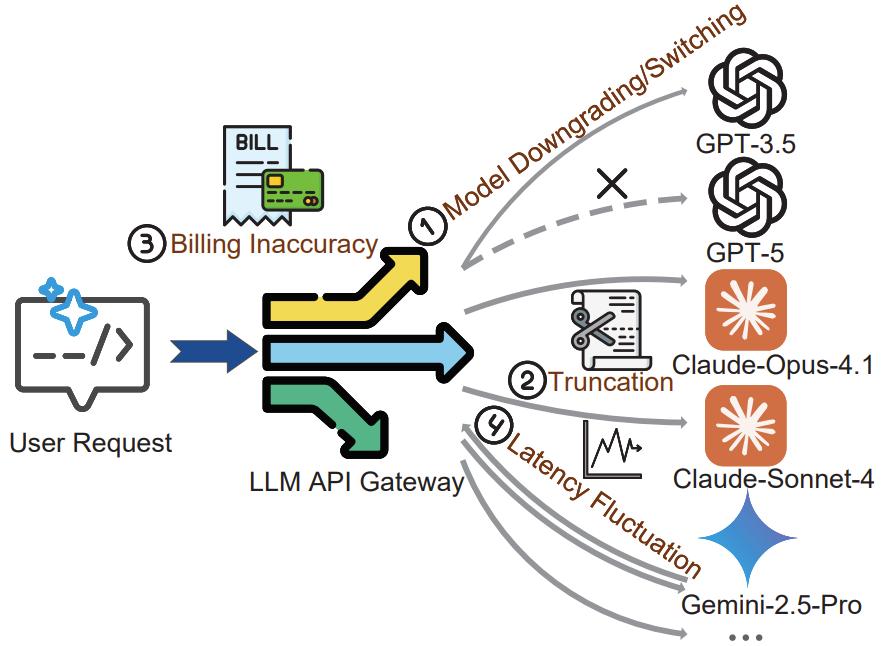
Image source: arXiv:2604.21083
The substitution methods range from crude to sophisticated. The most basic one is "probabilistic downgrading": out of 50 requests, 7 or 8 are redirected to cheaper channels, resulting in obvious quality fluctuations and inconsistent Token counts, which are easy to detect. The more advanced version is "silent version switching": every time the model is updated, the transfer station quietly switches the backend to a cheaper old version while increasing the price, and users are unaware.
We also reported on a similar study before. Refer to "Paying real money for fake models? 187 papers were severely affected by 'wrapped APIs', and the accuracy plummeted."