The smartest people in the world are flocking to Suzhou in groups.
In recent days, the most "internationally - flavored" place in China might be Suzhou.
On May 22, the 32nd APEC Ministerial Meeting on Trade kicked off in Suzhou. Inside the venue, more than 700 people from 21 economies and international organizations gathered here. Centering on the theme of "Building an Asia - Pacific Community for Common Prosperity", they discussed areas such as the digital economy, green and low - carbon development, and the resilience of industrial and supply chains.
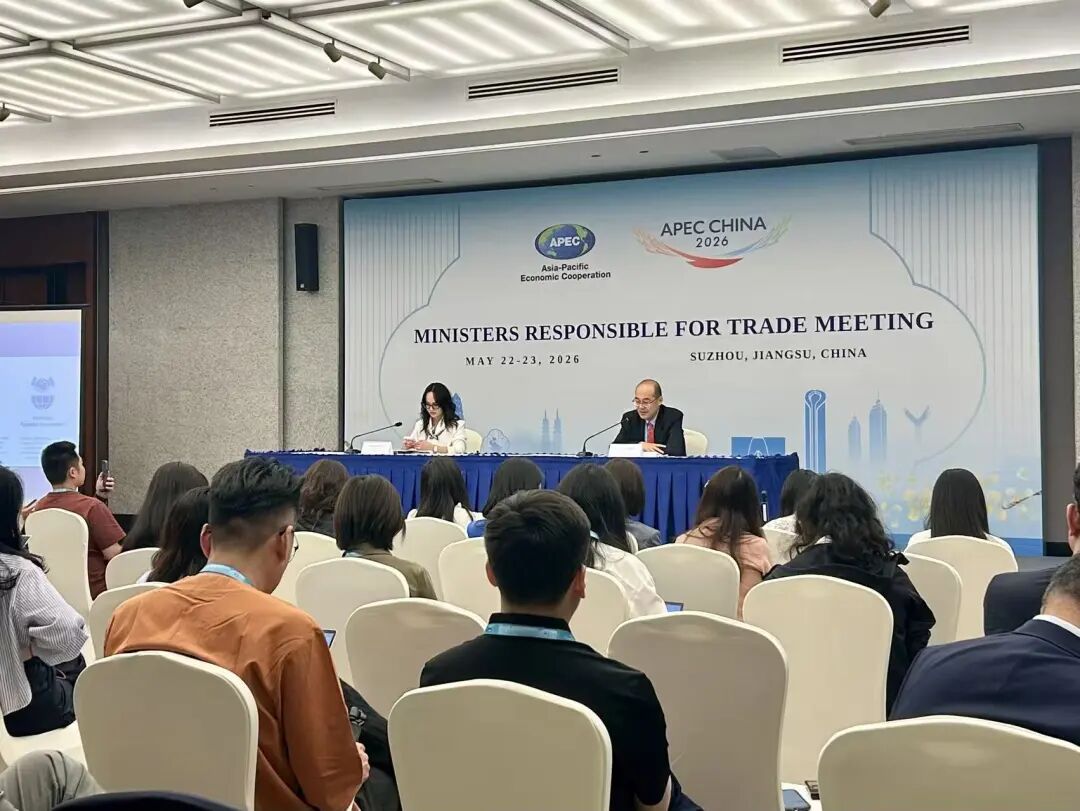
✎ The APEC Policy Support Unit released the latest Asia - Pacific Economic Outlook on May 21.
Outside the venue, the clattering of keyboards in the media center was as intense as a sudden rain, sending out the expectations for Asia - Pacific regional cooperation to the world. In the cafes by Jinji Lake, languages such as English, Japanese, and Thai were heard one after another, and people of different skin colors were communicating about more cooperation opportunities.
The day before, as an extended activity of the APEC Ministerial Meeting on Trade, at the Asia - Pacific Business Community Partnership Dialogue and the 2026 Suzhou Global Investment Promotion Conference, more than 200 executives from Fortune Global 500 and China's Top 500 enterprises gathered here to discuss the possibilities of industrial cooperation.
Companies like Nike, 3M, L'Oréal, and Panasonic were all guests. These names are no strangers to Suzhou. Over the years, what they have added in Suzhou is not just production lines, but also R & D centers, intelligent manufacturing bases, and regional headquarters.
Against the backdrop of the reconstruction of the global supply chain and the rise of trade protectionism, these multinational capitals, which are good at calculating risks and returns, are still continuously increasing their investment in Suzhou.
To some extent, this means one thing: they see the most precious certainty here at present.
In the first quarter of this year, Suzhou's export - oriented economy once again delivered an outstanding report card: the total import and export volume reached 799.9 billion yuan, a year - on - year increase of 26.5%, with the growth rate 11.5 percentage points higher than the national average, and its contribution to the national foreign trade growth reached 10.9%. Among them, Suzhou's import and export volume with other APEC economies was 569.9 billion yuan, a 26.1% increase.
In 2025, with a GDP of 387.7 billion US dollars, Suzhou ranked sixth among all cities in China and around the 20th among global cities. Its export and foreign trade volume have long ranked third or fourth in China. As of December 2025, the cumulative actual use of foreign capital in Suzhou exceeded 170 billion US dollars, and 185 Fortune Global 500 companies have invested in 508 projects here.
For Suzhou, the increase in numerical scale may no longer be the primary pursuit. Its irreplaceable uniqueness lies in: in the current global economic system, Suzhou is not only a geographical coordinate of "Made in China", but also a key efficiency node in the global high - tech industrial chain.
It's about saving time
If in the past, the competition in the manufacturing industry was about land, labor, and taxes, now the core of global manufacturing competition has become efficiency.
From R & D verification, supply chain collaboration, to manufacturing, logistics and transportation, and then to global delivery, in the entire chain, the one who uses the least time will have stronger competitiveness.
What makes Suzhou powerful is that the whole city is like a super factory.
Tai Cang, a county - level city under the jurisdiction of Suzhou, is known as the "Hometown of German Enterprises". There is a saying locally: "You can get 70% of the parts for a car by taking a bus around."
This is not just local investment promotion talk, but the real industrial situation.
Zhu Qinhua, the chairman of Boma Technology, mentioned that compared with the previous factories scattered in Dongying, Jinan and other places, after integrating production in Tai Cang, the enterprise not only reduced management costs, but also greatly optimized the internal logistics route. Parts that used to be transported across provinces and then assembled can now be produced collaboratively in Tai Cang.
This industrial cluster has brought a complete set of industrial collaboration systems. Boma Technology and its suppliers adopt the JIT (Just - in - Time) production model: the suppliers are only a 10 - minute drive from the factory, and the enterprise doesn't even need to build a large - scale warehouse. The goods delivered on the same day can be put into production immediately.
The enterprise and its customers adopt the "milk truck" circular distribution model: the vehicles transport back and forth along fixed routes and time points, gathering and transporting materials from multiple suppliers, which significantly reduces logistics costs.
Zhou Xiaohe, the deputy director of the office of the Suzhou Port Administration Committee and the deputy director of the Tai Cang Port Administration Committee, told a reporter from Times Weekly that in 2025, the container volume of direct foreign trade routes between Suzhou Port and APEC economies alone reached 1.21 million TEUs, a year - on - year increase of 11.9%.
In the first four months of this year, about 400,000 cars were exported from the Tai Cang Port Area. Among them, nearly 80,000 cars were exported to 13 APEC economies such as Mexico, Peru, and Singapore, a year - on - year increase of 17%, making it the main force in overseas exports. "There are many cars waiting to be exported at the Haitong Wharf. About 600 - 800 cars are exported to APEC countries every day," Zhou Xiaohe said.
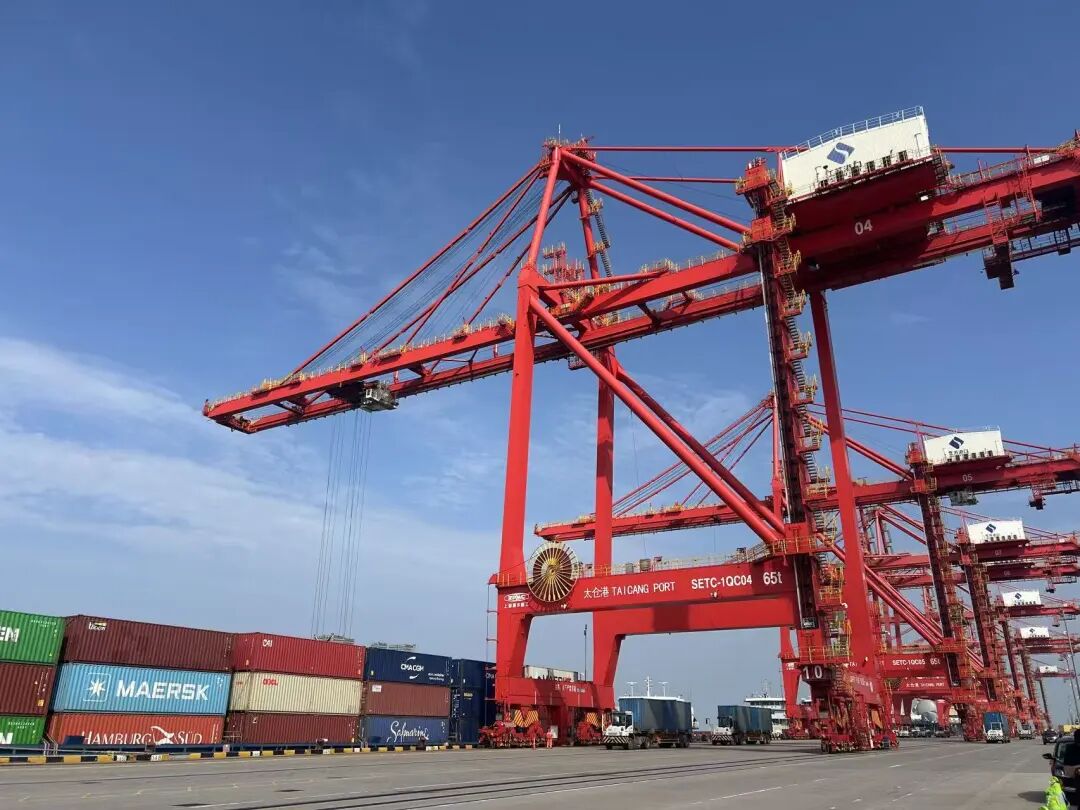
✎ Tai Cang Wharf. Photo source: Photo taken by a reporter from Times Weekly
Nike's choice to develop in Suzhou is also about saving time.
Ke Shihui, the chief government affairs and public policy officer and group vice - president of Nike, introduced that since Nike established its first entity in Tai Cang in 1996, it has been deeply involved in Suzhou for nearly 30 years. Among them, the Tai Cang Logistics Center is an important hub of Nike's logistics system in China. Since the establishment of the China Logistics Center in 2010, its operating efficiency has increased by 5 times, and the annual receiving and dispatching capacity exceeds 180 million pieces.
For multinational enterprises, this not only means storage capacity, but also the scheduling efficiency of the global supply chain.
Liu Sheng, the founder and chairman of Suzhou InnoLight Technology Co., Ltd., mentioned that the optical module industry is a typical global collaborative industry. The upstream involves multiple complex links such as high - speed optical chips, electrical chips, precision structural parts, and testing equipment, and has extremely high requirements for supply chain stability, collaborative efficiency, and response ability.
Suzhou is not only a super factory itself, but also located at a key node in the Yangtze River Delta, which enables it to quickly connect with resources in various parts of the Yangtze River Delta. "More than 95% of our upstream supply chain comes from the Asia - Pacific region, and many core supporting enterprises are concentrated in Suzhou and the surrounding Yangtze River Delta region," Liu Sheng said.
In the wave of computing power brought by artificial intelligence, optical modules have become an important infrastructure for the global AI industrial chain. Currently, 50% of the world's high - end optical modules are produced in Suzhou. This means that behind many global AI systems today, there is Suzhou's manufacturing ability.
For today's multinational enterprises, what is scarce is no longer a single factory, but a complete set of industrial networks that can respond stably, efficiently, and quickly. And Suzhou is precisely one of the densest nodes in this network.
Not only a factory, but also an R & D center
The changes in Suzhou are actually a microcosm of the upgrading of Made in China.
There stands a sculpture named "Cooperation" in the Central Park of Suzhou Industrial Park. The red S - shaped steel plates are interspersed and rotated in it. The "S" represents both Suzhou and Singapore.
In 1994, China and Singapore signed an agreement to jointly develop and construct Suzhou Industrial Park. In May of the same year, the first pile was driven in the park. At that time, Suzhou was learning from Singapore's industrialization experience, industrial planning, and public governance model. But thirty years later, this relationship has quietly changed.
Lee Kuan Yew, the former prime minister of Singapore, visited Suzhou Industrial Park nine times and commented that it "surpasses the master". Ji Huasheng, the executive director of the International Business Department of the Singapore Business Federation, mentioned that in recent years, Singapore has started to absorb new development concepts from Suzhou.
Behind this change is a deep - level upgrade of Suzhou's foreign investment structure. In the early days of reform and opening - up, Suzhou quickly grew into a globally well - known manufacturing base by virtue of its land, labor, and location advantages. At that time, a large number of foreign - funded enterprises came to Suzhou with the core goal of establishing production factories.
Take Samsung as an example. As one of the earliest foreign - funded enterprises to settle in Suzhou Industrial Park, it initially focused on the home appliance business, then shifted to the liquid crystal display industry. In recent years, it has introduced the medical device business into the park and gradually transferred the automated production research business to China for R & D and production.
Now, what multinational enterprises are adding in Suzhou are more and more R & D centers, regional headquarters, and intelligent manufacturing platforms.
The layout upgrade of Siemens is also representative.
After establishing Suzhou Siemens Electric Appliance Co., Ltd. in 1994, its role in Suzhou has been continuously upgraded: from a manufacturing factory to the establishment of the China headquarters for electrical products in 2021; the following year, it was further upgraded to the East Asia headquarters, responsible for the Japanese and Korean markets; in 2024, it also established the China headquarters of Advanta in Suzhou High - tech Zone, forming a pattern of "two headquarters and one center".
Xiao Song, the chairman, president, and CEO of Siemens China, said that the upgrade of the Suzhou headquarters means that Siemens is supporting Suzhou to build a high - ground for "headquarters economy" with a complete local value chain and global resources.
More importantly, global enterprises are starting to put their core technologies in Suzhou.
In 2001, when the German company SEW entered Suzhou Industrial Park, the Suzhou factory mainly undertook the processing of motor drive control products. It wasn't until 2012 that the German headquarters decided to introduce the core technology of EMS into China.
EMS is an overhead monorail suspension transportation system that uses a contactless energy transmission method to efficiently transport parts and equipment. For the German manufacturing industry, this is a highly core technological ability.
The person - in - charge of SEW Transmission Equipment (Suzhou) Co., Ltd. once mentioned that the German headquarters has long been very strict in protecting its core technology. But the rapid development of the Chinese market finally made it decide to transfer the technology.
Subsequently, Chinese engineers were trained in Germany and then carried out local improvement on the EMS system, developing a new system more suitable for the needs of Chinese factories. "Since then, there have hardly been any German engineers in the SEW factory in Suzhou," a relevant engineer recalled.
The deepest change in the upgrade of Suzhou's manufacturing is not just that the factories have become more intelligent, but that global enterprises are starting to put their "technology" in Suzhou.
This change is reshaping the global industrial chain.
Ding Hongyu, the global senior vice - president and China president of 3M, mentioned that many optical materials on cameras, mobile phones, and car displays today come from the 3M Suzhou factory. "The Suzhou factory is our largest global production and manufacturing center for optical products," Ding Hongyu said.
In the future, 3M will continue to increase its investment in Suzhou and build the Suzhou production base into a world - class design and manufacturing platform for optical and electronic materials.
From being part of the "world factory" to becoming a R & D node, an intelligent node, and an innovation node in the global high - tech supply chain, Suzhou has embarked on a clear industrial upgrading path, making its position in the global industrial map more and more important.
The "emotional value" of the strongest prefecture - level city
The most special thing is that, compared with many highly - stressed manufacturing cities, Suzhou, known as the "strongest prefecture - level city", always retains a rare sense of relaxation. This also makes many people who come to Suzhou for the first time feel a strange contrast.
The high - tech park is neatly arranged, but in the old city, the gardens still retain the elegance of the Ming and Qing Dynasties, and cats are stretching in the temples. There are no high - rise buildings in the ancient city because the ancient city of Suzhou strictly follows the rule that the building height should not exceed 24 meters - which is about one - third of the height of Beisi Pagoda built in the Southern Dynasties.
Here, there is both a high - speed global industrial chain and a leisurely Jiangnan life.
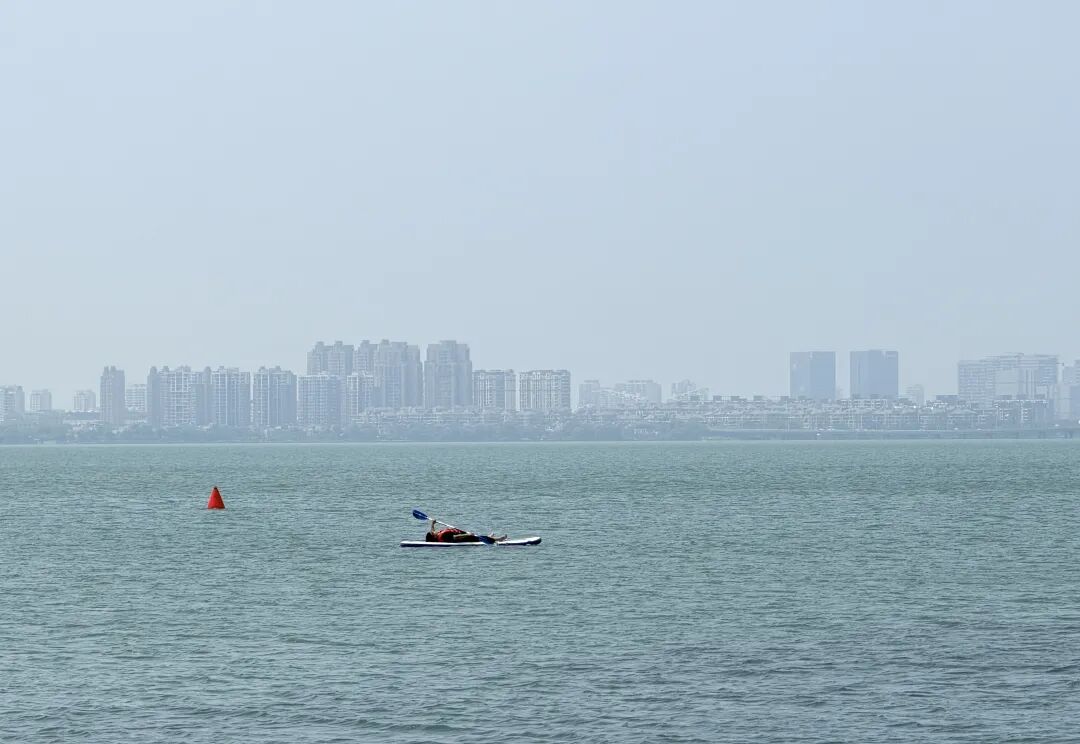
✎ People are playing paddleboarding in Dushu Lake.
During the day, in the office buildings by Jinji Lake, executives of multinational enterprises, investors, and engineers are discussing global orders, AI manufacturing, and supply chain collaboration; in the evening breeze on Pingjiang Road, people are tasting Suzhou - style noodles and mung bean soup in restaurants, queuing up to buy plum cakes, and then listening to a performance of pingtan or Kunqu Opera.
This "emotional value" is precisely an important reason for global capital to stay for a long time. As of now, Suzhou has been elected the "most attractive Chinese city in the eyes of foreign talents" for 14 consecutive years.
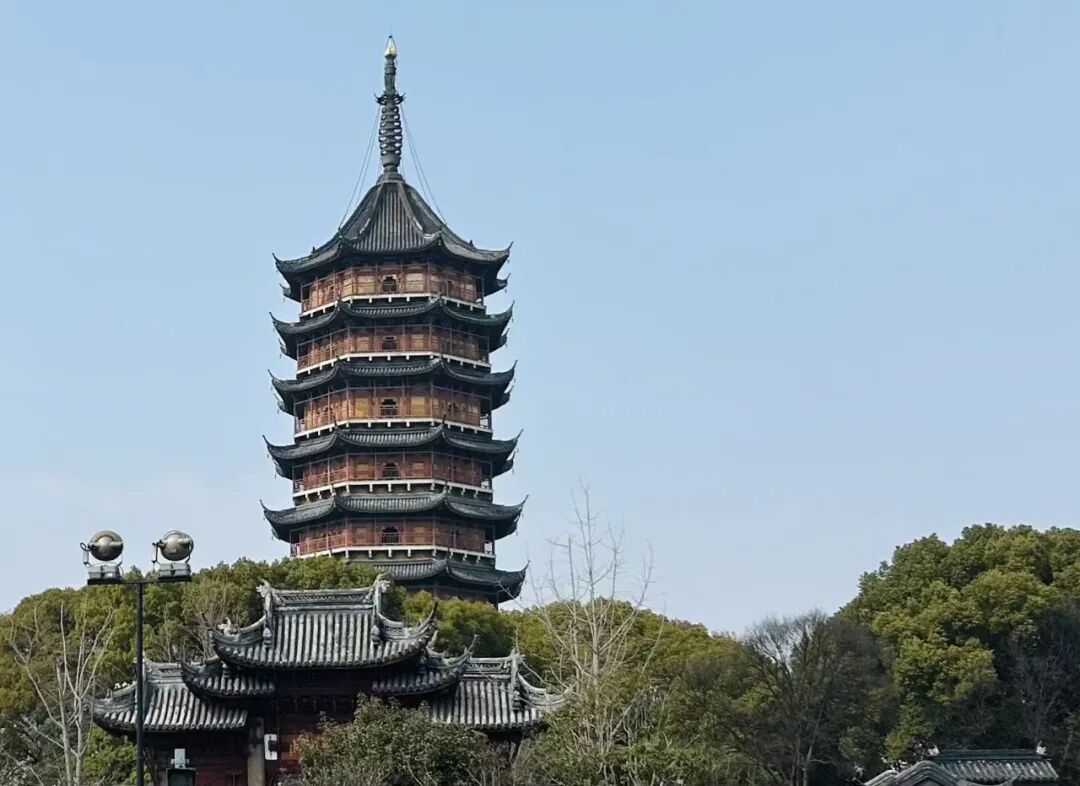
✎ Beisi Pagoda, the landmark of the ancient city of Suzhou
Behind this attractiveness is not just cafes and a livable environment, but more importantly, a sense of stability. Against the backdrop of increasing global economic uncertainty, enterprises are paying more and more attention to institutional efficiency and long - term expectations.
In recent years, Kunshan has deepened the implementation of the integrated service action for foreign trade and foreign investment, and established a "one - enterprise, one - commissioner" linked service mechanism to provide accurate and efficient response to enterprises' demands.
At the same time, Suzhou is also continuously promoting institutional opening - up. For example, after Safran Group of France was approved to establish a cross - border RMB two - way capital pool in the Suzhou Free Trade Zone, it applied for an RMB loan from the