An AI advertising company has become a sensation, netting 8.6 billion yuan in just three months with a profit margin of 85%.
Recently, a group of AI companies with the highest global profit margins have emerged. One of them is called AppLovin.
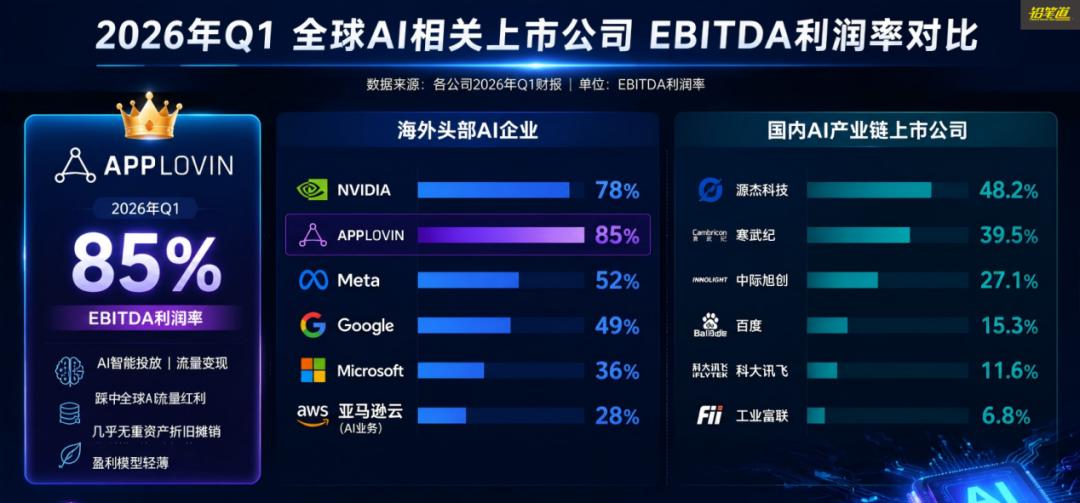
Its first-quarter report reveals that in Q1, its revenue reached $1.84 billion, a year-on-year increase of 59%; the net profit was $1.2 billion (8.6 billion yuan), a year-on-year increase of 109%; the adjusted EBITDA margin was 85%.
This figure of 85% surpasses that of leading giants such as NVIDIA, META, and Google.
What does AppLovin do? Simply put, it is an AI advertising platform on the verge of a breakout. The biggest driver of its profitability is that it has reaped the first wave of global AI dividends - by reconstructing the matching efficiency of mobile advertising with Axon.
The Axon recommendation system makes ad matching more precise: it predicts in real-time which users are more likely to click, download, or make a payment, and dynamically adjusts ad display and budget allocation.
According to media reports, after a kitchenware brand connected to Axon, its revenue increased from $4 million to $16 million and is expected to reach $80 million this year.
Behind this, there is also an important signal: The logic of Chinese enterprises going global is shifting from "manual experience-based trial and error" to "algorithm-driven prediction."
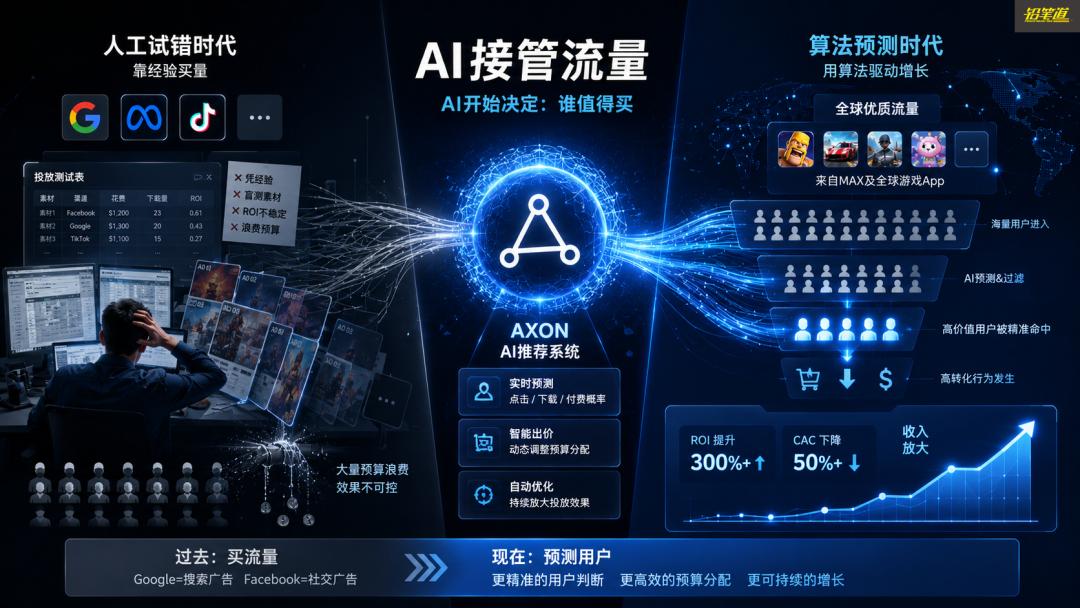
AppLovin's traffic does not come from Google, Meta, or TikTok, but from its self-developed platform MAX and the global game apps it has connected to. In other words, AppLovin is a new traffic option beyond search and social media.
The fundamental change here is that in the past decade, the formula for Chinese companies to buy traffic overseas was simple: Google = search ads, Facebook = social ads.
Now, AppLovin is more like a set of "growth tools": it doesn't just offer you an additional traffic entry point. Instead, it uses a recommendation system to help you more efficiently determine - which users are worth acquiring, where the budget should be allocated, and whether the advertising results can be continuously amplified.
85% Profit Margin: Riding the Wave of the AI Era
Recently, AppLovin released a highly unusual financial report.
According to its first-quarter report in 2026, in Q1, its revenue reached $1.84 billion, a year-on-year increase of 59%; the net profit was $1.2 billion, a year-on-year increase of 109%; the operating margin was 71%, and the EBITDA margin was about 85%.
What does this figure mean? For comparison, Meta's operating margin was about 41% during the same period, and Google's was about 36%. AppLovin's profitability is quite rare among global internet companies.
CEO Adam Foroughi revealed in an interview that the core advertising business team consists of about 400 people, and each person creates an EBITDA of over $15 million annually.
What surprises the industry about AppLovin is not just its profitability but also the fact that AI is replacing the traditional manual advertising placement system.
Over the past decade or so, the underlying logic of the advertising industry has actually remained unchanged: The traffic entry point is the power center.
Google controls search traffic. In 2024, Google's advertising revenue exceeded $280 billion, accounting for about 28% of the global digital advertising market.
Meta (Facebook/Instagram) controls social media traffic. In 2024, Meta's advertising revenue exceeded $160 billion, accounting for about 22% of the global digital advertising market.
The logic of Chinese companies going global has also revolved entirely around these two major entry points.
According to surveys by multiple institutions such as the Weizhuo Overseas Research Institute, the LeadLeo Research Institute, and eMarketer in 2025, about 40% - 45% of the advertising budgets of Chinese overseas companies flow to Meta platforms, and 28% - 32% flow to Google platforms. Together, they account for nearly three-quarters (70% - 75%) of the market share.
The remaining 15% - 25% is concentrated on TikTok, and 5% - 10% is scattered across channels such as X (formerly Twitter) and Snapchat.
Now, AppLovin is becoming a new traffic option beyond search and social media. Its traffic does not come from Google, Meta, or TikTok, but from its self-developed platform MAX and the global game app ecosystem it has connected to.
More importantly, it is not just changing the source of traffic but also the way traffic is allocated. In the past, Chinese companies' overseas traffic acquisition highly relied on manual experience: advertisers adjusted budgets, tested creative materials, monitored ROI, and continuously tested different target audiences.
According to the "2025 Overseas Mobile Game Traffic Acquisition Report" by DataEye, for a mid - tier game manufacturer, with a monthly investment of millions of dollars, parallel operations in multiple markets, and high - frequency material iterations, the advertising team usually consists of more than 20 people. For mature mid - tier manufacturers, the team can reach 40 - 50 people.
Now, a new change has emerged: The recommendation system can find the optimal match among a vast number of possibilities by continuously learning user behavior data, with higher efficiency and accuracy than manual experience.
Take advertising placement efficiency as an example. Traditional advertisers can barely manage dozens of advertising campaigns simultaneously in a day.
The deep - learning recommendation system behind Axon needs to process billions of advertising requests every day and optimize bidding and ad - matching strategies in real - time - this scale and response speed are beyond the reach of the manual advertising placement system.
After a 92% Drop in Market Value, Betting on AI
It's hard to imagine that before its breakout, AppLovin was almost on the verge of collapse. However, a series of crucial actions by CEO Foroughi turned the situation around.
In 2022, AppLovin experienced its darkest hour after going public. Its market value evaporated by $40 billion, and the stock price dropped by more than 92% at its worst. Investors thought this "weird - named advertising company" might be worthless.
"When you're running a business and the whole world says your company is terrible, what on earth should you do?" Foroughi recalled later in a podcast.
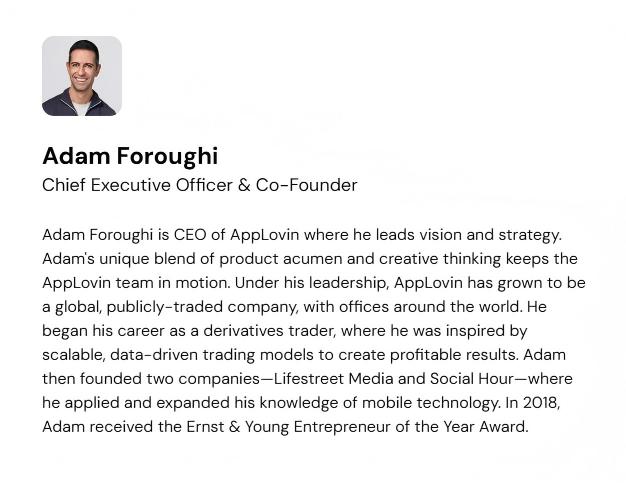
AppLovin CEO Foroughi used to be engaged in quantitative trading in the early years.
However, he noticed a set of key data.
When the company went public in 2021, its EBITDA profit was about $700 million; in 2022, this figure exceeded $1 billion - the business was growing, and the execution was progressing, but the stock price was collapsing.
Therefore, he made two counter - intuitive decisions.
The first decision: Borrow money to buy back shares. Within 18 months, the company invested about $6 billion in share buybacks, partly with its own funds and partly through leveraged financing. This buyback ultimately created a value of about $50 - 60 billion.
The second decision: Start from scratch. At the end of 2022, Foroughi almost halted the R & D of the old system and rebuilt a new one.
Foroughi judged that the old system could last at most 1 - 2 years, and not reconstructing it would be a death sentence. The reason was straightforward: AppLovin was still using a traditional machine - learning model at that time, while its competitors had already adopted more advanced deep - learning models.
During this period, the new CTO, Giovanni Ge, joined the team. Three to four months later (April 2023), AppLovin launched the new - generation advertising model, Axon2.
This reconstruction became a crucial turning point for its business. In 2024, AppLovin's stock price rose by more than 700%. Meanwhile, the business structure changed.
1. Consumer advertisers are flocking in, and the growth rate is abnormal. In April 2026, the advertising spending of consumer advertisers reached a record high. The advertising expenditure in March was 25% higher than that in January.
2. The boundaries of orders are disappearing, but games still remain the core business. Advertising scenarios have expanded from games to industries such as automobiles, finance, insurance, and food delivery. E - commerce currently accounts for only about 5% of the revenue.
In terms of revenue performance, the company's Q1 revenue in 2023 was about $715 million, increasing to $1.06 billion in Q1 2024 and reaching $1.84 billion in Q1 2026 - a 2.6 - fold increase in three years.
Why Do Customers Pay? Paying for Certainty
AppLovin's core business logic is actually quite simple: Help advertisers earn more money than they spend on advertising.
Foroughi once explained this logic in an interview: AppLovin focuses on performance - based advertising. Advertisers connect to the platform with the aim of earning more revenue than the advertising costs. The core factor determining this performance is the predictive ability of the advertising model. As long as the model makes more accurate predictions, advertisers can continuously increase their advertising investment, and the platform can continuously create incremental value.
After the release of Axon2 (April 2023), this ability began to be clearly reflected in business performance.
Take Otto, a German e - commerce giant, as an example. After connecting to App Discovery powered by Axon2, its 7 - day return on investment increased by 82%, the number of new installations grew by 185%, and the customer acquisition cost decreased significantly.
This means that in the past, when an advertiser spent $1 million on advertising, they might only earn back $1.2 million. Now, with the same $1 million budget, they might earn back more than $2 million.
This is AppLovin's core business logic: In essence, it is not selling ad spaces but helping advertisers improve the profitability of their "advertising expenses."
Once the ROI continuously improves, advertisers will keep increasing their budgets, and in turn, the increased budgets will drive the platform's revenue growth.
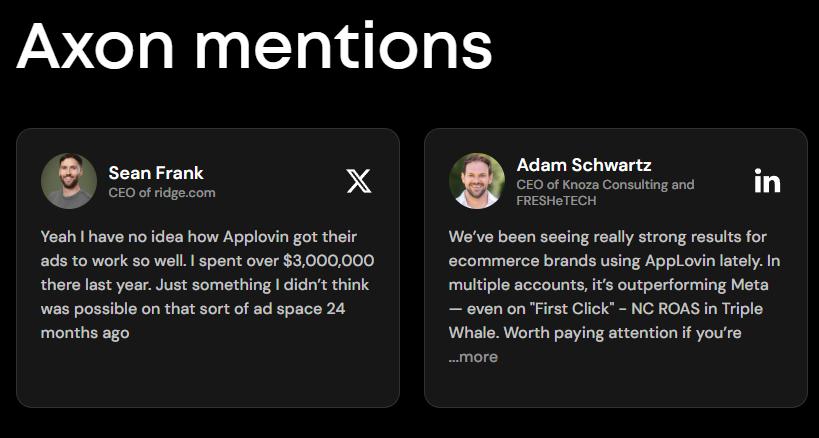
Foreign corporate CEOs' evaluations of AppLovin
This is not an isolated case. After the launch of Axon2, the annualized advertising spending of platform advertisers increased from less than $3 billion to more than $11 billion.
Behind this, it actually reflects a key change in the AI advertising industry: In the past, many advertising platforms sold "traffic," while AppLovin sells results.
In the past, the biggest headache for advertisers was that after spending advertising fees, they didn't know which users would actually make a payment. A lot of growth relied on manual trial and error - adjusting creative materials, changing target audiences, and monitoring ROI.
What Axon truly changes is that: The recommendation system continuously analyzes user behavior signals and dynamically predicts the conversion probability. The system will continuously analyze which types of users are more likely to click, which types are more likely to place an order, which types have a higher lifetime value, and then dynamically adjust the budget and traffic allocation.
According to data from the marketing agency WorkMagic (released in July 2025), after the food brand Immi adopted Axon, a notable change was that the same advertising budget not only drove orders on its official website but also boosted sales on Amazon.
Ultimately, Immi's customer acquisition cost was nearly half that of other channels, and its return on investment was 65% higher.
This reflects that the advertising industry is shifting from "testing with a large number of creative materials" to "letting AI improve the utilization efficiency of each piece of material."
In the past, a piece of advertising material might quickly become ineffective, and advertisers had to continuously increase the number of materials, human resources, and testing budgets. Now, the AI model will automatically identify which materials are more likely to bring about conversions and automatically optimize the advertising placement path.
The result is that the same number of materials can achieve a higher ROI.
Chinese Enterprises Going Global Are Changing Their Strategies
Some Chinese enterprises have started to regard AppLovin as a new "AI - powered growth tool."
According to a research report by Guotai Junan Securities, after the Chinese game company ChiZiCheng Technology connected to AppLovin's Axon2, the revenue of its high - quality games such as Alice's Dream increased by 182.5% compared with the same period in 2023.
Public data shows that before the cooperation, Alice's Dream was consistently ranked outside the top 400 on the Apple iOS free game list. After the cooperation, in May and June 2024, the game continuously entered the top 30 list of Sensor Tower's Chinese mobile games' overseas revenue.

The game interface of Alice's Dream
This means that Chinese overseas enterprises have realized that AI is not only influencing "how to place ads" but also influencing "whether a product can truly succeed."
Over the past decade or so, Chinese companies have been struggling in the highly competitive environment of several major traffic platforms. Those who understand Facebook and Google better and are more skilled in traffic acquisition are more likely to achieve growth.
As a result, the traditional formula for going global has become: A large - scale advertising placement team, high - frequency material testing, refined ROI management, and global user operation.
Under this model, the advertising costs of enterprises have remained high, to the point where they are almost unbearable.
Data shows that the average sales expense ratio of A - share game companies increased from 24% in 2020 to 29% in 2023. Take 37 Interactive Entertainment Network Group Co., Ltd., a leading A - share game company known for traffic acquisition, as an example. In 2021, its sales expenses reached as high as 9.1 billion yuan, accounting for 56% of its operating revenue.
However, now a new change is emerging: The explosion of AI applications is rapidly intensifying global traffic competition.
More and more AI products need to achieve global customer acquisition, large - scale advertising placement, high - frequency testing, and rapid market expansion in a very short time. The traditional advertising placement system that relies on manual experience is becoming increasingly difficult to adapt to this speed.
The rise of App