AI Era: Core Terminal Ecosystem Positioning and User Needs Insight | 2026 AI Partner · Beijing Yizhuang AI + Industry Conference
AI is not a story about a single super product but an ecological story of multi - terminal collaboration. Consumers' expectations and concerns are defining the evolutionary direction of this ecosystem.
The integration of AI and hardware is divided into four stages, and currently, we are at a critical juncture moving from deep integration to ecological development. The penetration rate of AI in mobile phones has increased from 15% to 40%, but it is still an "added bonus" rather than a "decision - making factor". In the future, the four steps of the AI hardware ecosystem - perception, memory, decision - making, and action - may be jointly completed by smart glasses, mobile phones, and PCs.
The following is the content of the speech, organized and edited by 36Kr:
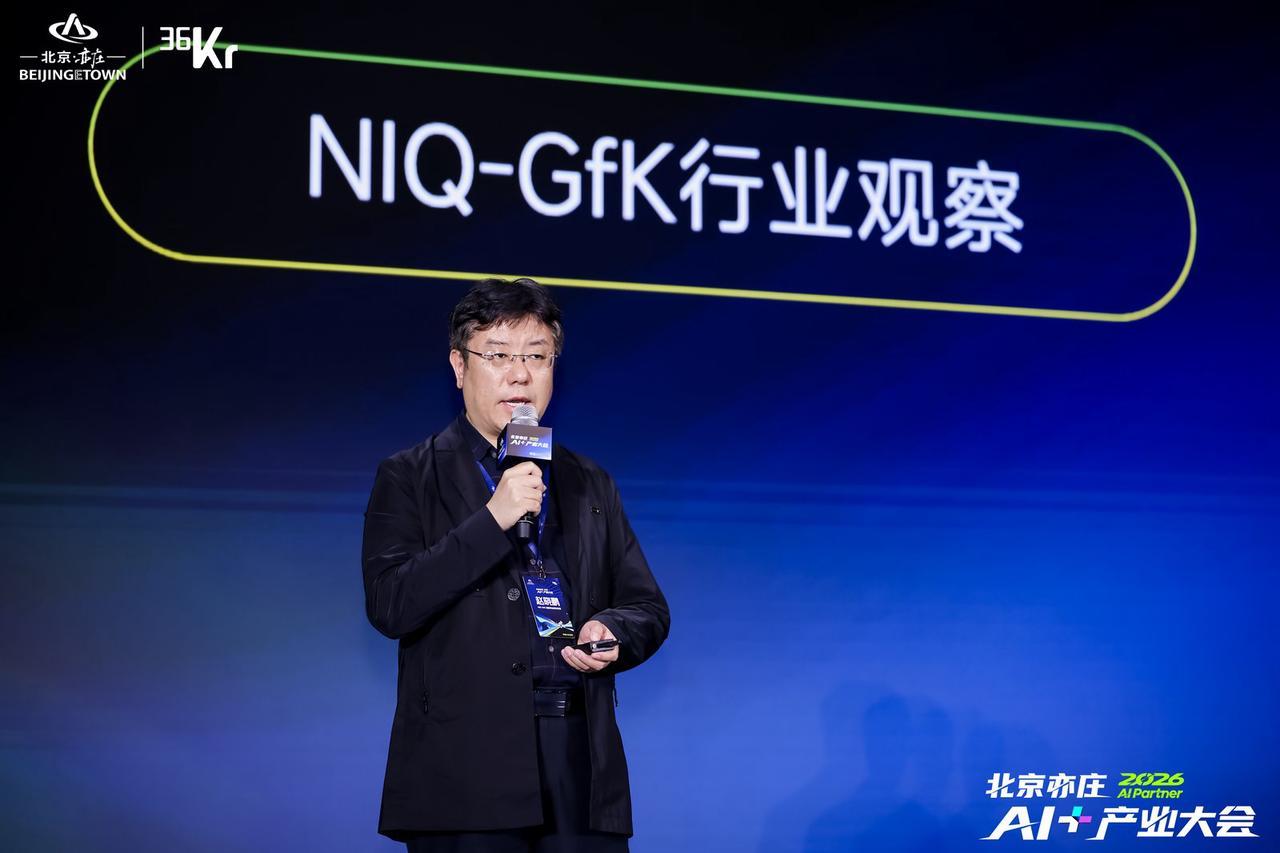
Zhao Xiaopeng | General Manager of the Innovation Division of NIQ GfK
Hello, everyone. I'm very honored to have this opportunity to share NIQ GfK's views on the consumer side with you. Our company focuses on researching consumers and terminal products, which are very closely related to your daily lives.
My topic today is Positioning of the Core Terminal Ecosystem and Insight into User Needs in the AI Era, which will be mainly divided into two parts.
The first topic is: When we talk about AI, which hardware are we referring to? And what features do consumers care about?
The integration of AI and hardware is a two - way process. In our view, it can be divided into four stages: The first stage is the exploration period; the second stage is the intelligent tool period - you should all have an impression, for example, a few years ago, AI voice interaction suddenly boomed, and many new products emerged; the third stage is the deep integration period, where AI and hardware are more closely combined and have entered mobile phones, PCs, and tablets. We believe this is not the end, and in the future, it will enter the fourth stage - the ecological dominance period, where various hardware will form a unified ecosystem and fully integrate into everyone's lives.
When consumers pay attention to AI hardware, they prefer portable devices. In our research, the top three most - concerned products are mobile phones, earphones, and smart glasses - these products are highly portable and close to daily use; traditional PCs and tablets also maintain a stable demand.
Young people under 25 are very concerned about productivity. That is to say, in addition to entertainment functions, they also care about whether it can improve work efficiency. This group mainly consists of college students, who use PCs more often and also have many creative needs.
Consumers are most interested in the entertainment and convenience - related functions of AI. Of course, there are also needs in learning and work, but their current ranking is not as high as that of entertainment. However, this does not mean that the demand is insufficient. On the contrary, we believe this is a direction worthy of exploration and excavation. Once these needs are verified, it will release a very large market space, which is also the key area that future hardware companies need to focus on.
There are many devices equipped with AI functions now, but the key to AI hardware does not lie in whether it has AI functions - in fact, almost all hardware now has some degree of AI capabilities. The AI we understand is deeply involved in the system architecture, interaction mode, and value - creation process of the device, mainly reflected in three aspects: First, system - level embedding, not just simple interaction, but truly embedded in the operating system; second, operating system reconstruction. In the past, people adapted to the device. In the mobile era, people are used to operating with apps. In the future, the device will adapt to people. When you issue an instruction, it can mobilize all resources to serve you; third, continuous value creation. The system can continuously learn and improve, and it will evolve with use.
The second topic is: Can a single piece of hardware meet all the expectations that users have for AI? Our conclusion is no.
Future AI will not rely on a single piece of hardware but a whole ecosystem. As I said at the beginning, the future is the integration of the AI ecosystem. We have selected three products that are highly relevant to ordinary consumers to form a simple ecological model: the first is smart glasses, the second is the mobile phone, and the third is the PC. Smart glasses are all - weather perception terminals. The mobile phone is responsible for lightweight data processing and decision - making. If there are heavy - duty tasks that the mobile phone cannot handle, they will be handed over to the PC for in - depth calculation; if the terminal side still cannot solve the problem, the cloud capabilities will be used to make up for it. This is the future direction we foresee: multi - terminal collaboration to build a distributed terminal - side AI ecosystem.
Our observations on hardware are as follows:
1. Mobile phones. Currently, mobile phones are essentially just app containers, and people basically operate each app separately. In the future, this model will change. AI applications can work collaboratively across multiple apps to complete complex operations for users. The AI entry point may be in the hands of mobile phone manufacturers or large - model manufacturers, but in any case, the trend of competing for the first entry point seems irreversible. In addition, mobile phones will also have a memory function, which will record the owner's operation information, understand your preferences and usage habits, and continuously learn during use to give you more accurate and satisfactory answers next time.
2. PCs. PCs will become the computing power center of AI, assisting mobile phones in completing some high - intensity computing tasks. In our view, the PC is the smallest unit of everyone's sovereign AI - this device belongs to you, the data is retained locally, but its capabilities can be extended to the cloud, combining the advantages of both the terminal side and the cloud.
3. Smart glasses. This is a relatively new field. In the past, we mainly talked about AR glasses, and the concept of AI glasses is relatively new. Currently, they are mainly divided into two types: with a screen and without a screen. The proportion of screen - less products is higher, which also conforms to our observation: the core direction of AI glasses is to simplify, not to make them too heavy. After all, we carry mobile phones with us, and there are usually computers at home. Glasses worn on the head must be light enough.
The uniqueness of AI glasses lies in that they are all - weather perception terminals. Computers and mobile phones are inconvenient to operate all the time in many scenarios, but glasses can collect data anytime and anywhere and play two roles: one is to interact with users anytime and anywhere, which is more convenient than using a mobile phone; the other is to continuously collect data. It is a lightweight AI tool and has irreplaceability because it does not require manual operation.
This is the hardware ecosystem in the eyes of NIQ GfK: responding to AI needs through the combination of various types of hardware. Smart glasses, as all - weather collection terminals, continuously transmit data to mobile phones, which perform lightweight processing to solve consumers' problems; in more complex situations, the data is handed over to the PC for processing. In a heavy - duty office environment, if the computer is nearby, the glasses can also directly interact with the PC to provide services for consumers.
There will definitely be more than these three products in the future, but solving problems through the ecosystem is the direction we believe hardware companies should adhere to. Seizing the AI track cannot rely on a single product, and it is also difficult for a single super product to solve all problems. The real competition lies in building a terminal ecosystem, constructing a complete ecological system through different types of products, and occupying the high - ground of the terminal.
That's all for my sharing. Thank you!