Behind the wealth myth of the AI era, who has taken the biggest slice of the cake?
The wave of AI is surging in, driving the entire industrial chain upwards. From NVIDIA to SK Hynix, and then to Changxin Storage, the figures on the financial reports have repeatedly refreshed people's perceptions.
The wealth myths of the AI era are emerging one by one.
However, in this round of wealth - creating movement, an overlooked detail is that wealth is concentrating in the hands of a few people to an unprecedented extent. It's more like a new reconstruction of the wealth map rather than the dividend of the AI development era. Some people stand at the top of the pyramid, while others can only hover on the edge of the wave.
Positive Signals from NVIDIA and Changxin's Financial Reports
Recently, the release of two financial reports almost simultaneously detonated the capital market.
Changxin Technology's prospectus for its IPO on the Science and Technology Innovation Board made the investment circle exclaim that "China's SK Hynix has arrived". Data shows that in the first quarter of 2026, Changxin Technology's revenue reached 50.8 billion yuan, and its net profit attributable to the parent company was 24.762 billion yuan, surging by more than 7 times and 16 times year - on - year respectively.
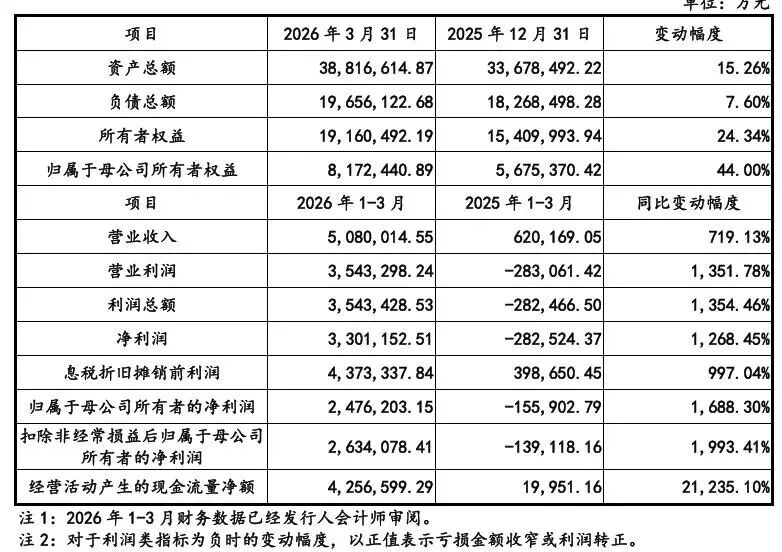
Moreover, the capital market is extremely confident in its post - listing market value, expecting it to soar to over 2 trillion yuan. This figure even exceeds the total market value of 124 A - share listed companies in Nanjing.
Almost at the same time, NVIDIA released its financial report for the first quarter of fiscal year 2027. The report shows that the first - quarter revenue was 81.6 billion US dollars, and the net profit was 58.3 billion US dollars, both far exceeding market expectations. Among them, the data center business contributed 75.2 billion US dollars, accounting for 92% of the total revenue.
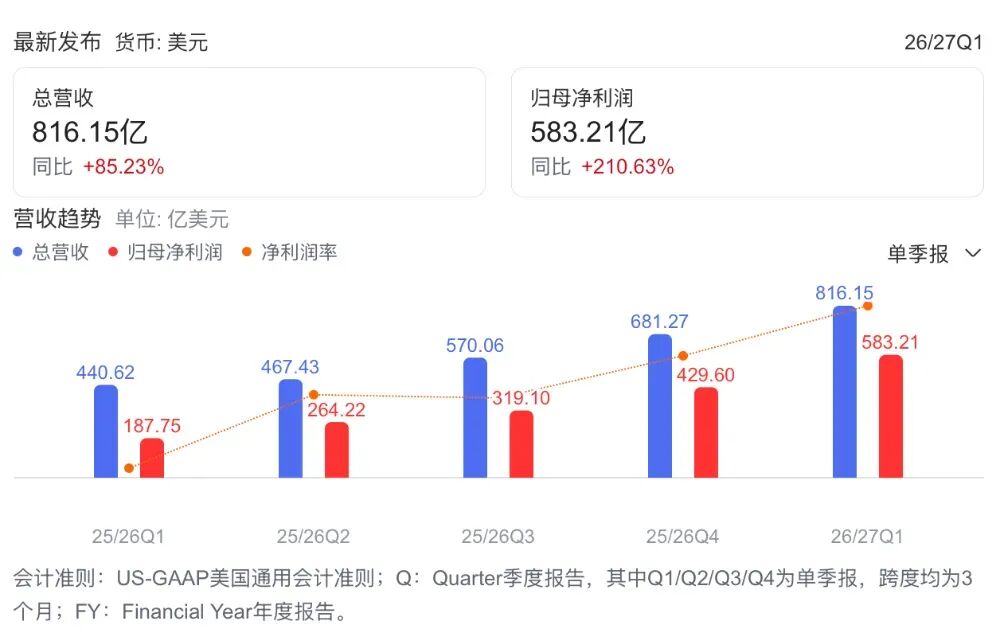
One is the global leader in AI computing chips, and the other is the leader in China's storage chips. They are in different links of the industrial chain but have delivered equally amazing results.
The logic behind this is actually quite simple. As core players in the upstream of the AI development industrial chain, they have high technological barriers, long production - capacity construction cycles, and a large and loyal customer base. These barriers allow "companies like NVIDIA" to take the first big slice of the cake in the AI wave.
Players in the Middle and Lower Reaches: Participants on the Edge of the Wave
While the upstream players in the industrial chain are reaping huge profits, the players in the middle and lower reaches seem to be having a hard time.
Let's look at some data first. According to TrendForce, in 2026, the capital expenditure of the world's four major hyperscale cloud service providers (Google, Microsoft, Amazon, and Meta) will soar to between 725 billion and 755 billion US dollars. In 2025, this figure was only 359 billion US dollars. The estimated total capital expenditure of the world's nine major CSPs has soared to about 830 billion US dollars.
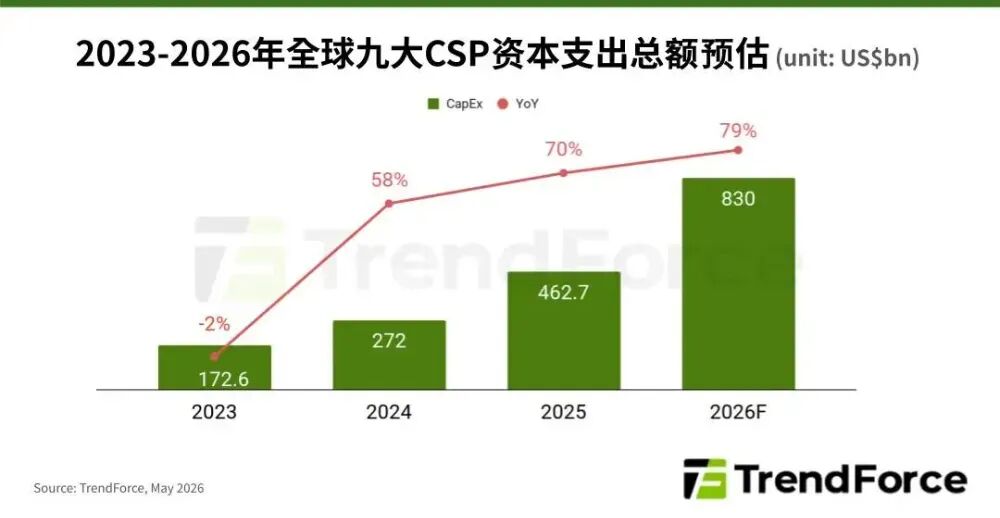
This means that the annual hardware expenditure of the four major cloud providers has exceeded the total revenue of all AI chip and storage manufacturers. Cloud providers are transfusing capital to the upstream with huge capital expenditures. What makes the manufacturers most helpless is that they have not yet achieved large - scale profitability in AI business but still need to increase their investment. Because once they stop investing, they are likely to fall behind in the competition for AI infrastructure.
This also explains why NVIDIA's after - hours stock price still fell even though its performance exceeded expectations. The market has never been worried about this quarter's profit, but rather about how much capital expenditure pressure the downstream cloud providers can bear. If one day the cloud providers start to cut their purchases, can NVIDIA's growth story continue?
Looking back at the domestic situation, it is equally complex.
Currently, domestic large - model startup companies generally face dual pressures: on the one hand, there are huge R & D investments; on the other hand, the business models have not yet been proven.
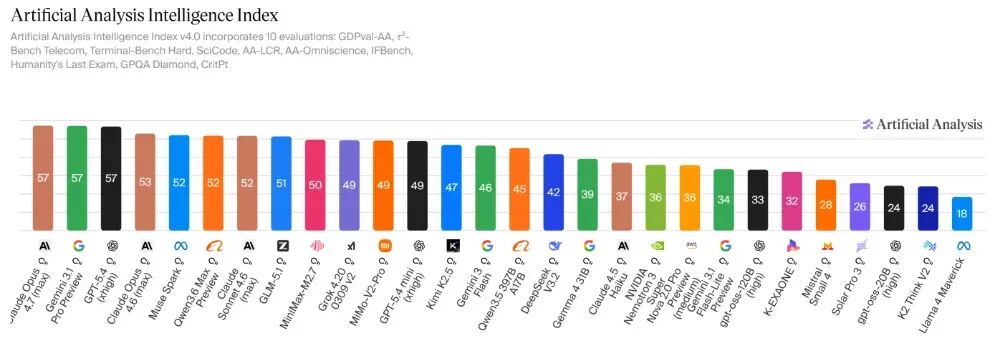
In the early days, many companies chose the free model to seize the market. Now, when they want to switch to a paid model, most users are not willing to pay. For most ordinary users, the value of large models only stays at the levels of "retrieving information" and "assisting text output", and their willingness to pay is far lower than expected.
This forms a sharp contrast with the huge profits of upstream chip manufacturers, which can reach tens of billions.
Ultimately, the profit distribution in this industrial chain follows a simple and cruel logic: those who master what others can't produce have the pricing power; those who engage in replaceable processes can only earn hard - earned money.
However, this logic has an important premise, which assumes that the global AI industrial chain is a unipolar pattern dominated by international giants such as NVIDIA and SK Hynix. But in reality, another track is growing in parallel.
China's "Local Story": A Closed - Loop Computing Power Ecosystem is Taking Shape
Many people don't know that the global AI computing power industrial chain is currently showing a "dual - track" development trend.
One track is the international supply chain centered around NVIDIA + SK Hynix; the other track is the Chinese local supply chain centered around Huawei Ascend + Changxin Storage.
In the Chinese market, a closed - loop local supply chain for AI computing power is taking shape.
Huawei Ascend is the most powerful local competitor to NVIDIA. In 2025, Ascend tied with NVIDIA for the first place in the Chinese AI chip market with a 40% market share. Some large models, including DeepSeek, are gradually reducing their dependence on NVIDIA's computing chips and are adapting to Huawei Ascend.
Multiple institutions predict that in 2026, Huawei will occupy 50% of the Chinese AI chip market, while NVIDIA's share will plummet from 95% three years ago to about 8%.
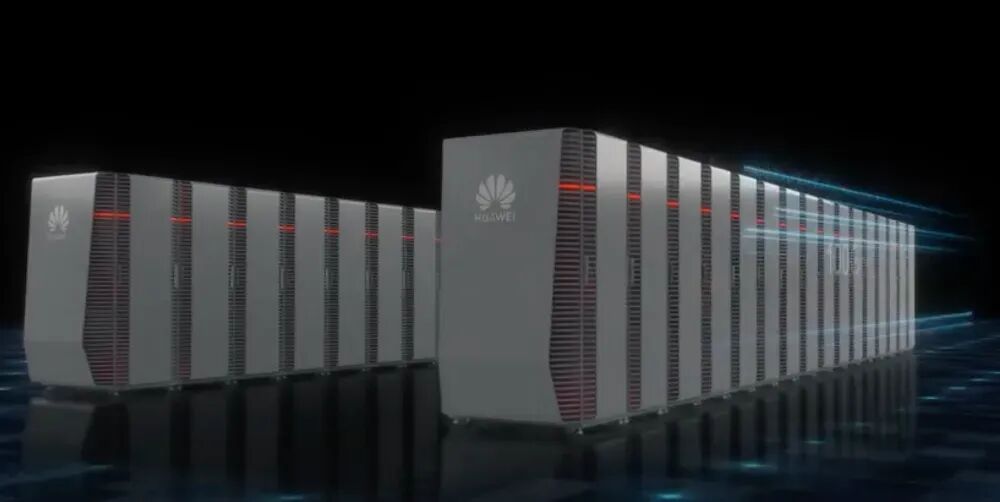
In the storage field, domestic substitution is also accelerating. The fact that Changxin Technology has gone from years of losses to a single - quarter profit of 24.7 billion yuan and its global market share has risen to 7.67% is the most powerful proof.
A clear picture is emerging: cloud providers are pairing domestic chips for computing power and domestic storage for storage capacity, and a complete local supply chain has begun to take shape. If there is still one piece of the puzzle missing, it is the localization of HBM (High - Bandwidth Memory) - once this is achieved, China's AI computing power infrastructure will truly achieve an independent closed - loop.
The Underestimated Cyclical Risks: How Long Can the Wealth - Creating Feast Last?
Under this wave of AI frenzy, everything seems prosperous on the surface. However, the history of the storage industry has repeatedly proven that the people at the top of the mountain are often the same as those at the bottom of the valley.
Changxin's performance explosion is highly dependent on the DRAM price increase cycle. According to TrendForce data, since the second half of 2025, DRAM prices have been rising continuously, with the price increase of some specifications exceeding 100%; in the first quarter of 2026, the quarter - on - quarter increase in DRAM contract prices was further revised upwards to 93% - 98%.
If the DRAM price drops, how much will Changxin's profit be reduced? Of the quarterly net profit of 24.7 billion yuan, how much is the result of the company's own capabilities, and how much is due to "good luck"? Changxin Technology also clearly mentioned in the "Special Risk Warning" of its prospectus the history of widespread losses in the industry during the downward cycle from 2022 to 2023.
NVIDIA is also not immune to this cyclical risk. If the capital expenditure enthusiasm of cloud providers fades, or the commercialization speed of AI applications fails to meet expectations, the ebb of infrastructure investment may come faster than expected.
Reflection on the Industrial Structure: Who Will Be at the Top in the Next Cycle?
The value chain of the AI industry is forming a clear hierarchical structure: the infrastructure layer captures most of the profits, the service layer bears the cost pressure, and the application layer is still struggling to compete for users. Profits are concentrated upstream, and costs are transferred downstream.
In China, thanks to the rise of companies such as Huawei Ascend and Changxin Storage, a complete closed - loop of local AI infrastructure is being formed. However, cyclical risks cannot be ignored. The price history of DRAM has repeatedly proven a simple truth: the most profitable moment is often the most dangerous moment.
When the investment enthusiasm for AI infrastructure reaches an unprecedented height, sustainability becomes an unavoidable issue. This "chain of profits moving upstream and costs moving downstream" is logically valid, but whether it can be maintained in the long - term commercially is still being verified.
This question will determine who can continue to stand at the top of the pyramid in the next cycle.
This article is from the WeChat official account “New Entropy” (ID: baoliaohui), written by the New Entropy - AI New Technology Group, and is published by 36Kr with authorization.