The largest IPO in history. Is Elon Musk about to become a trillionaire? Are Americans using their pensions to take over from him?
On June 12, 2026, the largest IPO in human history is about to take place on the NASDAQ. SpaceX will list on the U.S. stock market under the ticker symbol "SPCX", with a target valuation of $1.75 trillion and a planned fundraising of $75 billion.
This figure will completely rewrite the historical record of the capital market and may also make Elon Musk the world's first trillionaire (Musk's current net worth is $800 billion, compared with Bezos' approximately $224 billion).
However, this IPO also comes with significant risks. Whether the high valuation is just hype depends on the performance of the Starship.
The largest IPO in history. What's the market value?
According to the S - 1 prospectus submitted by SpaceX to the U.S. Securities and Exchange Commission (SEC), the target valuation for this IPO is between $1.75 trillion and $2 trillion, with a planned fundraising of $75 billion.
Previously, the record - holder for the world's largest IPO was Saudi Aramco, which raised $25.6 billion through its IPO. SpaceX's planned fundraising of $75 billion is more than 2.5 times that of Saudi Aramco.
If valued at $1.75 trillion, SpaceX will immediately rank among the top seven in global market capitalization after listing, behind NVIDIA ($5.3 trillion), Google ($4.7 trillion), Apple ($4.5 trillion), Microsoft ($3.1 trillion), Amazon ($2.9 trillion), and TSMC ($1.8 trillion).
What does $1.75 trillion mean?
It is equivalent to the combined value of Meta and General Electric, approximately 10% of China's GDP in 2025, or equivalent to 5.5 times that of Alibaba or 3.5 times that of Tencent.
Even more astonishing is that SpaceX claims in its prospectus that it has "locked in the largest total addressable market (TAM) in human history", with a total scale of $28.5 trillion ($26.5 trillion in the AI field, $1.6 trillion in Starlink communication services, and $37 billion in traditional space - domain rocket launch services).
That is to say, according to the grand vision painted by Musk, the $1.75 - trillion valuation of SpaceX is far from reaching its peak.
Is Musk the richest person on Earth?
Musk is already the richest person on Earth, and is about to become the first trillionaire.
According to the Forbes Global Billionaires List released in March 2026, Musk ranks first with a net worth of $839 billion, far exceeding Larry Page, the co - founder of Google, who ranks second with $257 billion.
A person lives about 30,000 days in a lifetime. Musk already has 6 trillion RMB now, which means he earns an average of 200 million RMB per day.

If SpaceX successfully lists at a valuation of $1.75 trillion, Musk's wealth will skyrocket further.
According to the prospectus, before SpaceX's listing, Musk holds 12.3% of Class A shares and 93.6% of Class B shares, corresponding to 849 million and 5.569 billion shares respectively. Since each Class B share has 10 votes, Musk will continue to hold 85.1% of the absolute voting rights after the IPO.
If valued at $1.75 trillion and assuming Class A and Class B shares have equal economic rights, the value Musk will gain through SpaceX's IPO will exceed $800 billion.
Musk's wealth mainly comes from several core assets: Tesla contributes about $300 billion (he holds about 21.9% of the shares), SpaceX will contribute about $800 billion after the IPO (holding about 42% of the shares), and there are also other assets such as Neuralink and The Boring Company.
What are SpaceX's businesses?
According to the prospectus, SpaceX divides its business into three segments: Space, Connectivity, and Artificial Intelligence (AI).
Space is SpaceX's original business, including rocket launch services, Starship R & D, and space transportation services for NASA and commercial customers. This segment had a revenue of $4.086 billion in 2025, accounting for 21.9% of the total revenue. In terms of operations, it had a loss of $657 million in 2025, mainly due to the high R & D expenditure of $3.004 billion on the Starship. The valuation of the launch service is about $150 billion.
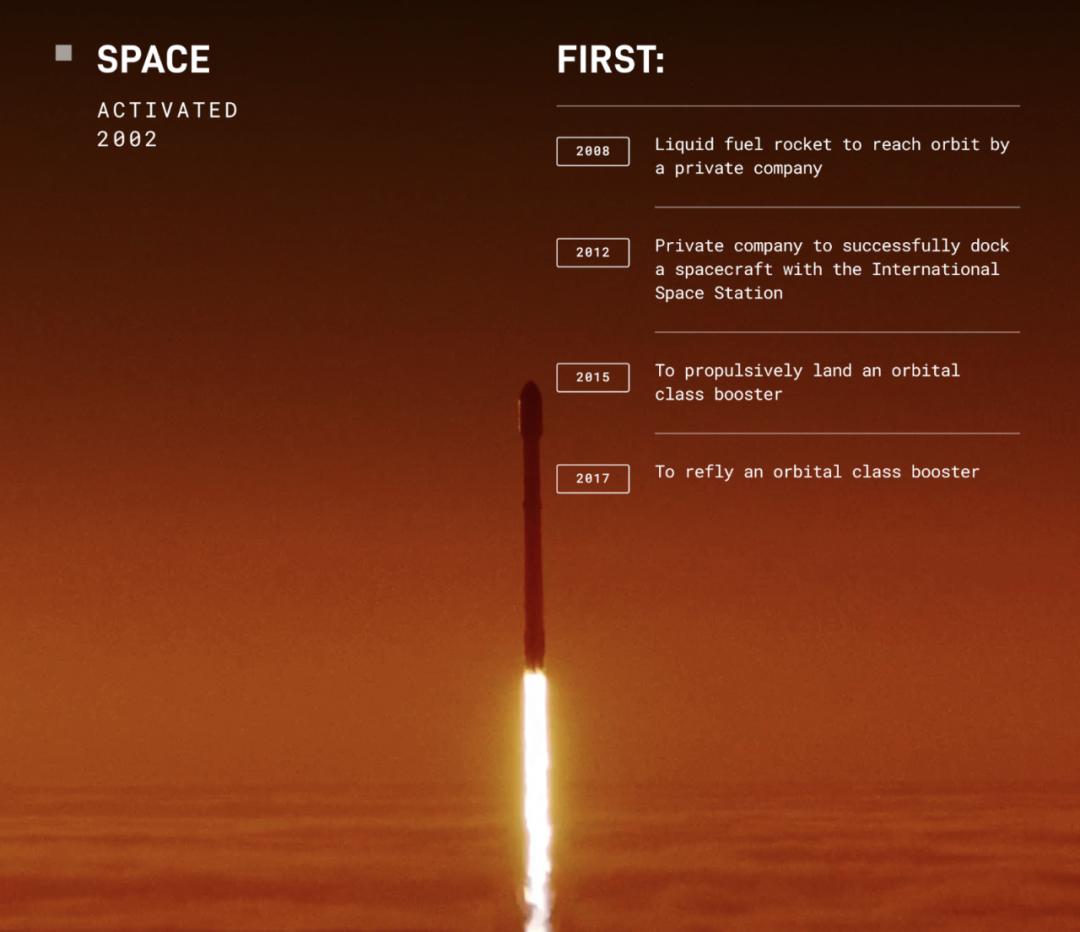
Space Services | SpaceX
The Connectivity segment is SpaceX's most profitable business, with the core being the Starlink satellite internet service. This segment had a revenue of $11.387 billion in 2025, accounting for 60.9% of the total revenue. Different from the Space segment, the Connectivity segment has achieved profitability and is the company's main source of cash flow. The valuation given by institutions is about $650 billion. As of March 31, 2026, there are more than 9,600 Starlink satellites in orbit, accounting for 75% of the world's controllable satellites, making it the world's largest low - orbit satellite constellation. Starlink provides high - speed broadband internet services to 164 countries and regions around the world, with 10.3 million users.
The Artificial Intelligence segment is SpaceX's latest and most capital - intensive business, resulting from the acquisition of xAI in February 2026. The AI segment includes the Colossus 1 and Colossus 2 data centers (with more than 220,000 NVIDIA GPUs), Grok AI, and the planned space - orbit AI data center. This segment had a revenue of $3.2 billion in 2025 (mainly advertising and subscription revenue from the X platform) and about $1.4 billion in the first quarter of 2026. However, the operating situation is worrying: it had an operating loss of $6.35 billion in 2025 and a single - quarter loss of $2.47 billion in the first quarter of 2026. Nevertheless, the valuation given by institutions is about $700 billion, which is a "forward - looking option value".
The combined institutional valuation of these three segments is about $1.5 trillion, while the IPO target is between $1.75 trillion and $2 trillion. The premium of about $250 - 500 billion in between is the "faith tax" brought by the narrative of "AI space infrastructure".
One of the world's biggest money - losing companies. Why is it valued so high?
Why is a company that had a net loss of $4.276 billion in a single quarter in the first quarter of 2026 valued at $1.75 trillion?
According to the prospectus, SpaceX had a brief period of profitability in 2024, but after the merger with xAI in February 2026, the huge investment in the AI segment pushed the company back into a loss - making state.
Why can a loss - making company have such a high valuation? The answer is that the capital market believes in it.
The logic of its story is as follows: SpaceX launches satellites, uses the satellites to develop Starlink for self - financing, and at the same time builds space data centers to support xAI (meaning that these businesses are not just forcibly grouped together).
Among them, the biggest vision painted by Musk is to move the AI computing center to space.
According to the prospectus, building an AI data center on Earth faces three major problems: power shortage, difficult heat dissipation, and large floor area.
Space perfectly solves these problems because it has unlimited solar energy, no need for cooling towers, and almost unlimited space.
SpaceX's plan is to use the Starship to launch large - scale satellites and establish data centers in orbit to provide computing power rental services for xAI's Grok model and other AI companies. The prospectus shows that SpaceX expects to start deploying space data centers as early as 2028.
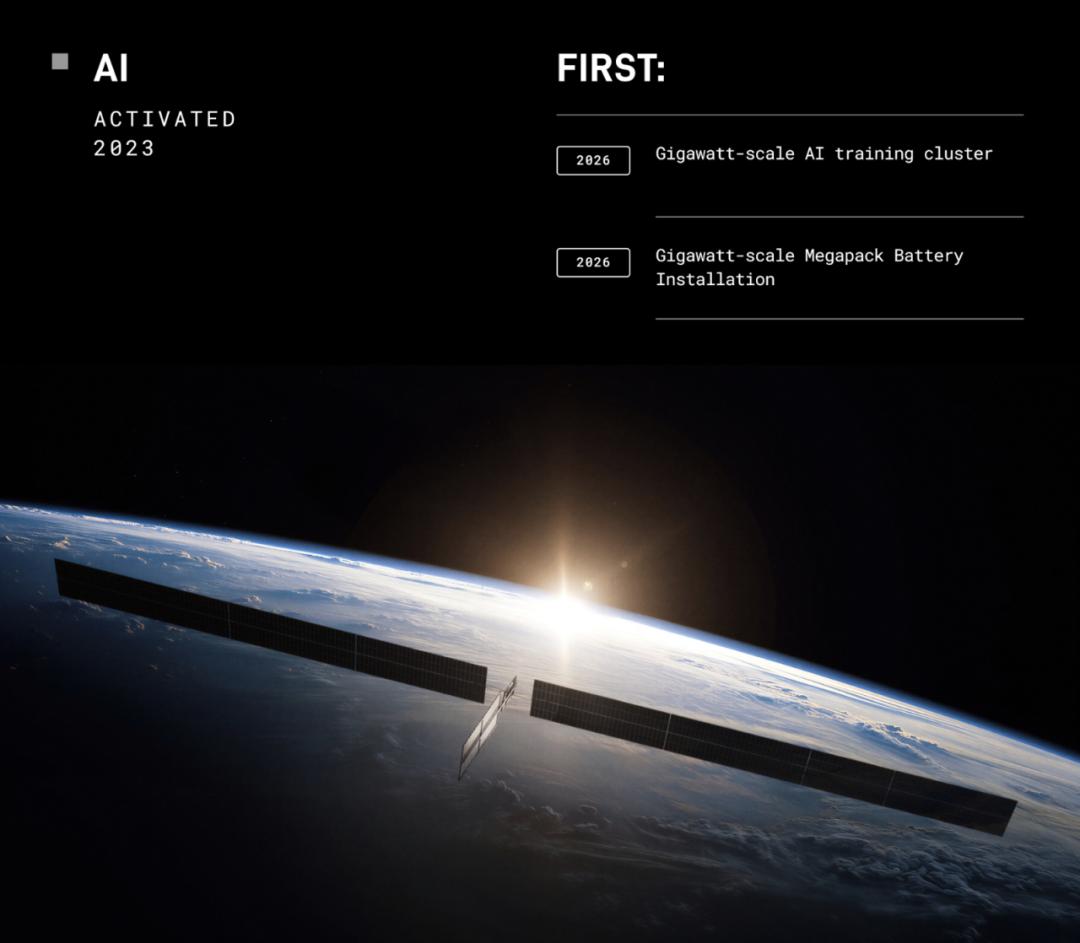
Schematic diagram of a space data center | SpaceX
Why is it said that SpaceX is "going all - in on the Starship"?
Because if the Starship fails, the entire $1.75 - trillion story will collapse.
Elon Musk realized early on that the traditional launch market is too small to support a company with sufficient growth potential.
So he had to create new demand himself.
That's how Starlink emerged - relying on SpaceX's ability to launch quickly, at low cost, and in large quantities, it opened up a new market that didn't exist before.
However, when Starlink and the space computing center continue to develop, they encounter a common problem: The Falcon 9 is not big enough.
The Falcon 9 rocket is too thin, and the internal space of its fairing is limited, which restricts the size of the satellites.
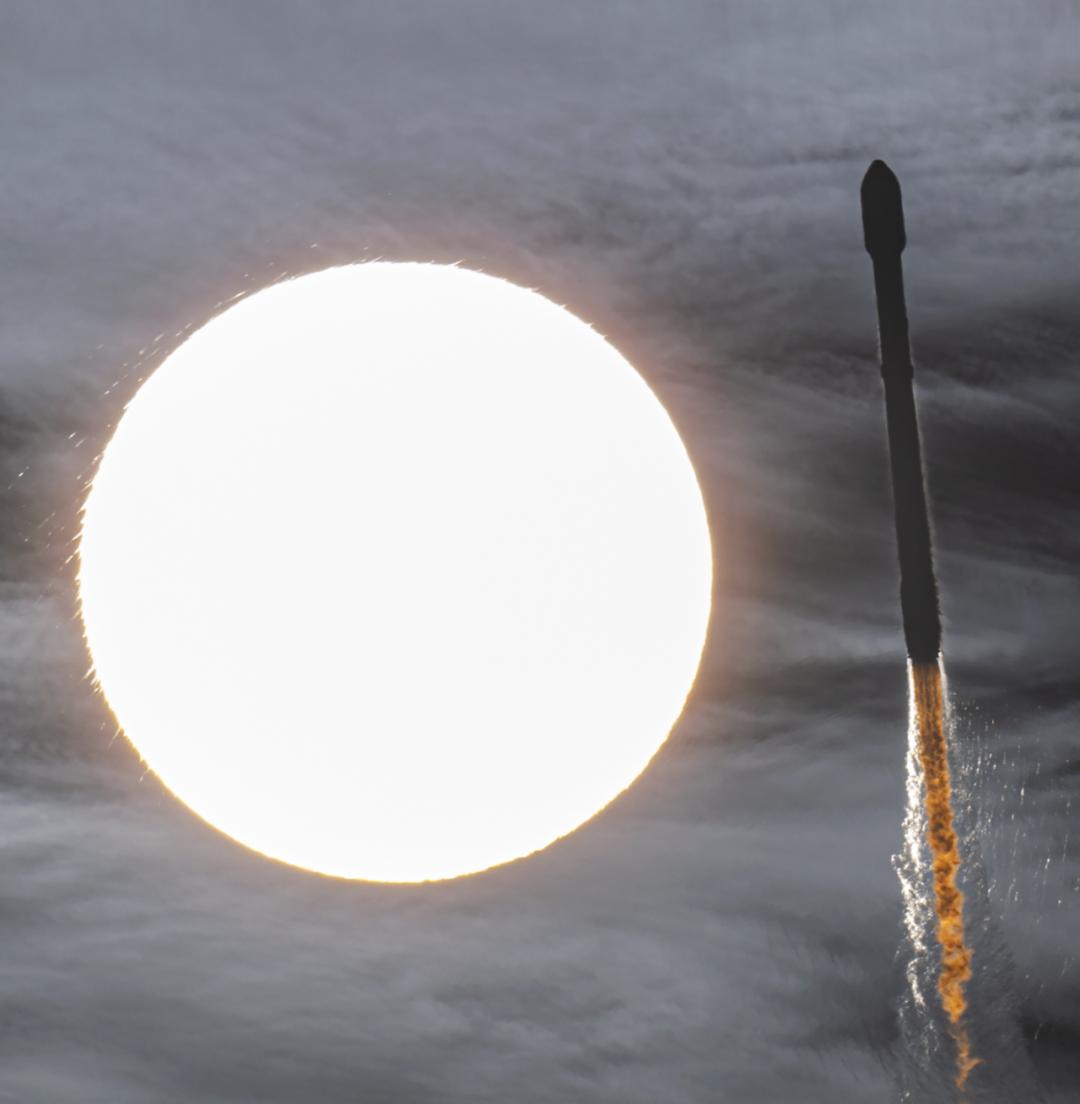
Falcon 9 launch | SpaceX
If Starlink wants to further increase the capacity of a single satellite, it has to make the satellites larger. When it comes to future space data centers and space computing centers, the problem becomes even more obvious because computing centers not only require the equipment itself but also large - area heat dissipation plates. This means that the relevant equipment cannot be made very small, and the satellite platform must be enlarged.
This is the importance of the Starship.
The Starship has a diameter of 9 meters, and the fairing space is much larger than that of the Falcon 9. In theory, it can launch larger, heavier, and more complex Starlink satellites and space equipment. More importantly, the Starship aims to be fully reusable. In an ideal state, like an airplane, it can be refueled after returning and take off again soon.
If this goal is truly achieved, the unit mass cost of space launches may be reduced by another order of magnitude. The Starship's low - Earth - orbit payload capacity has increased from 35 tons in V2 to over 100 tons, and the target launch cost is to be reduced to a few hundred dollars per kilogram.
The significance of the Starship to SpaceX can be summarized in one sentence: All future visions are based on the premise that the Starship must be able to achieve rapid and reusable operation.
The prospectus shows that SpaceX has cumulatively invested more than $15 billion in the Starship. In 2025, the R & D expenditure on the Starship was as high as $3.004 billion, nearly three - quarters of the annual revenue of the Space segment.
The prospectus also candidly states that if there are any failures or delays in the large - scale development, launch frequency, or reuse ability of the Starship, "it will delay or limit our ability to implement the growth strategy".
What's the cooperation between SpaceX and Anthropic all about?
The prospectus states that Anthropic pays SpaceX $1.25 billion per month to rent computing power.
According to the prospectus, on May 3, 2026, SpaceX and Anthropic signed a computing - power rental agreement. Anthropic will use SpaceX's Colossus 1 and Colossus 2 data centers and pay $1.25 billion per month, with the agreement valid until May 2029. This is one of the most important external revenue sources for SpaceX's AI segment at present.
In addition, in April 2026, SpaceX signed a cooperation agreement with the code - editing tool company Cursor that includes an acquisition option. According to the prospectus, SpaceX has the right to acquire Cursor at an implied valuation of $60 billion, using Class A common stock as consideration. At the same time, the two parties signed a computing - power cooperation agreement, and Cursor will use SpaceX's data - center resources to train and improve AI models.
These two transactions indicate that SpaceX is transforming from an "AI model developer" into an "arms dealer", no longer developing large models and selling tokens itself, but renting out computing power to others.
What does it mean in the prospectus to "push humanity to the Kardashev Type II civilization"?
This is the most science - fiction part of SpaceX's prospectus.
The Kardashev Scale is a civilization - classification system proposed by Soviet astronomer Nikolai Kardashev in 1964, which classifies civilizations according to the scale of energy they can utilize:
Type I civilization: Can utilize all the energy of an entire planet (including solar energy, wind energy, geothermal energy, etc.)
Type II civilization: Can utilize all the energy of a star (usually through megastructures such as Dyson spheres)
Type III civilization: Can utilize all the energy of an entire galaxy
Currently, human civilization is approximately at Type 0.7, far from fully utilizing all the energy on Earth, let alone the energy of the sun.
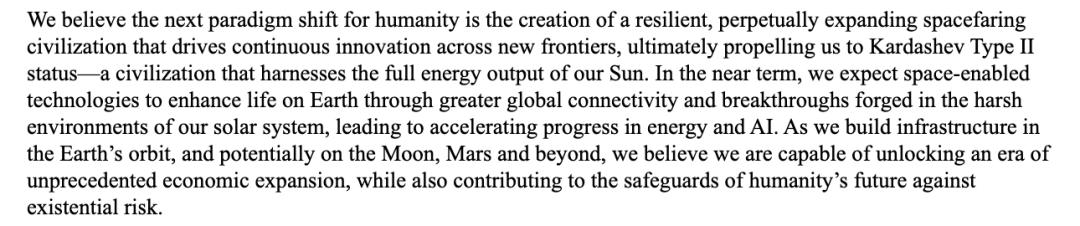
In an application submitted to the U.S. Federal Communications Commission (FCC) in February 2026, Musk wrote: "Launching one million satellites operating as orbital data centers is the first step towards a Kardashev Type II civilization."
Specifically, SpaceX's plan includes: deploying a large number of solar satellites in orbit to capture solar energy 24/7, with an energy density several times that of the Earth's surface; using the unlimited solar energy and natural heat - dissipation conditions in space to establish large - scale AI computing centers; using the fully reusable Starship to launch millions of tons of equipment into space every year, with the cost reduced to a few hundred dollars per kilogram; establishing an industrial base on the moon and then a permanent colony of one million people on Mars.
