Sino-US technology companies shake NVIDIA's dominance
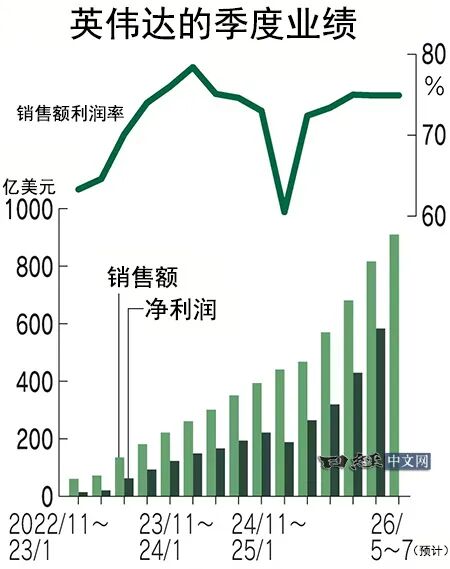
On May 20, US-based NVIDIA announced that its operating revenue from May to July 2026 will increase by 95% year-on-year, reaching $91 billion. Although this exceeded market expectations, the stock did not see a full-scale buying spree. Chinese and US technology companies are rising in the artificial intelligence (AI) semiconductor field, and the blind spots of NVIDIA's dominance have begun to be recognized.
“NVIDIA is the fundamental platform in the AI era and will meet the most diverse needs,” said CEO Jensen Huang with confidence in the company's growth during the earnings conference.
Funds Flow in with Large-scale Investments from US Technology Companies
NVIDIA's expected operating revenue from May to July 2026 exceeded the average market forecast compiled by QUICK FactSet (a 90% increase, approximately $87 billion).
The company's operating revenue from February to April 2026 increased by 85% year-on-year, reaching $81.615 billion. Net profit soared 3.1 times to $58.321 billion, hitting a new quarterly net profit high.
What supported NVIDIA's strong performance was the huge investments from US technology giants. The equipment investment of four companies, Google (owned by Alphabet), Amazon, Meta, and Microsoft, increased by 76% in 2026 compared to the previous year, reaching $725 billion.
NVIDIA holds 80% of the AI semiconductor market share, and technology giants have been purchasing its graphics processing units (GPUs). With the influx of huge funds, NVIDIA's available funds reached approximately $50 billion at the end of April. The company also announced a $80 billion share buyback.
NVIDIA will use its abundant funds as capital to create more demand for semiconductors. It has decided to invest in AI development companies such as Anthropic in the US and data center companies. It will also invest $2 billion in optical component companies that are indispensable for next-generation AI infrastructure to enhance its competitiveness.
Google Devotes to Developing “TPU” Semiconductors
However, during pre - market and after - hours trading after the earnings announcement, NVIDIA's stock trading was mixed.
From May to July 2026, NVIDIA's gross profit margin is expected to reach 75%, in line with market expectations. In terms of the indicator showing price - setting power, it is higher than that of its peer, US - based Broadcom (68% in the most recent quarter). The reason why there was no unanimous buying is that investors are aware of the rise of Chinese and US competitor companies.
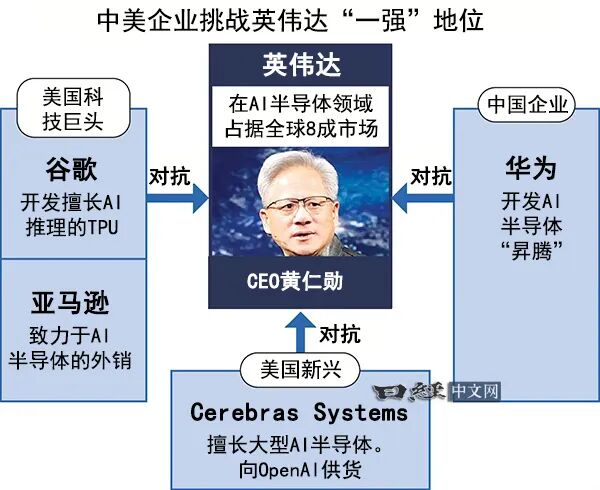
A representative example is Google, which is one of NVIDIA's high - quality customers.
Google will devote itself to developing “TPU” semiconductors that improve the efficiency of AI “inference”. It not only aims to use them for its own generative AI “Gemini” but also seeks to sell them externally. US research firm Omdia revealed that as of 2025, Google held 5% of the AI semiconductor market share.
On May 18, Google announced that it will join hands with US large - scale investment firm Blackstone Group to establish a cloud - computing joint venture using TPU. As AI progresses, the importance of inference is increasing, and Amazon has also started designing its own chips and selling them externally.

Cerebras went public on NASDAQ in May (Reuters)
Emerging companies are also catching up. In January, US - based Cerebras Systems, which develops large - scale chips using entire semiconductor wafers, signed a semiconductor supply contract worth over $20 billion with US - based OpenAI, the developer of ChatGPT.
It is said that compared with the previous method of connecting multiple chips, concentrating on one large - scale chip can increase the data exchange speed by thousands of times.
NVIDIA Poaches Executives from Competitors
NVIDIA cannot ignore these competitors.
In December 2025, NVIDIA poached executives such as Jonathan Ross, the CEO of US emerging company Groq, which competes in the AI semiconductor field and who once developed TPU at Google. It announced a way to combine Groq's technology with its own products to outpace its competitors.
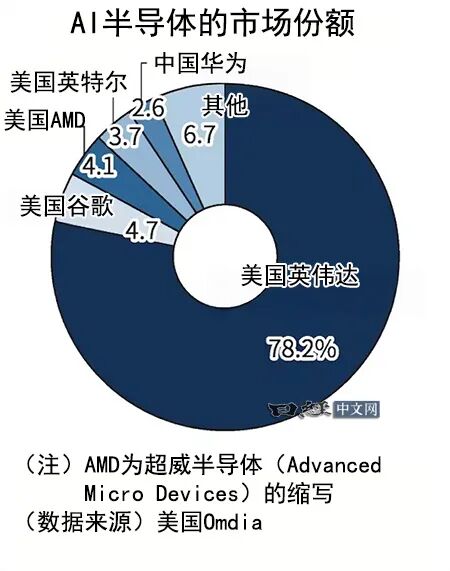
Chinese companies also pose a threat to NVIDIA. China is the second - largest AI power after the US and will build an independent supply chain in the AI field. The government will support AI semiconductor companies such as Huawei.
Alibaba is also Strengthening Semiconductors
Reuters reported that as DeepSeek, a powerful Chinese AI emerging company, has developed an AI model that can run on Huawei's “Ascend” AI semiconductors, the demand is rapidly expanding.
Alibaba Group also unveiled new AI - oriented semiconductor products on May 20. It will launch new semiconductors every year until 2028.
NVIDIA currently cannot enter the Chinese market. Regarding its high - performance semiconductor “H200”, the US government conditionally allows exports to Chinese customers. However, the Chinese government seems to be urging domestic companies to avoid purchases, so the exports have not been successful.
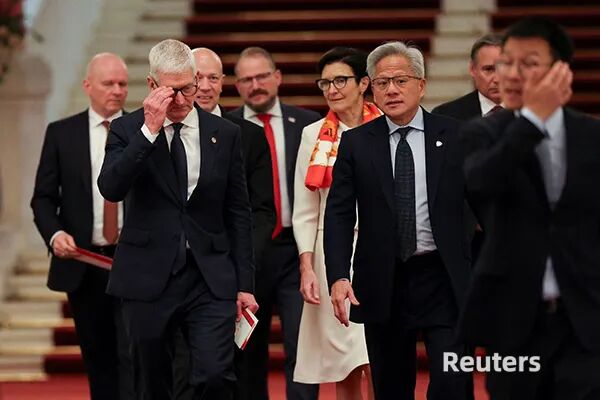
NVIDIA's CEO Jensen Huang (third from the right) accompanied US President Trump on a visit to China (Reuters)
NVIDIA did not export products such as the H200 to China from February to April 2026. The performance forecast from May to July 2026 also does not include relevant revenues from Chinese data centers.
NVIDIA's operating revenue from companies based in China was $4.55 billion from February to April 2026, a 53% decrease year - on - year. Its proportion in total revenue was 5.6 percentage points, a decrease of 16 percentage points.
Jensen Huang Says “Fully Prepared for the AI Agent Era”
If NVIDIA cannot enter the Chinese market, which is growing rapidly in the AI and robotics fields, its strategy of selling semiconductors globally will be flawed. Jensen Huang accompanied US President Trump on a visit to China from May 13 to 15, but it seems that little result was achieved.
NVIDIA has not only established itself in hardware but also made the software CUDA for AI development an industry standard. The market strongly believes that NVIDIA will maintain its dominant position in the industry in the future.
Jensen Huang said, “We are fully prepared for the era of (self - working) AI agents” without showing any signs of weakness. Can NVIDIA's era of dominance continue? The competition in the AI semiconductor field has truly just begun.
This article is from the WeChat official account “Nikkei Chinese Net” (ID: rijingzhongwenwang). The author is Nikkei Chinese Net. 36Kr is authorized to publish it.