Telecom operators start selling AI data packages: A lifesaver or a new revenue stream?
In the business of selling Tokens, the platforms of the three major operators have started to directly compete with cloud providers and large model providers.
Recently, China Telecom, China Mobile, and China Unicom have successively launched Token packages for individuals and enterprises, pricing and selling the computing power of large AI models in a form similar to "data packages".
Shanghai Mobile has offered a price of "1 yuan for 400,000 Tokens". China Telecom has launched a personal package starting at 9.9 yuan per month, and China Unicom has provided free test quotas of 30 million Tokens for Shanghai OPC customers.
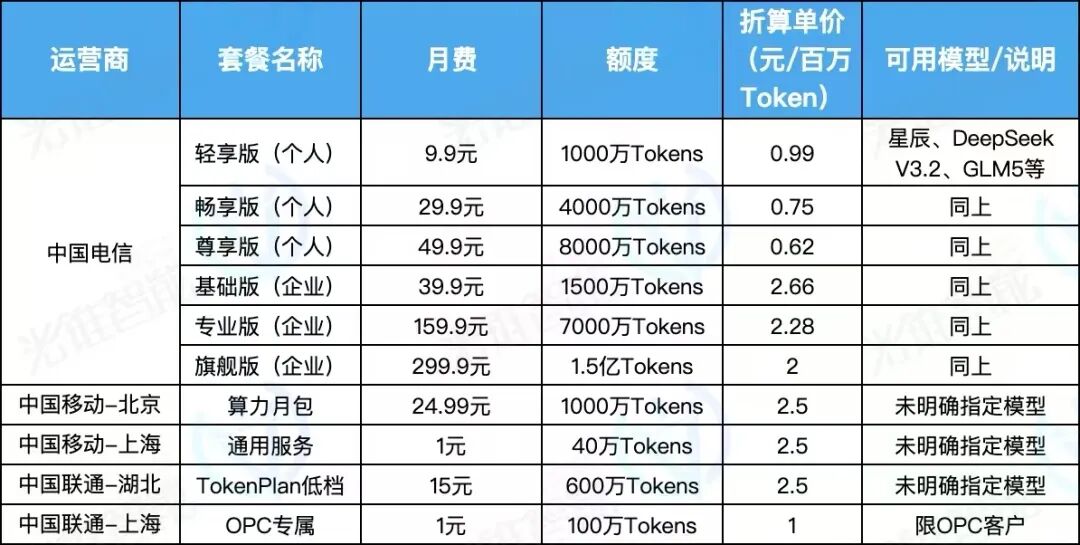
(Note: The operator packages follow a "monthly cap" system. Unused Tokens will be cleared, and additional purchases are required for over - usage. The converted unit price is only a theoretical value, and the actual cost depends on the monthly consumption ratio.)
For a moment, AI computing power has entered the era of "phone bills" and has become a new metric for operators after text messages and data.
After the three major operators released relevant news, they received a positive response in the capital market, and their stock prices continued to rise. However, in the consumer market, few developers and enterprise users seem to be interested.
"The first - month price of the operator's Token package is 9.9 yuan, but it takes 5 minutes to generate the first word. The overall execution efficiency is very low, and some of the large models it calls are not very intelligent at present." A product manager of a cloud provider told Guangzhui Intelligence.
He gave a vivid analogy to describe the experience gap between using Tokens from cloud providers and buying Tokens from operators: "It's like when you're used to staying in luxury hotels and suddenly go to a regular guesthouse. You'll always feel something is missing."
In addition, some users have even said bluntly: "There isn't a single competitive model in the operator's Token packages. I want Tokens for GPT 5.5 or Claude 4.7. Can other Tokens be compared?"
The business of the three major operators selling Tokens is not well - received in the entire consumer - level market. Even within the operators themselves, they are not fully prepared, and many relevant employees have not been informed about their company's Token package service.
In the current Token economy market, cloud providers are the well - deserved main force, occupying most of the large model API channel market. The entry of the three major operators at this time is undoubtedly an attempt to gain a share in this new market.
Some telecommunications industry experts have also said that this is the first time that China's three major operators have clearly retailed Tokens as standardized telecommunications products and packaged "Token + connection + security" as an integrated tariff. If China Telecom, China Mobile, and China Unicom follow up, it means that the large model API channel market may partially overflow from cloud providers to the operator system.
So, why are the three major operators so persistent in selling Token packages? Do they have a chance of winning when competing directly with cloud providers and large model providers?
It can be seen that as AI computing power is billed by usage like water and electricity, the three major operators are collectively turning around, trying to rewrite their business stories with Token packages. But behind this transformation, is it anxiety due to the peak of the data traffic dividend, or is it a real ticket to the intelligent era?
Forced Transformation
The launch of Token packages by the three major operators seems to be about selling computing power on the surface, but in essence, it is a self - rescue operation for survival.
To understand this, we need to first see how urgent their current business situation is. According to the 2025 financial reports of the three companies, the revenue growth rates of the three major operators in 2025 all fell below 1% (China Mobile: 0.9%, China Telecom: 0.1%, China Unicom: 0.7%).
In addition, data from the Ministry of Industry and Information Technology shows that in 2025, the revenue from data traffic business in China decreased while the traffic volume increased. The traffic increased by 17.3%, but the revenue decreased by 3.1%. Moreover, ARPU (Average Revenue Per User) continued to decline (China Mobile: 46.8 yuan, China Telecom: 45.1 yuan). The growth of users has reached its peak, with over 1 billion mobile users and a penetration rate of over 70%, leaving extremely limited room for new users.
Meanwhile, in 2025, the total capital expenditure of the three major operators was 289.8 billion yuan, a year - on - year decrease of 9.1%. While the overall investment was shrinking, the investment in computing power infrastructure increased significantly, and this trend was even more obvious in 2026.
Among them, China Telecom plans to invest 25.5 billion yuan in computing power infrastructure, a year - on - year increase of 26%, and the proportion of this investment in the total investment has climbed to 35%. China Unicom's capital expenditure is about 50 billion yuan, and the proportion of computing power investment exceeds 35%. China Mobile is accelerating the construction of its computing power network.
This means that the three major operators are "reducing traditional investment and protecting computing power", that is, reducing traditional investments such as 5G networks and tilting resources towards AI computing power. But the problem is, how can the invested computing power be monetized?
In this context, the "data traffic economics" that has sustained them for the past two decades is no longer working. When data GB can no longer drive revenue growth and computing power begins to dominate the market, the three major operators must find a new "pricing unit".
Tokens happen to provide this possibility, and operators have the computing power, network, and scheduling capabilities required to produce Tokens.
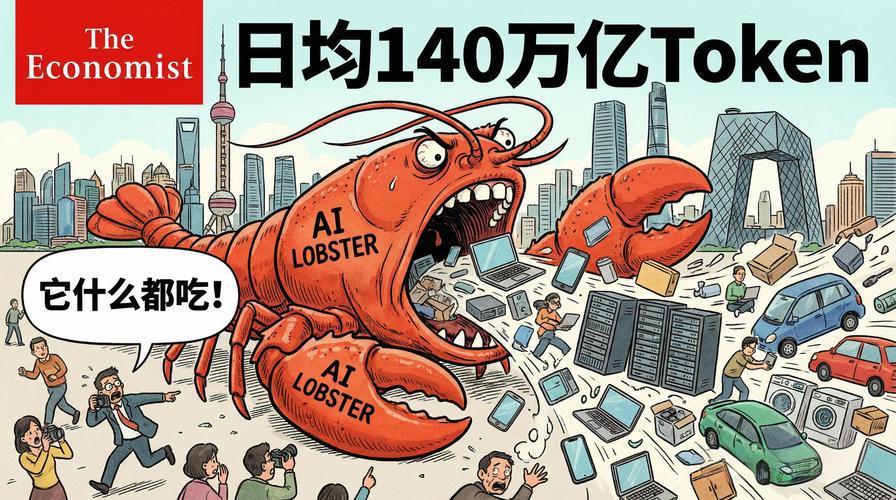
Liu Liehong, the director of the National Data Bureau, disclosed a set of data: The daily average Token call volume in China soared from 100 billion at the beginning of 2024 to 100 trillion by the end of 2025, and had exceeded 140 trillion by March 2026. In two years, it increased by more than a thousand times.
Therefore, the Token economy is booming globally, and every company selling computing power has started to bet on selling Tokens.
The three major operators are no exception. Ke Ruiwen, the chairman of China Telecom, proposed at the 2026 performance briefing: "Take Token services as the main business line and comprehensively shift from data traffic operation to Token operation."
Dong Xin, the chairman of China Unicom, proposed to build a new computing power operation model of "Agent + Token + AI cloud".
In summary, it can be seen that the launch of Token packages by the three major operators is a strategic choice made by traditional communication giants under the triple pressures of industry decline, asset idleness, and era change.
Their core goal is to get rid of the "pipeline" fate, revitalize computing power assets, seize the right to speak in AI infrastructure, and transform from "data traffic operators" to "computing power operators" in the Token economy era.
But the question is, can this work? At the same time, after becoming competitors from partners with cloud providers and large model providers, will they share the market together or fight against each other?
The New Tripartite Struggle in the Token Economy
Currently, with the entry of the three major operators into the Token - selling business, the players in the entire Token market have gradually formed three major factions:
Firstly, it is mainly cloud providers. Currently, mainstream cloud providers such as Alibaba Cloud, Tencent Cloud, and Volcengine have successively launched Token Plan programs.
Comparatively speaking, the core logic of cloud providers launching Token packages is platform locking. That is, they don't just sell Tokens; they sell a "model supermarket + development tools + enterprise - level services".
For example, the Token Plan team version launched by Alibaba Cloud's Bailing is charged by seat (starting from 198 yuan per seat per month), providing multi - model scheduling, Agent development framework, and enterprise - level security.
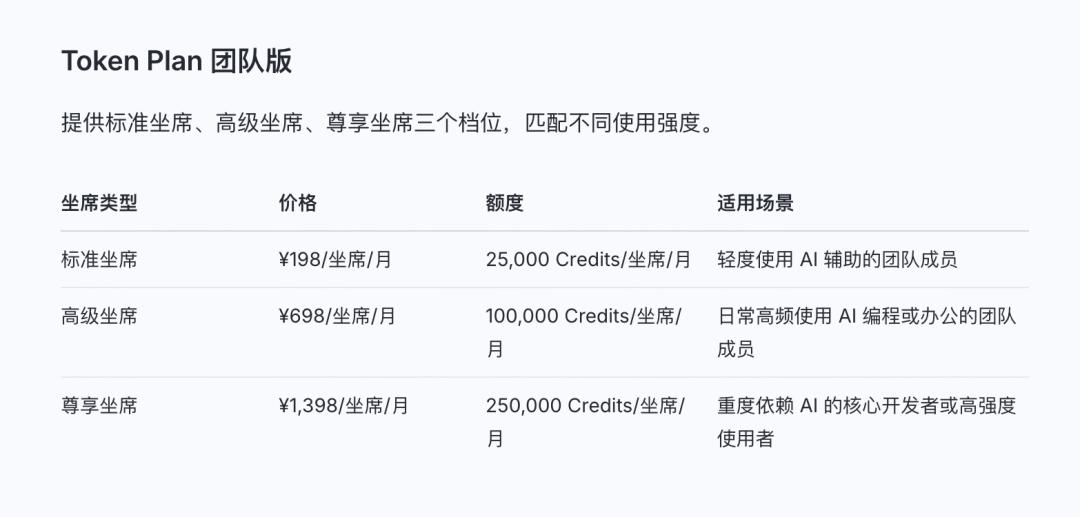
(Pricing standard of Alibaba Cloud's Token Plan team version)
Tencent Cloud has launched general - purpose and Hy (Hunyuan) series Token Plans, packaging self - developed models and third - party models for sale. Volcengine has launched the Coding Plan (40 yuan per month for 18,000 requests), binding ByteDance's Doubao model ecosystem.
"We launched the Token Plan team version to guide enterprise users to use model capabilities efficiently within a controllable range by setting a reasonable usage limit and binding product links, avoiding disorderly consumption." A marketing manager of Alibaba Cloud said.
In his view, the Token Plan team version of Alibaba Cloud can also help Alibaba Cloud better match supply and demand, promote the in - depth integration of its AI product ecosystem (such as Tongyi Qianwen and DQ) with enterprise workflows, and form a closed - loop service from interaction, calculation to result generation.
In other words, the core logic of cloud providers selling Tokens is still to sell platform capabilities.
Their advantage lies in the fact that once developers access their platforms, the migration cost of switching platforms is very high. After all, cloud providers provide not only Tokens but also enterprise - level functions such as log monitoring, permission management, and multi - model A/B testing.
Regarding the Token package layout of the three major operators, the product manager of Alibaba Cloud's Qianwen Cloud said straightforwardly: "The launch of similar services by the three major operators will indeed pose a certain competitive pressure on Alibaba Cloud, especially among price - sensitive customer groups. Users may choose the cheaper option first."
But she also clearly stated that the core competitiveness of Alibaba Cloud does not only lie in price but also in the stability of its infrastructure, brand trust, and the reliability of enterprise - level services, which are still its key advantages.
Comparatively speaking, the core logic of large model providers selling Tokens externally is model binding, that is, their models are the strongest, and developers will naturally come to them.
For example, MiniMax is the world's first Token Plan supporting all modalities (text + voice + image + video + music), starting at 29 yuan per month. Xiaomi's MiMo starts at 411.84 yuan per year, supporting 8 models and emphasizing inference ability and framework efficiency. The price of Zhipu AI's Coding Plan has increased by at least 30%, relying on model capabilities to support its pricing power.
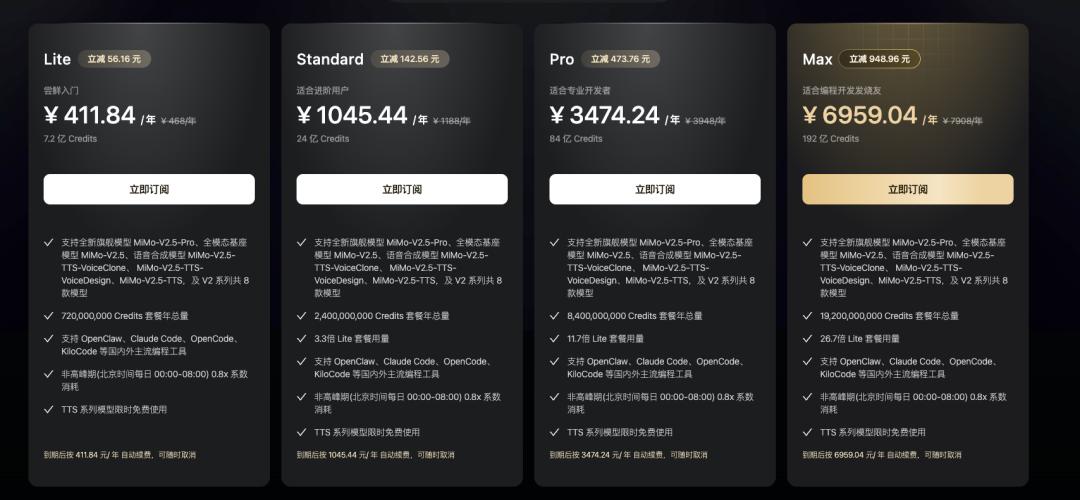
(Subscription price of XIAOMI MiMo Token Plan)
However, the anxiety of large model providers is that they don't have their own infrastructure, and their computing power costs are restricted by cloud providers. When cloud providers raise prices, model providers are under pressure from both upstream cost increases and downstream price competition.
With the entry of operators into the Token battle, a war for users, developers, and enterprise users may break out.
But from the current market situation, the Token packages sold by operators have not yet had an impact on cloud providers and large model providers, especially among enterprise users and developers.
In addition to the fact that good models do not have a price advantage, the most crucial point is that the three major operators have not yet formed a complete toolchain for the overall AI development workflow. Developers have long - term experience using the API services of cloud providers such as Alibaba Cloud, Tencent Cloud, and Volcengine, and have formed a stable workflow. The overall migration cost is very high.
Moreover, "The current Token packages of operators cannot be used in our product system," said the product manager of the above - mentioned cloud provider. "And for real developers, the amount of Tokens provided by their packages is far from enough."
This means that even if users buy the Token packages of the three major operators, they cannot use various AI application products developed by major cloud providers.
This means that if users are used to using a mature AI application from a large company and are suddenly told that "your operator Tokens cannot be used here", the experience will be very fragmented. Currently, the operators' strategies are more about establishing their own AI application entrances (such as China Telecom's "Tianyi Zhinao" and China Mobile's "Jiutian") or connecting to specific third - party platforms through API interfaces.
In fact, in the current market, mainstream AI application products, whether for the C - end or B - end, are dominated by large model providers and cloud providers in the first echelon. Each company needs to monopolize the user groups within its own ecosystem, and in the short term, it is actually difficult to break through the ecological barriers of each other.
In addition, operators still have obvious gaps compared with leading cloud providers in terms of model tuning, toolchain richness, and developer community operation. Their Token packages are often just "computing power channels", lacking in - depth model optimization and closed - loop application scenarios.
Obviously, in the short term, the entry of operators does not pose a substantial threat to cloud providers and model providers. The advantages of operators lie in their 1.9 billion user base, national business hall networks, phone bill payment systems, and government - enterprise customer relationships.
Ultimately, perhaps the one who can master the developers' workflow will get a larger share in the Token economy. Cloud providers are betting on "platform stickiness", model providers are betting on "model irreplaceability", and operators are betting on "channel access to 1.9 billion users".
AI Computing Power Becomes More Accessible, but the Price War Is Over
One of the current mainstream industry consensuses is that the price of Tokens will become cheaper.
However, if you are a developer or a technology manager of a small or medium - sized enterprise, your perception may be completely different because the cost of using Tokens is becoming more expensive.
From the second half of 2025 to the beginning of 2026, domestic companies intensively launched Coding Plans (programming subscription packages) for developers. MiniMax's first - month price was 9.9 yuan, and Volcano Ark's first - month price was 8.91 yuan, which were so low that they were almost "losing money to attract customers".
The industry logic at that time was simple: The Agent era had arrived, and the consumption of Tokens would skyrocket. First, attract users with low prices and then find ways to monetize. But this logic was shattered in 2026.
Zhipu was the first to adjust the price of its Coding Plan, with an increase of at least 30%. The price of Tencent Cloud's self - developed model API increased by up to 463%. Alibaba Cloud's Bailing and Baidu Smart Cloud also successively announced price increases for computing power.
