OpenAI has completely shocked the mathematics community. An 80-year-old core conjecture has been solved, and a Fields Medalist exclaimed that they were in disbelief.
Another epoch-making moment for AI!!!
At 3:04 am on May 21st, Timothy Gowers, a Fields Medalist and a contemporary mathematical giant, posted a short but almost terrifying tweet on X.
Within just a few hours, this post garnered over 1.2 million views, causing a major upheaval in the entire international academic community.

Today, OpenAI officially announced this historic scientific breakthrough:
Without any intervention from human mathematics experts, its new-generation general reasoning model independently tackled and completely overturned a core conjecture in discrete geometry that had been dormant for nearly 80 years - the Erdős unit distance problem.
This is the first time in human history that AI has independently and autonomously solved a major open problem in the core area of mathematics, a problem that has stumped countless top mathematicians.

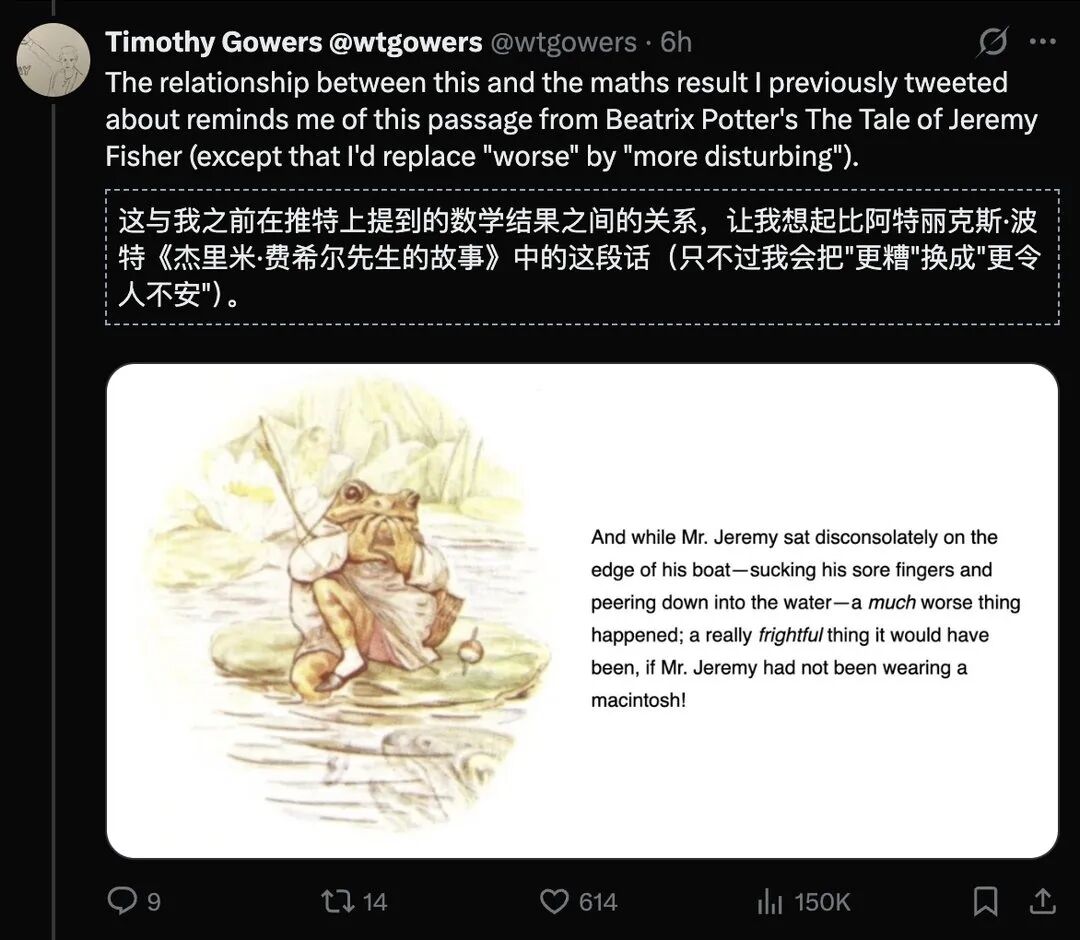
Timothy Gowers, a Fields Medalist, rarely spoke out:
If you're a mathematician, you might want to make sure you're sitting down before continuing to read .
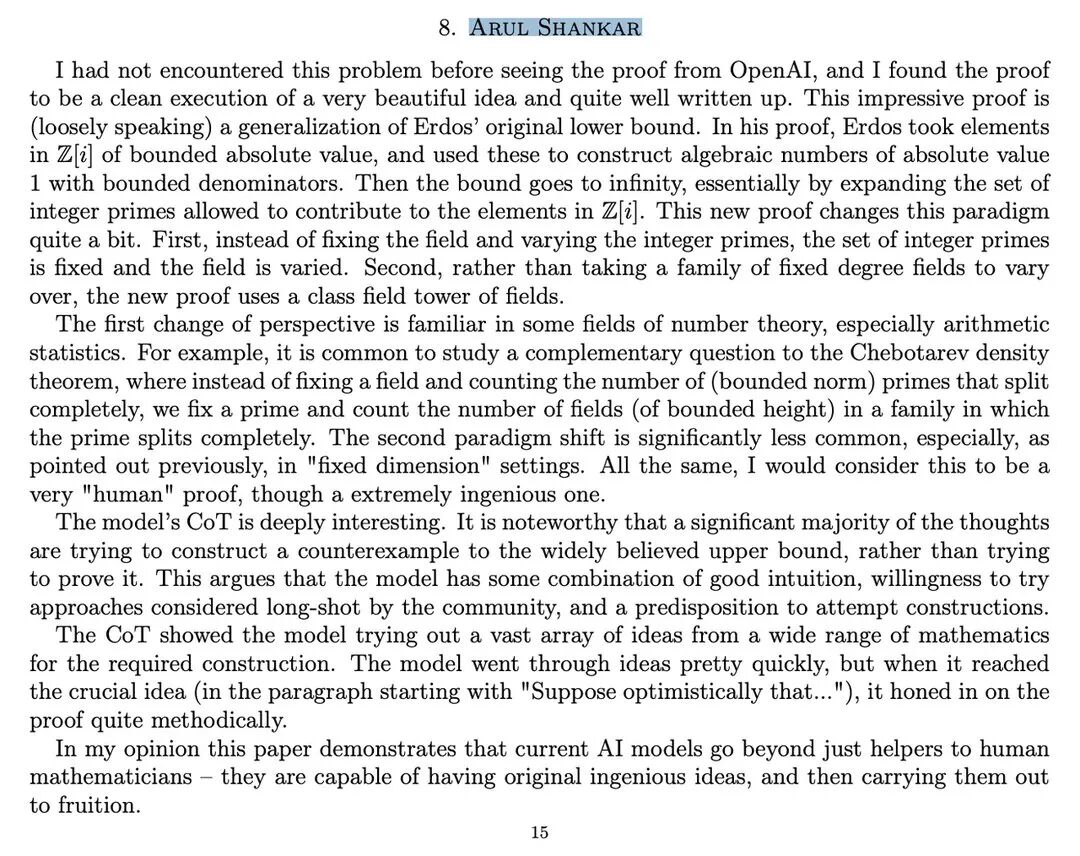
Arul Shankar, a top number theorist, said in shock:
In my opinion, this result shows that current AI models have gone beyond the role of assistants to human mathematicians - they are beginning to have original, sophisticated, and highly intelligent independent thinking and are capable of putting it into practice.
This storm not only makes mathematicians feel uneasy but also announces to all of humanity that AI has officially entered the uncharted territory of scientific research .
An extremely simple puzzle and a wall that has blocked humanity for 80 years
To understand how incredible this breakthrough is, we must first go back to 1946.
That year, Paul Erdős, one of the greatest legendary mathematicians of the 20th century, proposed a geometric problem:
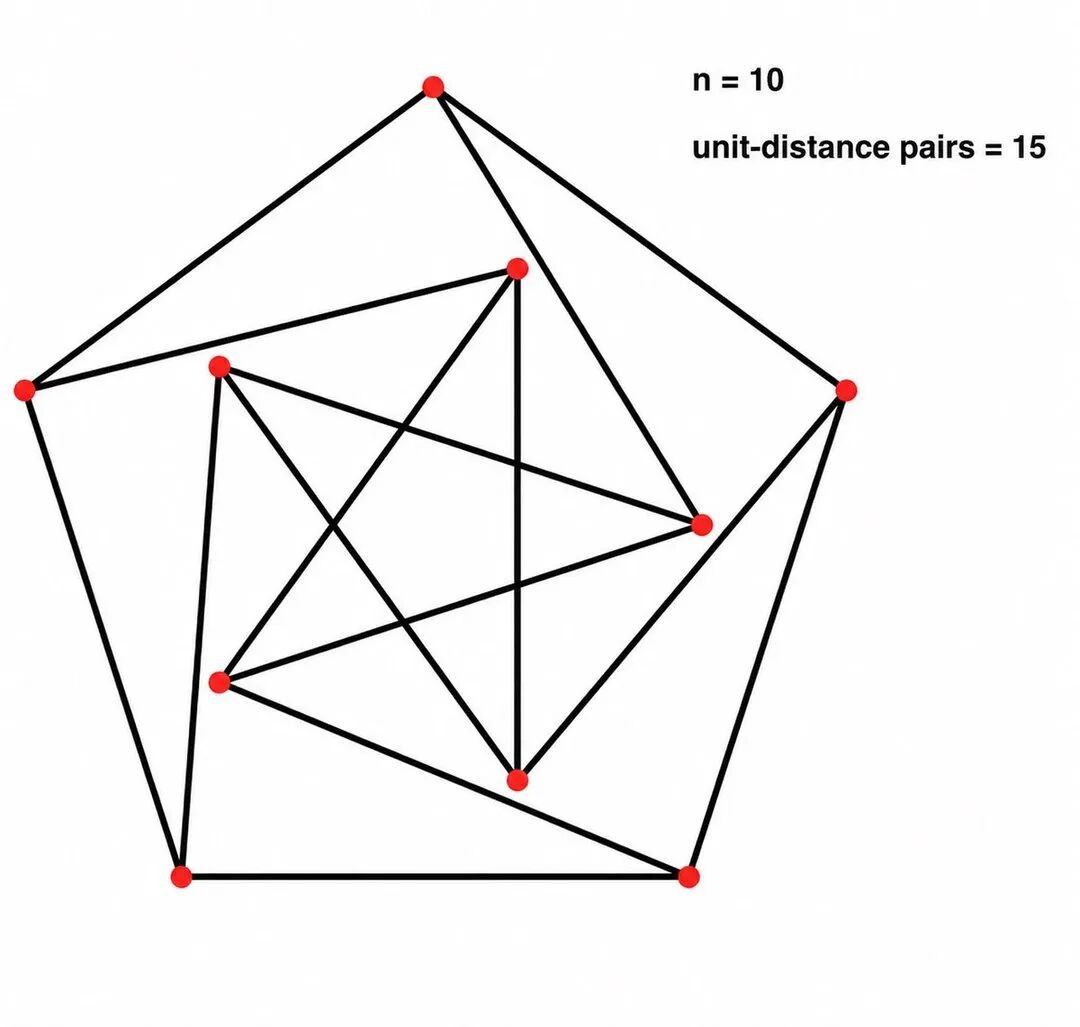
If you draw n points arbitrarily on a two-dimensional plane, then in this diagram, what is the maximum number of pairs of points whose distance between each other is exactly 1?

This is a problem that even primary school students can understand but has driven all subsequent mathematicians crazy.
Mathematicians denote the maximum possible number of pairs of points with unit distance as u(n).
This problem seems like a simple jigsaw puzzle. If you only have n points and want to maximize the number of unit distances, how would you arrange them?
Arrange them in a straight line? Then only adjacent points have a distance of 1, and you can only get n - 1 pairs.
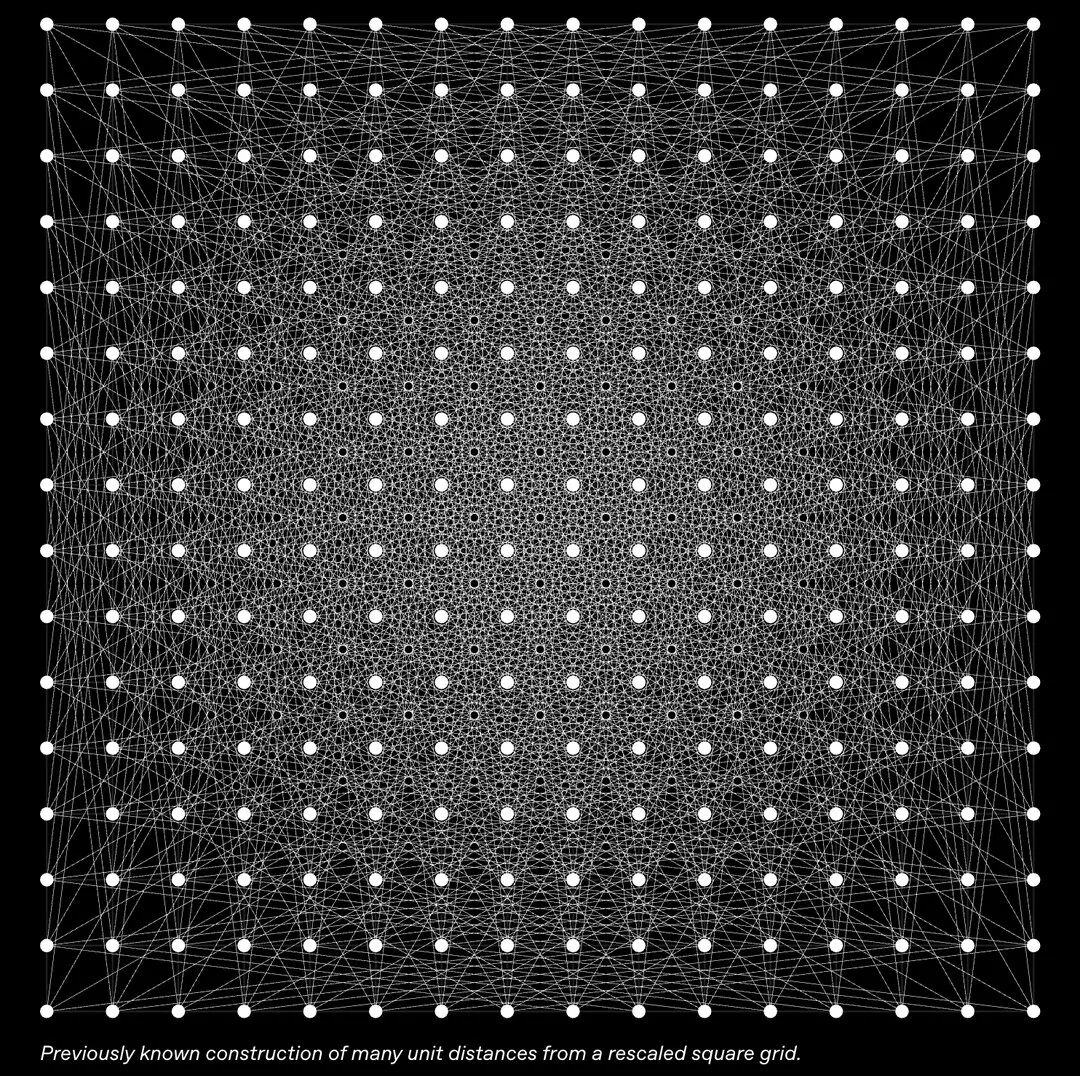
Arrange them in a square grid? The side length of each grid is 1. After a simple calculation, you can get approximately 2n pairs.
Intuition tells us that the more symmetrical and regular the structure, the more unit distances it contains.
Therefore, in the past few decades, the world's smartest mathematicians have reached a deep - seated consensus:
To maximize the number of unit distances, the best arrangement is essentially a structure similar to a "square grid".
Based on this consensus, in 1946, Erdős proposed the famous conjecture (Erdős Conjecture): He believed that the upper limit of u(n) is
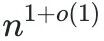
, (where o(1) is a term that approaches 0 as n approaches infinity).
In plain language, no matter how ingeniously you arrange these points, the growth rate of the number of pairs of points with unit distance can only be slightly faster than linear (the first power of n) and can never achieve a qualitative breakthrough.
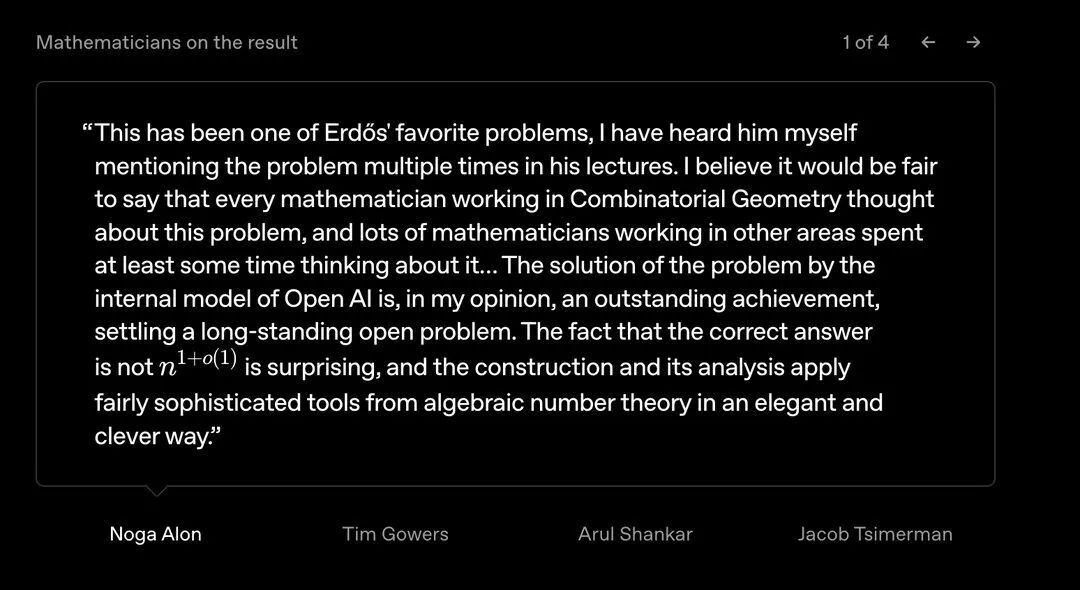
This was one of Erdős' favorite mathematical problems, and he mentioned it publicly many times.
To inspire future generations, Erdős also set up a cash reward for solving this problem.
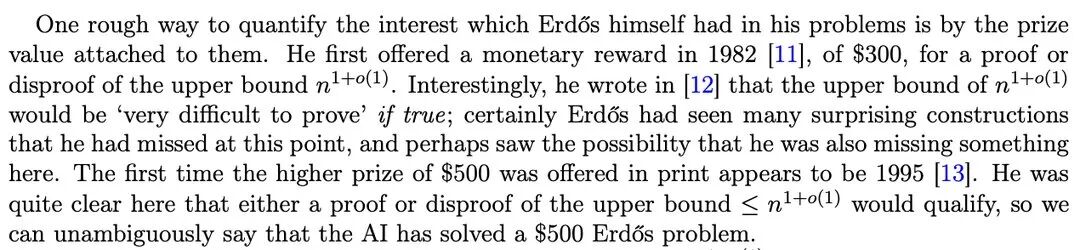
However, in the following 80 years, this problem has become an insurmountable wall in the field of discrete geometry.
The lower bound (the best - case scenario) of this problem is as follows: Since Erdős gave the result of
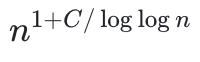
using a scaled square grid in 1946, human mathematicians have made no progress in improving the lower bound for a full 80 years.
Regarding the upper bound (the proof of the theoretical limit), the situation is as follows: In 1984, Spencer, Szemerédi, and Trotter proved that the upper bound is O(n^{4/3}).

Since then, even though countless geniuses (including Terence Tao) have made many fine - tunings to the relevant structures, this upper bound has remained unbreakable like an iron law.
Everyone thought that the square grid was the limit of nature.
However, OpenAI's mysterious model stepped in!
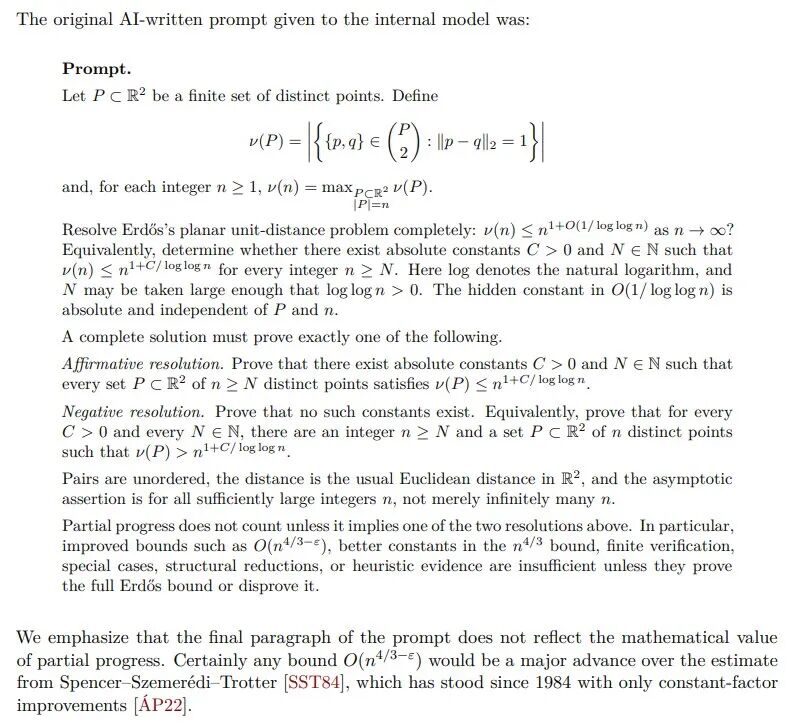
Complete prompt
Subverting cognition: AI found a "non - existent structure"
Surprisingly, it not only proved the conjecture but also directly overturned it.
It created a brand - new family of lattice configurations on the plane that human mathematicians had never imagined.
This configuration directly broke the "grid myth" and achieved a polynomial - level leap!
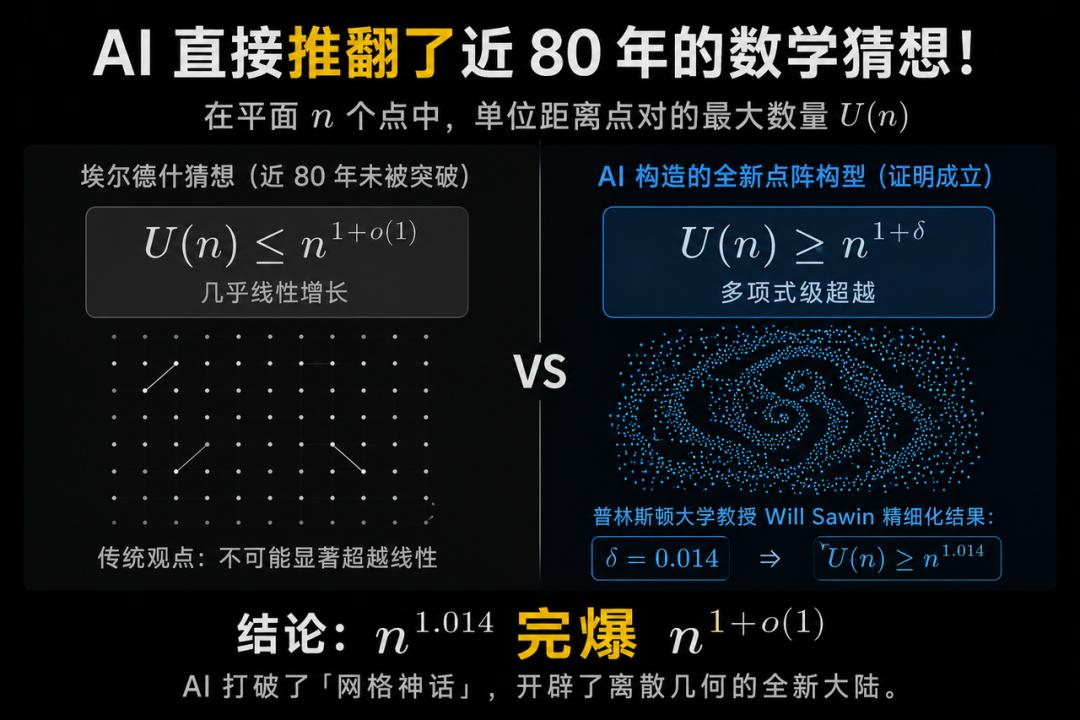
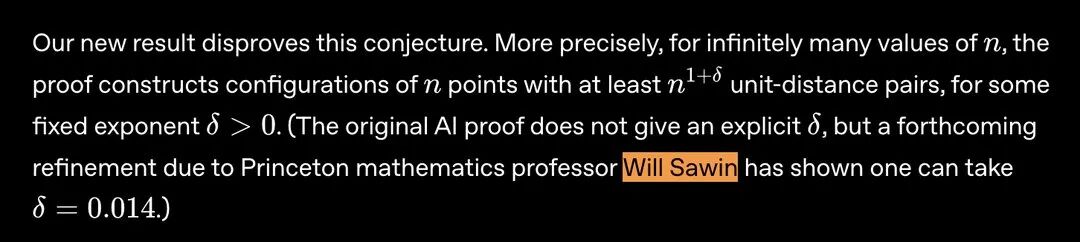
According to the data disclosed by OpenAI: On a plane with n points, the configuration constructed by AI made the number of pairs of points with unit distance reach an astonishing

(where

is a fixed positive constant greater than 0).
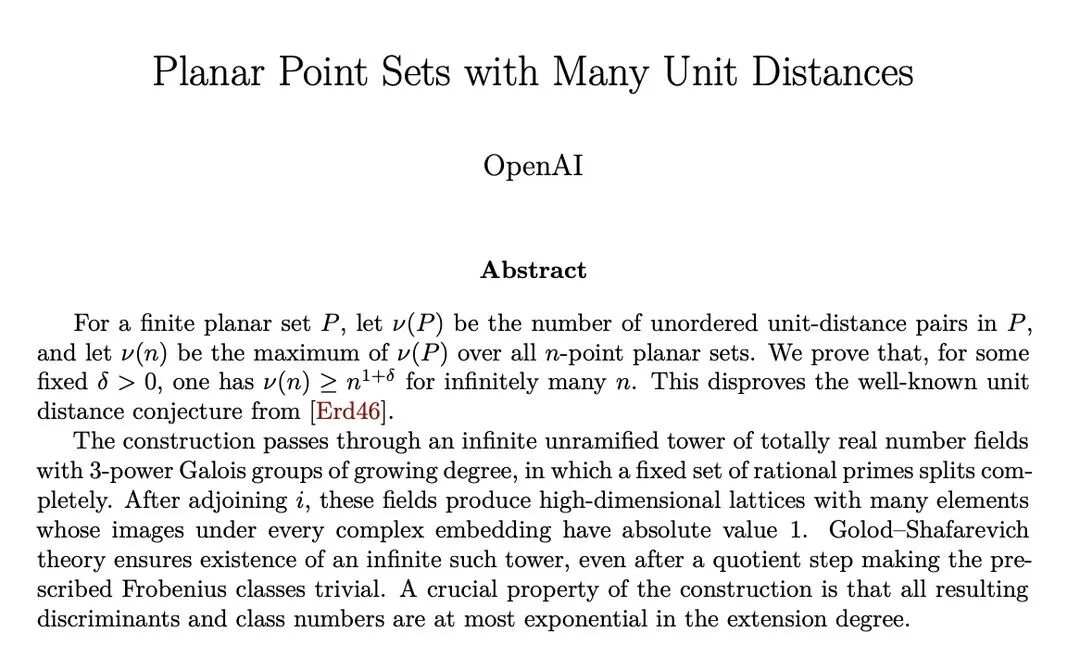
Proof link: https://cdn.openai.com/pdf/74c24085-19b0-4534-9c90-465b8e29ad73/unit-distance-proof.pdf
This means that the number of unit distances has achieved an exponential leap, completely breaking the upper limit predicted by Erdős back then!
Subsequently, Will Sawin, a mathematics professor at Princeton University, conducted a night - long refined derivation of AI's proof and further confirmed that

can be clearly taken as 0.014.

Obviously,
