The "Six Little Dragons" are collectively sprinting towards IPOs. What's the real depth behind the capital frenzy?
The capital wave of humanoid robots is surging into the secondary market at an unprecedented speed.
Since the beginning of 2026, this track has successively witnessed significant news.
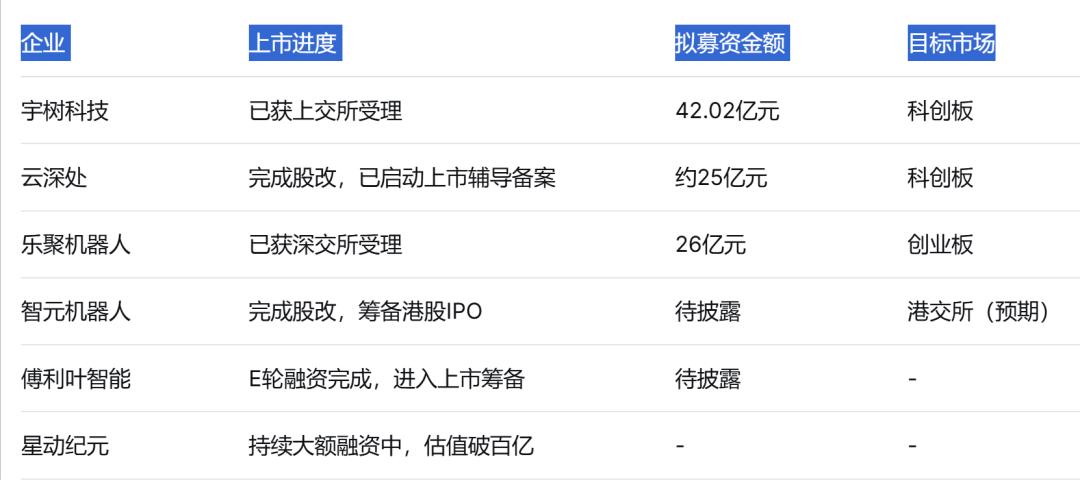
On March 20th, the IPO application of Unitree Technology on the STAR Market was accepted. It plans to raise 4.202 billion yuan, and its post - issuance valuation is about 42 billion yuan. Around April, Deep Robotics completed its share reform and initiated the listing process on the STAR Market.
On May 19th, the IPO application of Leju Robot on the Growth Enterprise Market was accepted, making it the first enterprise to use the fourth set of listing standards on the Growth Enterprise Market.
Coupled with the fact that ZhiYuan Robot is regarded by the market as likely to submit its prospectus at any time, Fourier Intelligence entered the listing preparation stage after completing its Series E financing, and Xingdong Jiyuan completed nearly 2.5 billion yuan in financing in two months with a valuation exceeding 10 billion yuan. The "collective sprint" of the six leading companies in the humanoid robot track is being labeled by the market as the "Six Little Dragons" IPO.
This IPO boom did not come out of thin air. In the first four months of 2026 alone, there were 332 financing events for Chinese robot companies, with a scale of 61.307 billion yuan. Among them, there were 55 financing events for humanoid robots, with a scale of 25.922 billion yuan.
In April alone, companies such as Xingdong Jiyuan, Wujie Power, Tashi Zhihang, and Zhongqing Robot successively completed hundreds of millions of dollars in financing, with the monthly capital scale reaching billions of dollars.
From the primary market to the secondary market, the capital race is accelerating.
01 Not all robots are on the same starting line
In the same wave of IPO boom, the financial situations of the six companies are very different. This is a highly differentiated track - Unitree Technology is leading the way, followed closely by ZhiYuan and Ubtech, while the other companies are still struggling to catch up in the early stage of commercialization.

Unitree Technology: An outstanding student with relatively comprehensive profitability. Unitree Technology's revenue in 2025 was 1.708 billion yuan, a year - on - year increase of 335%. Its net profit after deducting non - recurring items was 600 million yuan, and its gross profit margin was as high as 60.27%.
It turned a profit in 2024, and its net profit in 2025 was nearly 300 million yuan. The shipment volume of its humanoid robots exceeded 5,500 units, ranking first in the world.
Its profit - making logic is not complicated: its customers are mainly scientific research institutions and universities, who are not price - sensitive. Moreover, its products are general robot hardware platforms rather than customized solutions, and customers buy them back for secondary development and algorithm training.
On the supply chain side, Unitree self - develops core components such as motors and reducers. The hardware cost is controlled at 60,000 to 70,000 yuan per unit, but the terminal selling price is about 167,600 yuan (the average selling price in the first three quarters of 2025), with a considerable profit margin.

ZhiYuan Robot: A chaser breaking through in mass production. ZhiYuan Robot is a representative of the "mass - production school". In March 2026, its 10,000th general embodied robot, Expedition A3, rolled off the production line. It only took three months to increase from 5,000 to 10,000 units.
Deng Taihua, the chairman of ZhiYuan, revealed that the company's revenue in 2025 exceeded 1.05 billion yuan, making it "the fastest robot company in China to achieve 1 billion yuan in revenue".
In terms of financing, ZhiYuan has completed a total of 11 rounds of financing. After the Series B financing in March 2025, its post - investment valuation reached 15 billion yuan, led by Tencent. The market expects that ZhiYuan may go public in Hong Kong in 2026, with a target valuation of 40 - 50 billion Hong Kong dollars.
Ubtech: A loss - making giant betting on the industrial scenario to turn around. As the "first humanoid robot stock in the world", Ubtech went public on the Hong Kong Stock Exchange at the end of 2023, but its financial situation is not impressive. Its revenue in 2025 was 2.001 billion yuan, a year - on - year increase of 53%, and its net loss was 790 million yuan, a year - on - year reduction of 32%.
However, there are several signals worthy of attention. It delivered 1,079 full - size humanoid robots throughout the year, a year - on - year increase of 358 times. The revenue from this business line was 821 million yuan, a year - on - year surge of 22 times, and it exceeded the education robot business for the first time to become the company's largest source of income.
Its gross profit margin jumped from 28.7% to 37.7%, and the gross profit margin of the full - size humanoid robot business reached 54.6%.
Ubtech is betting on the manufacturing workshop. Automobile manufacturers such as BYD, Geely, Mercedes - Benz, and Audi are using its humanoid robots for assembly, inspection, and handling. The value of these real orders is much higher than the one - time hardware purchases of scientific research institutions.
Leju Robot: Climbing steadily and striving to get out of trouble. Leju's revenue in 2025 was 258 million yuan, a year - on - year increase of about 365%.
Among them, the "Kua Fu" series of full - size humanoid robots contributed 178 million yuan in revenue, accounting for 68.86%. The average selling price was 308,100 yuan per unit, and the annual shipment volume was 577 units.
The company is still not profitable and is expected to turn a profit as early as 2028. The compound annual growth rate of its revenue in the past three years was 118.68%, and its valuation is 4.327 billion yuan, the lowest among the "Six Little Dragons".
Fourier Intelligence and Xingdong Jiyuan: Still burning money and yet to be proven. Fourier Intelligence entered the humanoid robot field from the rehabilitation robot track. In early 2025, it completed its Series E financing, with investors including SoftBank and IDG Capital, and its valuation is about 8 billion yuan.
Xingdong Jiyuan completed nearly 2.5 billion yuan in financing from March to April 2026, with a valuation exceeding 10 billion yuan. In the second quarter of 2026, it started mass - delivering thousands of units and cooperated with China Post, SF Express, etc. to implement in more than 10 logistics centers. However, there is no public comprehensive financial data for these two companies, and the real test for the capital market is yet to come.
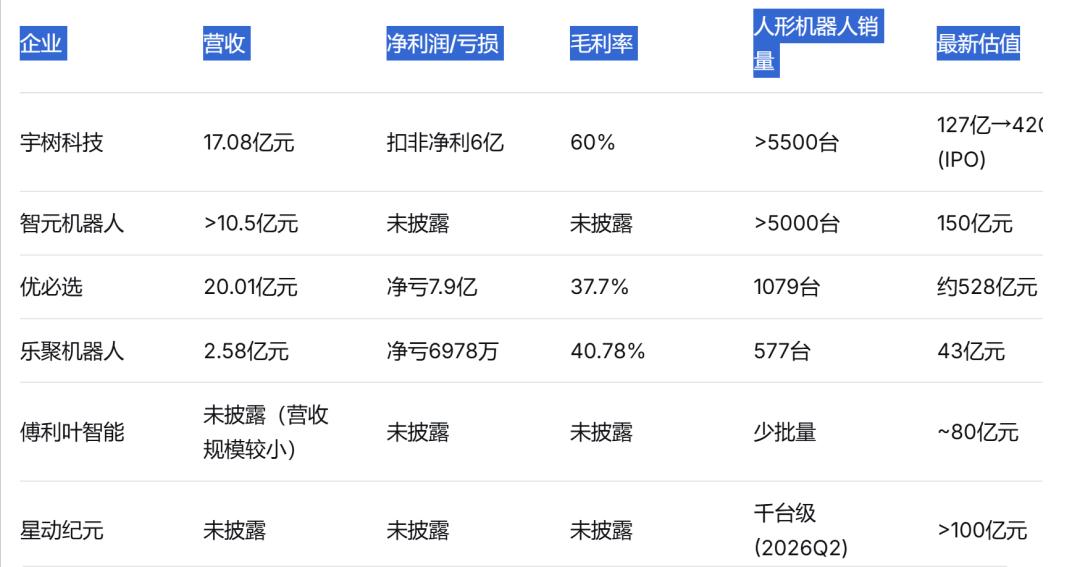
It can be clearly seen from the data that this is an extremely differentiated track.
The business models of the leading players have started to work. The mid - tier players are still sacrificing profits for scale, while the tail - end players are still in the concept verification stage and rely on financing to survive.
02 The "Dual Oligarchs" Pattern
In 2026, the Chinese embodied intelligence track presents a pattern of "led by dual oligarchs".
Unitree Technology and ZhiYuan Robot together account for about 80% of the domestic shipment volume, forming the first echelon.

Unitree and ZhiYuan have two completely different strategies.
Unitree is a typical "hardware school". Starting from quadruped robots, it quickly entered the humanoid track with its supply chain capabilities and motion control technology accumulated over ten years.
Its core competitiveness lies in vertical integration and extreme cost control. Its product logic is "move first, then think". It first maximizes the motion performance and then gradually makes up for the "brain" shortcoming.
ZhiYuan is the "full - stack school". Since its establishment, ZhiYuan has released multiple robot bodies and multiple AI models, covering multiple scenarios such as industrial manufacturing, logistics warehousing, and commercial services. In July 2025, by acquiring about 67% of the equity of Shangwei New Materials, ZhiYuan opened up the secondary - market financing channel first, showing an obvious capital - operation thinking.
In addition, Deep Robotics started with quadruped robots, and power inspection and emergency rescue are its main business. Fourier Intelligence follows a dual - track approach of "rehabilitation + humanoid". Xingdong Jiyuan focuses on high - dynamic motion and complex - terrain adaptability and has made the fastest progress in the logistics scenario implementation.

03 Primary - Market Valuation: Seemingly Absurd, but Actually with Logic
Many people are confused when looking at the valuations of humanoid robot companies. With revenues of only a few hundred million or even less than 300 million yuan, the valuations are often tens of billions or even hundreds of billions. Is this reasonable?
The current valuation logic in the primary market has completely abandoned the traditional PE model and shifted to a new framework of "benchmarking overseas + reverse - pushing from long - term space".
The logic of benchmarking overseas is very simple: The valuation of the American humanoid robot company Figure AI has reached 39 billion US dollars, and Tesla's Optimus has been given a long - term imagination of trillions of dollars by the capital market.
In the eyes of institutional investors, China has the most complete humanoid robot supply chain in the world. As long as a "Chinese - version Figure" emerges, a valuation of tens of billions of RMB is just an entry ticket.
Reverse - pushing the value from long - term space sounds more mysterious: Referring to Morgan Stanley's prediction of a 5 - trillion - dollar global robot market in 2050 and China's national strategy of "Artificial Intelligence +", the current valuation is "discounting in advance for the future trillion - level market".
However, the risks implied in this valuation logic are also very high. It bets on the matching between the speed of technological progress and the timing of market explosion.
Tian Feng, the dean of the Kuaisi Mansiang Research Institute, analyzed more accurately: A few leading companies with real delivery capabilities, such as Unitree and ZhiYuan, obtain "real - world premiums", while a large number of followers only obtain "narrative premiums".
The secondary market never tells stories. After the IPO, the real value of these two types of premiums will be completely disassembled by data.

04 The Lack of a "Brain" is the Biggest Hidden Concern behind the Billion - Yuan Valuation
No matter how enthusiastic the capital carnival is, a hard fact cannot be avoided: the current biggest bottleneck for humanoid robots is not the hardware, but the "brain".
Liu Bo, a partner at Clearstream Capital, said bluntly: "In the past two years, among dozens of companies called embodied intelligence, most of them can be called embodied, but not intelligent."
Most of the capital hot money has flowed into the visible and tangible hardware sectors such as robotic arms and reducers, while the core that determines whether a robot can really "work", the embodied large - scale model and high - quality physical data, is facing a serious "data shortage".
Peng Zhihui, the president of ZhiYuan Robot, admitted: "Data is indeed the biggest bottleneck for embodied intelligence." Different from the large - language models on the Internet, which can be trained with massive text data, the physical - world data required by robots involves high - dimensional information such as force, friction, and touch, and its data scale is 3 to 5 orders of magnitude different from that of large - language models.
This is not a technical problem that can be solved in the short term. It means that even if the hardware cost of humanoid robots drops low enough, if the "brain" is still at a primary - school level, the generalization ability and reliability of robots in real scenarios will always be a big question mark.
The inflection point of mass production: 2026 is regarded by the industry as the real "first year".
Although the "brain" problem has not been solved, 2026 is still a crucial node for the humanoid robot industry to connect the past and the future.
In terms of mass - production shipments, the global shipment volume of humanoid robots in 2025 was about 18,000 units, a year - on - year increase of 508%. It is expected to exceed 50,00