Business owners in Yiwu are integrating AI into their factories.
Gaining the trust of bosses in the real - world industries might be the first step for AI to transform the world.
In 2026, those "shovel sellers" in the upstream of the AI industry, who sell hardware and tokens, have already made a fortune. However, when we look back at factory workshops and shift our focus from Internet companies to the heartland of the manufacturing industry, a more pressing question emerges: Can AI truly penetrate into the capillaries of the Chinese economy - those small and medium - sized manufacturing enterprises with annual revenues of tens of millions, teams of less than a hundred people, and no IT departments?
Skeptics have good reasons. Small and medium - sized enterprises have a weak digital foundation. Data is scattered in WeChat groups and Excel spreadsheets. Bosses are naturally vigilant about implementing systems, and employees instinctively resist new tools.
More importantly, the scenarios in the manufacturing industry involve supply chains, production scheduling, cross - language communication, and multi - platform operations. AI - enabling any single link cannot be solved by a simple dialog box.
However, in Yiwu, known as the "World Supermarket", a star - light factory named "Youkela" offers a new solution.
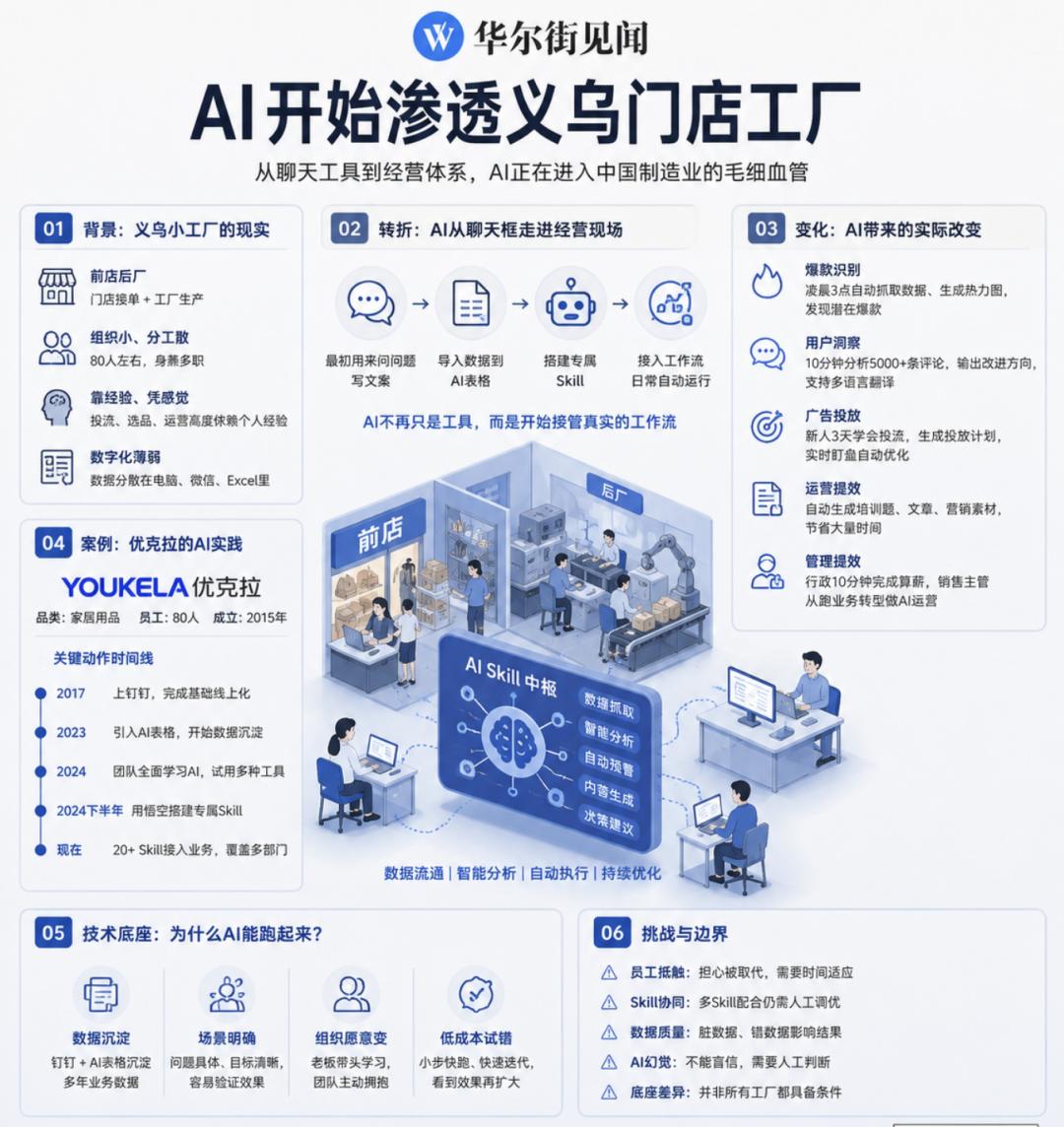
This enterprise, which has been established for over 18 years and has a team of less than a hundred people, completed the full - scale deployment of employees within two weeks after DingTalk launched its AI agent "Wukong" in March 2026.
Three months later, the success rate of its new product launches jumped from 60% to 92%. The daily sales of its Douyin team increased from a few thousand yuan to over 20,000 yuan. The salary - calculation work that used to take one administrative staff two days was compressed to just ten minutes.
Behind these figures is not some grand digital transformation project, nor is there a large IT team to support it. It relies on an AI agent that can directly operate DingTalk workflows, a group of ordinary employees willing to spend three or four hours to "give it a try", and a boss who graduated from a computer major but hasn't written code for twenty years.
This story is worth a closer look not only because it demonstrates the path for AI to create value but also because it exposes the real frictions that AI encounters when penetrating into the real economy.
Taking Over Factories and Stores
Before delving into the value created by AI in Youkela, we first need to understand the business characteristics of this enterprise.
Youkela follows the typical "front - store, back - factory" model in Yiwu. It has offline stores in the Yiwu International Trade City to receive global customers. Meanwhile, its own factory is responsible for R & D and production, and its products are sold through multiple platforms such as Tmall, Amazon, Douyin, and 1688. CEO Wei Jun graduated from the computer major of Nanchang University in 2005. Due to family reasons, he came to Yiwu to start a business in 2007, starting with selling glowing ceramic cups on Taobao.
"In 2012, we sold seventy or eighty thousand of these cups in a year, with revenues exceeding 200,000 yuan." He recalled to Wall Street News. After more than a decade, Youkela has become an invisible champion in the star - light category, holding authorizations from well - known IPs such as Disney, Ultraman, and Sanrio, as well as more than forty patents.
Wei Jun's computer background gives him an instinctive affinity for digitalization. He told Wall Street News that he started chatting with AI since the release of the first - generation GPT. Youkela started using DingTalk as early as 2017 and fully deployed DingTalk AI Spreadsheets in September 2023 - "in an era when most Yiwu bosses were still doing business using WeChat and Excel," he emphasized this time difference.
Two months ago, DingTalk's AI work platform "Wukong" was launched. Since Youkela's data was already running online, AI only needed to be connected rather than rebuilt, and it quickly took over those repetitive, mechanical, and labor - intensive tasks.
In the Yiwu International Trade City, Youkela's store "IP Magic Castle" receives international customers from the Middle East, Southeast Asia, Africa, and South America every day. Language barriers and information omission have always been long - standing problems that plague front - line stores.
Wei Jun told Wall Street News that his solution is to hang an AI recording card beside the counter, which automatically converts voice to text and performs multi - language translation. No matter whether the customers speak English, Arabic, or Spanish, the conversation content will be synchronized to the company's AI spreadsheet in real - time.

Back at the headquarters, the product R & D and supply - chain teams don't need to repeatedly ask "what exactly did that Middle - Eastern customer say." They only need to ask the Agent - "which customers came to the trade city today, and what are their customized requirements?" The AI will instantly retrieve, summarize, and analyze the information and provide a structured list.
"From the moment a customer steps into the store, their requirements start flowing on the digital chain. From the store to the headquarters, from sales to R & D, from an oral expression to an executable product requirement form, there is no need for manual transcription in between." Wei Jun described.
For a trading - manufacturing integrated enterprise with the "front - store, back - factory" model, this data highway from the "store site" to the "factory workshop" is as significant as connecting to the Internet back then.
The same logic is replicated in the e - commerce operation end.
In the past, Youkela's operation team needed to spend two whole hours every day manually copying data from Taobao Business Advisor and pasting it into Excel spreadsheets, and then relying on manual experience to analyze why the styles of competitors became popular.
"There used to be countless anxieties about hot products every day. A certain product from a neighboring factory suddenly sold over ten thousand units a day, and you didn't know why." Wei Jun told Wall Street News. "Now, at midnight every day, the Agent he built automatically grabs the hot - product data of this category across all platforms; in the morning, the analysis report is pushed to the DingTalk group.
However, information transfer is just the starting point. After data no longer needs to be manually transferred, Wukong starts to intervene in higher - level tasks, those analysis and judgments that originally relied on the boss's intuition and operation experience.
What impressed Wei Jun most was the AI's correction of cognitive blind spots.
"Our traditional operation team had inertial thinking. We always focused on high - unit - price products and completely ignored the low - unit - price market, resulting in falling behind in the competition." He admitted. After analyzing the market data, the AI pointed out that products priced below 100 yuan have great potential to cover young consumers, and details such as color preferences have a significant impact on sales.
"These are visual blind spots that manual analysis simply can't notice. To be honest, we learned our lesson before adjusting our work methods." Wei Jun admitted.
In the product R & D stage, Youkela let the Agent analyze more than five thousand user reviews and extract pain points such as "glare", itch points such as "need Bluetooth control", and excitement points such as "as a bedtime ritual for children." "In the past, the approach was to rely on the boss's decision - making or the inspiration of graphic designers, and occasionally glance at the comment section, but this unstructured information was easily forgotten."
In the real - money promotion stage, the changes are even more radical.
Youkela built an automated production - investment heat - map system on Wukong. It is recommended to increase investment in links with high ROI. They also set up an AI quality inspector. Links with a main - picture click - through rate of less than 3% will be directly blocked from being put on the shelves by the system.

"It has turned the originally mysterious operation and promotion into a fool - proof operation. Newcomers can get started in just three days." Wei Jun said. There is also a blind spot in traditional product analysis: "The lack of consideration for short - video dissemination and emotional value has led to a low product success rate and serious inventory backlog. We used to blindly follow the trend and suffered a lot of losses. Now, the AI integrates parameters such as industry cycles, festival growth rates, and target audiences, and combines the design trends of popular products on Xiaohongshu. The product success rate has indeed increased."
From information transfer to analysis and judgment, and then to execution and decision - making, AI's penetration in Youkela deepens layer by layer along a clear logical chain. However, what really makes this chain work comes from the reorganization of the organization.
Sales Supervisors Turn to Skill Development
"In our company, the most important department used to be the sales department, but now it's Skill development." Wei Jun told Wall Street News directly.
However, there is a real organizational adjustment behind this. The former head of the sales department has been transferred to be in charge of the development and maintenance of AI skills full - time. The operation assistants have been transferred to the content department, and the company has added new positions such as skill training and design director training.
As a user - defined AI encapsulated skill, Skill can stably operate Wukong through natural - language structuring to "do a specific thing." Currently, Youkela has 50 to 70 Skills, covering various aspects from hot - product grabbing, comment analysis, advertising quality inspection to attendance and salary calculation.
Wei Jun insists that people with business backgrounds should do this. "People who understand the business should handle relevant work to solve systematic problems rather than single - point problems." He directly criticized those external solutions: "Simple emotional - value training and external consultants who don't understand the business cannot promote the continuous growth of the enterprise."
The logic behind this choice is that the upper limit of AI tools does not depend on the technology itself but on the user's in - depth understanding of the business. An operation supervisor who understands why a link has a low ROI can build a more effective quality - inspection Skill than an engineer who can write code.
A detail in the interview confirms this.
Xiao Dong is the only administrative and personnel staff in the company. She majored in hotel management and used to work as a personnel and cashier in the catering industry. She came to Yiwu with her husband in 2023. When she joined Youkela, the company had never had a full - time HR, and everything started from scratch.
What really changed her work was salary calculation. Youkela has a team of seventy or eighty people. The attendance rules are not exactly the same as DingTalk's standard, and different departments have different rules, along with special situations such as holiday shifts.
Every month, she needs to export the attendance records from the background, manually copy and transcribe them one by one, convert them into the company's own salary - calculation format, and then calculate the salaries. It takes her two whole days to do this alone.
After the company's technical colleagues understood her workflow, they helped her build a Skill, which shortened the two - day work to less than ten minutes.
"This is a monthly task, and I will use it." Xiao Dong told Wall Street News. She can't write code and doesn't understand what prompt - word engineering is, but after the technical colleagues told her the logic of Wukong, she tried and adjusted it by herself. Most of the debugging work during the Skill - building process was done by herself, which took her three to four hours.
For someone who is deeply involved in work every day, this means that AI is moving from the "chat window" to the "work site."
When asked "what's different after AI is integrated into work," Xiao Dong thought for a while and said: "It doesn't seem to be easier, but for many things, I can throw the problems to AI and let it help me analyze, and then I can try according to the methods it provides. Maybe I can avoid a lot of detours."
Wei Jun has his own methodology for promoting AI across the whole enterprise. His approach is a four - step process of "data collection, online - based, visualization, and reward mechanism." The company's meetings are automatically scored by AI - "70 points, 68 points, 72 points. The AI will tell you how well the meeting was presented and chaired."
The sales staff in the stores are also evaluated by AI. The system automatically extracts customer consultation records from the recordings and scores them, including dimensions such as professionalism, goal - orientation, customer insight, and question - asking and listening abilities. "We set the standards ourselves and input them into the intelligent agent, and it will automatically evaluate." Wei Jun said. He even let the Agent automatically generate training questions based on customer consultation records, "letting others conduct the training."
The company's digital journey started in 2017 when it connected to DingTalk and fully deployed AI spreadsheets in 2023, in contrast to the "traditional Excel work mode." Wei Jun has a clear understanding of this: "Science and technology are the primary productive forces. Facing market changes, our attitude is to look for opportunities first and then problems." He plans to continue to increase investment in the AI field, aiming to triple the efficiency through AI optimization.
He still often holds training sessions in the factory to encourage Yiwu bosses around him to learn about AI. "Most people lack execution ability, so they can't keep up with the leaders. I hope to widen the gap between our company and competitors through this."
Beyond the Ability Boundaries
Simply packaging Youkela's practice as a successful story of AI empowerment will obscure the real frictions.
Wei Jun admitted that he encountered obvious employee resistance when promoting AI applications. His response was to "select the right people to start with, set up benchmarks, and let the data speak."
He also said frankly: "During the weekly meetings, when everyone puts forward requirements, to be honest, I feel quite embarrassed about most of them." Many AI requirements put forward by employees are not valid or cannot be met by the current technology. There is a significant gap between the vision of full - scale AI implementation and the actual cognition of employees.
The deeper difficulty lies in the leap from single - point to systematic transformation.
"Most existing AI tools can only solve surface problems and are difficult to comprehensively optimize the company's business system." Wei Jun observed that it is relatively easy for a single Skill to solve a single pain point, but to make fifty or sixty Skills work in synergy and truly reshape the enterprise's decision - making chain requires systematic top - level design, which is exactly what small and medium - sized enterprises lack the most.
The AI's own capabilities also have clear boundaries.
The Agent can handle tasks with clear rules and structured data. The reason why Xiao Dong's salary - calculation Skill is successful is that the attendance rules can be clearly described. For those business logics that are "hard to explain" - such as whether a product should be developed or whether a market is worth entering, the AI can provide analysis, but the final strategic judgment still needs to be made by humans.
"The AI can detect the low conversion rate caused by the mismatch between product positioning and target users, but it can't automatically solve the problem." Wei Jun said.
There is also a more fundamental ecological problem.
Youkela is a pioneer in Yiwu, but the premise for being a pioneer is that it built a digital foundation as early as 2017. In Yiwu, the data of most small and medium - sized enterprises is still scattered in WeChat groups and paper documents. For them, the problem is not "whether AI is useful" but "where the data comes from."
Enterprises without a digital foundation cannot connect to the Agent even if they get it. Wei Jun is aware of this: "Consciousness awakening is the first step." But this step is still far away for many people.
Nevertheless, Youkela's practice still answers an important question: How low can the threshold for AI to