Just now, Google sentenced the website to death.
Google has killed itself and given hyperlinks a death sentence with a reprieve.
At the I/O Conference, Google presented Gemini Omni, Gemini 3.5 Flash, Gemini Spark, AI audio glasses, and Android Halo, fully integrating powerful AI and Agent capabilities into Google's entire software and hardware ecosystem (Search, YouTube, Android, Book, glasses...). Compared with OpenAI and Anthropic, which have relatively single applications, Google shows the demeanor of a king.
The updates around Google Search all point to the same result: humans will no longer need to view web pages.
Agent Search becomes the mainstream, and traditional search will take a backseat
Over the past few decades, the search logic has remained unchanged: users enter keywords, search engines return links, and websites receive traffic. In recent years, Google, Baidu, and Bing have successively added AI summaries to search results, which are just patches to the original system.
Google is going even further this time. It has opened a new "copy" outside the "search results page": Google Search AI Mode, which is essentially a universal ChatBox. Gemini 3.5 Flash generates answers in real - time, and users no longer face ten blue links.
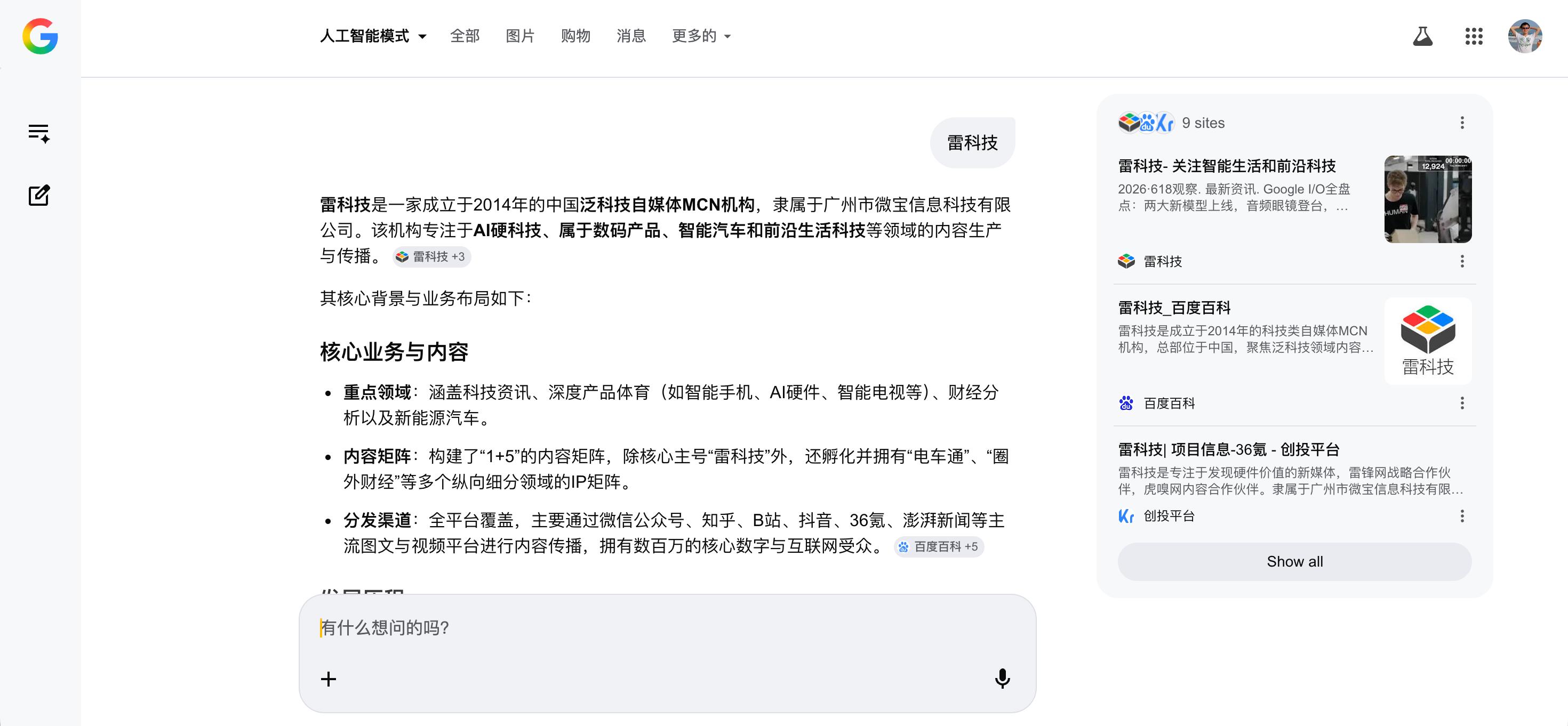
(Image source: Google)
This direction is not new. Doubao, Qianwen, DeepSeek, and Kimi are all working on it. Domestic users have an extremely high acceptance of the "universal input box". The monthly active users of Doubao have exceeded 345 million. Even though there are often "AI failure jokes", young people have defaulted that "asking AI" is more convenient than "searching web pages".
However, the results highlighted by ChatBoxes, including Google AI Mode, are all static. What has changed is the way of obtaining information, but the form of information has not changed.
Google's second move this time directly targets the form of "web pages". It has launched a brand - new "Generative UI", using Antigravity to generate results: not static content, but dynamic applications. When users search for "how the mortise and tenon structure works", a dynamic demonstration application is directly generated; when searching for a new car, users can directly enter a 3D space generated in real - time by AI, switch the interior, view the seats, and simulate the driving perspective.
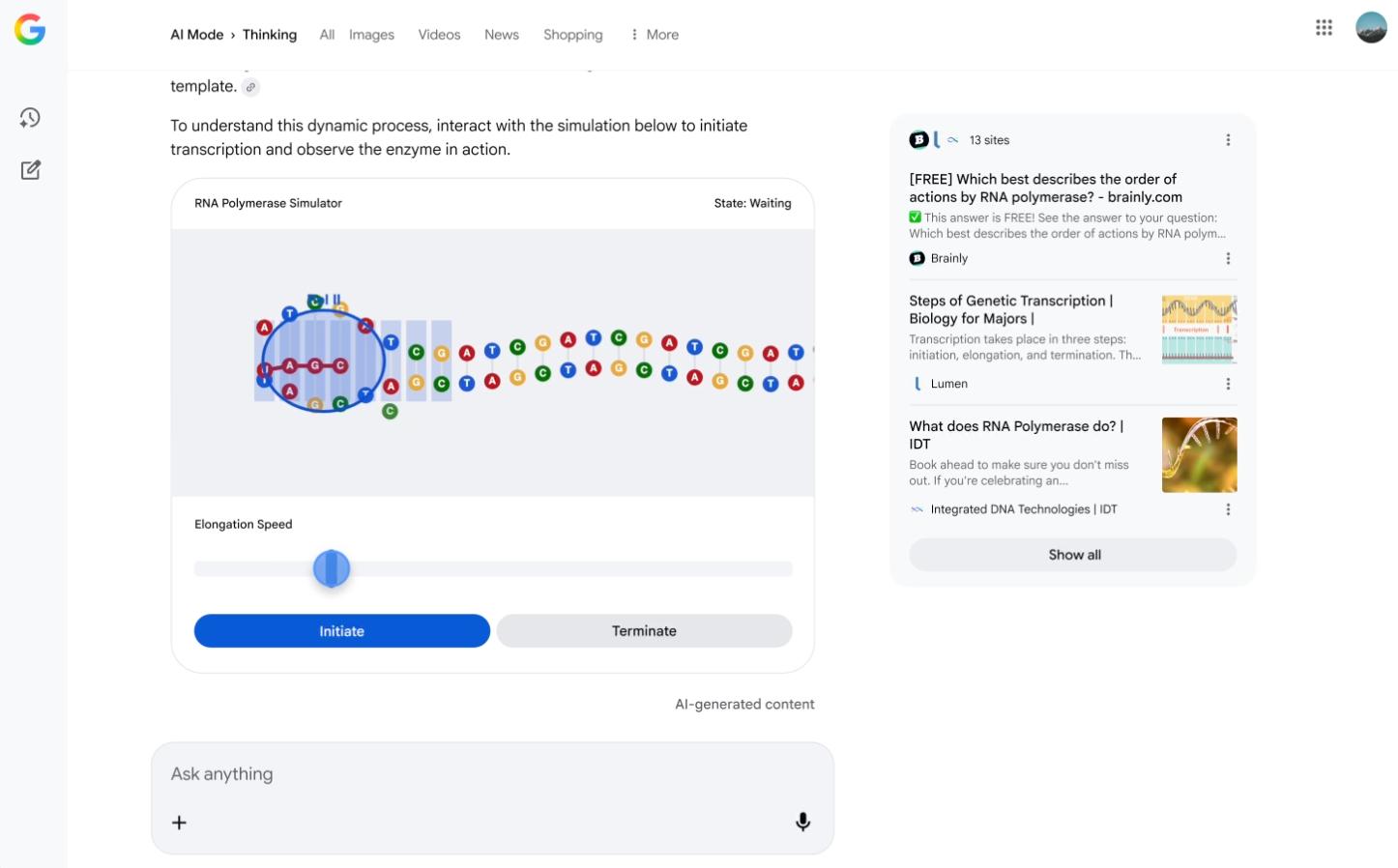
(Search on Google AI: "Tell me how RNA polymerase works. What are the stages of transcription? How does transcription differ between prokaryotic and eukaryotic cells?")
Each search customizes an app, and the results are presented dynamically, which is more vivid, intuitive, and interactive. Of course, not all cases require such results. AI will judge what form of results to give according to users' search needs.
It's a real revolution. The basic logic of the Internet in the past few decades has been "web pages carry information". Google helps users find web pages, and what it has always done is to "accelerate the flow of information". Now Google believes that the web page as an intermediate layer is redundant because AI can either aggregate information from third - party web pages or provide a more suitable interactive interface, and information flows in a different way.
Once upon a time, the Internet was an open "interconnection": HTTP was responsible for connection, HTML for expression, and browsers for access. But in the AI era, Gemini takes over everything, and web pages have become consumables for its generated results, almost having nothing to do with users.
Websites have degenerated into databases, mainly for AI use
Google has also launched Agent Gemini Spark for individual users and integrated it into the search. When searching becomes "lobster - like", Spark can run in the background all day long, continuously monitoring specific information according to users' requirements. For example, an editor at Lei Technology asks the search Agent to keep an eye on AI companies such as OpenAI, Anthropic, Grok, Perplexity, and AI news on X before going to bed. When there is a major hot event, an email reminder will be received.
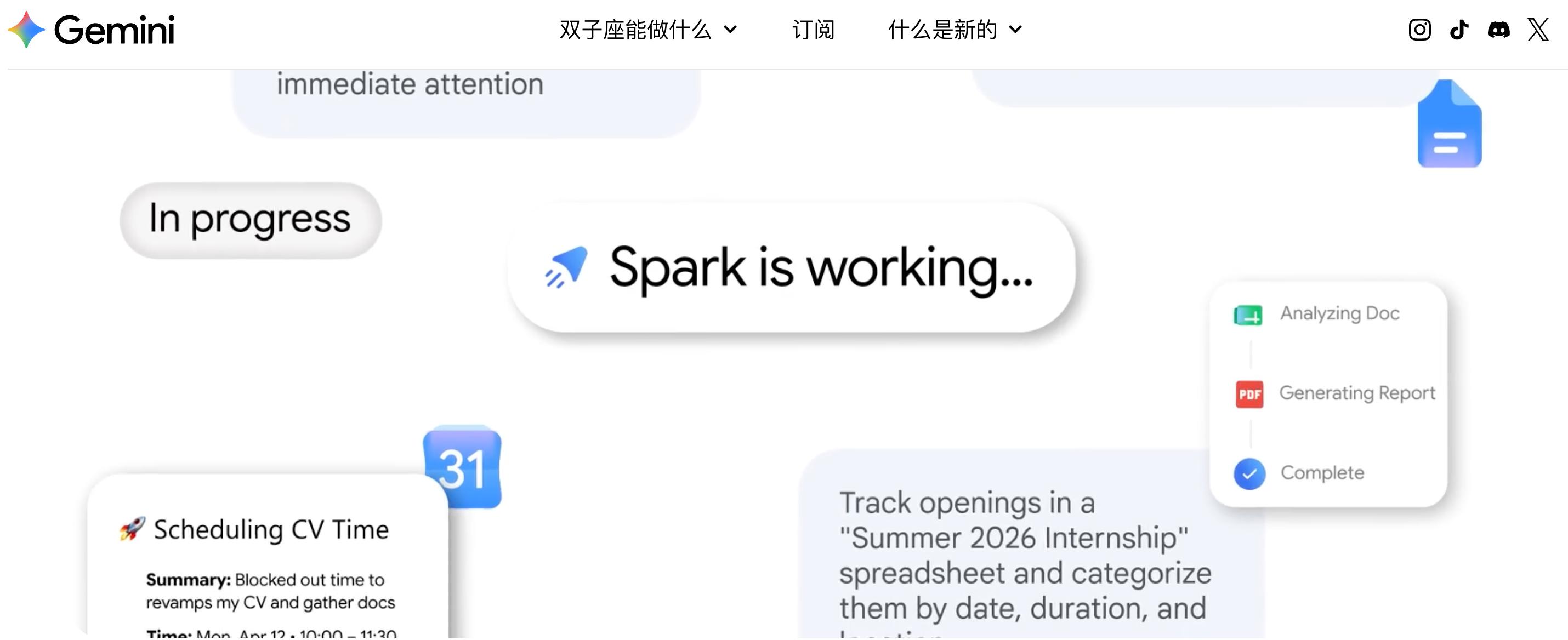
(Image source: Google)
Gemini Spark runs on the Google Cloud and supports multi - device collaboration. Users can assign tasks on their mobile phones and get results on their computers. It has not only directly interacted with Google components (Google Docs, Google Calendar, Gmail, etc.), but in the future, it can also be interconnected with external apps through the MCP protocol to achieve more comprehensive task hosting. In the future, it will also be integrated into Android Halo, Google Book, Chrome, and AI glasses.
Web pages are made for Sparks to view. Even apps need to develop skills to connect with Sparks, actively delivering content to AI. Users only see the final answers and hardly care where the information comes from.
This reminds people of the famous article in 2010: Chris Anderson, the editor - in - chief of Wired magazine (the father of the long - tail theory), wrote an article called "Web is Dead, Long Live the Internet". He said that the Web was dying, but the Internet would live forever. At that time, the mobile Internet was just emerging. Users no longer accessed the Internet through browsers but turned to apps. The app ecosystem swallowed up the open Web and became isolated information islands.
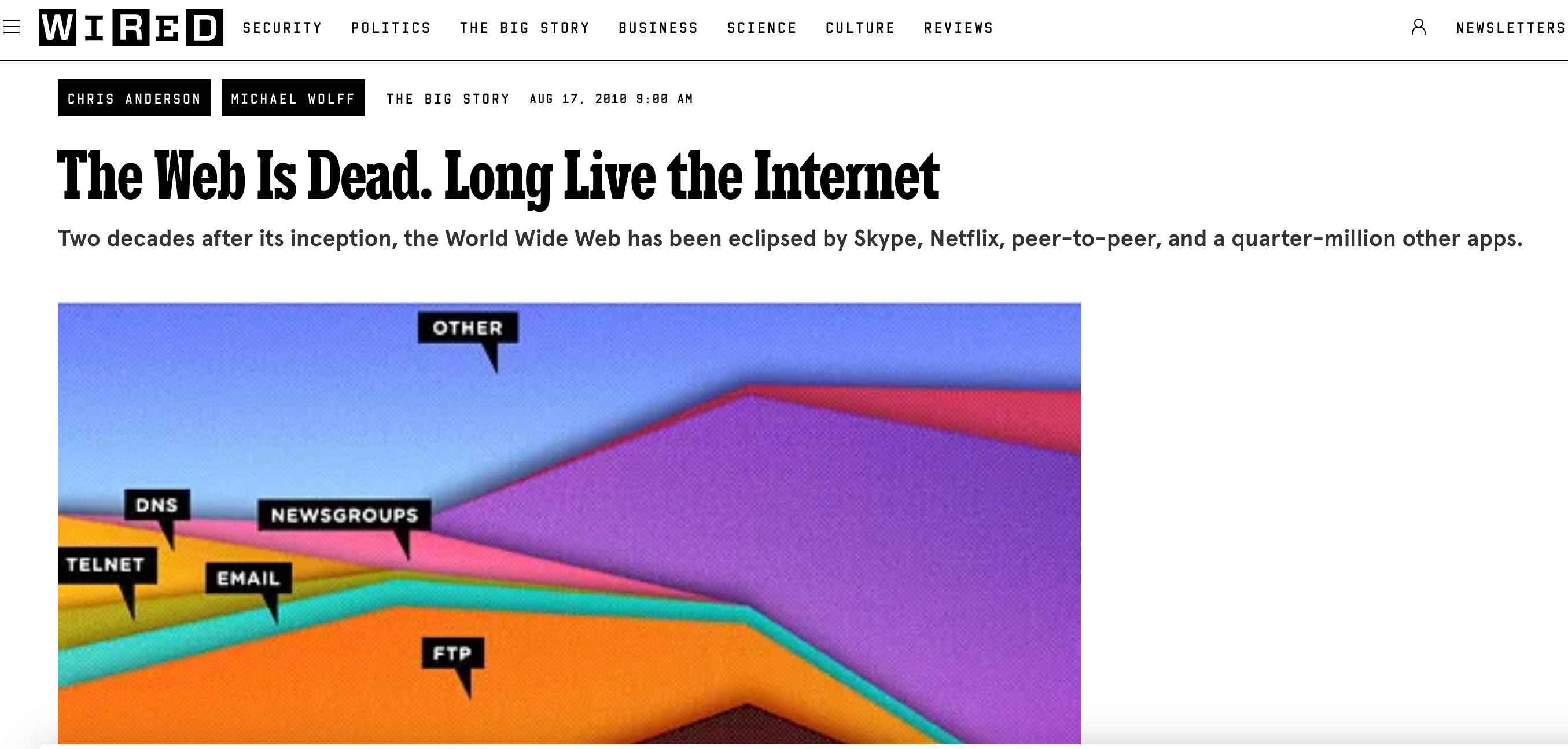
(Image source: Wired)
After the rise of the mobile Internet, browsers have been marginalized. Sogou, Cheetah, and FireFox have withdrawn from the historical stage. Users' time has been consumed by apps. Many young people today don't even know website addresses. They only need to open Douyin, Xiaohongshu, WeChat, and Taobao.
However, the change from PC to mobile is essentially an "entrance migration". Web pages still exist but are hidden behind apps. In fact, this article you are reading is carried in the form of a web page, but you don't need to know the "website address".
Google is different this time. It is trying to eliminate the action of "clicking" itself. At that time, Chris Anderson said in the article: We of course like the open and free Web, but we are gradually abandoning it and looking for simpler, trendier, and more comfortable - to - use services. Sixteen years later, such a service has emerged: Agent, simple enough and useful enough.
The WEB will completely die out. In the past, websites needed Google to distribute traffic, and Google needed the content of websites, so there was the discipline of SEO. But AI no longer gives links but gives answers and completes tasks. The results users get from AI search are accurate enough. If they are not accurate, users can ask follow - up questions and don't need to click on web pages to verify at all. Even if they want to verify, they are more likely to cross - verify with other Agents.
As a result, SEO is gradually becoming ineffective, and GEO is taking over. Brands don't need to "rank high on web pages" but need to "become the answer". Brands need to find ways to fill their content into AI to occupy a good position and become the only answer to relevant questions. If this is achieved with false information, it is AI poisoning. If it is done through proper channels, it is Generative Engine Optimization, GEO. One way to do GEO is to spread content on websites to feed AI. GEO may be the greatest remaining value of websites. Most of the traffic of websites will come from AI and Agents, and Agents will decide whether to quote and how to aggregate.
Gemini cannot take over everything, and apps still have a bright future
Google has launched the Android Halo mode to strengthen the intelligent agent this time, and will integrate Spark in the future to make it an Agent. At the same time, the real AI phones represented by Doubao phones will definitely become Agent - based. Will apps be swallowed up by Agents, which seem to obtain all information and services on the mobile end?
No.
The reason why websites are being eliminated is that their core value is "displaying information". In the Web era, the most prosperous industries were search, portals, forums, blogs, and web games. In recent years, the WEB ecosystem has shrunk sharply into the "Internet information ecosystem", and the quality has declined exponentially in the past two years due to AIGC - polluted content.
However, the truly complex, difficult, and valuable things on the Internet are service systems, which are carried by apps. For example, the most profitable industries such as e - commerce, payment, social media, logistics, short - video, local life, and mobile games all require complex ability systems rather than simple information display. These Agents are difficult to replace in the short term and can only be connected at most.
Moreover, apps are fighting back and becoming AI - enabled. Amazon has clearly blocked AI crawlers including Gemini. It realizes that once AI crawls all the product information, review systems, and price systems, users may not need to open Amazon anymore. Even if users want to use Amazon's fulfillment system, the platform needs to charge AI a toll.
The same thing is happening in the Chinese Internet. Alibaba's "All in AI" not only has the AI technology infrastructure built by Alibaba Cloud at a cost of hundreds of billions, including the Zhenwu AI chip, the Qwen basic model, the Bailian reasoning platform, and AI applications such as Qianwen and Kuaike, but also a prosperous consumer service network - Taobao, Taobao Flash Sale, Fliggy, Taopiaopiao, Hema, Gaode, Cainiao, and Alipay outside the system. These things seem to be just apps on the surface, but they correspond to a complex service and ability system in the physical world. Because of SKUs, logistics, payment, finance, membership, offline instant delivery, merchant fulfillment, and a large amount of consumer behavior data, Qianwen can quickly connect the Alibaba ecosystem to form a unified entrance and create a closed - loop end - to - end service.
No matter how powerful Gemini is, it cannot automatically generate human relationship chains, payment systems, supply chains, content copyrights, financial capabilities, and offline fulfillment systems. These are the barriers of Meta, Amazon, Alibaba, and Tencent.
However, Google's upgrade is still worth recording: As the biggest beneficiary of the open Internet, Google has resolutely done one thing: killing links. The old king of the Internet, which established its ruling order by distributing blue links, has overthrown the foundation on which it depends for survival. It certainly knows that this will impact the website traffic system and the search advertising business model, but it has to do it: Instead of being eliminated by OpenAI, Perplexity, Anthropic, etc., it is better to "die" first and be reborn if it succeeds in AI.
In the article "Web is Dead, Long Live the Internet" 16 years ago, Chris Anderson said "the Internet will live forever": The World Wide Web is just one form of the Internet, and the connection, openness, and intelligence represented by the Internet itself are being integrated into the underlying logic of human society in an invisible way. Now it seems that he was at least one - third right: Intelligence is indeed everywhere.