Raised $6.5 million in financing, with revenues of $45 million: In Suzhou, a group of non-humanoid robots are quietly making money.
What was the hottest thing in the robotics circle in the past year? Humanoid robots: walking, doing somersaults, and chatting with you.
However, the real money has quietly flowed to another type of robot - non - humanoid robots.
In Suzhou, there is such a robotics company: it has only raised a cumulative total of 6.5 million yuan (invested by Suzhou Industrial Park Leading Venture Capital), but its commercialization pace is no less than that of companies that have raised 100 million yuan.
It is Tuode Robotics, which has been based in Suzhou International Science Park (SISPARK) for 17 years. Founder Ke Yang revealed to Pencil News, "The company has a team of about 50 people. The revenue last year was 45 million yuan, and it is expected to be between 60 million and 80 million yuan this year."
The products of Tuode Robotics are by no means "human - shaped": there is a robotic arm on top, a mobile chassis at the bottom, and a set of control systems in the middle. They just keep doing one thing every day: transporting a box of chips worth 400,000 yuan from one device to another.
What's the result? Customers make bulk purchases and bring these robots into factories such as TSMC, Intel, and Unilever to work.
Recently, Pencil News conducted an exclusive interview with Ke Yang, the founder of Tuode Robotics, to discuss the latest opportunities in this field. The following are some highlights:
1. What is the background of the Tuode team?
Answer: Industrial software outsourcing.
2. What are the major pain points in factories?
Answer: Some small tasks, such as who puts the materials into the machine.
3. Are humanoid robots suitable for entering factories now?
Answer: No.
4. What is the willingness of customers to buy non - humanoid robots?
Answer: The willingness is higher because they can work stably.
5. What stage is the market currently in?
Answer: Customers are starting to make bulk purchases.
- 01 - Borrow 1 million yuan and start the robotics business
The starting point of Tuode Robotics was not actually robotics, but software outsourcing.
In 2009, when the company was just established, the team mainly developed industrial software for factories. Most of the customers were foreign companies, such as Bosch and Siemens. "We initially helped factories develop automation software," said Ke Yang.
Around 2013, the mobile Internet boomed, and a large number of software companies began to enter the market. "After the rise of APPs, software outsourcing quickly declined," recalled General Manager Ke.
At that time, Tuode actually discussed two directions internally: switching to APP development or staying in the industrial field. Finally, they chose the latter: to develop industrial robots.
However, the problem was also very real: developing robots is very costly, especially the robotic arm. Many robotics companies have to invest a large amount of money just in researching and developing the robotic arm itself.
At that time, Tuode didn't have much money in its account. In the most difficult times, the company even took out a 1 - million - yuan loan from the bank while maintaining the team.
But later they found a path that is very "Suzhou - manufacturing - style": not reinventing the wheel.
In 2013, they started to act as an agent for the Danish collaborative robot UR (Universal Robots). Many people act as agents for UR to sell robotic arms, but Tuode is different. What they really targeted were the opportunities behind the robots.
"In fact, we took a shortcut." This "shortcut" is: using off - the - shelf robotic arms and mobile chassis, but developing the control systems, software, scheduling, and fixtures on their own.
In 2015, Tuode began to develop the first - generation compound robots, and around 2018, the products officially started to be shipped.
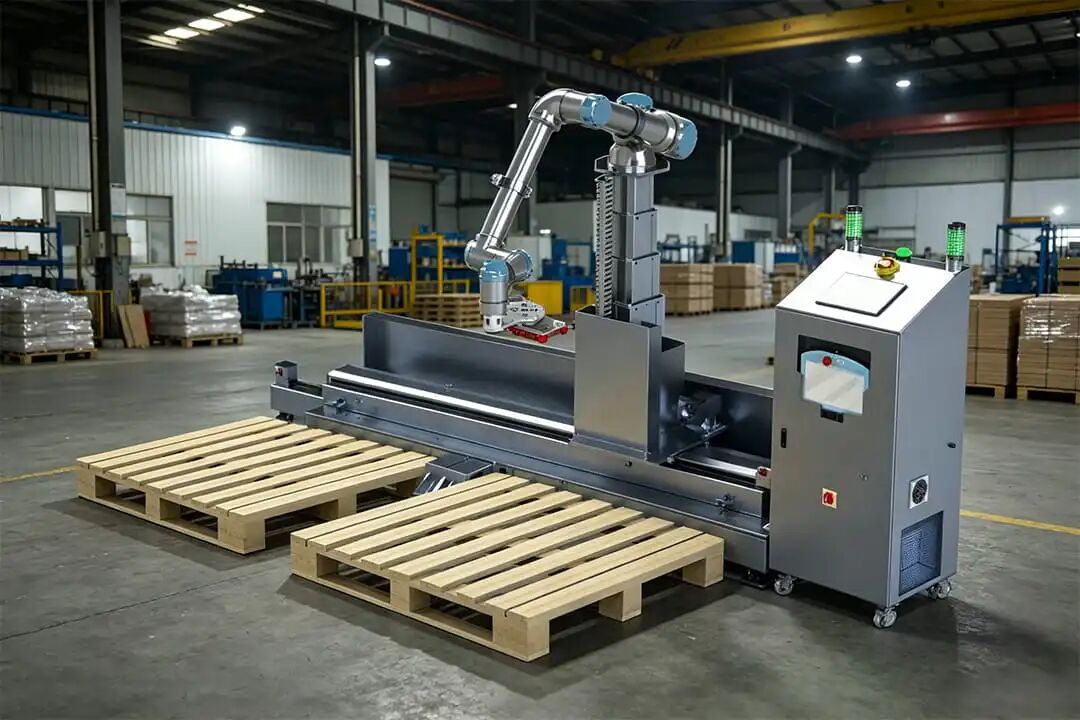
Tuode robots can be used for "palletizing": neatly stacking and arranging goods
These robots have one thing in common: they are simple and easy to use. In the past, many industrial robots required writing code, having engineers on - site, and re - debugging when changing actions.
But Tuode has been doing something else: enabling ordinary workers to use robots without writing code. They can directly drag and operate, complete the deployment in half an hour, and develop new applications in one and a half hours.
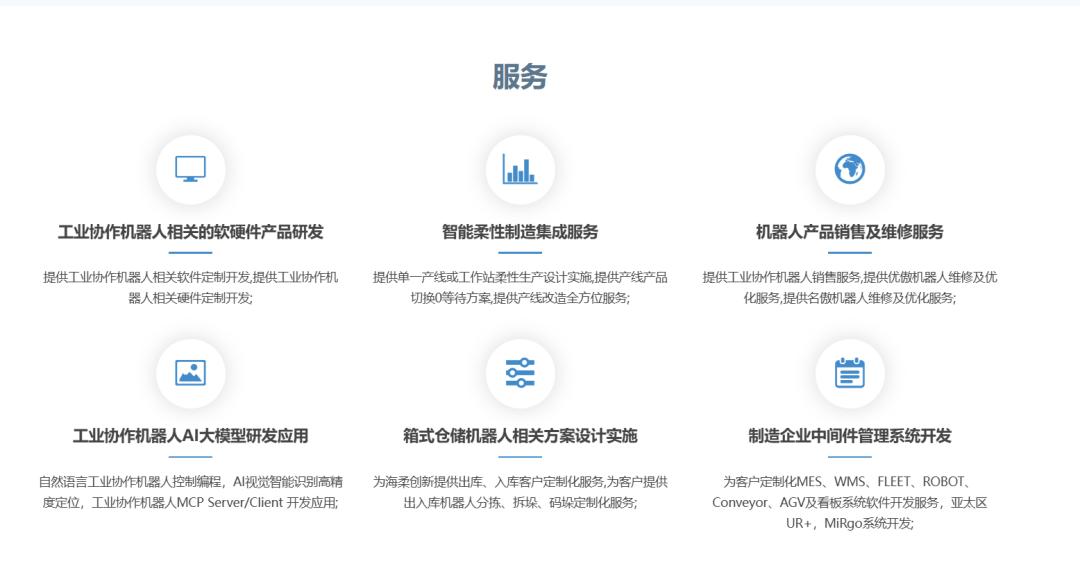
The main products of Tuode
- 02 - A pain point: Factories have been troubled for 10 years
What problems can these robots actually solve? Many people think that there are hardly any people in large factories now and that automation has taken care of everything. In fact, that's not the case.
In the past decade or so, Chinese factories have indeed achieved a large amount of automation: warehouse automation, AGV automatic handling. In a large - scale factory, goods can even "run" on their own.
However, many production lines are still stuck on a very small action: who puts the materials into the machine?
Ke Yang calls it the "line - side problem." "The current model is that after warehouse automation, AGVs transport the materials to the line - side, and then the people at the line - side feed the materials," he said.
That is to say: the first half is like a future factory, while the second half is still like it was ten years ago.
A very typical scenario is: an AGV cart transports the materials to the side of the production line and then stops. Then, a worker walks over, takes the materials down, aligns them with the equipment, and then precisely puts them in.
After the equipment finishes processing, he takes them out and sends them to the next device.
This action seems simple, but it has always been difficult to automate. Because it requires the robot to be able to move, avoid obstacles, locate, grab, and be precise enough at the same time.
If it's just for transportation, an AGV is enough. If it's just for fixed processing, a robotic arm is enough. But there has always been a gap between "moving" and "operating."
The compound robots of Tuode Robotics are essentially here to fill this gap. "Our robots basically take materials from one place and send them into the equipment," said Ke Yang.
It sounds simple. But in a semiconductor factory, a box of chips may be worth 400,000 yuan. "If they are dropped or damaged, the loss will be huge," he said.
So what factories really care about is never whether the robot can do somersaults. Instead, it's whether you can stably send this box of materials in 24 hours a day.
- 03 - Why do people buy non - humanoid robots?
Why are people willing to buy these "non - human - like" robots? Because they can work stably and the cost - benefit can be calculated clearly.
In the semiconductor back - end packaging scenario, one Tuode robot can usually replace 8 workers. Customers can usually recoup their investment in 3 - 4 years, and the equipment's service life is about 8 years.
This means that in the following years, it's basically "pure labor savings."
Moreover, for many factories, what robots really solve is not just "saving labor." More importantly, it's stability. Ke Yang mentioned that in many manufacturing scenarios, the most feared thing is production line stoppage.
Especially in the semiconductor industry, the loss of a production line stoppage may be calculated by the hour.
In contrast, humans get tired, take leave, and change jobs, but robots can repeat the same action 24 hours a day as long as they are well - maintained.
"Factories are not afraid of robots being expensive. They are afraid of instability," Ke Yang repeatedly mentioned.
This is also why what many customers really care about is not whether the robot is "smart," but whether it will drop materials, hit equipment, and can operate stably in the long run.
Ke Yang believes that many current humanoid robots are more suitable for display rather than factories. The reasons are very practical.
First, battery life. Many humanoid robots need to go back to charge after working for two or three hours. But factories often have 24 - hour production schedules.
Second, precision. In semiconductor scenarios, many actions require an accuracy of ±0.1 mm.
Third, it's the failure rate.
"Humanoid robots have more than thirty joints, while ours have about seven joints now," said Ke Yang. In industrial scenarios, more joints mean a higher probability of failure.
Ke Yang mentioned that many of Tuode's major customers are the most "demanding" foreign companies, such as TSMC, Intel, Bosch, Unilever, Dell, and Continental Group.
So far, the company has completed more than 400 projects, and none of them has ended up in failure.
- 04 - The industry is heating up: Factories are waking up
Interestingly, this type of "non - human - looking" robot was not actually the most popular direction in the past.
Because it's too "arduous." It doesn't perform shows or attract traffic. What it does every day is basically moving materials, feeding materials, loading and unloading materials, and running back and forth between devices.
Many robotics companies were not very willing to take on such projects before. The reason is very simple: it's too fragmented. Each factory has its own requirements, and each workshop has its own interfaces. In the end, it's easy to end up with "one customer supporting a team of engineers."
For example, in many past industrial robot projects, although the robots were installed, customers couldn't do without engineers.
When changing a production line, it needs to be readjusted; when changing a fixture, it needs to be redesigned; even when changing an action, the code needs to be rewritten.
The result is that as the number of projects increases, so does the number of engineers. Ke Yang mentioned that in the past, many industrial robot companies were essentially more like "engineering companies."
"You can't withdraw your people," he said. This is also why many robotics companies had relatively large revenues in the past, but their profits were always low. Because a large amount of money was actually consumed by project implementation.
But in recent years, a change has begun to occur: customers are starting to change from "pilot purchases" to "bulk replication."
Ke Yang mentioned that in the past, many factories bought robots more like "buying one to give it a try." But now, many customers have started to replicate across a production line, a workshop, or even an entire factory.
Because many factories have found that the most difficult stage of robots is no longer "whether they can be made." Instead, it's whether they can be quickly deployed like standard equipment.
In the past, the competition was about who had a stronger robotic arm. Now, many customers are more concerned about whether it can be quickly deployed, whether code - writing is not required, whether actions can be changed independently, and whether it can be replicated on a large scale.
Because for factories, robots can only be truly popularized when they are as easy to use as "standard equipment."
This article only represents the independent views of the interviewee and does not constitute any investment advice.
This article is from the WeChat official account "Pencil News" (ID: pencilnews), written by A Yao, edited by Zou Wei and Wang Fang, and published by 36Kr with authorization.