The biggest opportunity in the next five years: Recreate all industries with AI.
AI has completely transformed the underlying logic of business. The era when one could effortlessly make money just by grabbing attention and buying traffic is over.
In the past two decades, the most valuable asset in the Internet was attention. Whoever could keep users engaged for longer could sell more ads, traffic, and conversions.
However, with the emergence of agents, business has shifted from "making things visible to people" to "accomplishing things for people." Users no longer need to switch, compare, filter, and place orders among a dozen apps. They only need to express an intention: what they want, what they are willing to happen, and what they don't allow to cross the line.
Those once - invincible empires are now on the verge of decline. They are like Kodak, which was reluctant to abandon the film business. They cling to the vested interests of the attention economy, unaware that a greater revolution has arrived.
This revolution is the paradigm shift from the "attention economy" to the "intention economy."
In the future, your biggest customers will no longer be humans, but agents; the employees who earn the most for you will no longer be humans, but AI employees. In the next 20 years, the agent economy will contribute 99% of the global GDP, and the wealth directly created by humans will only account for 1%.
What does this mean for you?
If you are an entrepreneur, you no longer need to spend a fortune on buying traffic. The A to A network will help you precisely match the needs of the world. If you are an employee, you don't have to worry about losing your job to AI. A brand - new professional group of billions is emerging.
In this article, Yan Yanchun, a senior partner of Shengjing Network and the founding partner of the AIC Artificial Intelligence Startup Incubator, based on his investment practice and industry observation in the AI field, explains the core architecture of future business.
Read it patiently, and you will see the opportunities of the next decade earlier than 99% of people.
I. Civilizational Shift: What is the Intellectual Industry Civilization?
The intellectual industry civilization is the third civilizational shift for humanity after the agricultural civilization and the industrial civilization.
The agricultural civilization settled people on the land, the industrial civilization integrated people into machines and assembly lines, while the intellectual industry civilization connects people's intentions to models, agents, robots, and action systems, enabling an idea to pass through data, skills, tools, and collaborative networks to achieve real results.
It's not just about "stronger AI tools." Instead, intelligence has become a new production base. Labor is reorganized, organizations are fluidized, the market shifts from traffic to intention, wealth shifts from resource ownership to resource - calling ability, and the value of people shifts from execution proficiency to direction, judgment, aesthetics, endorsement, and signature.
Why do I need to propose the concept of the intellectual industry civilization?
Because the term "AI era" is too narrow. It only focuses on technology and fails to notice the shift in the civilizational structure.
What we are facing is not just an industry upgrade, but a re - allocation of time, action rights, and meaning. Time is compressed, and old experiences are losing their effectiveness. Action rights are spreading, and agents are starting to accomplish things in the real world on behalf of people. Meaning is being re - evaluated. As machines become better at doing "useful" things, humans must re - answer what is worth doing and what consequences they are willing to bear.
Proposing the intellectual industry civilization is not to crown AI with grandeur, but to draw a new map for humanity: After intelligence is capable of completing the world, how can humans still be themselves?
This is the beginning of the intention economy. Let's start with the paradigm shift from the "attention economy" to the "intention economy."
From intention to result, from the birth of all things from a single thought to the responsibility of all things. From this moment on, what is truly scarce is no longer just traffic, but intention entrances, action pipelines, and accountable results. The attention economy won't disappear overnight, but it is on the decline.
The new business battlefield is shifting from the time users spend on the screen to the collaborative network among agents.

In the future, enterprises will face a strange new entity for the first time. It is both like a customer and an employee. It is not swayed by advertisements, doesn't make impulsive purchases, and won't work overtime just because the boss gets angry in the group. It only recognizes authorization, interfaces, data, results, and responsibilities.
The intellectual industry assembly line will become the new production architecture of the intellectual industry civilization, and the i2x pipeline (intent 2X) will become the new infrastructure in the era of AI Agents. X can be a skirt, a medicine, a robot's movement, a short drama, a software program, or a quantitative operation.
i2x is not a tool company, but a result - infrastructure company, from the intention entrance, agent formation to the verification of contracts and contribution ledgers. The largest AI companies in the future may not be those that are best at generating answers, but those that are best at organizing intentions into verifiable results.
i2x, in a small sense, is also the pipeline of the future software dark factory and the production system or development mother - machine for all things (from software, short dramas, intelligent software to drugs, etc.). The end goal of the software dark factory is not to generate code, but to deliver business results that are operable, monitorable, roll - backable, and endorsable.
II. Paradigm Shift: From the "Attention Economy" to the "Intention Economy"
We are at a crossroads of civilizational change. Great disorder, great support, and great pursuit are not three generations of time sequences, but three force fields operating simultaneously within the intellectual industry civilization:
Some people are losing their jobs, some are being supported by the system, and some have started to pursue meaning. In the same era, the future does not arrive evenly but is folded on the same planet.
The Industrial Revolution took centuries to reshape the world, while the rewriting of business and organizations by artificial intelligence may be completed within a generation. We are witnessing the birth of a brand - new civilizational form, the "intellectual industry civilization."
1. The economic focus of Maslow's pyramid is shifting upwards
The essence of all economic forms ultimately boils down to the fundamentals of human needs. It's not that Maslow's pyramid is simply inverted, but that the focus of economic growth is starting to shift upwards.
Human physiological and safety needs at the bottom are still the foundation, but their marginal growth space is limited. Global over - capacity has become the norm. The spiritual needs, meaning needs, and self - actualization needs at the top of the pyramid will have a larger incremental market in the entire economic system.

After survival needs are gradually met, humans won't stop consuming or creating desires. On the contrary, more needs will shift from "surviving" to "being oneself": better education, long - term health, deeper companionship, more unique experiences, more free creation, and higher - level meaning pursuit.
This is not an upgrade of consumerism, but a shift in the demand structure.
2. The biggest disruption: Both supply and demand sides are agents
The biggest disruption brought by AI is never just a simple improvement in productivity, but the simultaneous replacement of the subjects on both the supply and demand sides. In the future, your biggest customer group will no longer be just humans, but agents acting on behalf of humans; the employees who earn the most for you will no longer be just humans, but an army of agents, that is, AI employees.
When each person is equipped with 3 to 5 exclusive agents, the global number of agents will reach tens of billions or even more. They will become important participants and executors in economic activities.
More radically, in the future, a large amount of GDP formation processes will involve, be scheduled, or be executed by agents. However, the ownership of wealth should not belong to AI itself, nor should it only belong to the giants with large models. Instead, it should return to the hands of intention initiators, contributors, infrastructure builders, and ultimate responsibility bearers.
This means that there will be a shift in the main body in the business world. In the past, enterprises faced "users"; in the future, enterprises will face both "users' agents" and "enterprises' own agents." On one side is the AI butler making decisions for people, and on the other side is the AI employee delivering results for the enterprise.
When customers become agents, advertising slogans will lose some effectiveness; when employees become agents, management logic will also lose some effectiveness. It doesn't respond to motivation, doesn't participate in team - building activities, isn't moved by PPTs, and won't work overtime just because the boss says "everyone, work a little harder." It only recognizes tasks, permissions, interfaces, costs, results, and responsibility logs.
Business is no longer just about capturing people's attention, but about winning the trust of agents.

3. The attention economy is on the decline
Internet giants that have achieved great success through the attention economy are facing a structural re - evaluation of their growth logic. They find it difficult to give up their vested interests, just like Kodak was reluctant to abandon the film business and Nokia was reluctant to abandon feature phones.
The essence of the attention economy is to turn people's time spent on the platform into a commercial asset. It continuously attracts, delays, guides, and converts users through advertisements, pop - ups, recommendation streams, shelves, search rankings, and content distribution. It's not always evil. After all, in the past two decades, the attention economy has also reduced the cost of information acquisition, allowing many small and medium - sized businesses to have access to national and even global users for the first time.
However, its problems are also obvious: it often makes money by creating frictions. Simple things are broken down into complex paths, clear demands are dragged into recommendation streams, users waste time in countless comparisons, screenings, switches, and waits, and platforms turn this time into advertisements and commissions.
AI doesn't just reduce frictions. While eliminating some old frictions, it creates a new set of frictions: authorization, trust, auditing, responsibility, and circuit - breaking. The path in the old world has become shorter, but the consequences have become more significant.
What used to take five steps to complete may not require any steps in the future. It's not even "completing in one step." Instead, before the user even opens the app, the agent has already completed the comparison, screening, price - inquiry, and execution suggestions on their behalf.
This is the "death of the process."
In the past, it took three afternoons to write a love letter, with careful word - choosing and repeated revisions. The uneasiness, expectation, and sincerity in it were the most precious parts of love. Now, AI can generate a hundred flowery love letters in five seconds, but they may not carry any emotional weight.
In the past, it took a long time to develop a new drug, and countless scientists spent their entire lives on it. Now, AI is compressing the early stages of drug discovery, such as candidate molecule generation, screening, and experimental feedback, and reorganizing the entire R & D process.
Of course, waiting is not always a good thing. Waiting also involves inefficiency, queuing, humiliation, and the poor being forced to wait longer. AI's compression of many old processes is a step forward. However, some processes are not frictions but the places where people are shaped.
The disappearance of the process has reversed our judgment of value. When a machine can write five love poems in a second, the time and unique experience of the person who spends an afternoon writing a love letter by hand become extremely precious.
Slowness, waiting, personal experience, and emotional investment, which were once ruthlessly abandoned in the era of efficiency, will become the last buffer zone of civilization and an important value that distinguishes humans from AI.
Machines produce consistency, while craftsmanship preserves the origin. Just like the unhurried lifestyle in Europe, it will become a more desirable luxury in the AI era.
4. In the future, it's about the ability to ask questions
This reversal of value will also change our understanding of education. In the past, we required children to memorize Tang poems, formulas, and get high scores because knowledge itself was scarce. But now, AI remembers more and calculates faster than any human. Scores are no longer the only passport, but basic abilities, expression abilities, and judgment abilities will become more important.
In the future, what really matters is not just memory and understanding, but the ability to ask questions, generate intentions, and have rich imagination.
Whether a child can ask good questions, express real intentions, distinguish what they really want from what the system recommends, and take responsibility for their choices will become increasingly important. Education should not only train people to answer questions but also to generate ideas, make judgments, ask follow - up questions, and sign.
III. Five - level Action Pipeline: The Future Intellectual Industry Assembly Line
A single thought can give birth to all things, the universe, and the world. The core architecture supporting the operation of the entire intention economy is the "five - level action pipeline."
i2x connects a person's thought to the five - level pipelines of intention pipeline, data pipeline, skill pipeline, agent pipeline, and result pipeline, delivering endorsable results in the digital and physical worlds. It's not a chat box, nor a single mother - machine; it's an action pipeline from a thought to all things.
This is an end - to - end i2X, that is, Intent to X action pipeline system from intention to result. It's like when Ford established the automobile assembly line. However, the industrial assembly line produces standardized industrial products, while the intellectual industry assembly line produces personalized results that meet human intentions.
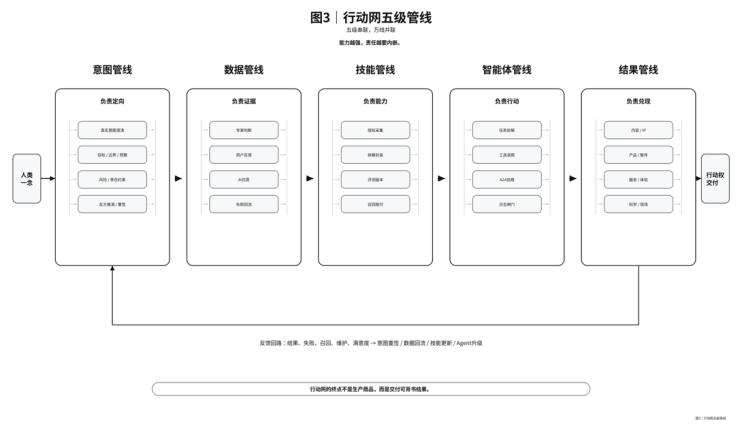
However, we must clearly recognize that in the AI era, there is no shortage of smart engines, but a lack of result pipelines that can organize intelligence into accountable consequences.
The large model is the engine, the agents are the workers, and i2X is the factory. It doesn't produce the result itself, but a chain of consequences that is interpretable, distributable, reviewable, and accountable.
The first level is the intention pipeline
This is the source and the key of the entire system, and also the most valuable entrance in the future. Identifying, disassembling, and amplifying deep, vague, and unspoken intentions will become the core ability of future business.
Here, we must clearly distinguish three concepts: a thought is not a demand, and a demand is not an intention. "I'm a bit thirsty" is a thought, "I want to buy a bottle of iced cola" is a clear demand, while "I want to be happy" and "I want to have a romantic night" are real intentions.