Dongguan, a huge order explosion
At 9:25 a.m. on May 13th, the call auction for Dongguan's advanced manufacturing sector began.
On the market, there was enthusiastic buying in the "hard technology" tracks such as packaging and testing equipment, semiconductor materials, and AI server cooling solutions - these are not concepts for tomorrow, but orders for today.
And this is just a slice of the performance of Dongguan's A-share composite index since the beginning of the year. In just the first ten days of May, the index rose by more than 9%.
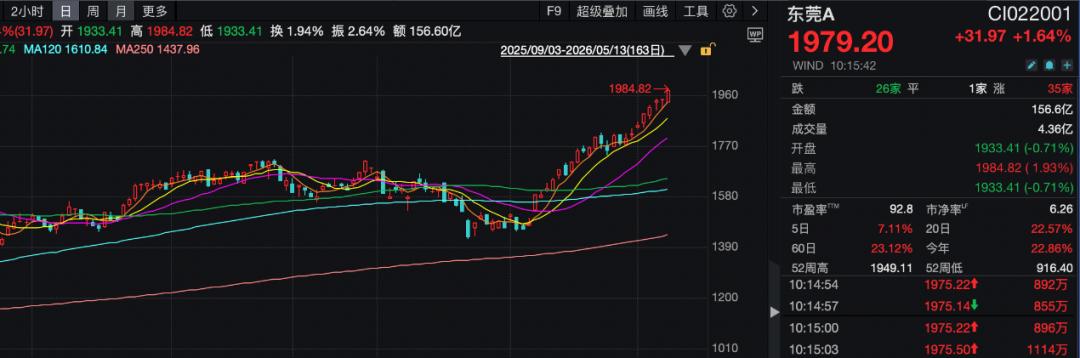
▲ Image source: Wind
The rise is due to the outstanding performance of many core companies in the Dongguan sector, which far exceeded market expectations. For example:
Kaige Precision Machinery, an automated precision equipment enterprise with core business covering electronic assembly and semiconductor packaging, saw a year-on-year revenue increase of 72.80% in the first quarter. Dingtai High-Tech, which specializes in precision micro drill bits for PCBs (printed circuit boards), had a year-on-year increase of 91.14% in net profit attributable to the parent company. Qipai Technology, which focuses on the packaging and testing of semiconductor integrated circuits and power devices, had a capacity utilization rate of over 90% in the first quarter.
Behind the fluctuating numbers, Dongguan, which is accelerating towards becoming a smart manufacturing center, is working "overtime" for global high-end manufacturing with higher efficiency and in higher-value fields.
01
The "Three Big Items" with Exploding Orders
On the sixth day of the first lunar month after the Spring Festival, the production workshop of Qiyuan Automation Technology Co., Ltd. in Chashan Town, Dongguan, was already brightly lit.
General Manager Li Qiyuan stood in front of the high-speed placement machine, watching high-precision motor motherboards for Apple phones and drones being sent out from the assembly line.
"We started the year with a sprint. The return rate of employees this year is 90%, and all employees are in intense production."
Qiyuan Automation's products are exported to the United States, India, South Korea, and Europe. Its output value target for 2026 is to achieve a year-on-year increase of 26%, and orders have been scheduled until the third quarter - "We are being urged by customers to deliver goods."
Qiyuan is just a small microcosm of the rush to start work after the Spring Festival in Dongguan in 2026.
In Chang'an Town, an industrial town in Dongguan, the surrounding suppliers of OPPO and vivo resumed two-shift work on the seventh day of the first lunar month. In Songshan Lake, Huawei's production lines had already arranged the material schedule for the post-festival period before the Chinese New Year's Eve.
Some enterprises related to AI and energy have orders scheduled until 2027 or even further.
The machines in the workshops are accelerating, but what really excites the bosses in Dongguan is that a large number of foreign businessmen with various high-value-added orders are rushing back to Dongguan. They are not here to look at samples, but to grab production capacity.
Monitoring data from Dongguan Customs shows that the number of foreign business people entering through various ports in Dongguan in the first quarter of 2026 increased by more than 140% year-on-year, with the sharpest increases coming from business people from Vietnam, India, and Mexico.
A purchasing manager of a foreign enterprise said, "Our factory in Vietnam is facing power outages. One production line is shut down for three days a week. Our customers can't wait. Now our group has decided to move all high-precision SMT patching and whole-machine testing back to Dongguan."
As orders pour in, enterprises are starting to "lack people." But what they lack is not ordinary workers, but "people who can adjust machines."
At the Zhitong Talent Market in Chang'an Town, a company that supplies in-vehicle display screens to BYD posted a recruitment notice that read: "Urgent recruitment of SMT engineers, with a monthly salary of 15,000 to 22,000 yuan, 16 salaries, and accommodation provided."
Another precision mold enterprise in Dalingshan even posted an advertisement saying "Reward 5,000 yuan for recommending an engineer to join the company." The person in charge of the enterprise sighed, "Molds are the mother of industry, but good mold masters are rarer than pandas. We received an order for Tesla's Cybertruck accessories last year, and it took us two months to find a mold flow analysis engineer."
The fact behind this is that the quality and value of the orders have changed.
The new orders pouring into Dongguan's workshops this time are no longer simple plastic toys and ordinary hardware, but come from three of the hottest technology tracks - AI computing power, robotics, and automotive electronics, collectively known as the 'New Three Big Items'.
At 9 p.m. at the Dongguan Customs inspection site, container trucks are queuing up for clearance, and the line seems to stretch to the horizon.
"In the past, we mainly inspected and released fresh produce and urgent parts during the evening hours. Now, there are too many ordinary goods to handle," a on-site staff member said helplessly. "In the first quarter, the number of orders we inspected and released during overtime increased by 30% compared to the same period last year, mainly integrated circuits, lithium battery controllers, and industrial robot parts."
With the rapid development of global AI data center construction, orders for servers, high-speed backplane connectors, and liquid-cooled heat dissipation modules in Dongguan have increased sharply. The factory director of a server OEM factory in Songshan Lake said that the company's export volume in the first quarter increased by 210% year-on-year.
"Our customers are NVIDIA and Amazon. Now they want not dozens, but tens of thousands of units."
In the wave of the explosive demand for AI computing power, a number of listed companies in Dongguan are deeply embedded in the world's most cutting-edge industrial chain with their own "unique skills." As a globally leading supplier of electronic circuit substrates, Shengyi Technology is actively deploying in the field of high-performance copper-clad laminates and has planned a total investment of more than 9.7 billion yuan in Dongguan.
Shengyi Electronic, a subsidiary of Shengyi Technology, has invested 2 billion yuan to build a production base for high-order HDI boards dedicated to AI in Dongguan. At present, its AI supporting motherboards and accelerator card projects have achieved mass production, and it has also received bulk orders for 800G switches.
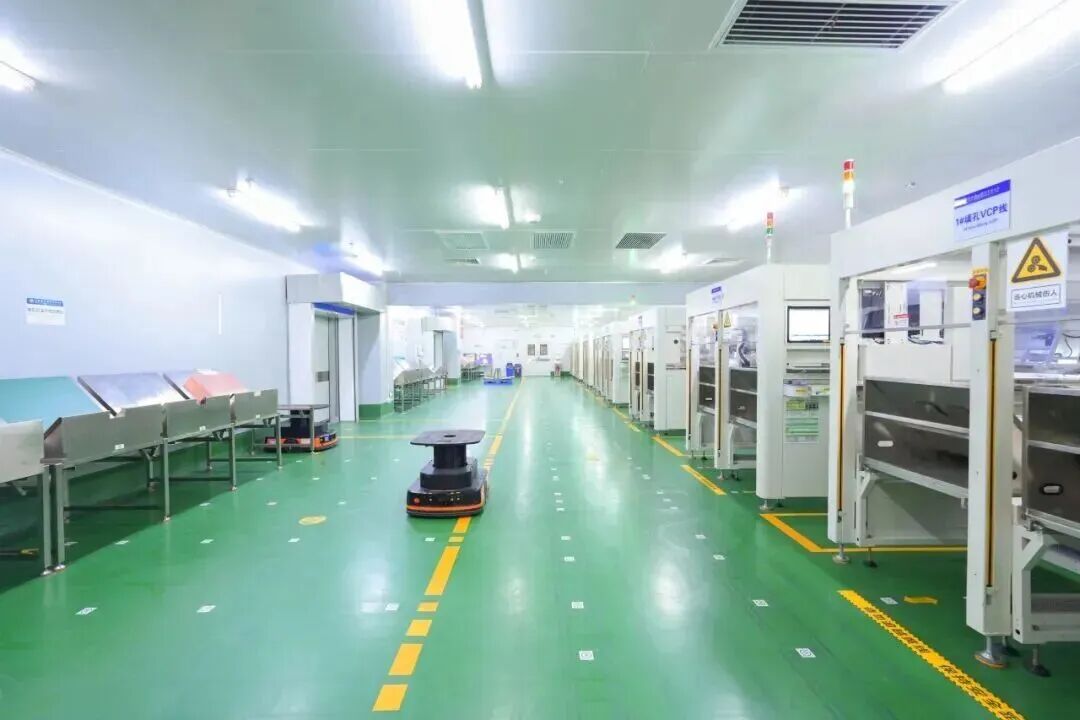
▲ Image source: Dongguan Release
In addition to these leading companies at the forefront of AI computing power, enterprises in Dongguan's traditional industries are also accelerating their intelligent transformation and upgrading. DeRUCCI, which mainly produces high-end mattresses and sofas, has obtained the certification for medical-grade vital sign monitoring sensors, successfully integrated into the HarmonyOS ecosystem, and through the upgrade of Industry 4.0, has increased the production efficiency of its digital workshop by 120% and shortened the product development cycle by 38%.
Along with the explosion of orders for the "brain" of computing power, there are also robots as the "body." Weichuang Power Technology Co., Ltd. - a relatively unknown enterprise in Hengli Town - is a "hidden supplier" for DJI, CATL, and BYD. The robots equipped with its micro servo steering gears are exported to 36 countries.
"We shipped 8 million units last year, and this year we plan to expand our production capacity to over 10 million units," the R & D director of the company introduced. The workshop is currently rushing to fulfill an order for an American robot unicorn, which requires at least 50,000 sets to be delivered every week.
The boom in the automotive electronics industry is mainly due to the return of orders from Southeast Asia. Affected by the rise in international coal prices and the drop in the water level of the Mekong River, Vietnam's power shortage has reached 30%, hindering manufacturing production and making overseas deliveries difficult.
In Tangxia, a company that produces in-vehicle chargers has received more orders in the first quarter than in the whole of last year. "We originally only supplied domestic new energy vehicle brands. This year, we suddenly received a lot of inquiries from overseas car manufacturers, especially European and Southeast Asian brands - their original suppliers in Thailand and Vietnam are having trouble with deliveries."
From the brightly lit workshops, to the changing trend in the recruitment market, to the long queues at the customs late at night - Dongguan is working "overtime" for global high-end manufacturing. But if we only regard these bustling scenes as an ordinary rebound in foreign trade, we are underestimating Dongguan.
02
The Dongguan Signal
In 2016, the "Yiwu Index" predicted the U.S. presidential election through flag orders. In Dongguan, there is also a hardcore "global manufacturing prosperity signal" - The export of electronic components, molds, and industrial robots from Dongguan often sends a turning point signal two to three months earlier than the global PMI (Purchasing Managers' Index).
Currently, one out of every four smartphones in the world is produced in Dongguan, and one out of every five computers has components from Dongguan. Dongguan also supplies 30% of the world's industrial robot reducers.
When the electronics factories in Dongguan start working overtime, the supply chains of global technology giants start to accelerate. When the operating rate of mold factories in Dongguan drops, it means that the release of new global consumer electronics products will be postponed three to six months later.
This "Dongguan Signal" is not just theoretical. In the past few years, it has accurately predicted major turning points in the global technology industry at least twice.
At the end of 2018, many bosses of connector and memory card packaging factories in Dongguan suddenly found that orders from a leading communication equipment manufacturer were decreasing at a rate of 30% per month.
A boss who runs a radio frequency cable business in Humen recalled, "At that time, we thought it was very strange. The customer said, 'Stock up first and postpone production.' It wasn't until the first quarter of 2019 that we found out that there would be a chip supply shortage." And the official significant decline in the global semiconductor market began in the third quarter of 2019 - the factories in Dongguan felt the chill two quarters earlier.
At the end of 2022, a company in Songshan Lake, Dongguan, that makes server cooling modules suddenly received an "impossible task": an American cloud service provider required it to increase its production capacity by five times within three months. The engineering director of the company judged that "they are preparing for some large-scale AI computing."
At that time, ChatGPT had only been released for two months, and the world was still immersed in the novelty of chatbots. Few people realized that a computing power revolution had begun. By the third quarter of 2023, when NVIDIA's H100 was in short supply, this factory in Dongguan had completed its expansion and seized the market opportunity.
Now, looking back in the spring of 2026, Dongguan is sending out a new signal - this time, it points to a more structural change than the previous two.
According to the joint monitoring data of Dongguan Customs and the Bureau of Commerce in the first quarter, the export of high-tech products increased by 21.1% year-on-year. Among them, the export of integrated circuits soared by 46.2%. The export volume of industrial robots increased by 67%, and the export unit price also increased by nearly 20% year-on-year.
Macroscopically, the import and export volume to countries participating in the Belt and Road Initiative reached 130.2 billion yuan, a year-on-year increase of 10.8%. Among them, the export growth rate of electronic intermediate products to Vietnam, India, and Mexico all exceeded 25%.
The more crucial figure is that the import of precision machine tools from Japan and Germany in Dongguan increased by 18.5% in the first quarter. This means that the factories are not simply expanding production, but upgrading their manufacturing.
Putting these figures together, the signal released by Dongguan is very clear: This is not an ordinary rebound in exports, but a structural growth in high-end manufacturing driven by AI, electrification, and robotics. Moreover, The production capacity shortage in Southeast Asia is "driving back" high-value-added links to Dongguan.
A Hong Kong boss who has been in the export business in Dongguan for twenty years straightforwardly summarized, "By looking at the export of electronic components from Dongguan, you can tell whether the global technology industry is taking medicine or having a big meal. Now, it's having a big meal."
The reason why Dongguan can become an early signal for global manufacturing is that the industrial texture of this city is engraved with the genes of continuous iteration over the past forty years. To understand today's explosion of orders, we need to go back to the starting point of the story.
03
Dongguan, the World's
Just like the story of trading chicken feathers for sugar in Yiwu, the people of Dongguan also have a similar grassroots memory.
In 1978, the first "processing with supplied materials, samples, and diagrams" enterprise - Taiping Handbag Factory - was born in Humen, Dongguan. Female workers with no foreign trade experience sewed the first batch of handbags for export with hand-operated sewing machines. The former factory director Zhang Zimi wrote in an internal report, "What we need to do is not just sew clothes for others, but let the world know that the best things can be made here."
Starting from Taiping Handbag Factory, Dongguan's export categories entered a period of explosive growth in labor-intensive products. Industrial clusters for clothing, bags, and toys sprang up like mushrooms after rain.
The turning point occurred in the mid-1990s when IT enterprises from Taiwan, Japan, and South Korea entered Dongguan on a large scale. The export of computer peripheral equipment, electronic components, and other related products increased rapidly, and Dongguan's export industry underwent its first transformation.
By 2000, the total output value of Dongguan's electronic information industry was nearly 80 billion yuan, accounting for about 80% of the city's total industrial output value. At its peak, the factories of giants such as Nokia, Samsung, and Sony were lined up along the 107 National Highway, and Dongguan was well-known around the world for the saying "When Dongguan has a traffic jam, the world runs out of goods."
However, doing OEM work always means being led by others. After the 2008 financial crisis, a large number of export orders were cancelled, and low-end processing factories closed down in droves. The Dongguan government learned from the pain and actively phased out more than ten thousand small "processing with supplied materials" factories and began to transform into high-end manufacturing such as electronic information and electrical machinery.
That year, a boss who made power adapters in Dongguan closed his rented factory, sold his Mercedes-Benz, and devoted himself to the R & D of gallium nitride fast chargers. Seven years later, his company became a gold medal supplier for Huawei and OPPO, and its products were exported to Europe, the United States, Japan, and South Korea.
Such stories are not isolated cases in Dongguan. What emerged from the OEM factories is not only the personal turnaround of the bosses, but also a complete reshaping of the industrial genes of a city.
Today, Dongguan is no longer simply the "world's factory," but the "outlet" and "R & D test field" for global manufacturing.
In Chang'an Town, OPPO and vivo not only keep their factories in Dongguan but also set up their global R & D centers here. In 2025, 70% of the R & D and trial production work for OPPO's Find series flagship phones launched in the overseas market was completed in Dongguan. An OPPO executive admitted, "In the past, it was overseas design and Dongguan manufacturing; now, it's Dongguan innovation and global replication."
In Dalingshan, Lunfei Precision Technology Co., Ltd. is exporting high-end watch movements to Switzerland. The general manager couldn't hide his pride, "Swiss customers used to