It is reported that LIN Junyang has started a business, with a first-round valuation of 13.6 billion.
On May 13th, according to foreign media The Information, two people familiar with the matter revealed that Lin Junyang, the former head of Alibaba Group's Qianwen large - model, is seeking hundreds of millions of dollars in financing for his newly founded AI laboratory (name not announced yet). After the financing, its valuation may reach approximately $2 billion (equivalent to about 13.584 billion yuan). Gaorong Capital and Sequoia China are in talks to provide funds for it.
It is quite rare in China for a brand - new AI laboratory to achieve a $2 billion valuation (equivalent to about 13.584 billion yuan) right from the start. The high valuation of Lin Junyang's new laboratory also indirectly confirms his strength and industry achievements accumulated during his work at Alibaba.
Lin Junyang was born in 1993. He graduated from the English Department of the University of International Relations with a bachelor's degree and from the School of Foreign Languages of Peking University with a master's degree. His research fields include natural language processing and multimodal representation learning, and his research interests focus on large - scale multimodal pre - training.
After graduating from his master's program, he joined Alibaba's DAMO Academy's Intelligent Computing Laboratory in 2019 and became an algorithm expert in the laboratory, participating in the research and development of Alibaba's M6 multimodal pre - trained model.
At the end of 2022, Alibaba merged its AI teams such as language and vision from the DAMO Academy into Alibaba Cloud and established Tongyi Laboratory. Lin Junyang was officially appointed as the technical leader of the Tongyi Qianwen (Qwen) series of large models and became the youngest P10 - level technical leader at Alibaba.
During the years when Lin Junyang was in charge, Alibaba's Qianwen large model gradually became one of the world's strongest model brands, competing with models like GPT and Claude on the benchmark test leaderboard.
In January 2026, the latest data from Hugging Face, the world's largest AI open - source community, showed that the number of derivative models of Alibaba's Qianwen exceeded 200,000, and the download volume of the Qianwen series of models exceeded 1 billion times, ranking first globally among open - source large models.
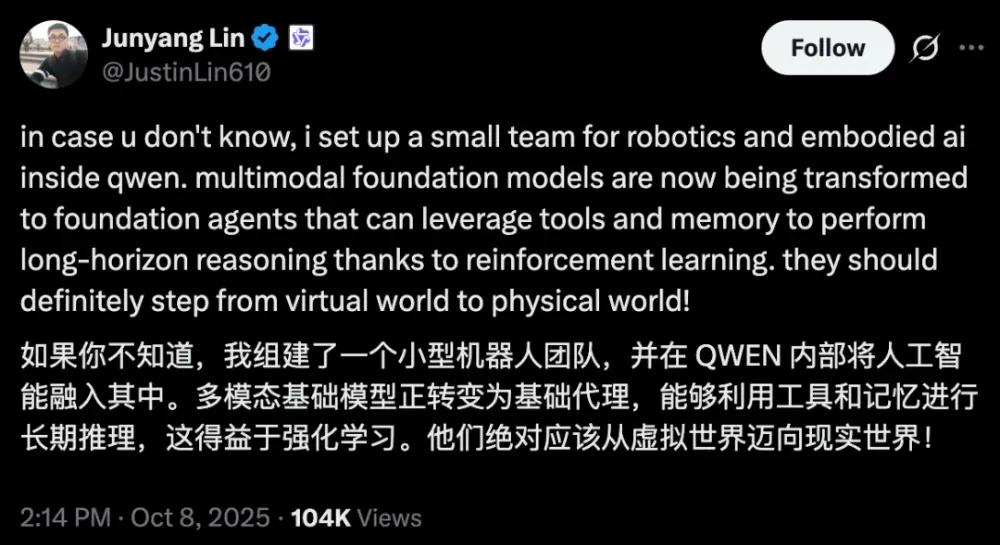
In October last year, Lin Junyang also announced on X that he had formed a robotics and embodied intelligence team within Qianwen.
On March 2nd, 2026, Lin Junyang promoted the open - source Qwen 3.5 small - size model series on the overseas social media X. Just two days later, he suddenly posted an official announcement that he was leaving the Qwen team.

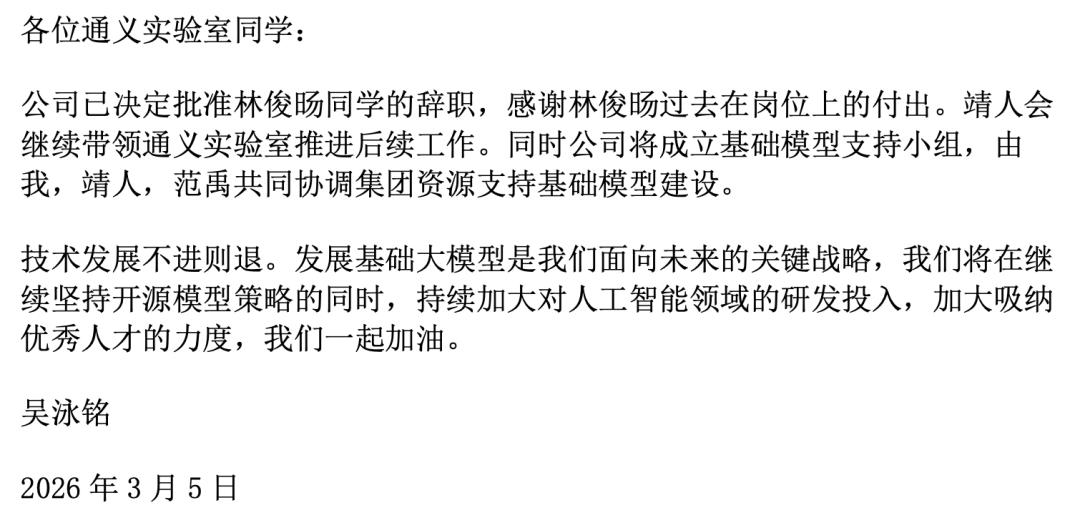
The next day, Alibaba CEO Wu Yongming responded in an internal email, approving Lin Junyang's resignation as the head of the Qianwen large model. He also established a basic model support group led by Wu Yongming, Fan Yu, partner of Alibaba Group and Chairman and CEO of Ele.me, and Zhou Jingren, CTO of Alibaba Cloud.
Subsequently, on March 16th, Alibaba announced the official establishment of the Alibaba Token Hub (ATH) business group, directly under the responsibility of Alibaba CEO Wu Yongming. Tongyi Laboratory is included in this division, which also includes the MaaS business line, Qianwen Division, Wukong Division, and AI Innovation Division, a total of five divisions. (Just now, Alibaba is all - in on Token: a new business group is established, directly under the responsibility of Wu Yongming)
In the United States, many AI startups founded by well - known former researchers from leading industry companies are raising funds at sky - rocketing valuations.
For example, the Safe Superintelligence company co - founded by Ilya Sutskever, the former chief scientist of OpenAI, raised $1 billion (equivalent to about 6.792 billion yuan) at a $5 billion (equivalent to about 33.96 billion yuan) valuation just three months after its establishment.
Similarly, the Thinking Machines Lab founded by Mira Murati, the former chief technology officer of OpenAI, last year raised $2 billion (equivalent to about 13.584 billion yuan) at a $10 billion (equivalent to about 67.921 billion yuan) valuation in its first - round financing.
Conclusion: Chinese local AI laboratories need to take a differentiated path
Domestic venture capital institutions said in an interview with foreign media that Chinese local emerging AI laboratories face more challenges and uncertainties than their American counterparts. The high valuations of American AI startups are largely due to the market's expectation that they will eventually be acquired by tech giants. However, it is still difficult to determine whether this logic can be applied in China.
Domestic new - comer AI laboratories first need to overcome the hurdle of computing power supply. In addition, they must take a differentiated route and avoid overlapping with the existing AI giants such as Alibaba and ByteDance in their R & D directions.
This article is from the WeChat official account “Zhidongxi” (ID: zhidxcom), written by Wang Han, and is published by 36Kr with authorization.