The star self-driving company backed by Baidu earns 99% of its revenue from selling cars.
Autonomous driving has been a hot topic for many years. While Robotaxi is still waiting for large - scale commercialization, Robotruck (autonomous heavy - duty trucks) has already taken the lead in commercial implementation.
Compared with passenger - carrying Robotaxi, which has to face complex urban roads, regulatory and safety disputes, the commercial implementation of cargo - carrying Robotruck is obviously more realistic and faster: highways, fixed routes, closed - loop scenarios, and a logistics industry that has long been troubled by high costs.
From Aurora, Mainline, Inceptio, Plus, to new - energy heavy - duty truck and intelligent driving companies increasing their investment, the competition around Robotruck is heating up.
Amid the fierce competition, DeepWay is the first to rush into the capital market.
Image source: Prospectus of DeepWay
Recently, DeepWay updated its listing application documents on the Hong Kong Stock Exchange, officially launching its second attempt at a Hong Kong IPO after last November.
Before this second attempt at an IPO, DeepWay's financing pace had already caught people's attention:
In January this year, DeepWay completed a Pre - IPO round of financing worth 1.177 billion yuan; in April, the cumulative fundraising in this round further exceeded 310 million US dollars, breaking the record for the largest single - round financing in the heavy - duty truck autonomous driving industry in the past five years.
Three foreign investors, LeiShi Capital from the UAE, NGS Super from Australia, and ABC Impact from Singapore, have also rarely bet on this company together.
Whether it's commercialization or financing, DeepWay seems to have a bright future. How can this new company, which has only been established for five or six years, become a "dark horse" in the autonomous driving field?
Backed by Two "Financial Backers"
To understand DeepWay, we first need to know about the two major players behind it: Baidu and Lionbridge.
Wan Jun, the founder and CEO of DeepWay, was once the vice - president of Zoomlion and founded Lionbridge Group in 2012. Lionbridge is deeply involved in the commercial vehicle industry chain, with its business covering vehicle finance, after - sales service, and trunk logistics.
On the other hand, Baidu provides the technological foundation for autonomous driving.
In 2018, Baidu made a strategic investment of 1 billion yuan in Lionbridge Group, aiming to extend its autonomous driving capabilities to the logistics scenario and find a commercial outlet that could be realized earlier than Robotaxi.
After its establishment, DeepWay also obtained the authorization of Baidu's "white - box" autonomous driving technology, becoming the first company to implement Baidu's Apollo X project and the only authorized entity in the commercial vehicle field.
This allows DeepWay to directly inherit Baidu's technological and R & D accumulations in the field of autonomous driving over the past decade since its establishment, and conduct in - depth customization and optimization according to the unique scenarios of trucks such as long - distance cruising and cornering.
This means that DeepWay, founded in 2020, is not a company starting from scratch.
Baidu provides the technology, and Lionbridge provides the logistics scenario and industrial resources. DeepWay can skip the models and test data in the laboratory and directly face the real - world logistics market: who is transporting goods, how to set prices, whether the trucks can operate smoothly, and how to calculate costs.
It is precisely Wan Jun's in - depth understanding of the logistics industry that made him aware of the most practical problems in the heavy - duty truck industry.
In the entire logistics and transportation industry, fuel costs and driver salaries have long accounted for the majority of operating costs, accounting for about 40% and 20% - 30% of total expenses respectively. There is an urgent need to reduce costs and increase efficiency.
To put it simply, for a heavy - duty truck driver, what is most needed in long - distance driving is not "how smart" or "how cool" the truck is, but whether it can reduce the burden and save money.
In the existing heavy - duty truck market, most of the intelligent transformations of traditional fuel trucks are "converting from fuel to electric", that is, replacing the engine with an electric motor and the fuel tank with a battery.
This approach is derived from the traditional fuel - vehicle architecture, and there are natural limitations in aspects such as the center of gravity, space, wire - control system, and data transmission. After the trucks are sold, it is difficult for vehicle manufacturers to continuously obtain sufficient real - world operation data, let alone long - term OTA and intelligent driving iteration.
DeepWay has chosen another path: redefine heavy - duty trucks from the perspective of electric drive and intelligence.
For example, the integration of the battery and chassis, the streamlined low - drag body, distributed drive, and self - developed three - electric systems all point to the same goal: to make heavy - duty trucks more suitable for new energy and intelligent applications.
According to the prospectus, compared with traditional fuel heavy - duty trucks, the total life - cycle cost of DeepWay's pure - electric heavy - duty trucks defined from the ground up can be reduced by 22.8%; compared with fuel - to - electric converted heavy - duty trucks, it can also be reduced by 10.8%.

Image source: Official website of DeepWay
The temptation of cost reduction has been reflected in deliveries and revenues.
Currently, DeepWay's new - energy heavy - duty trucks include models such as DeepWay Xingchen and DeepWay Xingtu. From 2023 to 2025, the company's new - energy heavy - duty truck deliveries increased from 509 to 8,020, the number of customers soared from 34 to 539, and revenues also grew from 426 million yuan to 3.961 billion yuan.
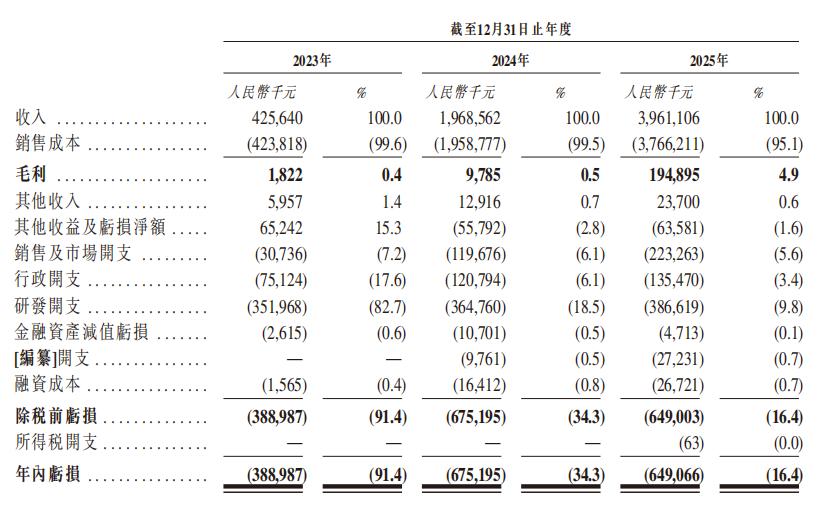
Image source: Prospectus of DeepWay
However, as the delivery volume increased, DeepWay's awkward situation also became apparent.
The prospectus shows that from 2023 to 2025, DeepWay's sales revenues from new - energy heavy - duty trucks were 425 million yuan, 1.961 billion yuan, and 3.927 billion yuan respectively, accounting for 99.9%, 99.6%, and 99.2% of the company's total revenues.
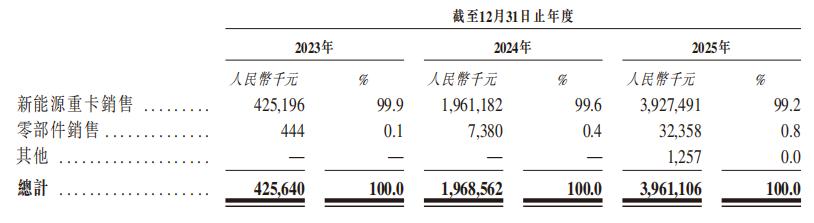
Image source: Prospectus of DeepWay
To put it simply, at least from the current financial statements, DeepWay is not yet a company that mainly makes money from autonomous driving software, technology subscriptions, or unmanned operations.
However, if its main revenue comes from selling trucks, why should the capital market give DeepWay the imagination of an autonomous driving company?
L4: An Unfulfilled Dream
However, even with such a revenue structure, DeepWay is not just a "truck - selling company".
The key to supporting this judgment is data.
For autonomous driving, data is the core fuel for technological iteration. The more trucks are on the road and the more data is transmitted back, the faster the autonomous driving system can learn and iterate, forming a data closed - loop.
When an ordinary heavy - duty truck is sold, the transaction is basically over; but when a smart new - energy heavy - duty truck is put into operation, it will continuously operate in real - world freight scenarios, bringing back data on road conditions, driving behavior, energy consumption, scheduling, and energy replenishment.
This also gives another meaning to DeepWay's current L2 assisted - driving model, which mainly focuses on selling trucks: selling trucks not only brings in revenue and scale but also provides a data entry point in real - world scenarios.
In other words, DeepWay sells trucks into the real - world logistics network and then uses the data generated by these trucks to support the iteration of the intelligent driving system.
Currently, DeepWay has launched intelligent highway freight technology products such as Tianji·Suixing, Tianji·Yanxing, Tianji·Duxing, and DeepWay·Tianshu, and has started charging for annual and lifetime subscriptions.
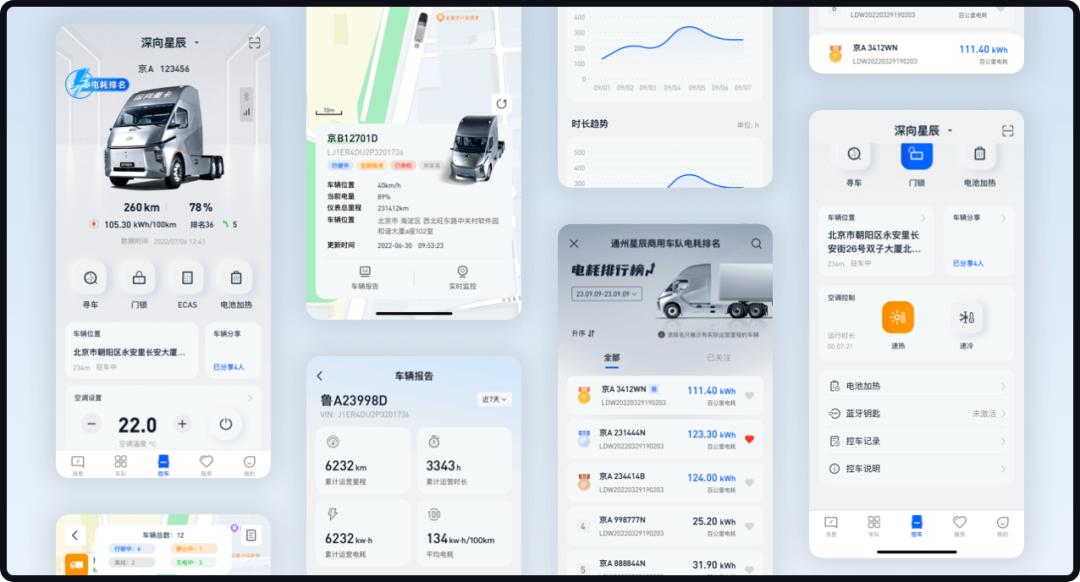
Image source: Official website of DeepWay
The prospectus shows that DeepWay has become the world's first new - energy heavy - duty truck company to achieve subscription revenue through intelligent highway freight technology, and the paid - subscription rate for L2 has already exceeded 30%. In contrast, the subscription rate for Tesla's FSD is only 12%.
Among them, Tianji·Suixing is mainly for L2 assisted - driving scenarios and has functions such as forward collision warning, lane departure warning, automatic emergency braking, and adaptive cruise control.
By the end of 2025, more than 6,000 vehicles equipped with Tianji·Suixing had been delivered, covering more than 300 end - customers.
However, the problem is that L2 is ultimately just assisted driving.
It can improve safety, reduce the driver's burden, and help DeepWay accumulate real - world operation data; but from a commercial perspective, it has not really supported a second revenue stream.
In 2025, DeepWay's revenue from "other" businesses was only 1.257 million yuan, which is almost negligible compared to the total revenue of 3.961 billion yuan.
In other words, L2 is more like an entry point for DeepWay rather than the end - goal.
If DeepWay only stays at L2, it is still telling the story of "smart new - energy heavy - duty trucks". Only by moving towards L4 can it truly enter the narrative of Robotruck.
After all, the most core issues in the freight industry are always cost, efficiency, and safety.
Long - distance trunk transportation highly depends on drivers, but driver costs, fatigue driving, transportation safety, and vehicle turnover efficiency are long - standing pain points in the industry.
The value of L4 for Robotruck is not just to make the trucks smarter, but to give fleets the opportunity to reduce their dependence on drivers, lower labor costs and the risk of fatigue driving, and improve the operational efficiency of vehicles in scenarios such as fixed routes, closed - loop parks, ports, and mines.
Of course, L4 for Robotruck is not really what we understand as "driverless"; instead, it still involves a certain amount of human intervention.
In real - world logistics scenarios, loading and unloading, weighing, card - swiping, toll - station inspections, urban traffic restrictions, park scheduling, extreme weather, animals crossing the road, and road construction can all affect vehicle operations.
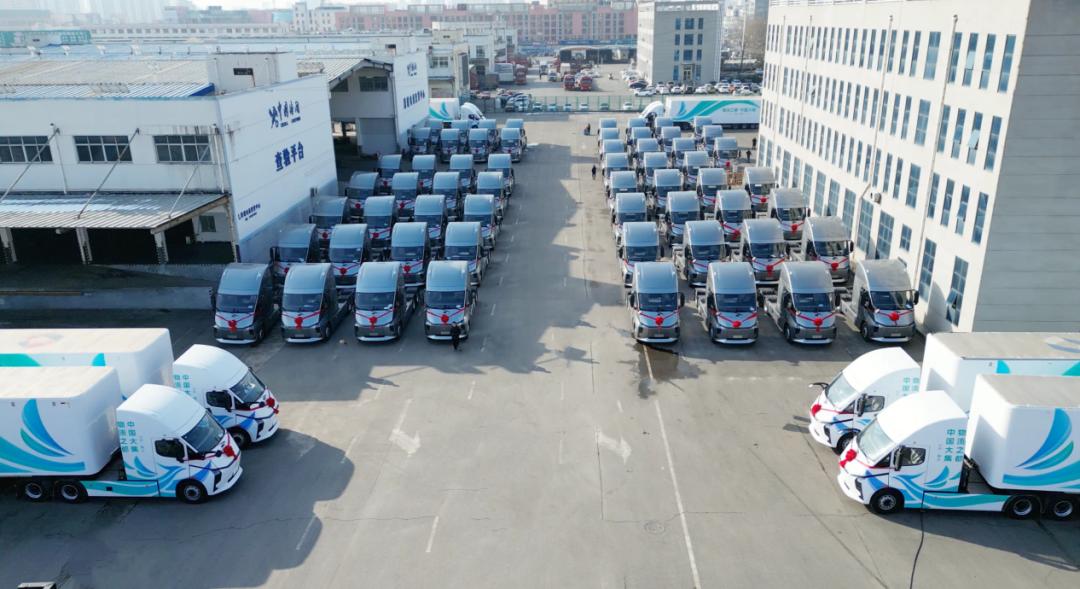
Image source: Official WeChat account of DeepWay
The large size, long braking distance, and high accident cost of heavy - duty trucks also determine that the promotion of driverless technology will be more cautious.
Therefore, the implementation of DeepWay's L4 is more like a phased process: first deploy in relatively fixed and controllable freight routes and specific scenarios, and then gradually expand the scope of operation.
Currently, DeepWay has carried out L4 - related tests and cargo - carrying operations in Xinjiang, Inner Mongolia, Sichuan, etc., and completed the first - batch delivery of formation - capable models to customers.
According to the prospectus, by the end of 2025, DeepWay had become one of the only two companies in China to commercialize L4 - level technology through new - energy heavy - duty trucks.
At this point, DeepWay's company profile becomes clear:
L2 is responsible for selling trucks and generating data; L4 is responsible for pushing "assisted driving" towards "unmanned operation".
Among them, L4 is an unfulfilled dream that DeepWay must achieve.
Robotruck: Still Needs to Prove Itself
Undoubtedly, Robotruck is indeed a blue - ocean market.
Road freight is a business with thin margins, high costs, and high risks. The average profit margin in the industry is less than 10%. Although freight vehicles account for less than 10% of the total number of road vehicles in China, they contribute about 25% of road traffic accidents.
For logistics companies, reducing costs, improving efficiency, and controlling risks are almost inevitable long - term propositions.
That's why the combination of new - energy heavy - duty trucks and autonomous driving technology has always been favored by capital.
According to CIC Consulting, by 2030, the penetration rate of new - energy heavy - duty trucks in China is expected to reach 59.0%, and the market size will reach 283.5 billion yuan. Therefore, DeepWay is targeting the excellent opportunity at the intersection of the new - energy transformation of heavy - duty trucks and the intelligentization of commercial vehicles.
However, a blue - ocean market does not mean easy money.
In the past few years, there has been no shortage of star companies in the Robotruck field.
TuSimple once landed on the NASDAQ with the halo of "the world's first autonomous driving stock", but later gradually deviated from its main business of autonomous driving due to internal turmoil and business contraction; players such as Qingtianzhika and Embark Trucks were also highly anticipated, but ultimately got stuck in the commercialization progress and sustainable profitability.
