Kuaishou Keling, making money so fast
Kuaishou may spin off an AI business worth $20 billion. It has been online for less than two years, and its valuation is already close to half of Kuaishou's.
On May 12, Kuaishou publicly admitted for the first time that it is evaluating the restructuring of its Keling AI-related assets and business, which may include introducing external financing.
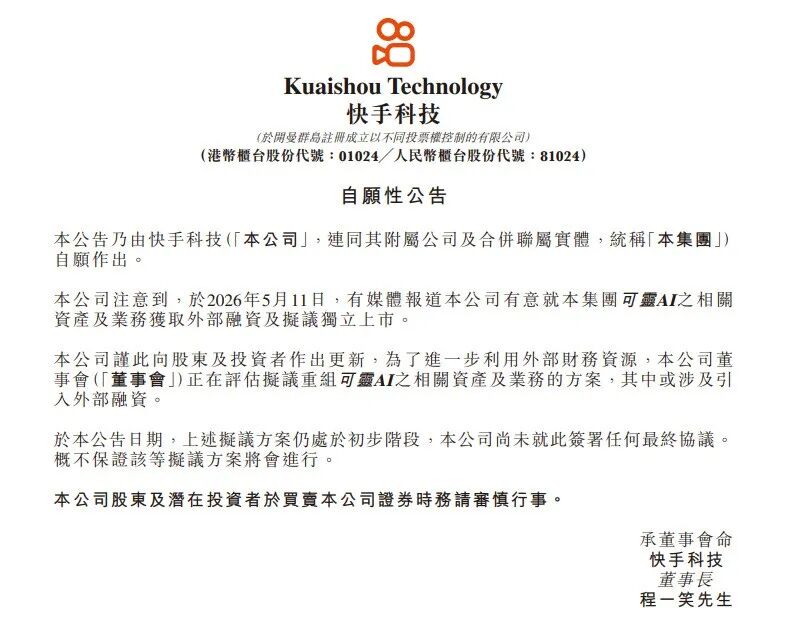
This means that the AI video generation business hidden within Kuaishou's system is being revalued by the capital market.
According to The Information, Kuaishou plans to spin off and finance Keling AI with a target valuation of about $20 billion and plans to push for an independent listing in 2027. Several media outlets subsequently reported that the scale of this round of financing could reach $2 billion, and investors such as Tencent are in contact.
The most unusual thing about this is that Kuaishou was originally a short - video company, and what the capital market is most excited about now may not be short - videos anymore.
If the transaction is finally completed, Keling AI may become one of the projects with the fastest capitalization speed in China's AI video track.
Reaching $20 billion in two years
If this round of financing is finally implemented, the most special thing about Keling AI is that for an AI product, from the launch of the test, to achieving hundreds of millions of dollars in ARR (Annual Recurring Revenue), and then to discussing financing at a valuation of $20 billion and preparing for an independent listing, the whole process took less than two years.
This speed is very rare among Chinese AI companies.
Keling was first open for testing on June 10, 2024. It is positioned as a large - scale video - generation model independently developed by Kuaishou. Users can automatically generate a video up to 2 minutes long, 1080P, and 30 frames by inputting a sentence.
More than a month later, on July 25, 2024, Kuaishou announced that Keling AI was fully open to global users and quickly launched a charging system. Its membership is divided into three levels: gold, platinum, and diamond, with monthly fees of 66 yuan, 266 yuan, and 666 yuan respectively.
That is to say, it took Keling less than two months from "going online" to "charging".
What really made the capital market revalue it was the subsequent revenue growth rate.
Kuaishou's financial report disclosed that in the fourth quarter of 2025, Keling's single - quarter operating revenue had reached 340 million yuan; among them, the single - month revenue in December 2025 exceeded $20 million, corresponding to an ARR of about $240 million, which only took about 18 months.
In the AI industry, there are very few products that can achieve hundreds of millions of dollars in ARR in 18 months.
The growth continues.
In March 2026, Kuaishou CEO Cheng Yixiao further disclosed at the earnings conference call that as of January 2026, Keling AI's ARR had exceeded $300 million.
That is to say, in just one month, its ARR increased from $240 million to over $300 million.
Subsequently, more aggressive data spread in the market. Multiple market sources said that as of the end of April 2026, Keling AI's ARR had reached about $500 million, almost doubling compared with before the Spring Festival.
This data has not been officially confirmed by Kuaishou yet, but it has become one of the important bases for the market to discuss its $20 billion valuation.
Why does Kuaishou suddenly want to spin it off?
Why is an AI product that has been online for less than two years being discussed for financing at a valuation of $20 billion and even preparing for an independent listing?
A core reason is that the capital market is now willing to give a higher valuation to AI businesses than traditional Internet businesses.
Kuaishou's annual revenue in 2025 exceeded 140 billion yuan, and its adjusted net profit exceeded 20 billion yuan. Its main revenue still comes from advertising, e - commerce, and live - streaming.
However, the valuation of mature Internet platforms usually depends on growth speed, profit margin, and cash flow, while the valuation logic of AI companies is completely different.
What the capital market pays more attention to is ARR, user growth, model capabilities, and the industry's imagination space.
Simply put, for the same one - yuan profit, AI companies often get a higher valuation than traditional Internet companies.
This is also why if Keling continues to be within Kuaishou's system, it is more like "Kuaishou's new business"; but once it is independently financed and listed independently, it may be redefined as an "AI video company".
These are two completely different valuation systems.
Another practical reason is that the AI business itself is very capital - intensive.
Compared with text generation, video generation requires more computing power. Model training, video inference, and rendering all require continuous investment in GPUs, data, and R & D teams.
Independent financing can help Keling obtain a more independent capital and talent system without relying entirely on the Kuaishou parent company.
At the same time, for Kuaishou, spinning off Keling also helps to unlock the value of AI assets.
Currently, Kuaishou's overall market value is about $30 billion, while the rumored valuation of Keling has reached $20 billion.
That is to say, an AI business that has been online for less than two years has a valuation close to half of Kuaishou's. This means that the capital market has begun to try to re - price Keling as an independent AI company.
Why does it make money so fast?
But the problem is that Keling is not the only one doing AI video generation. There are many companies that can directly generate videos.
Domestically, Keling AI's biggest competitor is ByteDance's Jimeng AI, followed by Alibaba Tongyi Wanxiang, Shengshu Technology Vidu, Aishi Technology PixVerse, Zhipu Qingying, MiniMax Hailuo, etc.
They are all working on text - to - video, image - to - video, video editing, and multi - modal creation capabilities. Keling is not the only player.
In terms of user scale and traffic capabilities, the ByteDance ecosystem may even be stronger.
As of March 2026, Jimeng AI's monthly active users were about 13.525 million, and Keling AI's were about 7.8 million. The former is about 1.7 times that of the latter. In January this year, Keling's monthly active users were about 12 million, slightly lower than Jimeng AI's (13 million) in the same period.
But the real key difference is that while many companies in the industry are still comparing model effects, user growth, and product experience, Keling has already begun to publicly disclose revenue, ARR, and corporate customers.
Kuaishou's financial report disclosed that in the fourth quarter of 2025, Keling's operating revenue reached 340 million yuan; in December 2025, its ARR reached $240 million; and in January 2026, it further exceeded $300 million.
In contrast, the current public information of Jimeng AI is more concentrated on user growth, product capabilities, and function updates. There is no sign that ByteDance has disclosed revenue and ARR data under the same caliber.
Perhaps Jimeng AI's revenue is higher than Keling AI's, but the outside world has no way of knowing.
Then look at independent startups.
Aishi Technology PixVerse is one of the domestic AI video companies with a relatively fast commercialization speed.
The company publicly disclosed that it started commercialization in November 2024. As of October 2025, its annual recurring revenue ARR exceeded $40 million, the global user scale exceeded 100 million, the product's MAU exceeded 16 million, and the revenue mainly came from membership subscriptions.
But in the same period, Keling's publicly disclosed ARR had reached $240 million, about 6 times that of PixVerse.
Shengshu Technology Vidu, Alibaba Tongyi Wanxiang, Zhipu Qingying, etc. have also entered the product - opening and charging stage.
But the currently publicly disclosed commercialization data of these products are more about pricing, functions, and application scenarios. There is no sign of clear disclosure of single - quarter revenue, ARR, and corporate customer scale like Keling.
So, the key reason why Keling is ahead is not that "there is no competition", but that it completed the business closed - loop earlier.
After opening for testing in June 2024, Keling launched a charging system in just about 45 days, turning the "video generation quota" directly into a commodity. At the same time, it also entered the corporate scenario earlier. Kuaishou disclosed that as of the end of 2025, Keling AI had served more than 30,000 corporate customers and developers.
More importantly, it has been integrated into Kuaishou's original business system. In the fourth quarter of 2025, the consumption amount of online marketing services brought by AIGC marketing materials reached 4 billion yuan. This means that Keling has begun to enter the advertising, e - commerce, and marketing budgets, and is no longer just a creator's tool.
This article does not constitute any investment advice.
This article is from the WeChat official account "Pencil News" (ID: pencilnews), author: Xi Wen, published by 36Kr with authorization.