Is Tesla going head-to-head with BYD? Elon Musk unveils a 1.2-megawatt ultra-fast charger, three times faster than the V4 Supercharger.
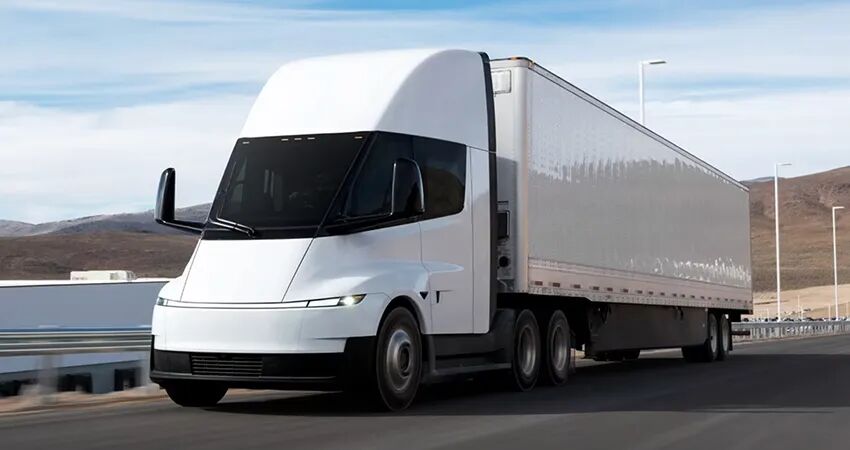
After BYD and CATL, Tesla's version of "megawatt flash charging" has also arrived.
According to CheDongXi on May 11th, recently, a regulatory document from the California Air Resources Board (CARB) in the United States has "unveiled in advance" the battery and energy replenishment information of the mass - produced version of the Tesla Semi.
According to the CARB administrative order document cited by foreign media, the long - range version of the Tesla Semi is equipped with a battery pack with an available capacity of 822 kWh, and the standard - range version is equipped with a 548 kWh battery pack. Both use the lithium - ion NCMA chemical system.
More importantly, both versions of the Semi are based on Tesla's second - generation 4680 cell architecture and support a peak charging power of up to 1.2 MW.
After all, the battery capacity of the Tesla Semi is 10 times that of a passenger car. Improving battery consistency and developing fast - charging technology are necessary choices.
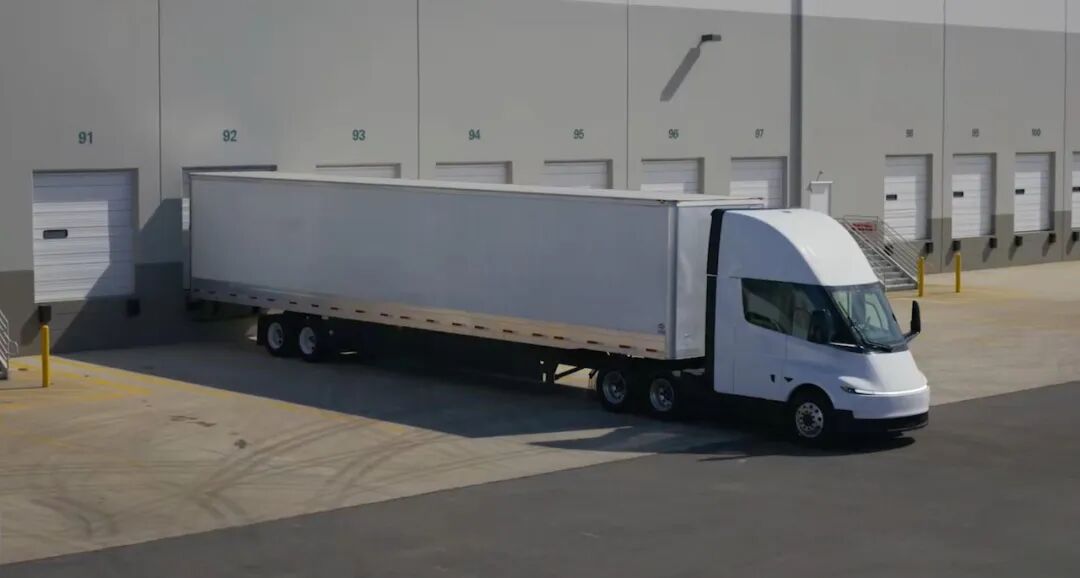
▲ Tesla Semi
However, it should be noted that there are some differences between BYD's megawatt flash charging and Tesla's. The former is currently a product used in the new - generation passenger car models.
Tesla's use of megawatt charging technology for the Semi truck also indicates that it already has the relevant battery technology. It is not impossible to transition to passenger cars in the future.
01. Megawatt charging comes to the Semi first, ahead of passenger cars
The source of this information is a vehicle certification - related document issued by CARB (California Air Resources Board). The corresponding model in the document is the 2026 Tesla Semi electric heavy - duty truck.
According to the information compiled by foreign media, the Semi has two battery configurations: the standard - range version has an available capacity of 548 kWh, with a target range of about 325 miles (520 kilometers); the long - range version has an available capacity of 822 kWh, with a target range of about 500 miles (800 kilometers).
Both use the NCMA lithium - ion system and support a peak charging power of about 1.2 MW. If compared with the peak power of 400 - 500 kW of Tesla's V4 Supercharger, Tesla's "megawatt flash charging" is nearly 3 times faster than the V4 Supercharger.

▲ Two battery specifications of the Tesla Semi
At the same time, Tesla has also built a "megawatt flash charging" energy replenishment system called Megacharger for the Semi.
InsideEVs reported that Tesla has prepared 64 "soon - to - be - launched" Megacharger stations in the United States, and its Q4 shareholder report also showed 37 locations planned to be put into operation in 2026.
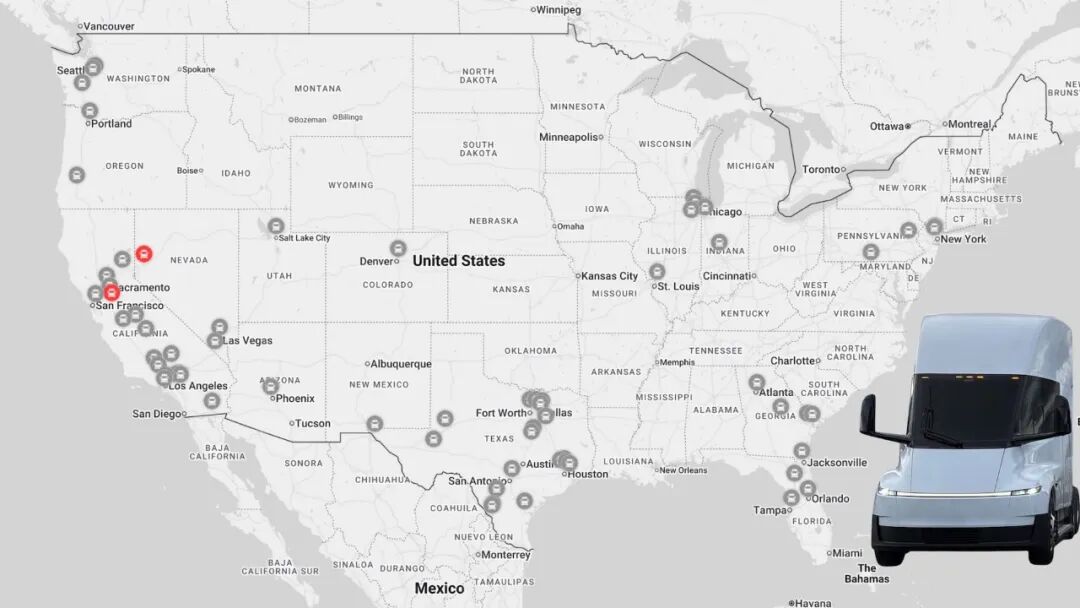
▲ The rumored distribution of Tesla Megacharger stations
The report also mentioned that the Semi has been confirmed to reach a charging power of about 1.2 MW and can replenish about 60% of the battery capacity in about 30 minutes.
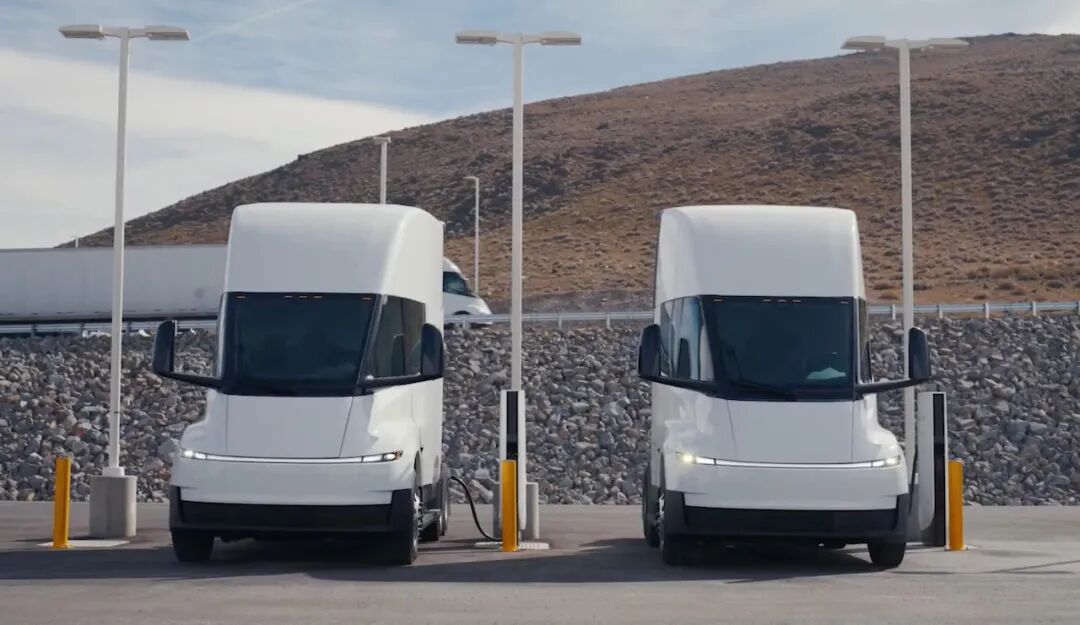
▲ The Tesla Semi is charging
This may not have a strong impact on the perception of passenger - car users, but it is of great significance for commercial vehicles. Driver rest, loading and unloading of goods, and route scheduling are all key nodes for fleet efficiency calculation.
If an electric heavy - duty truck can replenish a large amount of range in about half an hour, it has a chance to truly enter the operation model of logistics companies.
02. The second - generation 4680 cells are used, and the key lies in the battery pack and thermal management
Another key point revealed this time is that the Semi is not equipped with an ordinary battery pack, but a battery system based on Tesla's second - generation 4680 cell architecture. Foreign media calls it Cybercell, which is a new - generation large - cylindrical cell solution extended from Tesla's Cybertruck project.
The name 4680 is quite straightforward: the diameter is about 46 mm, and the height is about 80 mm.
Compared with traditional small - cylindrical cells, the large - cylindrical 4680 cells have a higher single - cell capacity, the number of cells can be reduced, and the battery - pack structure also has the opportunity to be further simplified.
When Tesla talked about the 4680 cells at Battery Day, the core logic was to reduce costs, improve efficiency, and simplify manufacturing complexity through large - cylindrical cells, electrodeless/fully - electroded design, dry - electrode technology, and structural battery packs.
However, the ideal is plump, but the mass production is skinny.
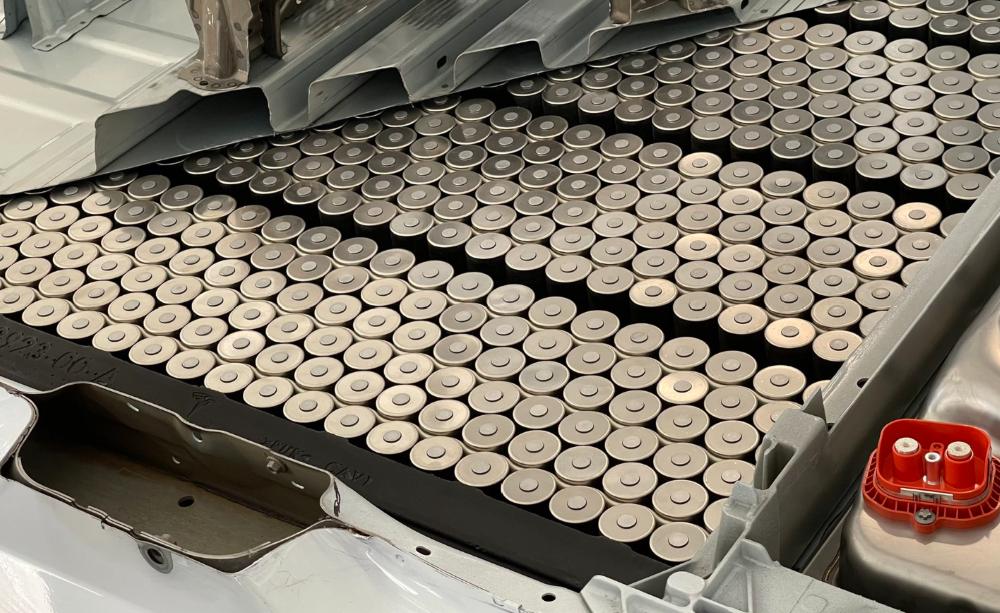
▲ Tesla 4680 battery
In the past few years, the 4680 cell has always been one of the toughest nuts for Tesla to crack.
The earliest 4680 - version Model Y once appeared at the Texas factory and then faded out for a while. The Cybertruck has become the main application model for the 4680 cells.
At the beginning of 2026, Tesla mentioned again in its financial report that it had started producing battery packs with self - produced 4680 cells for some Model Ys.
However, the situation of the Semi is different from that of the Model Y.
The Model Y uses the 4680 cells mainly considering supply - chain flexibility and local manufacturing, while the Semi's use of the second - generation 4680 cells is directly related to large - capacity battery packs, high - power discharge, and megawatt - level energy replenishment.
A long - range Semi has to carry an 822 kWh battery pack and withstand a peak charging power of 1.2 MW. This is a test for cell internal resistance, current - collection efficiency, battery - pack thermal management, and charging curves.
03. How is it achieved? The core is the all - dry electrode and composite binder
The key behind this technology is still the dry - electrode technology that Tesla has been working on for many years.
In traditional battery - electrode manufacturing, the positive and negative electrode materials, conductive agents, binders, and solvents are usually mixed into a slurry, then coated on the current collector, and then dried in a long oven, and the solvents are recovered. This process is mature, but the equipment is large, the energy consumption is high, the floor area is large, and the production line is long.
The idea of the dry electrode is to avoid using solvents and drying as much as possible. Instead, the powder materials are directly mixed, and the electrodes are made into self - supporting films through methods such as binder fiberization and roll - pressing. In theory, this can reduce the drying oven, solvent - recovery system, and factory - building area, and also reduce energy consumption.
The problem is that it is very difficult to do it by the dry method.
The electrodes need to have sufficient mechanical strength, not shed powder or crack, and ensure smooth transmission of ions and electrons.
Especially for the negative electrode, if the binder system is not properly handled, it is easy to cause irreversible capacity loss, affecting the battery's energy density and cycle performance.
According to the patent US20250364562 publicly disclosed by Tesla in 2025, its solution is likely to be a PTFE composite binder system. The patent mentions that the electrodes can use a composite binder composed of PTFE and PVDF, PVDF copolymers, or PEO, and can be used in energy - storage devices such as lithium - ion batteries.
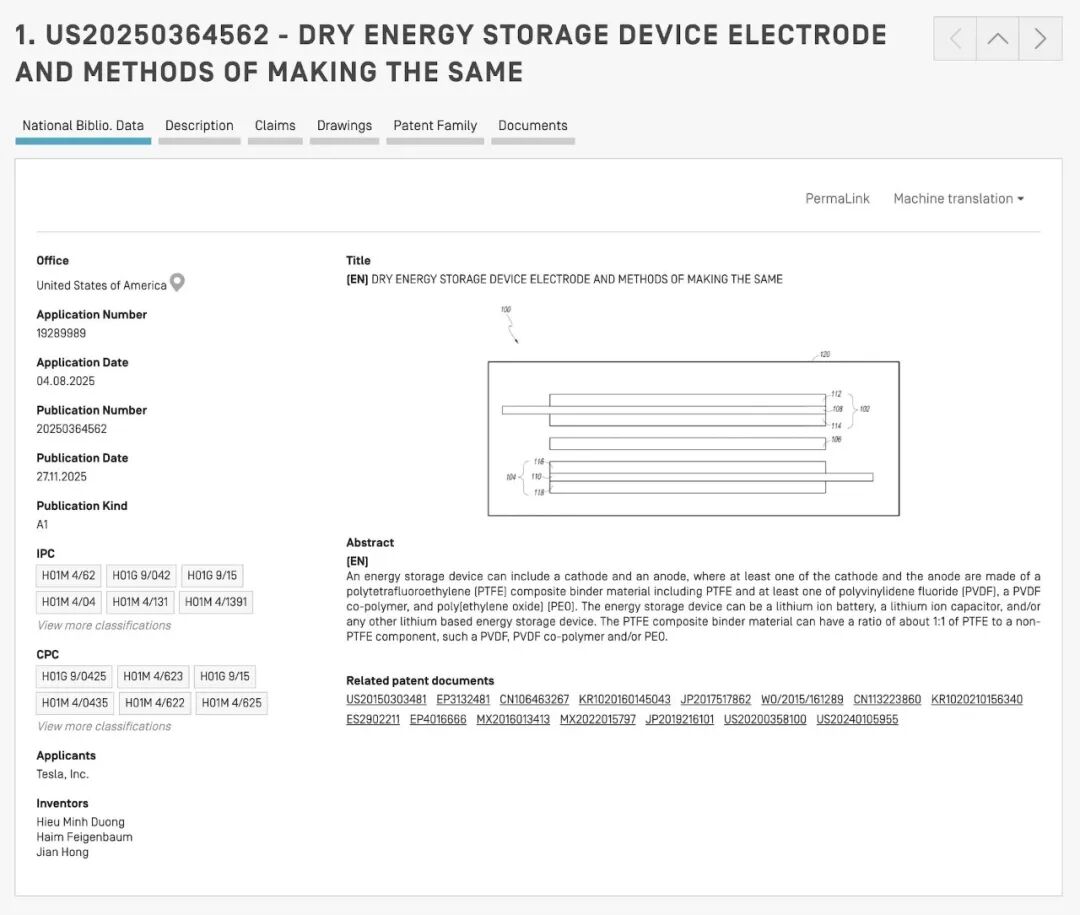
▲ Tesla's patent related to dry electrodes
The role of PTFE can be understood as "weaving a net". Under high - shear treatment, PTFE will fibrillate, forming a microscopic fiber structure similar to a spider web, connecting powder particles such as active materials and conductive agents, and finally forming a tough self - supporting electrode film.
More specifically, Tesla's patent describes such a process:
First, the active materials, conductive agents, and part of the binder are dry - mixed; then, through high - shear processes such as jet milling, the binder is fully dispersed or fibrillated; finally, a self - supporting electrode film is formed through calendering and then composited onto the current collector.
The significance of this process is that it is not simply removing the solvent from the wet slurry, but re - designing a dry - powder film - forming logic: using PTFE to "build the net", using materials such as PVDF and PEO to improve stability and processability, and then using high - shear and calendering to turn the powder into a continuous electrode film.
Of course, this does not mean that Tesla has completely solved all the problems of the 4680 cells.
The Semi is still in the capacity - ramping stage, and Tesla still needs to prove that it can produce the second - generation 4680 cells and Semi battery packs in a long - term, stable, and low - cost manner.
Secondly, 1.2 MW is the peak charging power, which does not mean that this power can be maintained throughout the charging process. What really affects the fleet experience is the complete charging curve, thermal - attenuation control, station reliability, and queuing efficiency.
Thirdly, the Megacharger network has just started to expand. Although Tesla has planned a large number of new stations, to truly form an inter - state logistics corridor, the station density, grid connection, station construction, and fleet scheduling need to keep up.
This poses a particularly great challenge to the electrical infrastructure construction in the United States.
04. Conclusion: Tesla's 4680 cells are used in heavy - duty trucks
Compared with the previous situation where the Model Y was re - equipped with the 4680 battery, the information about the Semi this time is more complete.
The "4680 pie" drawn by Elon Musk at Battery Day five years ago has been held back by mass - production problems in the past few years.
Now, from the all - dry electrode to the Semi's megawatt energy replenishment, Tesla has at least baked a part of this pie.
However, in the next step, the tests will be more realistic: whether it can be mass - produced, whether it can be stably delivered, whether the Megacharger can keep up, and whether the total cost of ownership of the fleet can be lower than that of diesel trucks.
This is the real test that the Tesla Semi and the second - generation 4680 cells need to face.
This article is from the WeChat public account "CheDongXi" , author: Janson. Republished by 36Kr with authorization.