Is Xiaomi the most affected by the wave of rising mobile phone prices?
The soaring costs are causing a major upheaval in the mobile phone market landscape.
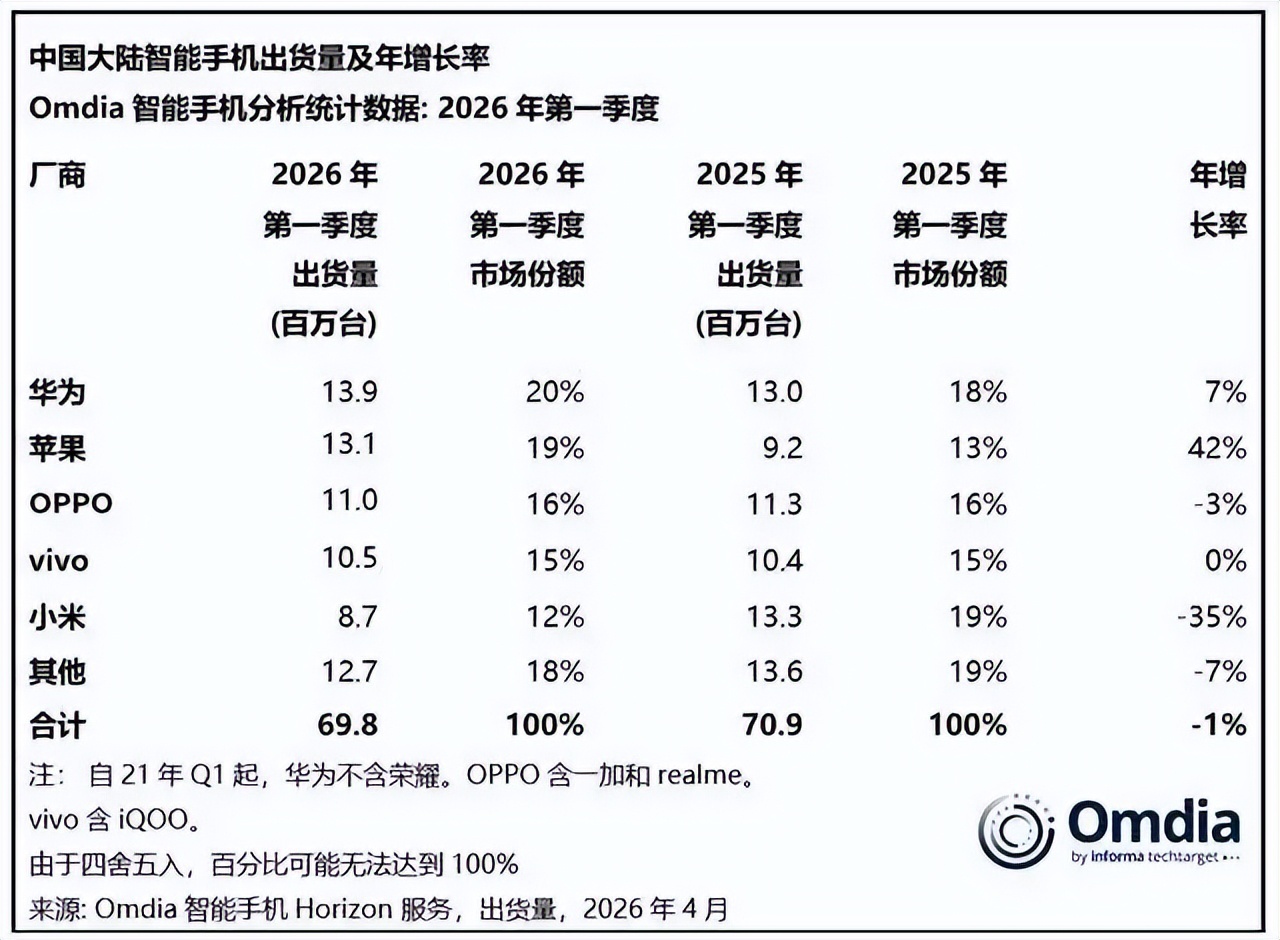
Recently, research firm Omdia released the rankings of major smartphone manufacturers in key global markets for the first quarter of this year. Apple shipped 60.4 million units in the first quarter, a year-on-year increase of 10%. Although Huawei did not make it into the global top five, it achieved year-on-year growth in the Chinese mainland market.
In contrast to the reverse growth of Apple and Huawei, OPPO, Vivo, Honor, and Xiaomi all experienced collective declines. OPPO (including realme and OnePlus) shipped 30.7 million units globally, a year-on-year decrease of 6%. Vivo shipped 21.3 million units globally, a year-on-year decline of 7%. Honor achieved growth overseas, but its sales in the Chinese mainland market declined year-on-year.
Source: Screenshot from Omdia
Among the major mobile phone giants, Xiaomi suffered the most severe decline. In the first quarter, Xiaomi's domestic shipments were only 8.7 million units, a staggering 35% year-on-year drop, ranking fifth in the domestic market.
According to IDC's statistics, in the domestic market in the first quarter, Huawei, Apple, OPPO, Vivo, and Honor occupied the top five positions. Xiaomi was relegated to the "Others" category, marking its worst quarterly ranking in the Chinese market in nearly a decade.
This year, Xiaomi is not the only mobile phone brand to raise prices. Why has Xiaomi been hit the hardest? When the "cost-effectiveness" card is torn apart by rising costs, how can mobile phone brands maintain their market share?
01. Is Xiaomi's decline benefiting Apple and Huawei?
"I can understand why our competitors are raising prices. Everyone is facing difficulties, and we're also feeling the pain."
"We'll try our best to reduce the impact of price increases on consumers."
...
From Lu Weibing to Lei Jun, the relevant person in charge of Xiaomi Mobile has responded more than once this year to the pressure of mobile phone price increases.
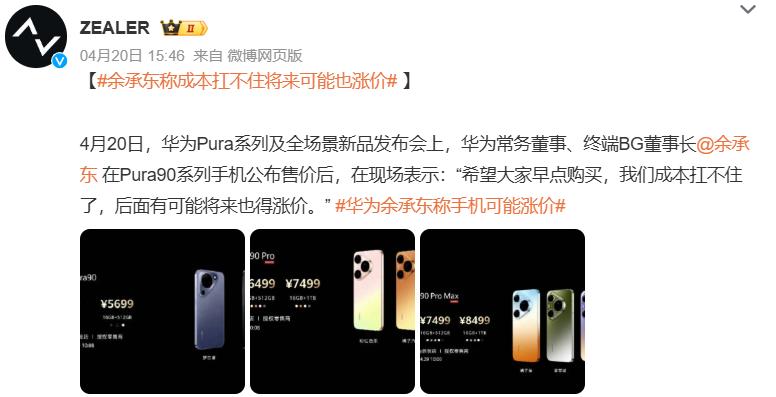
"Fun Business Explanation" noticed that since the price of memory chips started to rise, all domestic brands except Huawei and Apple have significantly increased their prices. The flagship OPPO Find X9 series has seen a price increase of about 500 yuan. The latest Honor Magic V6, in its 16GB + 512GB and 16GB + 1TB large-memory versions, is priced 1000 yuan higher than the previous generation.
Source: Screenshot from Weibo
Among all domestic mobile phone brands, Xiaomi's price increase is not the largest, yet it has been the most affected by the price increase wave.
This is mainly related to Xiaomi's brand image. More than 50% of Xiaomi's shipments are concentrated in the low-end price segment below $200, with a large number of price-sensitive customers. Even a price increase of 200 yuan can affect its "cost-effectiveness" brand. In April this year, the Redmi Turbo 5/5 Max series was released 15 months after the previous generation, and the starting price increased by 300 yuan. RD observation data shows that the sales volume of the Turbo 5 series during the first sales period was only 60% of that of the Turbo 4 series.
The tricky part is that the price of storage chips continues to rise. SemiAnalysis data shows that the price of mobile LPDDR5 memory has tripled since the first quarter of 2025, and the current contract price is about $10 per GB. It is expected to see double-digit growth in 2027.
Storage chips are a must-have configuration for mobile phones. From mid - to low - end to high - end and flagship models, the cost of storage chips accounts for 10% - 15%. After the memory price increase, the storage cost of some mid - to low - end mobile phones has risen to about 30% - 40%.
Liang Zhenpeng, a senior industrial economic observer, said that the product gross profit margin of Redmi, Xiaomi's mid - to low - end brand, is relatively low. The gross profit of some Redmi models may be less than 100 yuan per unit. They can't withstand the doubling of memory and flash memory costs. If they don't raise prices, they'll lose money on each unit sold. Xiaomi is also consciously reducing the proportion of mid - to low - end product shipments, and the pace of new product launches in the first quarter of this year has slowed down. The decline in sales volume and market share in the domestic market in the first quarter may just be the beginning for Xiaomi Mobile.
Source: Canstock
A mobile phone distributor revealed that the sales of mid - to low - end models below 4000 yuan have been greatly affected this year, especially models with large memory configurations like 12GB + 512GB, which are becoming increasingly difficult to sell. OPPO and Vivo, which mainly sell mid - range phones, have also been affected by the price increase wave, with a significant decline in global shipments. However, they have basically maintained their positions in the domestic market.
Some industry insiders estimate that the shipments Xiaomi lost have been snatched by Huawei and Apple. Huawei and Apple are the only two brands that have not raised prices this year, and some of their models have even seen price cuts.
The price increase has turned many low - end phones into mid - range ones. Huawei's "Enjoy" series targets the thousand - yuan phone market previously dominated by Xiaomi, OPPO, and Vivo. The Enjoy 90 series released by Huawei in March has a starting price of 1299 yuan, equipped with a "Kirin 8 series chip + HarmonyOS 6 + a large - capacity battery", attracting many users of low - end phones such as Xiaomi REDMI, OPPO A series, and vivo Y series.
Huawei's high - end flagship models have not raised prices. Instead, some models have offered discounts. The price advantage, combined with Huawei's domestic supply chain system, has made Huawei one of the few brands that can "increase sales by reducing prices".
Like Huawei, Apple also sees the "soaring memory prices" as an opportunity to expand the market. Apple's hardware gross profit margin has long been maintained between 35% - 40%. Even with the rising memory costs, it has sufficient profit margins to absorb the impact. The iPhone 17 is priced the same as the previous generation, and this year, the iPhone 17e and iPhone Air have also seen significant price drops on e - commerce platforms, with a direct reduction of 1000 - 2000 yuan. Coupled with the low base in the first quarter of last year, Apple's sales growth this year is quite obvious, with shipments in the Chinese mainland reaching 13.1 million units, a year - on - year increase of 42%.
02. What else can be done besides raising prices?
In addition to the impact of price increases, the decline in Xiaomi's mobile phone market share is also related to the shift of its business focus.
The growth of the mobile phone market has almost stagnated, and the low - end market is under pressure. Xiaomi has gradually shifted its strategic focus to new businesses such as smart cars and home appliances.
In the past two years, the proportion of Xiaomi's mobile phone business revenue has been declining year by year. In 2025, the revenue of Xiaomi's smartphone business was 186.4 billion yuan, accounting for 40.8% of the total revenue. In 2024, this proportion was 52.4%.
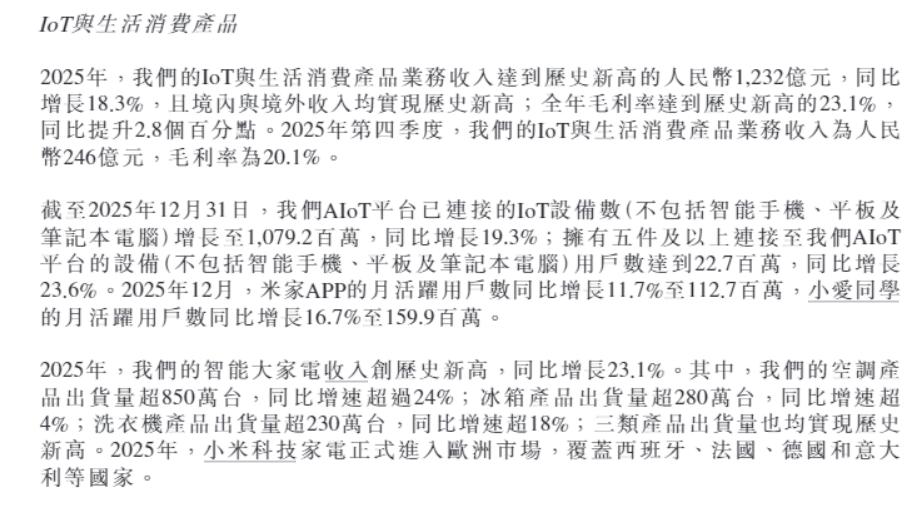
Xiaomi's financial report shows that in 2025, the revenue from its innovative businesses such as smart electric vehicles and AI was 106.1 billion yuan, accounting for an increase from 9% to 23.2%. The revenue from IoT and consumer products was 123.2 billion yuan, a year - on - year increase of 18.3%, and the gross profit margin increased to 23.1%.
Source: Screenshot from Xiaomi's financial report
The adjustment of Xiaomi's offline channels also shows that it is re - balancing its business layout.
In November 2025, Xiaomi announced an internal adjustment of Xiaomi Home stores, closing some inefficient and loss - making stores and "improving quality and efficiency". A clerk at a Xiaomi Home store said that this year, Xiaomi's offline sales focus has shifted from mobile phones to home appliances. In addition to maintaining the proportion of high - end mobile phones in the sales assessment, a new indicator for the proportion of home appliances has been added, and the proportion of home appliances in the overall store assessment has increased to over 20%.
In fact, Xiaomi has long shown its ambition to become a leading brand in the home appliance industry. Lu Weibing, the president of Xiaomi Group, has publicly stated many times that "in the next five years, Xiaomi aims to become a leading brand in China's home appliance industry, drive the home appliance business to reach a scale of 100 billion yuan, and the air - conditioning business aims to enter the top two in the Chinese market."
However, in the home appliance industry, traditional giants such as Haier, Midea, and Gree have firmly controlled the market channels and consumer mindsets. It is difficult for Xiaomi's home appliances to break through with its current quality reputation and scale. A report from "Consumption Protection", a consumer complaint platform under the China Electronics Chamber of Commerce, showed that in the first three quarters of 2025, Xiaomi accounted for 46.63% of home appliance complaints in some statistical measures, equivalent to the total number of complaints of giants such as Gree and Midea.
Shan Lianyu, the general manager of Xiaomi Group's home appliance department, proposed at an internal meeting that in 2026, Xiaomi's home appliance business should change consumers' inherent perception of its products as "poor quality".
Xiaomi entered the home appliance market through the OEM model. Although it is promoting the construction of its own factories, the construction of the supply chain is not something that can be achieved overnight.
In addition, traditional giants such as Midea are also blocking Xiaomi by "not allowing after - sales service providers to cooperate with other brands". Whether Xiaomi's home appliance business can maintain its growth momentum and fill the revenue gap left by the mobile phone business this year remains uncertain.
In addition to Xiaomi, OPPO, Vivo, and Honor are also trying to cope with the pressure of the price increase wave.
OPPO recently deeply integrated OnePlus and realme, incorporating the realme R & D team into the group, concentrating core resources such as imaging and hardware to reduce internal consumption and hedge against the pressure of rising costs. Vivo is consolidating its high - end market with imaging flagships such as the X300 Ultra, adjusting prices in stages, strictly controlling mid - range costs, and betting on edge - side AI and sensing technologies to try to digest the impact of price increases with differentiated value. Honor is trying to make breakthroughs in product form. The Robot Phone released this year has a built - in mechanical gimbal, creating a different photography experience.
It is conservatively estimated that this round of price increase wave will last until 2027. Whether the various measures taken by mobile phone brands can withstand the cost pressure remains to be seen.
Zhong Xiaolei, a senior analyst at Omdia, believes that the way for mobile phone manufacturers to break the deadlock in the future depends on breakthroughs in AI functions. The brand that can offer unique and more practical AI agent functions can not only achieve a breakthrough in brand image but also build a new strategic moat.
Whether it is the change in storage prices or the development of AI, the market development of domestic smartphones is full of uncertainties. The entire mobile phone industry will face a new round of pattern reconstruction under the double pressure of rising costs and technological iteration. Whether Xiaomi, which is diversifying its development, can make a breakthrough in its mobile phone business will determine its position in the future industry reshuffle.
This article is from the WeChat official account "Fun Business Explanation", author: Zhang Yuge, published by 36Kr with authorization.