308 billion. The amount of money Jensen Huang has invested in AI this year is almost enough to buy a DeepSeek.
On May 11th, according to foreign media CNBC, as of today, NVIDIA's total committed investment in the AI industry in 2026 has exceeded $45.3 billion (approximately RMB 308.074 billion).
According to a report by foreign media The Information on May 8th, the valuation of DeepSeek may exceed RMB 350 billion. In comparison, NVIDIA's investment in the AI industry this year is already close to DeepSeek's valuation.
On May 7th, NVIDIA reached an agreement with data center operator IREN, obtaining the right to invest up to $2.1 billion (approximately RMB 14.282 billion) in the company. One day before that, NVIDIA also reached an agreement with glass manufacturer Corning, allowing it to invest up to $3.2 billion (approximately RMB 21.762 billion).
NVIDIA's investments in the AI field as of now in 2026 are as follows:
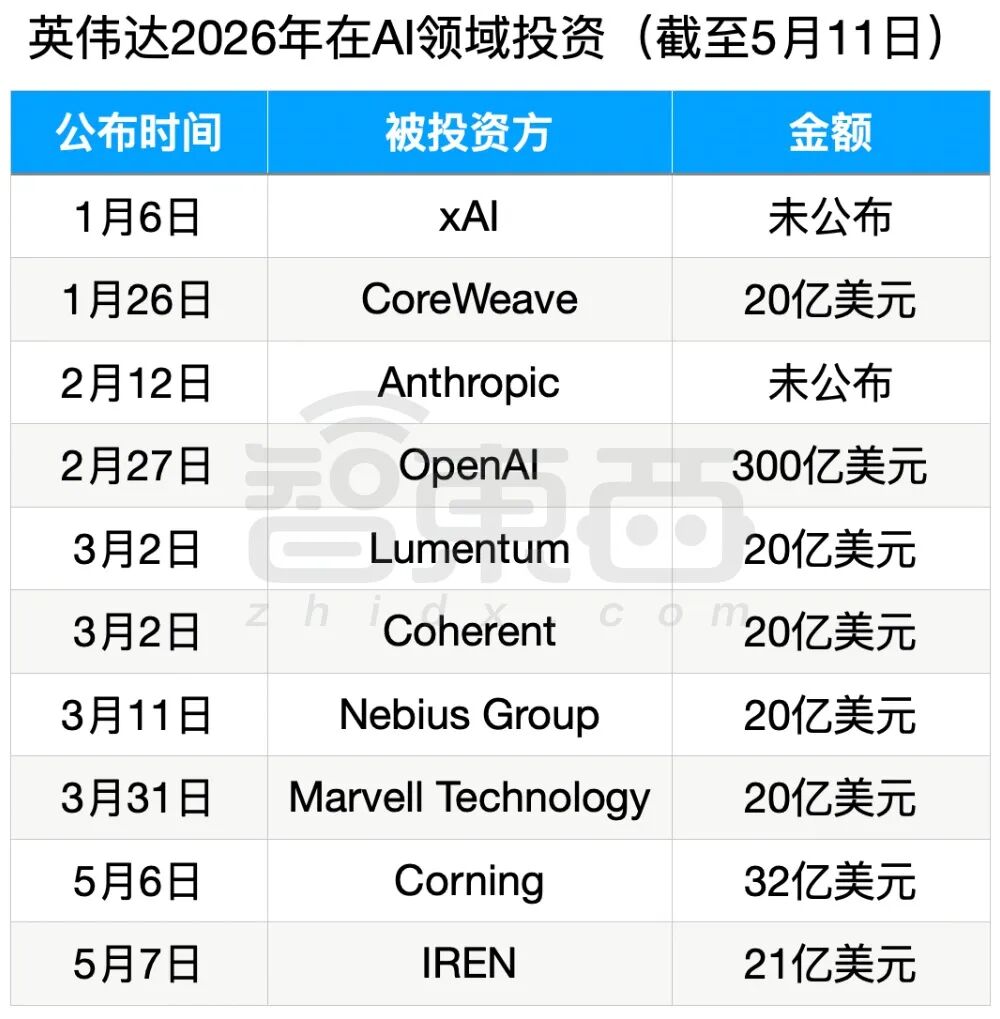
▲ NVIDIA's investments in the AI field as of now in 2026 (as of May 11th, charted by Zhidx)
According to NVIDIA's annual filing with the U.S. Securities and Exchange Commission (SEC), NVIDIA actually completed private company and AI infrastructure investments of approximately $17.5 billion (approximately RMB 119.013 billion) in the previous fiscal year (from February 2025 to January 2026), which is only 39% of the $45.3 billion.
01. NVIDIA Bets on Infrastructure, New Cloud, and Large Models
In 2026, NVIDIA's investments in the AI field can be roughly divided into three aspects: AI infrastructure, new cloud, and large AI models.
In the field of AI infrastructure, on May 7th, NVIDIA announced a strategic cooperation with data center company IREN. IREN will deploy up to 5 gigawatts of NVIDIA's DSX brand infrastructure design in its facilities around the world to support AI workloads.
In the agreement, IREN granted NVIDIA a five - year right to purchase up to 30 million common shares at an exercise price of $70 per share. Accordingly, NVIDIA obtained an investment right of up to $2.1 billion (approximately RMB 14.282 billion).
On May 6th, NVIDIA invested up to $3.2 billion (approximately RMB 21.762 billion) in glass manufacturer Corning. As part of the deal, Corning is building three new factories in the United States to produce optical technology products specifically for NVIDIA. NVIDIA may switch from copper cables to fiber - optic cables when building its rack - level systems.
According to CNBC, in addition to the investment, NVIDIA also paid billions of dollars to Corning to fund the glass manufacturer's construction of new factories.
In March this year, NVIDIA invested $2 billion (approximately RMB 13.601 billion) in Marvell Technology as part of its strategic cooperation in the field of silicon photonics technology. In the same month, it also invested $2 billion (approximately RMB 13.601 billion) in each of the two photonics technology development companies, Lumentum and Coherent.
In the "neoclouds" field, in January this year, NVIDIA invested $2 billion (approximately RMB 13.601 billion) in cloud computing company CoreWeave. The agreement includes building data centers using NVIDIA technology. NVIDIA also invested $2 billion (approximately RMB 13.601 billion) in AI cloud company Nebius Group as part of a cooperation agreement in areas such as AI infrastructure deployment, cluster management, inference, and artificial intelligence factory design.
In addition, in the field of large AI models, in January this year, Elon Musk's xAI (now called SpaceXAI) announced the completion of Series E financing, raising a total of $20 billion (approximately RMB 136.015 billion). NVIDIA participated as a strategic investor.
In February this year, NVIDIA also participated in Anthropic's Series G financing. Anthropic raised $30 billion (approximately RMB 204.022 billion) in this round of financing, and its valuation reached $380 billion (approximately RMB 20.4 trillion). At the end of February, NVIDIA announced an investment of $30 billion (approximately RMB 204.022 billion) in OpenAI.
In September last year, NVIDIA and OpenAI announced that as OpenAI deploys 10 gigawatts of NVIDIA systems, NVIDIA will gradually invest up to $100 billion (approximately RMB 680.075 billion) in OpenAI.
However, this deal ultimately did not materialize. Jensen Huang said in March this year that investing $100 billion in OpenAI was likely "impossible" and stated that the $30 - billion deal "might be" NVIDIA's "last" large - scale check to OpenAI before its possible initial public offering (IPO) this year.
The specific reason is that OpenAI is no longer focused on developing data centers but relies heavily on partners such as Oracle, Microsoft, and Amazon to piece together as much computing power as possible.
02. NVIDIA Invested 119 Billion Last Year, and Its Stock Price Rose 11 - Fold in Four Years
NVIDIA has always been the biggest winner in the AI boom. The graphics processing units (GPUs) produced by the company are essential products for training AI models and running large - scale workloads.
The global frenzy to buy GPUs has caused NVIDIA's stock to rise more than 11 - fold in four years, pushing the company's market value to approximately $52 trillion (approximately RMB 35.36 trillion) and making it the most valuable company in the world.
As of the close on May 8th, NVIDIA's stock price was $215.22 (approximately RMB 1463.66), and its total market value was approximately $52 trillion (approximately RMB 35.36 trillion).
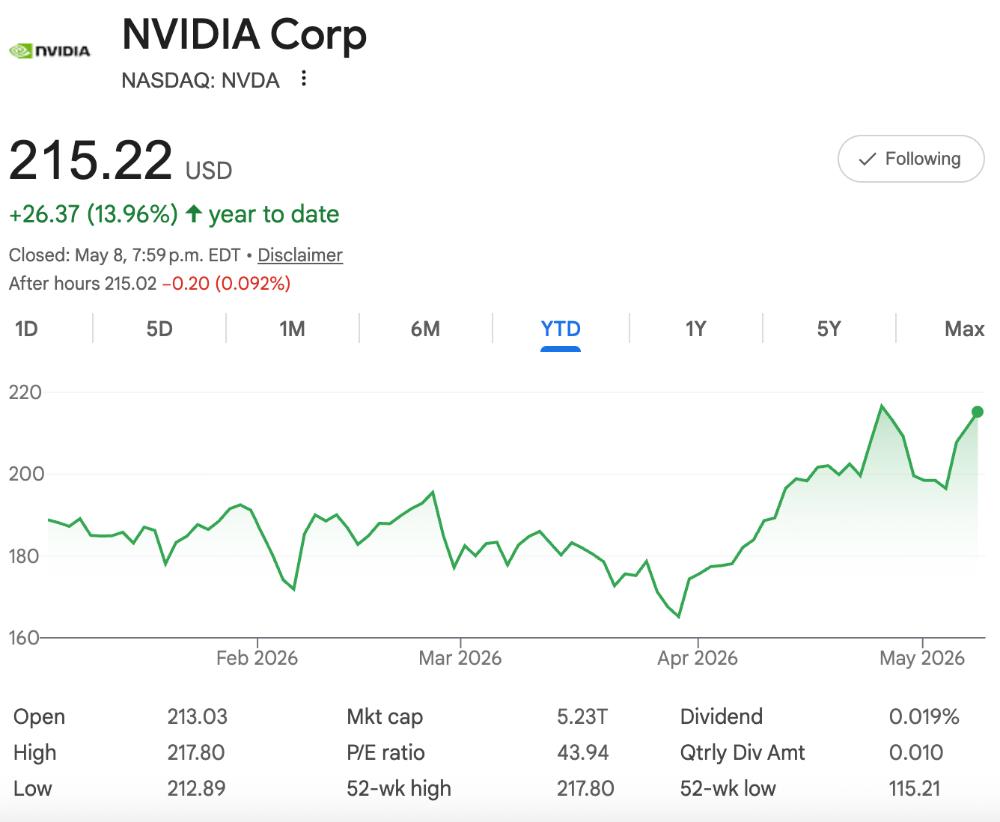
▲ NVIDIA's stock price (Source: Google)
To help the company expand its dominance beyond the chip field, NVIDIA is funding the entire AI supply chain, ensuring that the supply chain runs on NVIDIA's hardware and that there is sufficient production capacity to meet the demand.
NVIDIA generated $97 billion (approximately RMB 659.673 billion) in free cash flow in the previous fiscal year. According to NVIDIA's annual filing with the U.S. Securities and Exchange Commission (SEC), in the previous fiscal year, the company invested $17.5 billion (approximately RMB 119.013 billion) in private companies and infrastructure funds. The company said that these investments include AI model companies that purchase its products directly or through cloud service providers.
The non - listed equity securities (i.e., investments in private companies) held on NVIDIA's balance sheet soared from $3.39 billion (approximately RMB 23.055 billion) a year ago to $22.25 billion (approximately RMB 151.317 billion) at the end of January this year.
The company reported that the gains from these assets and the publicly - held stocks were $8.92 billion (approximately RMB 60.663 billion), much higher than $1.03 billion (approximately RMB 7.005 billion) in the previous fiscal year, partly due to its investment in Intel - Intel's stock price has risen by more than 200% this year.
"There are so many excellent and amazing foundation model companies. We are trying to invest in all of them," NVIDIA founder and CEO Jensen Huang said in a podcast in April. "We don't pick winners. We need to support every company."
During NVIDIA's earnings conference call in February, Huang Renxun said: "Our investments are very clearly and strategically focused on expanding and deepening the coverage of our ecosystem."
03. Analysts Warn of Circular Investment Risks for NVIDIA
As the investment amount continues to increase, there is growing concern that NVIDIA, like Google and Amazon, is promoting its own growth through investments in other companies.
NVIDIA is supporting some companies that purchase a large number of its chips, and in some cases, it also leases computing power back from these companies. Matthew Bryson, an analyst at Wedbush Securities, wrote in a report that NVIDIA's investments and expansion "fully conform to the circular investment model."
However, Bryson believes that these investments highlight NVIDIA's vision, and if the company can execute effectively, it will create a "competitive moat" for it.
Jordan Klein, a chip analyst from Japanese financial group Mizuho, said that these deals between NVIDIA and component manufacturers "are extremely wise for the chief financial officer and the team and are an excellent use of cash" because they help accelerate the development of key technologies and scarce products.
But he is more skeptical about NVIDIA's investments in the new cloud field. "It feels like pre - funding the purchase of your own GPUs and products," Klein said in an email. However, he also added that these cloud providers have the key resources that NVIDIA needs, such as power and data center capacity.
Ben Bajarin, an analyst at U.S. research firm Creative Strategies, expressed a similar view on NVIDIA's deal with IREN. He said in an interview with CNBC: "The risk is that if the cycle turns, the market will start to question how much of the demand is real market demand and how much is supported by NVIDIA's own balance sheet."
04. Conclusion: NVIDIA Is No Longer Satisfied with Just Being the "Shovel Seller"
Looking at NVIDIA's investments in 2026, in essence, it is a strategic layout by NVIDIA for the long - term future of the AI industry.
By supporting industries such as photonics technology, fiber - optic connections, and data centers, NVIDIA is actively solving the bottleneck problems that restrict the large - scale development of AI. The new factories built by Corning and the 5 - gigawatt infrastructure to be deployed by IREN will all be transformed into computing power bases. The strategic investments in large - model companies such as xAI, Anthropic, and OpenAI ensure that frontier explorers have sufficient resources to break through technological boundaries.
From these investments, we can clearly perceive that NVIDIA is upgrading from a chip supplier to the "general contractor" and "major financier" of AI infrastructure.
This article is from the WeChat official account “Zhidx” (ID: zhidxcom). Author: Wang Han. Republished by 36Kr with permission.