The landscape of the 2026 World Cup has changed, with AI taking the lead: 3D digital humans judge offsides, and referees wear "cyber prosthetic eyes".
There is only a little over a month left until the opening of the 2026 FIFA World Cup jointly hosted by the United States, Canada, and Mexico. However, the broadcasting rights plan for this World Cup in the Chinese mainland has not been finalized yet. The latest news shows that CCTV has rejected the price offered by FIFA, and it is estimated that the two sides will have to conduct multiple rounds of negotiations. No matter in what form the broadcasting rights are finally settled, it is highly likely that it will not affect the enthusiasm of ordinary viewers for watching the games.
Anyway, the World Cup is a super big IP with a huge pool of traffic behind it. Naturally, such a stage cannot do without the performance of AI.

(Image source: FIFA)
Leitech (ID: leitech) noticed that the 2026 FIFA World Cup in the United States, Canada, and Mexico has become the first World Cup in the AI era. For this football event, the penetration of AI technology is all - dimensional, which is the first time in the nearly 100 - year history of the World Cup. From the stadium layout to the game refereeing, and then to the game broadcasting process and the way viewers watch the games, all will be profoundly affected by AI.
The stadium management is undergoing a transformation, and the naked - eye refereeing is turning into all - dimensional AI
The operation of modern football games has long been an extremely large and complex systematic project.
With the intervention of AI, the stadium management of this World Cup is completing the transformation from a labor - intensive model to a computing - power - intensive one. Since 2024, Lenovo has become a global technology partner of FIFA and has joined hands with FIFA to create the first AI World Cup.
As a Chinese technology giant deeply involved in this World Cup, Lenovo is building an invisible digital foundation for this global top - level event. In this process, the role of AI is mainly reflected in two dimensions: game refereeing and overall stadium scheduling.
1. Transparency of the refereeing system: VAR 3D digital humans and enhanced referee perspective
Controversial refereeing decisions on the football field are often topics that fans enjoy talking about. However, in the top - level stadiums that pursue absolute fairness, any misjudgment may change the fate of a national team. In the past few years, the introduction of VAR (Video Assistant Referee) and semi - automatic offside recognition technology has significantly reduced misjudgments, but there are still blind spots on the field.
In the era of the popularization of large AI models, Lenovo has brought a more extreme solution - the VAR 3D digital human visualization solution. This system no longer solely relies on traditional camera physical positions. Instead, through a matrix of high - speed AI cameras deployed around the stadium, it can capture the skeletal dynamics of players and the movement trajectory of the ball in real - time. And within milliseconds, it uses AI computing power to generate high - precision 3D digital human reconstruction images in the virtual space in real - time.

(Image source: Lenovo)
When a controversial refereeing decision occurs, the system can instantly provide any angle, including even the virtual camera perspective, allowing the offside line and foul actions to be presented in the most intuitive 3D form to fans around the world.
According to Sina Finance, Lenovo will set up 28 3D scanning cabins during the World Cup. These cabins will operate in the hotels where the players stay before the games to generate exclusive 3D digital humans for all players and enter them into FIFA's database.
In addition, the application of the referee perspective AI video enhancement system is like equipping the referees with "cyber artificial eyes". Through the miniature edge - side AI devices worn by the referees, combined with the in - field edge computing nodes, the system can use AI algorithms to enhance the picture clarity in real - time, supplement the lost frames, and even highlight the potential foul action trajectories in low - light, rainy or snowy weather, or even when the players are densely blocking. This greatly improves the accuracy of refereeing and also relieves the mental pressure of the referees.
Leitech (ID: leitech) believes that the entry of AI technology into the refereeing system can achieve both accuracy and efficiency. It not only makes the game fairer but also avoids long - term interruptions of the game that affect the fluency, which the electronic technology in the pre - AI era could not achieve.
2. Invisible dispatcher: The overall control of the game operation by AI infrastructure
The venue of the World Cup is not limited to a single football field. The people involved in the World Cup are not limited to players and referees, but also include a large number of spectators and staff. It is worth noting that this World Cup is being held in three countries for the first time, and the number of participating teams has increased from 32 to 48 for the first time. The complexity of logistics, communication, security, ticketing and other aspects has increased exponentially, posing a huge challenge to the infrastructure and resource scheduling capabilities of the three countries.
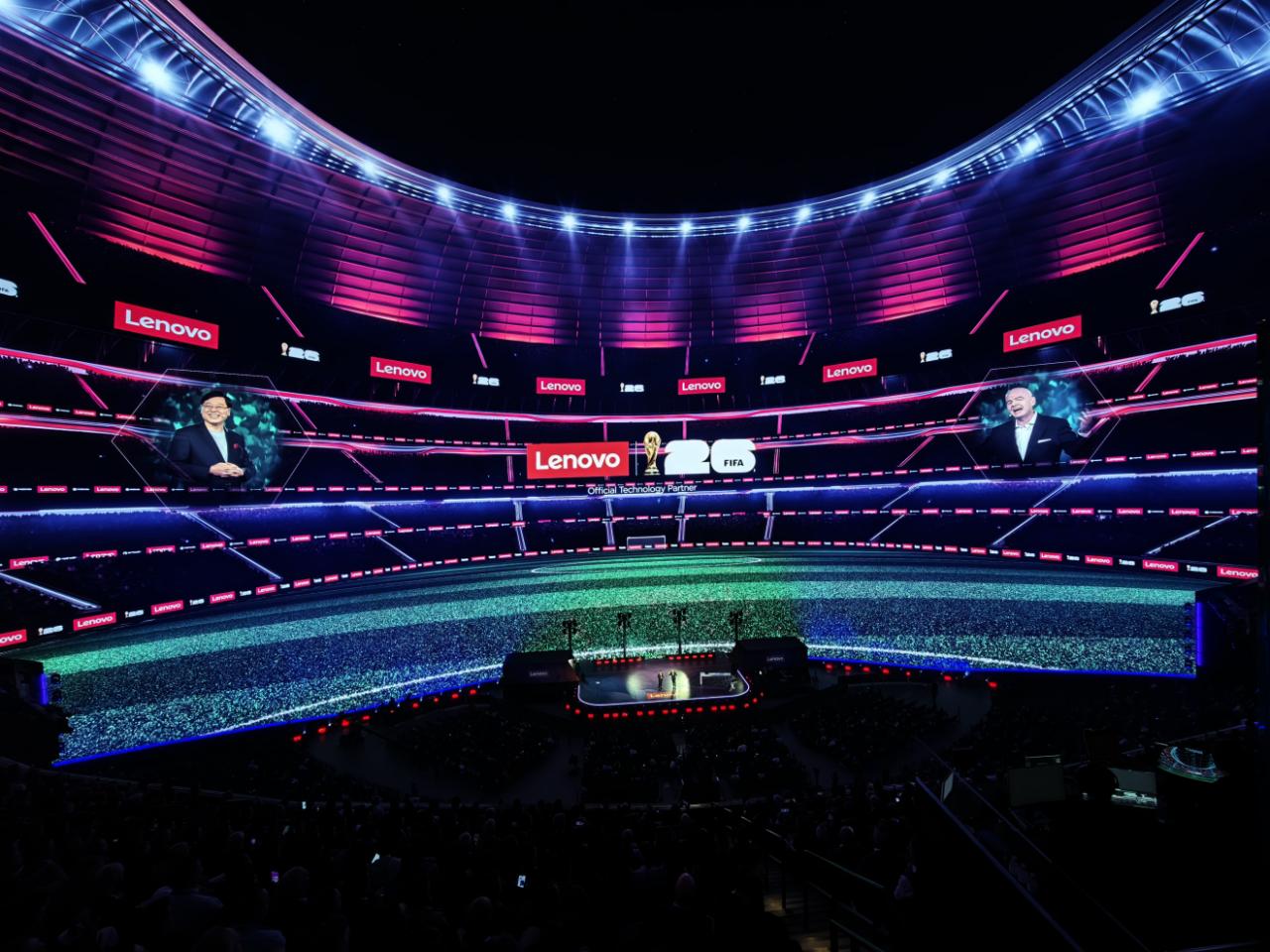
Facing the new challenges, manufacturers such as Lenovo manage and dispatch the entire event through AI. Specifically, Lenovo has built a huge intelligent entity. Through a group of AI servers deployed in the cloud and on the edge side, the system can conduct real - time monitoring and intelligent scheduling of all aspects of the event.
(Image source: Lenovo)
For example, in terms of logistics, AI can dynamically plan the distribution routes of equipment, catering, and peripheral products according to the real - time consumption data of different stadiums, traffic congestion conditions, and weather changes to achieve the optimal allocation of resources; in terms of communication, AI network slicing technology can dynamically allocate bandwidth according to the real - time network traffic peak of tens of thousands of fans in the stadium to ensure both the non - delayed transmission of VAR data and the high - definition video sharing of fans.
The large model is like a super - brain with a global view, integrating different operation modules in the event for unified scheduling.
There are major changes in event dissemination, and AIGC is the key
In the era of social media, the influence of the World Cup is no longer limited to the 90 - minute game itself. However, in 2026, the traditional content production model of sports media, which is a pipeline of director switching camera angles - editor writing game reports - anchor commenting, will face a dimensionality - reduction blow from AIGC.
First of all, the content production speed is increased, and the language barrier is broken. For broadcasting and media platforms, AI will become an indefatigable "tool person". The AI video analysis system based on multi - modal large models can understand the game in real - time. It no longer requires a real - person director to stare at the screen but can autonomously capture highlight moments such as goals, red and yellow cards, and wonderful performances. In the past, these tasks had to be completed manually.
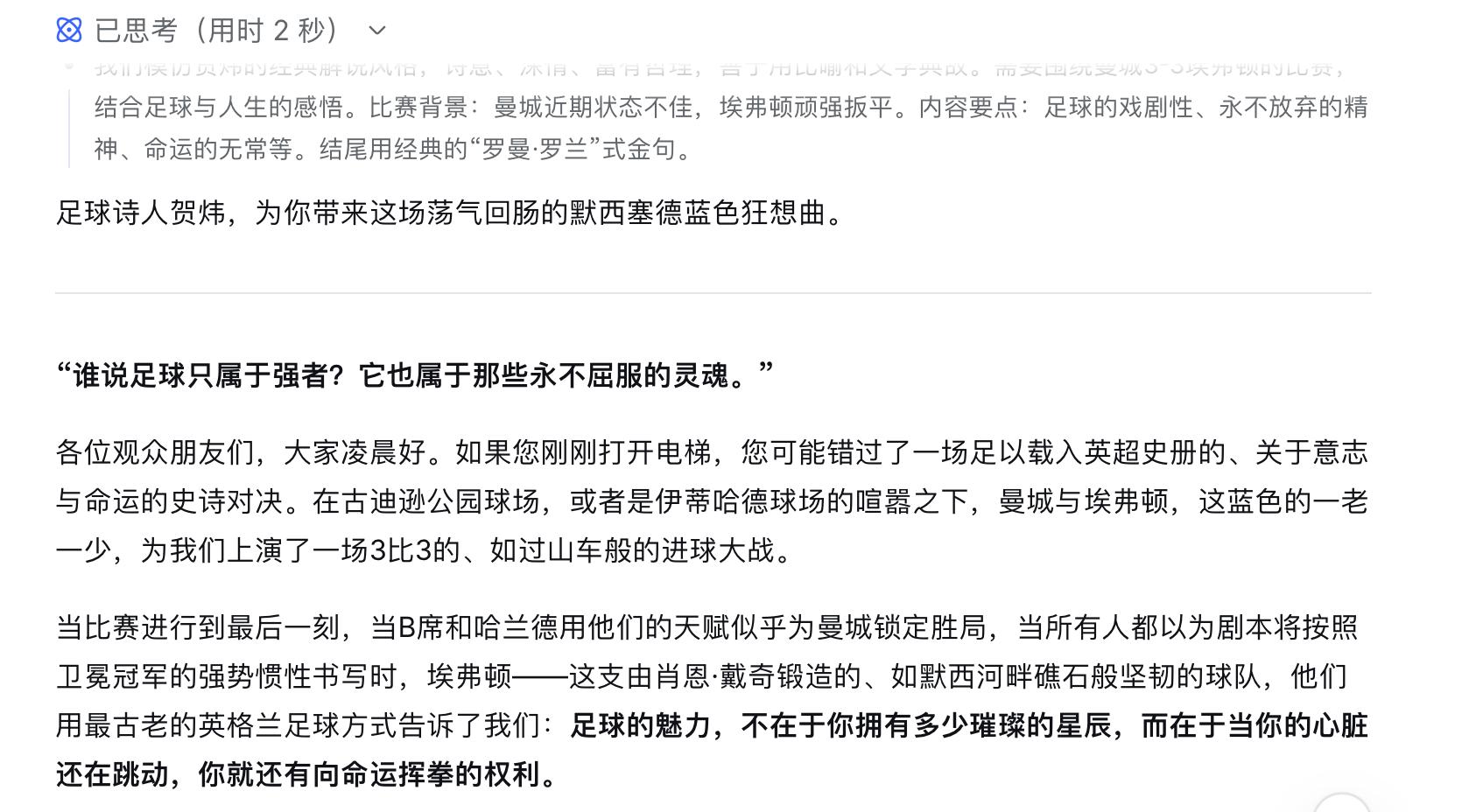
What's even more amazing is its efficiency. Within a few seconds after a goal is scored, AI can automatically complete the editing of multi - camera materials, add highlight special effects, and automatically adapt the frame and duration according to the attributes of different social platforms. At the same time, automatically generating game report highlights has become a basic operation. Most of the current mainstream large models can generate objective written game reports according to users' requirements and even imitate the tone of specific famous commentators to generate comment articles with emotional colors.
(Image source: DeepSeek)
In terms of multi - language broadcasting, the accuracy of AI simultaneous interpretation has reached a very high level. Now, using AI voice cloning and real - time translation technology, the broadcasting platform can instantly convert the on - site official English commentary into dozens of languages with low latency and even retain the emotions of the original commentator, which largely eliminates the language barrier for the global dissemination of World Cup content.
On the viewer side, the threshold for UGC content will be continuously lowered. When AI tools are made available to ordinary users, the dissemination form of the World Cup will completely become fragmented and diversified.
If short - video platforms obtain the broadcasting rights, they will probably embed powerful AIGC video creation tools. Platforms such as Douyin and Kuaishou all have their own video generation models.

(Image source: Leitech, produced with Seedance 2.0)
Fans are no longer just consumers of content but also creators. Users only need to enter a sentence on their mobile phones like "Help me generate a well - timed mixed - cut video of all the ball - touching moments of XX star player in this game", and the short - video platform embedded with a large AI model can call the copyright library materials to generate a high - quality short video within a few seconds.
This significantly lowers the threshold for UGC (User - Generated Content) production, which means that the content related to the World Cup will present various forms, and more ordinary users can participate in content production. A large amount of highly customized content will spread exponentially on social networks like a virus and will completely squeeze out the value of the long - tail traffic of the event.
Our experience of watching football games is being subverted by AI
No matter how the broadcasting technology develops, most fans still watch the World Cup in front of the screen. However, in the AI era, the concept of this screen and the interactive relationship inside and outside the screen are being completely subverted.
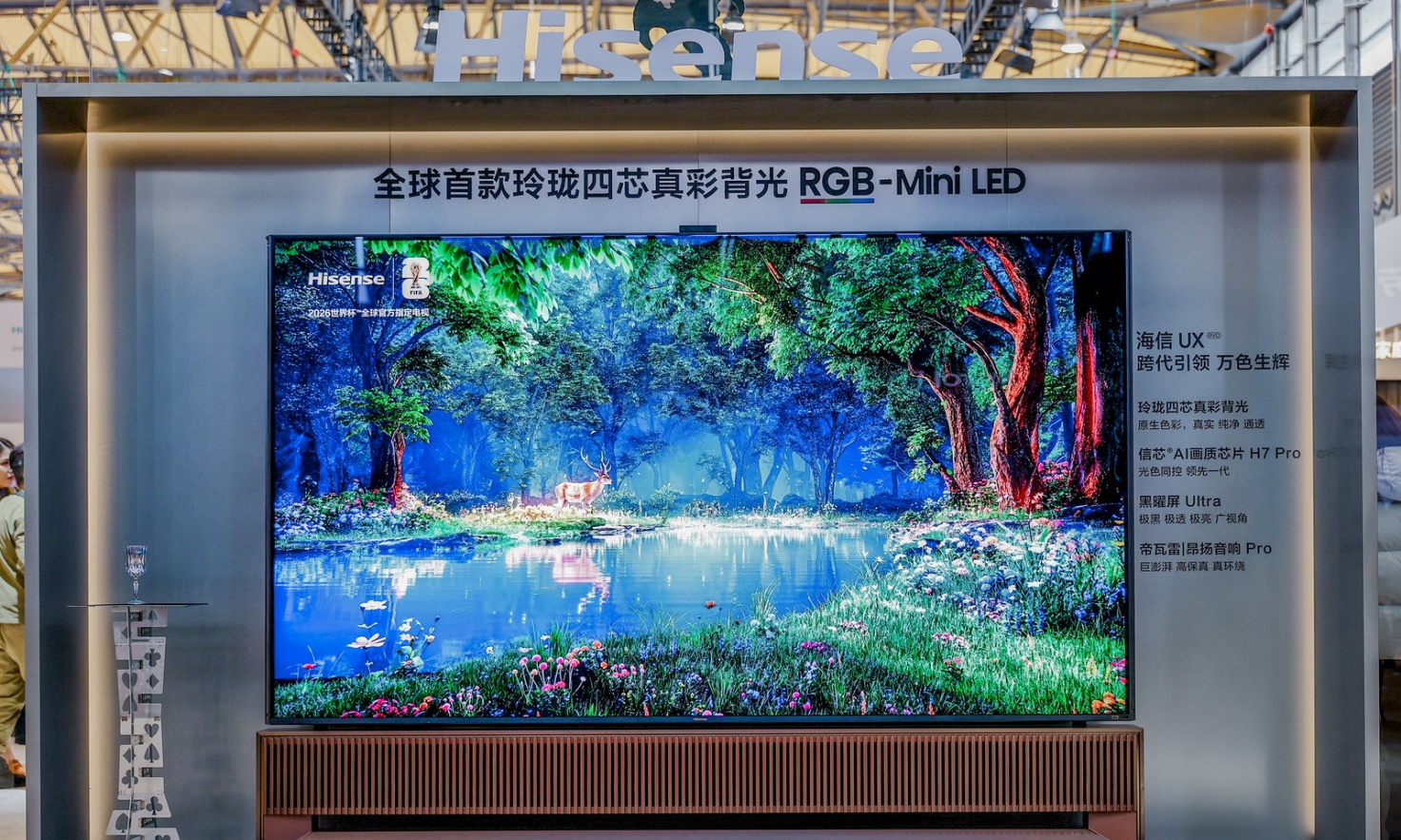
In terms of display devices, Chinese home appliance giants have always been the protagonists on the World Cup stage. Sponsors represented by Hisense are using AI technology to redefine the TV for watching games.
The AI RGB TVs strongly promoted by giants such as Hisense are not just simple panel upgrades but have built - in AI image - quality chips. It can enhance the image quality of the broadcast picture at the pixel level in real - time locally by deeply learning a large amount of football game materials. Whether it is eliminating the trailing shadows of the football during high - speed movement, sharpening the details of the turf texture, or adjusting the highlight dynamic range of the players' faces when they are sweating, AI can complete the processing within milliseconds, bringing a stronger sense of on - site presence.
(Image source: Hisense)
Moreover, the maturity of spatial computing devices (such as various AR/MR/AI smart glasses with viewing functions) will completely break the limitation of the physical screen. Fans can see a hundred - inch giant screen by wearing lightweight smart glasses and can also switch between different viewing perspectives in the air with gestures. This multi - perspective, holographic immersive experience allows fans on the sofa to have a richer viewing dimension than those on - site.

(Image source: TCL)
At the same time, watching football is no longer a passive reception, and fans can have two - way interaction.
The upgrade of hardware is just a carrier. The real subversion brought by the large model lies in the change of the viewing experience. In the past, watching football was one - way - the commentator said something, and the audience listened. When the audience didn't understand something, they had to look up information by themselves.
In the AI era, each fan will have a World Cup AI assistant. The AI assistant embedded in the broadcast APP or smart TV system changes the way users obtain information and can play a role in many scenarios:
- Real - time encyclopedia and tactical analysis: Don't understand the complex offside rules? Want to know the background of a substitute player from a less - known national team? In an ideal state, just ask the voice assistant, and the large model will instantly combine the current game picture to popularize knowledge for the audience.
- Big - data game prediction: Combining historical football game data, real - time weather, and players' physical running distances, the predictive AI can provide fans with real - time changes in the probability of victory or defeat and even specific score trend predictions, adding more fun to watching the games.
- AI commentary companionship while watching: For fans watching the game alone, the sense of loneliness will be dispelled by AI. The broadcasting platform can not only provide AI commentaries in various styles but also realize real - time dialogue interaction. The AI commentator will immediately answer users' questions during the broadcast, as if a real football - savvy friend is watching the game with you.
AI is taking over competitive sports comprehensively
In fact, the AI - enabled World Cup in the United States, Canada, and Mexico is just an example of AI sweeping across the global competitive sports industry. If we look further, we will find that AI has already been bound to other top - level events.
On the stage of the Olympic Games, AI is rewriting the rules of scoring and training. For example, in events such as gymnastics and diving that highly rely on the subjective scoring of referees, the AI - assisted scoring system based on computer vision has begun to be applied regularly, more accurately capturing the athletes' movements in the air and reducing human bias to a greater extent.
In Formula 1 racing, known as the world's fastest laboratory, AI also plays an important role. The AI algorithms provided by giants such as AWS process the massive data returned by hundreds of sensors on the racing car every second. The racing teams use large models to conduct aerodynamic simulations, predict tire wear curves, and calculate the optimal pit - stop strategy through AI based on the real - time situation of the track and the dynamics of opponents.
