Observation of the Norwegian car market: Fuel-powered vehicles are almost out, and Chinese brands have entered the mainstream battlefield
While consumers in most global auto markets are still weighing between gasoline and electric vehicles or hesitating due to charging infrastructure and battery costs, Norway has provided the clearest answer with a set of achievements.
The latest data from the Norwegian Road Traffic Information Council (OFV) shows that in March 2026, the registration of new passenger cars in Norway increased by 32.9% year-on-year. Electric vehicles accounted for 98.4%, setting a new monthly record and breaking the previous record of 98.3% set in September 2025. Only 22 gasoline cars and 126 diesel cars were registered in March, which is rare even in Norway, a leader in electrification.
However, behind the almost "all-electric" new car market in Norway, a large-scale pattern change is taking place: the market position of traditional European brands is being rapidly eroded, while Chinese brands are entering the mainstream competition matrix at an unprecedented speed. This is not only a story about Norway but also a preview of the electrification transformation across Europe.
Electric vehicles accounted for 98.4% in March, and fuel vehicles are almost out of the market
Norway's electrification process has entered the "final stage" from the "acceleration stage". In the first quarter of 2026, a total of 27,175 new passenger cars were registered in Norway, of which electric vehicles accounted for 97.9%. This means that in the first three months of this year, there were only 558 non-electric passenger cars newly registered in the whole of Norway, compared with 2,606 in the same period last year.
It is worth noting that the wave of electrification is not limited to the new car market. In March, the share of electric vehicles in the second-hand car market increased from 24.4% last year to 32.2%; the share of electric vehicles in the second-hand van market also doubled from 4% to 8%. The commercial vehicle sector is also accelerating: electric trucks accounted for 51.6% in March, and the share of electric lorries increased from 19% in the same period last year to 22.2%. Norway is moving from "all-electric new cars" to "full fleet electrification". The consumption radius of electric vehicles is expanding, and the market maturity is further improving.
The share of European brands is shrinking, while Tesla and Chinese brands are rising
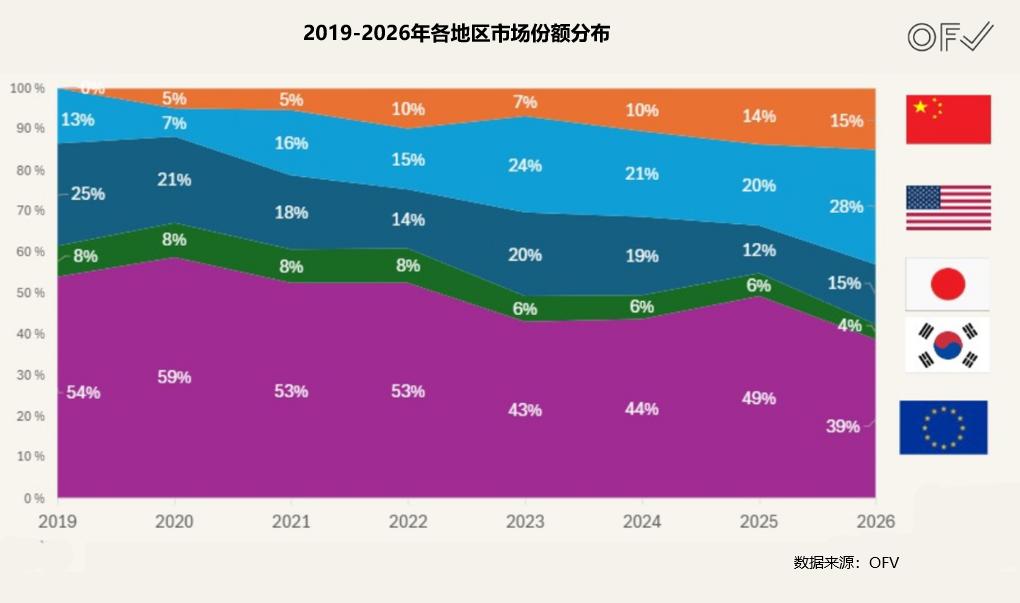
The quarterly data from OFV shows that the market share of European car brands in Norway has been continuously declining:
It dropped from 54% in 2019 to 38.7% in the first quarter of 2026. Just from the first quarter of 2025 to the first quarter of 2026, it fell from 49.6% to 38.7%. Some traditional European brands have seen significant declines in both the number of registrations and market share, and European automakers are currently at a disadvantage.
The market lost by European brands is being filled by Tesla and Chinese brands. In March, Tesla led the brand list with a 34.8% market share. The single-month sales of Model Y reached 4,288, accounting for nearly a quarter of the entire market.
The performance of Chinese brands is also worthy of attention. Their market share has increased from almost zero in 2019 to 14.9% in the first quarter of 2026. In 2025, Chinese brands sold a total of 24,524 new cars in Norway, accounting for 13.7%, a 3.3-percentage-point increase compared with 2024. The share in December alone climbed to 17%. Geir Inge Stokke, the director of OFV, believes that Chinese automakers are quickly becoming an important part of the Norwegian market by launching competitive electric vehicle models in key market segments.
Meanwhile, the market share of Chinese car brands has exceeded that of Japan (14.7%) and South Korea (3.7%), making them the third-largest car category after Europe (39%) and the United States (28%), and truly entering the mainstream competition matrix.
Focus on March data: BYD, XPeng, and Zeekr lead the Chinese contingent
Focusing on the performance of Chinese automakers, in the Norwegian new car market in March, Chinese brands sold approximately 1,920 vehicles in total, accounting for 10.8%. However, their growth rate far exceeded the market average:
BYD ranked first among Chinese brands with 782 vehicles sold, with a year-on-year growth rate of up to 139%. Its market share rose to 4.4%. The Sealion 7 delivered 476 vehicles in a single month and entered the top ten list of vehicle sales in Norway.
XPeng sold 460 vehicles, a year-on-year increase of 62.5%, and entered the top ten list of brand sales in Norway.
Zeekr sold 308 vehicles, a year-on-year surge of nearly 389%, demonstrating strong market explosive power.
MG, one of the earliest Chinese brands to enter Norway, sold 210 vehicles in March, but its sales declined by 50.2% year-on-year. With the influx of new brands, its market share is under pressure of reallocation.
Chinese brands had a cumulative sales volume of 3,229 vehicles in the first quarter, accounting for 11.8%. From BYD's doubling growth to the high growth rates of new players like XPeng and Zeekr, Chinese brands have formed a diversified product matrix from entry-level to high-end in the Norwegian market, accelerating their entry into the Norwegian market space.
Norway's rapid electrification benefits from the absence of domestic automakers to protect, no tariff barriers for the popularization of electric vehicles, and the highest density of charging infrastructure in Europe. Some industry insiders call Norway the "European electric vehicle laboratory". Any success or failure of a brand here will be a harbinger for other European markets.
Chinese automakers operating in Norway already have the strength to compete with international brands. However, they need to be vigilant against Tesla's strong position and possible policy counterattacks from European brands. In addition, they should quickly layout the second-hand car and after-sales service systems. The electrification of new cars in Norway is almost complete, and the share of electric vehicles in the second-hand car market is rising rapidly. Maintaining a healthy second-hand car residual value and establishing a local repair and recycling network will determine whether a brand can form a long-term sustainable user base in Norway and use it as a springboard to enter the Nordic and broader European markets.
This article is from the WeChat official account "Automotive Market Insights". Author: Automotive Market Insights. Republished by 36Kr with permission.