Observations from the Beijing Auto Show: AI is Grabbing the Steering Wheel
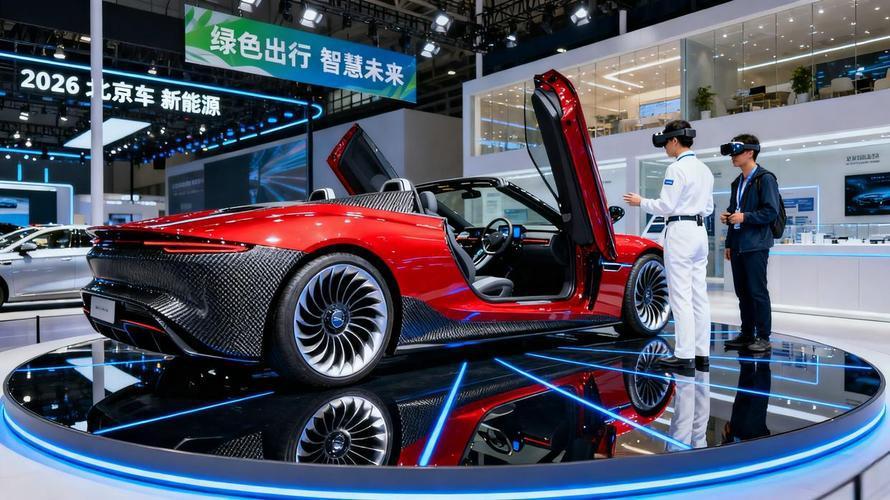
In April in Beijing, there is still a lingering chill in the air at the end of spring. However, outside the east gate of the Shunyi Hall, a long queue has formed - not of spectators, but of the media. There is still an hour before the official opening of the 2026 Beijing International Auto Show, and a waiting line hundreds of meters long has snaked out in front of the registration channel.
This is the first time in the more than thirty - year history of the Beijing Auto Show that two halls are used in tandem: between the Shunyi Hall and the Capital International Convention and Exhibition Center, shuttle buses run every three minutes, and the drivers' walkie - talkies are constantly transmitting the instruction "depart as soon as full".
The exhibition area covers 380,000 square meters, with 1,451 exhibition vehicles - among them, 181 have never been unveiled, and 71 only exist in concept.
A German journalist who has attended the Beijing Auto Show for twelve consecutive sessions sighed to his colleagues at the security checkpoint: "Ten years ago when I came here, I was watching how they copied; now I'm here to see how they define."
The "definition" he mentioned is hidden in the theme of this year's auto show.
In 2024, the theme was "New Automobiles"; in 2026, it became "Intelligent Future".
Behind the change of two characters is a silent power shift: the pattern of the first half of electrification is set, and the starting gun for the second half of intelligentization has been fired in Beijing.
Large AI models are being mass - installed in cars, and L3 - level autonomous driving has changed from a concept on the display board to a mass - producible commodity. The global automotive industry's vane is deviating from Detroit, Wolfsburg, and Nagoya and shifting to Beijing like never before.
AI in Cars and the Computing Power Arms Race
When entering this year's auto show, the most intuitive feeling is that labels such as "AI", "Large Model", "L3", and "Integrated Cockpit and Driving System" are everywhere on the display boards. It seems that car companies are collectively "transforming" into AI technology companies.
Oliver Blume, Chairman of the Board of Management of Volkswagen Group, clearly stated: "After the popularization of electrification and advanced driving assistance functions, we are entering a new era where intelligent AI fully empowers automobiles."
Volkswagen Group officially released the technical roadmap of "Global Intelligent AI" at the auto show and announced that starting from the second half of 2026, all new models based on the CEA electronic and electrical architecture will be equipped with in - vehicle AI intelligent agents, using locally trained large language models as the core of natural language interaction.
BMW is also actively embracing the local AI ecosystem, integrating Alibaba and DeepSeek large models with the HarmonyOS ecosystem.
In contrast, Chinese car companies are more radical in the wave of AI transformation.
The XPeng Group, which participated in the exhibition with the theme of "AI Changes the World", made its debut as a "Physical AI Technology Company" for the first time. He Xiaopeng, Chairman of XPeng Motors, predicted in his speech that the ultimate form of future cars will revolve around "more intelligent, safer, and more comfortable", and the in - depth integration of safety and intelligence will ultimately promote the arrival of the era of full - scale autonomous driving.
Lu Fang, Chairman of VOYAH, even said bluntly: "AI will restructure or subvert the automotive industry because future cars will definitely be products deeply integrated with AI. Once integrated, the product structure, organization, and even the business model will change. This is an inevitable trend."
Zhao Chunzhang of Ries Strategy Consulting made a more incisive judgment. From electrification to intelligentization, the core variables are actually large AI models and AI capabilities. "Car companies that do not transform quickly in this process are doomed to be eliminated." The core technological highlights of this year's auto show, from the central computing platform, physical AI embodied intelligence, to multi - modal large models and automotive - grade computing power systems, are all deeply bound to "intelligence". The auto show is no longer just a showcase for car models, but also a global vane for AI technology routes and business logic.
Judging from the content displayed by each brand, "AI in cars" is not just a slogan, but is implemented into actual products through specific computing power figures. If you walk a few more steps in the exhibition hall, you will find that what really excites engineers and silences opponents is hidden in the parameter list.
The Li L9 Livis made its global debut. It is equipped with 2 self - developed 5nm "Mach 100" chips, with a comprehensive computing power of 2560 TOPS, and is priced at 559,800 yuan.
The NIO ES9 is equipped with a self - developed Shenji chip, with a computing power of over 1000 TOPS, and the pre - sale price starts at 528,000 yuan.
The XPeng GX is even more exaggerated. It is equipped with 4 self - developed Turing AI chips, with a local effective computing power of 3000 TOPS, and the pre - sale price is only 399,800 yuan. It is known as "China's first full - stack self - developed pre - installed mass - produced Robotaxi prototype vehicle".
Geely is not to be outdone. Its first native Robotaxi, the "Eva Cab", integrates three chips from NVIDIA, Thor U, and Qualcomm at the same time, and the total computing power also exceeds 3000 TOPS.
Brands not satisfied with just stacking computing power are also promoting the implementation of L3 road tests. Just a few days before the opening of the auto show, the Qijing GT7 jointly developed by Huawei Qiankun and GAC officially obtained the permit for L3 - level conditional autonomous driving road tests in Guangzhou, becoming the first hunting - style vehicle of Chinese brands to be approved for such tests.
This intelligent hunting - style vehicle equipped with an 896 - line dual - optical - path image - level lidar will conduct a one - year L3 - level autonomous driving test on 10 expressways such as the first phase of the Congpu Expressway and the Nansha Port Expressway. This means that the L3 concept, which was still being repeatedly discussed on the display board in 2019, is now running on the open expressways in Guangzhou at this auto show.
Zhang Xiang, a researcher at the Automotive Industry Innovation Research Center of North China University of Technology, pointed out that it is a major trend in the intelligent upgrade of new models at this Beijing Auto Show that some brands replace imported chips with self - developed chips and implement them first in high - end models. The "coincidence" that all three "9 - series" large six - seat SUV flagship models - the NIO ES9, the Li L9 Livis, and the XPeng GX - are equipped with self - developed chips even declares that "self - developed chips" have become the basic configuration for leading car companies to compete in intelligentization.
The stacking of computing power is the surface phenomenon we can see. What really determines the outcome is integrating the intelligent cockpit and intelligent driving systems into the same computing platform - what the industry calls "integrated cockpit and driving system".
Horizon released the world's first mass - production solution at this auto show: the "Xingkong" chip plus the operating system "Kakaxia™", China's first vehicle - level intelligent agent operating system, which can simultaneously dispatch intelligent driving and intelligent cockpit with a single natural language command.
Cui Dongshu, Secretary - General of the China Passenger Car Association, summarized this auto show in four words: "Pattern reshaping, technological breakthrough, path differentiation, and configuration involution."
He is right, but he missed a more direct feeling: Standing in Beijing in April 2026, you can't smell gasoline, you can't hear the roar of the engine, but you can hear the chips calculating and see AI grabbing the steering wheel.
Cars are becoming "mobile AI terminals". And the referee of this game has just entered the arena.
A Battle with No Retreat
At this year's auto show, domestic brands showed their full - brand line - up in a "hall - exclusive" manner - BYD occupied Hall E3 exclusively, Chery took over Hall E1, and new forces such as NIO, XPeng, Li Auto, and Xiaomi concentrated on releasing new - generation flagship models and full - stack intelligent solutions. Their technological strength and product competitiveness are comprehensively comparable to or even surpass those of international luxury brands.
Cui Dongshu, Secretary - General of the Passenger Car Market Information Joint Conference, pointed out the essence: "Clustering to launch large - scale high - end new cars is the core strategy for domestic brands to penetrate the high - profit market and achieve brand up - grading."
The Li L9 Livis, NIO ES9, XPeng GX, new - generation Wenjie M9, Leapmotor D19, BYD Datang, and Wei brand V9X were all unveiled at this auto show. Chinese brands clustering in the flagship - level SUV market has become one of the most prominent industry features of this auto show.
BYD not only launched the "Ocean 8 Series" double - flagships, the Seal 08 and the Sea Lion 08, at a price range of over 300,000 - 350,000 yuan - the world's first vehicle series with flash - charging technology as standard across the board, but also demonstrated cutting - edge technologies such as megawatt flash - charging and all - solid - state batteries on its booth.
The Huawei ecosystem was presented in a cluster form. The "Five Realms" of Hongmeng Smart Mobility were fully displayed, and multiple deeply - empowered cooperative models were grouped for display. The total area of the booth exceeded 4,400 square meters, and there were more than 20 planned exhibition vehicles, making it one of the largest formations at this auto show.
Three Huawei - affiliated sedans, the Shangjie Z7, Qijing GT7, and Avita 06T, made simultaneous efforts. The Shangjie Z7 received over 80,000 cumulative orders in less than a week after its launch, the Qijing GT7 received over 20,000 orders in 3 days of blind - booking, and the Avita 06T received over 12,000 orders in 12 hours of pre - sale. Behind these figures is the huge market appeal of the Huawei technology ecosystem.
But joint - venture brands are not going to back down.
Oliver Zipse, Chairman of BMW Group, said firmly at the press conference: "China is the core market for BMW's global transformation." On the screen behind him were the long - wheelbase versions of the new - generation iX3 and i3 - built on an exclusive pure - electric platform, completely saying goodbye to the "gasoline - to - electric" conversion, with a CLTC comprehensive range exceeding 900 kilometers.
It is worth noting that BMW's intelligent driving system was jointly developed with Momenta and is specifically designed for China's complex traffic environment, covering all scenarios including urban, highway, and parking. Now, more than 60 exhibition vehicles are equipped with Momenta's intelligent driving solutions. Audi will also be the first to apply Momenta's L3 - level autonomous driving mass - production capabilities in the E7X model.
What does this mean? The localization cooperation of multinational brands has moved from the primary stage of "adapting to Chinese users' habits" to the high - level battlefield of "in - depth co - research of core technologies".
BMW has not only built one of the world's largest R & D centers in Shenyang (with over 3,000 engineers), but also introduced Alibaba and DeepSeek large models to create an intelligent cockpit that better understands Chinese users.
A detail can illustrate the point well: In the intelligent cockpit experience area of the BMW booth, an engineer said in Chinese, "Navigate to the nearest non - spicy restaurant", and the system provided three routes within two seconds, while automatically lowering the air - conditioning temperature and playing soft music.
Yes, things are different now.
In the past few years, the narrative in the public opinion field has always been "domestic cars are leading, and joint - venture cars are on the defensive", but the clear signal sent by this Beijing Auto Show is that joint - venture car companies have started a full - scale counter - attack, and this counter - attack is not just empty talk, but a head - on confrontation of products and technologies.
The Whistle of the Elimination Round and the Ultimate Referee
At the "Roots · Trends" themed forum held during the Beijing Auto Show, Li Bin, founder of NIO, made a key judgment: Chinese car brands are entering a relatively long convergence period. Under the homogeneous competition of products, car companies have entered an era of comprehensive system - ability competition.
Li Bin frankly said, "It can be said that we are now in the finals. The situation of the industry will become clearer and clearer, and I hope NIO can still stay in the game."
Zhu Jiangming, Chairman of Leapmotor, judged: "China can't accommodate 17 car companies."
Zhu Huarong, Chairman of Changan Automobile, provided more specific data: By 2030, an annual sales volume of 3 million vehicles is the minimum threshold for car companies to survive.
In other words, among the brands that displayed 1,451 exhibition vehicles in the exhibition hall today, the vast majority will be eliminated in four years. This is not alarmist talk; it is the "consensus" that the industry leaders repeatedly mentioned to their peers and the media at the forum.
"Convergence period" and "system strength" have replaced "price war" as the gloomiest and most sober keywords of this auto show.
What does convergence mean? It means that products can no longer survive by simply competing on parameters and configurations.
He Xiaopeng, Chairman of XPeng Motors, gave a direction in another dialogue: The future iteration of cars will no longer rely on high - frequency hardware innovation and model replacement, but more on software and digital OTA upgrades to improve product capabilities.
He even said bluntly, "Reducing the product iteration speed is one of the important current measures." When this statement comes from a new force once known for its "speed", it is a signal in itself.
On the other side of the convergence period, there is a subtle shift in the consumption pattern.
At this auto show, we can hardly see the marketing slogans like "whose screen is bigger, whose refrigerator is more" a few years ago. Instead, words like AI intelligent agents, L3 - level autonomous driving, and urban pilot assistance... These once - distant terms are now printed at the top of every display board.
Consumers no longer ask, "How many speakers does this car have", but instead ask, "Can its autonomous driving drive into the underground garage of my community by itself?"
Obviously, cars are changing from a "collection of configurations" to "mobile AI terminals". When the basic pattern of electrification is firmly established, and when computing power and large AI models become the new weapons for the "second half", the Beijing Auto Show has sent a clear and cold signal to the world that the rules of the game have changed.
In the next era defined by Chinese car companies, the standards are no longer horsepower and torque, but safety, wisdom, practical quality, and ultimate user experience.
In this once - in - a - century industrial reshuffle, Chinese brands are leading the standards with technological confidence, and multinational car companies are embracing the Chinese market and supply chain with unprecedented openness.
The test of future competition lies in who can deeply cultivate product experience under the pressure of intelligent capital and innovation, reduce costs, and ultimately truly impress users in the intelligent era with practical products. Only those who can do this can survive in the cruel "convergence period" and lead the real future.
* The pictures are from the Internet. Please contact us for deletion if there is any infringement.
This article is from the WeChat official account "Insight New Research Society" (ID: DJXYS - 0309), written by Chen Wen, and is published by 36Kr with permission.