There are 40 days left until the college entrance examination. Note that these majors are being recruited for the first time this year.
On April 28, the Ministry of Education released the Catalogue of Undergraduate Majors in Regular Institutions of Higher Learning (2026).
This catalogue is guided by scientific and technological innovation, industrial development, and national strategic needs. It adds a new category of "Interdisciplinary Sciences" and introduces 38 new undergraduate majors in regular institutions of higher learning. Currently, the catalogue of undergraduate majors covers 13 categories, 92 major groups, and 883 majors.
It is understood that institutions of higher learning approved to offer these majors can include them in the college entrance examination enrollment in 2026. Universities such as the University of Science and Technology of China, Tianjin University, Harbin Institute of Technology, China University of Mining and Technology, Dalian University of Technology, and University of Jinan have officially announced the approved majors.
The release of this new major catalogue is also an important manifestation of "optimizing undergraduate education and expanding enrollment". At the Two Sessions in 2026, "continuously expanding the enrollment scale of high - quality undergraduate education" was written into the government work report, marking that China's higher education development is moving from a stage dominated by scale expansion to a new stage centered on structural optimization and quality improvement.
The adjustment of the major catalogue is the practical implementation of this transformation in talent cultivation.
Adding the Category of "Interdisciplinary Sciences" to Meet the Development Needs of Emerging Fields
In order to strengthen the coordinated linkage of discipline and major catalogues, promote the organic connection and vertical integration between the undergraduate major catalogue and the postgraduate education discipline and major catalogue, and better meet the development needs of emerging interdisciplinary disciplines and the cultivation needs of compound talents, the Catalogue of Undergraduate Majors in Regular Institutions of Higher Learning (2026) adds the category of "Interdisciplinary Sciences" and includes 15 majors in this category for the first batch.
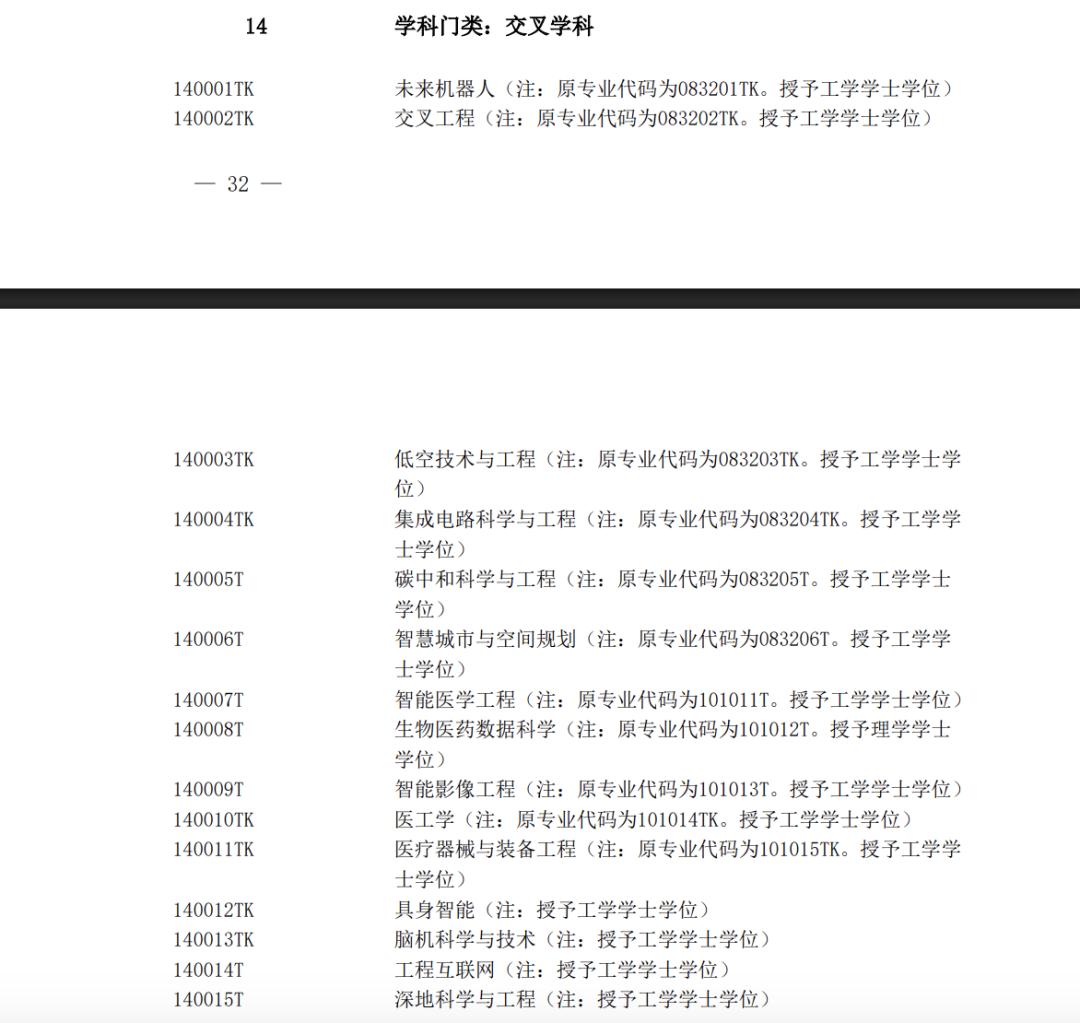
These 15 majors include 11 existing majors in the catalogue such as Future Robotics, Interdisciplinary Engineering, and Low - Altitude Technology and Engineering, as well as 4 new majors included in the catalogue this time, such as Embodied Intelligence, Brain - Computer Science and Technology, Engineering Internet, and Deep - Earth Science and Engineering.
This means that interdisciplinary disciplines are no longer exclusive to the postgraduate stage, but are systematically planned from the undergraduate level.
This is also a crucial step in "optimizing the structure" of "optimizing undergraduate education and expanding enrollment": it is not simply increasing the enrollment quota, but opening up new cultivation tracks in emerging fields.
Previously, Minister of Education Huai Jinpeng revealed at a press conference on people's livelihood topics that this year, the construction of the National Interdisciplinary Science Center will be launched to further enhance the ability of original innovation supply and the cultivation of new - quality productive forces through breakthroughs in frontier interdisciplinary disciplines.
It is worth noting that among the newly added interdisciplinary majors, Tianjin University and Harbin Institute of Technology were approved to offer the new major of Brain - Computer Science and Technology this year and will start enrollment in 2026. This is the first undergraduate - oriented Brain - Computer Interface major in China.
Tianjin University started its layout in the field of brain - computer interface earlier. As early as the autumn semester of 2024, it offered the first brain - computer interface major direction in China and officially enrolled students through its Future Technology College; in 2025, it added the first first - level interdisciplinary doctoral program in "Brain - Computer Interface" in China.
As a disruptive frontier technology in the highest form of human - machine interaction, brain - computer interface integrates advanced theories and frontier technologies from multiple disciplines such as clinical medicine, neuroscience, artificial intelligence, electronic information, and integrated circuits. Its technology chain is long and it involves many integrated disciplines. Currently, there is a huge gap in relevant professional talents.
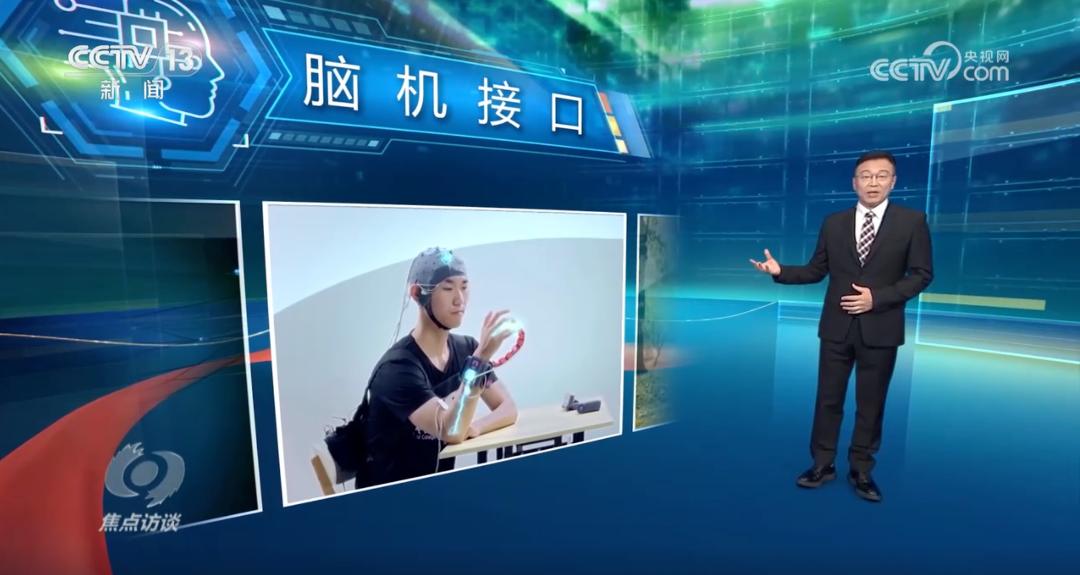
The "Shenggong - Lingxi Finger", the world's first wearable brain - controlled external limb system independently developed by the Brain - Computer Haihe Laboratory team of Tianjin University. Picture source: the official WeChat account of the university
In addition, other new interdisciplinary majors have also been implemented in many institutions of higher learning. Nine universities, including Beijing University of Posts and Telecommunications, Northeastern University, Shanghai Jiao Tong University, Zhejiang University, Xi'an Jiaotong University, Beihang University, Beijing Institute of Technology, Harbin Institute of Technology, and Nanjing University of Aeronautics and Astronautics, have added the new major of Embodied Intelligence; China University of Mining and Technology has added the new major of Deep - Earth Science and Engineering.
Adding 38 Majors, Canceling or Suspending More Than Ten Thousand Program Offerings, and the Adjustment Ratio Exceeds 10% for the First Time
According to statistics, during the "14th Five - Year Plan" period, institutions of higher learning across the country added 10,200 undergraduate major offerings and canceled or suspended 12,200. The scope of major adjustment has been continuously increasing, and the cumulative adjustment ratio has exceeded 30%. This year, the major adjustment ratio of institutions of higher learning across the country has exceeded 10% for the first time.
Against this background, the Ministry of Education has continued to promote the adjustment and optimization of major settings this year, guiding and supporting institutions of higher learning to actively add new majors that serve national strategies and the development needs of modern industries.
In response, a relevant person in charge of the Department of Higher Education of the Ministry of Education said that from the perspective of the external environment of institutions of higher learning, the adjustment of high - quality major settings should serve high - quality development. On the one hand, it should serve national strategic needs and enhance the contribution of higher education to the construction of a powerful country; on the other hand, it should serve the innovative development of industries and improve the adaptability of talent supply to development needs by adjusting and optimizing the discipline and major structure.
According to CCTV News, the Catalogue of Undergraduate Majors in Regular Institutions of Higher Learning in 2026 issued by the Ministry of Education adds a total of 38 undergraduate majors. These majors are mainly distributed in the following five directions:
Precisely meet national strategic needs by adding majors such as Energy Science and Engineering and Deep - Earth Science and Engineering;
Support the optimization and upgrading of traditional industries by adding majors such as Transportation Energy Integration Engineering and Agricultural Robotics;
Promote the innovative development of emerging and future industries by adding majors such as Biological Manufacturing and Brain - Computer Science and Technology;
Based on the expansion and quality improvement of the service industry, add majors such as Digital Culture and Tourism and Business Artificial Intelligence;
Focus on creating a new form of intelligent economy by adding majors such as Digital Trade and Digital Finance.
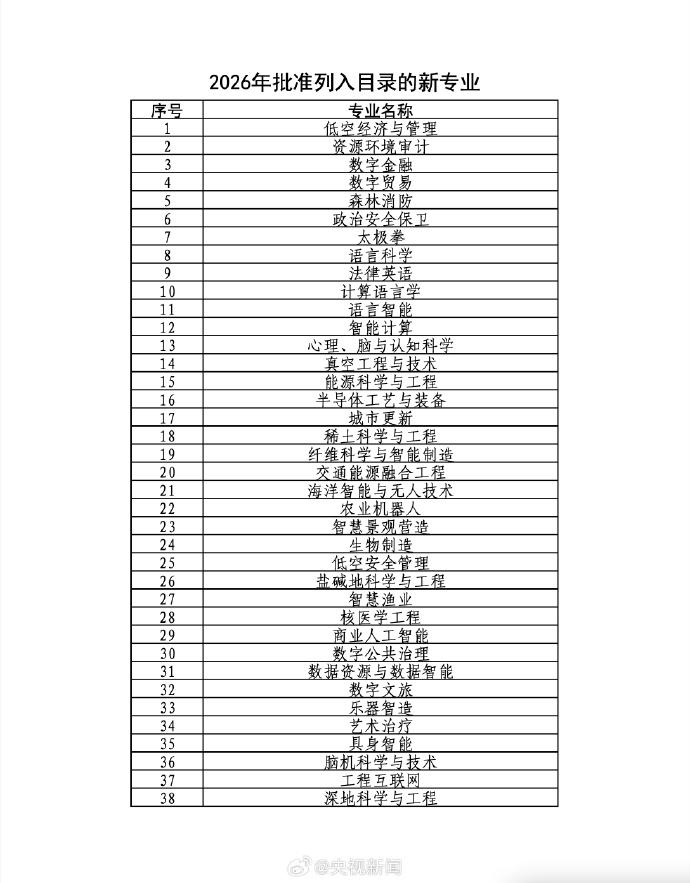
Take the major of Saline - Alkali Land Science and Engineering as an example. It was approved to be added by Shandong Agricultural University, which is committed to "turning barren beaches into fertile fields" and safeguarding national food security. There are 500 million mu of saline - alkali land in China that can be transformed into cultivated land, and this major is to train talents for this major task.
Shandong Agricultural University is a multi - disciplinary university with agricultural science as its advantage and life science as its characteristic, integrating agriculture, science, engineering, management, economics, liberal arts, law, art, and education. It is a university in Shandong Province that is striving to become a first - class university.
In addition, the Ministry of Education has carried out in - depth work to improve the matching degree between major settings and regional development, continuously improved the annual release mechanism of the guiding list of majors for priority development and postponed development at the provincial level, guided each province to make forward - looking judgments on the supply - demand relationship of local talents, and promoted each province to release the list of urgently needed majors and the list of major warnings covering 473 majors. Eight provincial - level administrative regions, including Heilongjiang, Zhejiang, and Chongqing, have piloted the work of improving the matching degree between major settings and regional development, and created 247 characteristic and advantageous major clusters.
"Wherever the industrial upgrading goes, the major layout follows." Cheng Shuang, the deputy director of the Department of Education of Heilongjiang Province, said that in response to the "Harbin Fever" in the past two years, Heilongjiang was the first in the country to add the major of "Ice and Snow Dance Performance" and at the same time cultivated frontier interdisciplinary directions such as "Ice and Snow Cultural Creativity" and "Ice and Snow Sports Tourism" to train compound talents in ice and snow culture and tourism, event performance, etc.
"The matter of major settings cannot be decided casually or blindly follow the trend." Cheng Shuang introduced that in recent years, Heilongjiang has focused on building a closed - loop mechanism of "data monitoring - intelligent analysis - dynamic regulation" to ensure that every addition, cancellation, or transformation of a major is supported by data and based on facts.
"In 2025, based on data analysis, we did not approve the addition of 21 majors and did not pre - approve 24 majors, mainly because the market was saturated or the school - running conditions were not yet mature."
It can be seen that "optimizing undergraduate education and expanding enrollment" is not only an increase in the number of majors but also a deep match between the major structure and regional development and industrial needs.
In the New Era, the Adjustment of Discipline and Major Settings in Institutions of Higher Learning Must Combine an Effective Market with an Active Government
From the establishment of the category of interdisciplinary sciences to the systematic layout of 38 new majors, the adjustment of the undergraduate major catalogue in 2026 is a vivid microcosm of the higher education reform centered on "optimizing undergraduate education and expanding enrollment" and with structural optimization and quality improvement as the core.
This is not only an active response to national strategies and market demands but also an important step for China's higher education to move towards a new stage of high - quality development.
On April 28, Lu Xiaozhong, a professor at South China Normal University and a specially - appointed professor of the Changjiang Scholars Program of the Ministry of Education, wrote an article in the Education Thought section of Guangming Daily, analyzing that the core logic of current discipline adjustment can be summarized as "reaching for the sky", "rooting on the ground", and "integration".
The so - called "reaching for the sky" means taking serving major strategic needs as the fundamental guideline and aiming at national urgent needs and technological frontiers. Specifically, it includes: adding discipline and major settings that serve major national strategies and have a sharp increase in short - term demand; adding emerging discipline and major settings facing the world's technological frontiers with uncertain demand; adding discipline and major settings with relatively stable talent demand.
The so - called "rooting on the ground" means taking responding to market demand as an important orientation and highly unifying the provision of high - quality talent support for industrial innovation and the high - quality employment of graduates. Specifically, it includes: developing characteristic discipline and major settings according to local conditions; developing popular discipline and major settings in a scientific and orderly manner; and improving the national big data platform for talent supply - demand docking according to the characteristics of industrial development and the actual needs of the labor market.
"Integration" means integrating the "reaching for the sky" and "rooting on the ground" strategies, promoting the effective embedding of discipline and major construction into the education chain, innovation chain, talent chain, and industrial chain. Strengthen the chain - type collaboration of disciplines and majors in institutions of higher learning, and establish a discipline and major adjustment mechanism that is compatible with the classification reform of institutions of higher learning. While promoting the layout and construction of basic, applied, and strategic discipline and major settings in a differentiated manner, strengthen the connection and docking between basic, applied, and strategic discipline and major settings that may exist among research - oriented, applied, and skill - oriented institutions of higher learning and within the same type of institutions of higher learning, and coordinate the layout of discipline and major settings at the undergraduate, postgraduate, and doctoral levels of the same discipline and major.
Lu Xiaozhong specifically pointed out that in the new era, the adjustment of discipline and major settings in institutions of higher learning must combine an effective market with an active government.
On the one hand, give full play to the effective role of the "invisible hand" of the market in resource allocation and develop an effective market that drives the adjustment of discipline and major settings in institutions of higher learning; on the other hand, give full play to the leading role of the "visible hand" of the government in the adjustment of discipline and major settings in institutions of higher learning, strengthen planning connection, policy coordination, resource coordination, and evaluation linkage, improve the strategic coordination and implementation mechanism of education, science and technology, and talents, and strengthen the organic connection of strategic goals, the integrated deployment of strategic tasks, and the coordinated implementation of policy measures.
He believes that an effective market and an active government complement each other: the effectiveness of the market in driving the adjustment of discipline and major settings in institutions of higher learning helps the government to make scientific plans and precise layouts at the macro - level; the government is good at using the "invisible hand" of the market to make market demand truly an effective market for driving the adjustment of discipline and major settings in institutions of higher learning.
This article is from the WeChat official account "Oak Laboratory", and the author is Xu Meijuan. It is published by 36Kr with authorization.