Lobster breaks into retail chains: How does Hikvision CloudEye Claw serve as a "digital employee"?
The management mode in the retail chain industry is beginning to take on new forms.
After the Spring Festival, "Lobster" (General Agent) has almost become one of the hottest keywords in the AI industry. From writing code and creating content to handling daily affairs, its capabilities in the To C scenario are constantly being verified. Many people are starting to expect that such capabilities can further enter enterprises to collaboratively handle business processes that require more flexibility.
But soon, a gap emerged.
The value of an individual "Lobster" cannot be realized in the enterprise scenario. For example, a store inspection process involves clear standards, role divisions, responsibility chains, and system constraints; a problem rectification needs to be recorded, tracked, and re - checked. A general agent can understand instructions, but it is difficult to directly integrate into these existing structures and take on the full responsibility of execution.
Therefore, what the retail chain industry needs is not just a few "Lobsters". Instead, it needs the ability to "do things stably, controllably, and connect with existing businesses".
This is also why general capabilities in enterprises often stay at the scenario and tool levels, and it is difficult to form truly AI - native applications. So, how can we fundamentally understand what changes "Lobster" can bring to enterprise applications?
On the basis of traditional rule - based enterprise applications, achieving flexibility through "Lobster" and realizing the part of agile applications that previously required a large amount of customization in an efficient and low - cost way through "Lobster", and realizing the transformation from digital tools to digital employees may be another path for the application of "Lobster" in enterprise applications today.
This is exactly the direction chosen by Hikvision's recently released CloudEye Claw. Based on years of experience in retail chain store management, it does not attempt to use a "universal assistant" to cover all scenarios. Instead, it integrates the multi - module capabilities of "Lobster" into the most core and complex management link of store inspection, enabling the system not only to understand tasks but also to undertake execution, close loops, and make flexible adjustments.
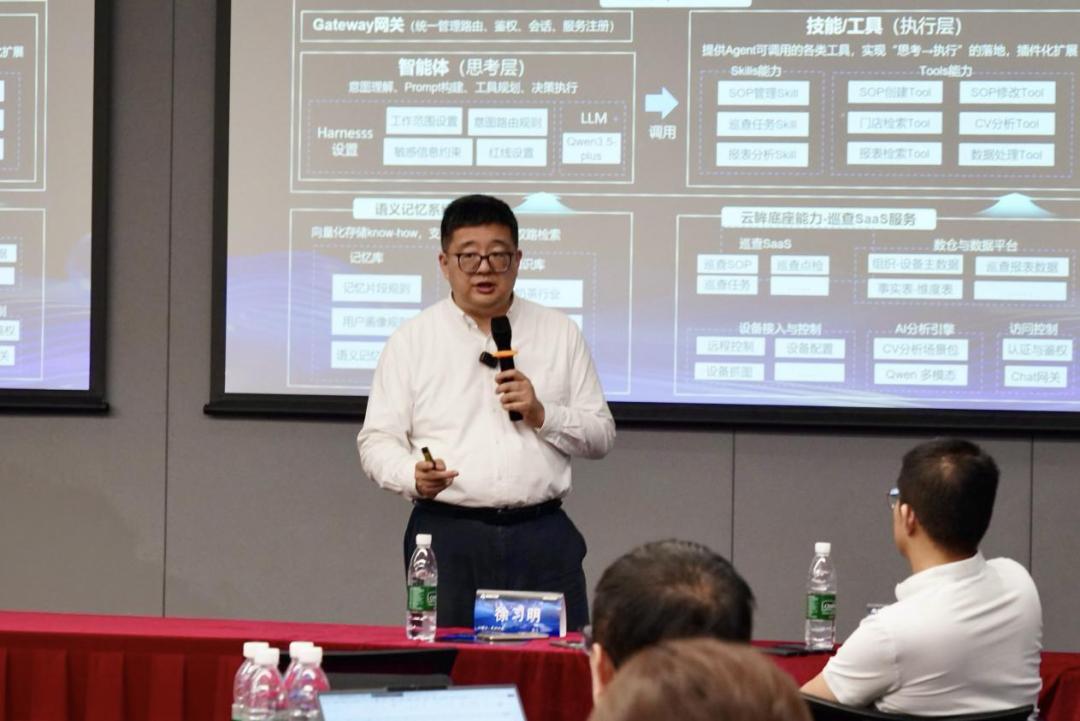
As Xu Ximing, the senior vice - president of Hikvision, said, "Lobster" aims to upgrade CloudEye from a digital tool to a digital employee, helping everyone to expand the scale, improve the quality and density of inspections, and reduce the management and change costs of single stores.
In this design, "Lobster" is no longer an ability floating outside the system but begins to become a "digital employee" that can participate in business operations. And this may be closer to a new form of human - machine collaboration in the To B scenario.
01
When Scale No Longer Equals Efficiency
From a more macroscopic perspective, the rapid development of the chain business model in China is closely related to the pattern of China's unified large market. Stores can be replicated across regions, the supply chain can be efficiently coordinated, and standards can be implemented on a large scale, which makes chain operation gradually become a high - efficiency organizational form.
However, scale brings not only efficiency but also an increase in management complexity. When the number of stores expands from dozens to thousands or even tens of thousands, how to maintain consistent standards in different cities, among different populations, and in different scenarios while having sufficient flexibility has become an unavoidable problem for retail chain enterprises.
In the past decade, the digital transformation of enterprises has been continuously promoted. Systems such as ERP, CRM, and SaaS have covered most of the business processes at the system level, and the capabilities of data recording, analysis, and decision - making have been continuously improved. IDC data shows that the global investment in digital transformation has been continuously increasing from about $1.5 trillion in 2022, and it is expected to exceed $3 trillion in 2026. Enterprises have hardly stopped investing in the system level.
However, outside these systems, on - site management has always been a management challenge. The experience, service, and delivery of offline retail are all completed offline. Standardization, normalization, and humanization offline are the keys to the success of offline retail.
In the retail chain industry, this problem is particularly prominent. Stores are scattered, scenarios are complex, and personnel flow is frequent. Management still relies on people to observe, record, and report. Front - line information needs to go through multiple levels of transmission and processing before it can enter the system. This means that although enterprises have accumulated a large amount of data, the first - hand information from the on - site is often not timely or complete enough. The traditional CloudEye chain has provided digital tools for the industry, and with the emergence of "Lobster", new possibilities have emerged.
The "Annual Trend White Paper of China's Chain Industry" shows that the growth rate of the chain industry has continued to slow down in the past few years, gradually shifting from scale - expansion - driven to efficiency - driven. A survey by the China Chain Store & Franchise Association also points out that more than 80% of enterprises are improving the output of single stores through store renovation rather than continuing to open a large number of new stores. The growth of the number of stores has slowed down, but the management complexity has continued to increase.
In this context, the value of the on - site has been further magnified. How to understand on - site data and transform it into management capabilities has gradually become the common direction of the retail chain industry.
CloudEye Claw is advancing along this path: based on video capabilities and the store inspection system, it continuously incorporates the on - site layer into the digital system, introduces collaborative intelligent execution capabilities into the existing processes, gradually forms a stable human - machine collaborative relationship, and digital employees officially start working.
02
Integrate "Lobster" into the Business Process
Before the emergence of CloudEye Claw, CloudEye had already accumulated a relatively mature capability system in chain store management: from visual - based store inspection, to the automatic recognition of displays, labels, and operation specifications, to the monitoring and reminder of abnormal behaviors, these capabilities make it possible to "see the on - site".
In 2017, Hikvision CloudEye was established. From then on, CloudEye bet on the informatization transformation of retail chain enterprises. "There were already similar players in the market at that time, and we also had in - depth exchanges with many people. Finally, we decided to do it ourselves because we judged that the biggest opportunity in this industry was AI intelligence." Xu Ximing recalled the original intention at that time: "Only by serving the industry end - to - end can we create value most efficiently."
A few years later, CloudEye has become the most important "ten - thousand - store brand" in the industry. Many leading brands are already CloudEye's customers, covering fields such as milk coffee, pharmacies, fast food, footwear and clothing, and general retail.
However, CloudEye is not satisfied with this. With the arrival of AI, especially after the emergence of "Lobster", the CloudEye team quickly sensed the change in the industry trend.
Therefore, on the basis of the existing system, CloudEye Claw introduces a new execution role - a "digital employee" that can understand instructions, dynamically schedule, and participate in business execution.
The previous systems solved the problem of process operation, while the new role focuses on another thing, that is, in the constantly changing store scenarios, whether management can keep up with the changes, and can dynamically combine and respond immediately within the existing capabilities according to the manager's instructions.
Flexibility is a combination of capabilities based on a clear set of constraints and engineering systems.
In the design of CloudEye Claw, the system first revolves around the actual roles in chain management - different identities such as headquarters, supervisors, store managers, and franchisees all correspond to clear responsibility boundaries and operation permissions. All instructions will first be restricted to the specific business context, only retaining the intentions related to store management, and then the tasks will be disassembled and executed, rather than processing irrelevant information like a general model. This constraint allows the system to maintain its understanding ability while avoiding deviating from the business itself and also reduces the usage cost for users.
At the execution level, the system does not directly call a general model but disassembles the instructions into a series of executable actions. For example, for stable - state requirements, the existing store inspection, analysis, and rectification capabilities are called. These capabilities come from the SOP system and inspection methods accumulated by CloudEye over the years and are organized into reusable "atomic skill modules" for dynamic combination and use in different scenarios. For agile - state changes, they are flexibly executed through the general large - model, "Lobster", and Skil, which can also improve the accuracy of user usage and reduce the usage cost.
In order to make this set of capabilities run stably in a large number of stores, the system also makes trade - offs in model and engineering implementation: it relies more on visual models and multi - modal capabilities optimized for store scenarios to strike a balance between cost and accuracy. For example, in some high - frequency scenarios, rapid recognition is first completed by a small model on the edge side, and then re - checked by a large model on the cloud side to ensure both low - cost large - scale deployment and control of the risk of misjudgment.
At the same time, the system will form a "memory" during continuous use. Under authorization and constraints, the system precipitates the store profile, task history, and management preferences of users and dynamically adjusts the execution strategy in subsequent tasks to make the results gradually meet the specific business needs.
Behind this ability is essentially an execution system based on industry experience and constrained by data and rules. It ensures the stability of management actions and leaves room for flexible response, making the system neither out of control nor rigid.
CloudEye Claw adds a more flexible layer of capabilities on top of the original system.
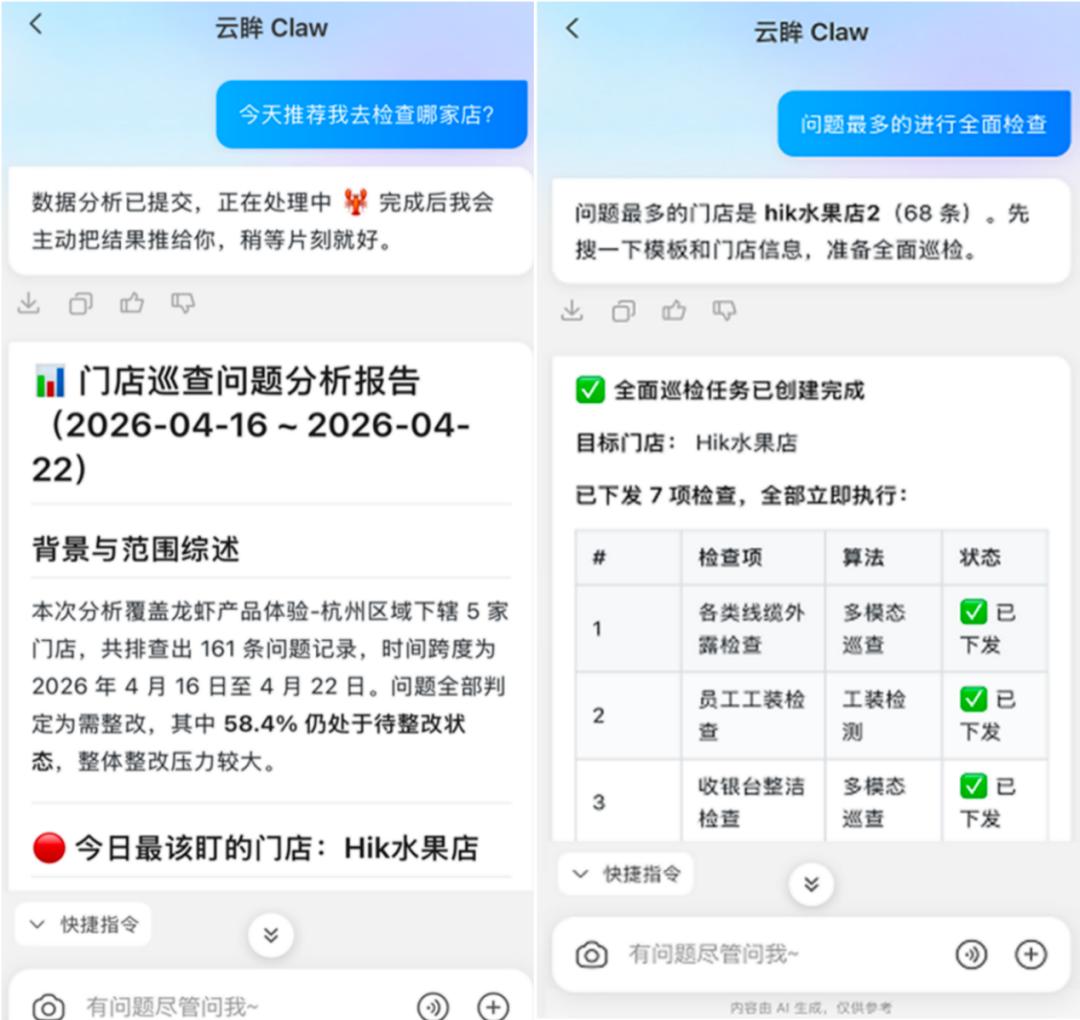
The most intuitive change comes from the interaction mode: in the past, store inspection relied on fixed processes and manual operations. Now, with just one sentence, the system can initiate a task and complete judgment and execution based on historical data and real - time status.
The key lies in having the ability of flexible scheduling - stably executing rules in standardized scenarios such as food safety and operation specifications, and dynamically adjusting the path in changing scenarios such as marketing activities, display adjustments, and store grouping, enabling management to switch naturally between the stable state and the agile state.
This change has also reshaped the management mode: the headquarters can directly obtain on - site information closer to real - time. The system continuously promotes inspection and rectification, and people are freed from repetitive execution and turn to judgment and decision - making. At the same time, data is naturally generated and precipitated during the business process, making the management foundation more real and continuous.
With these changes combined, the management mode in the retail chain industry is beginning to take on new forms.
03
Redefine the "Stable State" and "Agile State" of Management
From a broader perspective, the implementation of AI in enterprise scenarios has not been as smooth as expected in the past.
Compared with smarter tools, enterprises have always been concerned about "more stability and controllability". Once entering complex business processes, the uncertainty brought by general capabilities can easily magnify risks and weaken the reliability of the system itself.
For this reason, the value of AI on the enterprise side is more reflected in adding a new layer of capabilities on top of the existing system. And CloudEye Claw is a specific implementation in this direction.
In the retail chain industry, standardization has always been the foundation of management, which ensures the consistency and replicability of scale expansion. However, standardization also brings a long - standing contradiction: once the rules are solidified, the system tends to become rigid; once there are differential requirements, additional configuration or even re - development is often required.
The key premise for this ability to be established is that it does not attempt to replace the original system but clearly divides the ability boundaries.
As Xu Ximing said, "Lobster" does not solve all problems. It focuses on the "agile state" part of enterprise IT applications, while the "stable state" part still relies on the original IT system.
In the management process of retail chain enterprises, a large number of processes belong to the "stable state" - such as finance, supply chain, and basic operations. These links require a high degree of certainty and rely on the stable operation of the existing IT system. The other part belongs to the "agile state" - such as marketing activities, store grouping, and event marketing. These scenarios change frequently and rely more on flexible response.
CloudEye Claw focuses on the latter. It does not take over all systems but introduces schedulable execution capabilities in the most frequently changing and labor - dependent links, enabling management to obtain higher flexibility while maintaining stability.
As a result, chain management no longer has to choose between "strict execution" and "flexible adjustment" but begins to have both capabilities at the same time: one end is more solid and certain execution, and the other end is more flexible change response.
In this process, the relationship between "people" and the system is also changing.
CloudEye Claw does not attempt to replace people but undertakes the work at the execution level, freeing people from a large number of repetitive processes. The management still takes responsibility for judgment and decision - making but can promote management actions based on information closer to the on - site. Stores and supervisors are no longer led by the process but focus more on the problems themselves and business improvement.
From the perspective of the organizational structure, this means that a new layer begins to form within the enterprise: on top of the traditional system, there appears a layer of schedulable execution capabilities - a "digital employee" that is neither the same as a tool nor completely equivalent to a person.
In the retail chain industry, this change is particularly crucial. As the scale of stores expands, the core of competition is no longer just the ability to open stores but the ability to maintain stable and efficient management under high complexity. Those who can maintain standards and respond promptly in more stores and more complex scenarios are more likely to convert scale into efficiency.
When store inspection, rectification, and analysis gradually transform into system capabilities that can run continuously, the management radius of enterprises is also re - defined - the headquarters can reach the front - line more directly, differences between stores can be identified more quickly, and management actions can sink more timely.
Currently, this type of ability mainly serves "standardized operations", helping enterprises to reduce deviations and improve execution stability. But in the longer term, it may further extend to "business optimization" - not only ensuring no mistakes but also helping to identify opportunities and support more effective business operations.
This also means that the role of "digital employees" represented by CloudEye Claw is gradually evolving from an executor to a collaborative force closer to the business.
Xu Ximing said that the purpose of CloudEye Claw is to "improve quality, increase efficiency, and reduce costs for the retail chain industry and provide truly practical digital employees". There may be a new solution to the balance between scale and management in the retail chain industry.