Chinese cars are eyeing the US market covetously.
At the Beijing Auto Show, the CEO of Volkswagen personally stopped and listened in front of XPeng's booth. This scene symbolizes that the relationship between foreign automakers and Chinese automakers has undergone a huge change. Chinese automakers are continuously increasing their market share in Southeast Asia, Europe and other regions, but they have not truly entered the US market. There are signs of a breakthrough in this situation...
Chinese automakers' technological strength in cutting - edge fields is overwhelming their Japanese and European counterparts. Chinese cars use the advancedness of artificial intelligence (AI) and pure - electric vehicle (EV) charging technology as weapons to actively explore the world market. They are also eyeing the North American market, which was once considered a high - barrier market.
At the Beijing International Automobile Exhibition, which opened on April 24, around 3 p.m. that day, the booth of XPeng Motors, a rising star in the electric vehicle industry, welcomed Oliver Blume, the CEO of Volkswagen.
In front of XPeng's large SUV "GX", which is considered equivalent to the "Level L4" of autonomous driving, He Xiaopeng was giving an explanation, while Oliver Blume was listening attentively with a serious expression.
Volkswagen invested about 5% in XPeng Motors in 2023 to jointly develop EVs. The pure - electric model ID.UNYX08 released by Volkswagen on April 16 is equipped with two AI chips "Turing" developed by XPeng.
XPeng Motors has already applied the "E2E (end - to - end)" driving assistance technology, in which AI performs environmental perception and decision - making, to mass - produced models using the Turing chips. Volkswagen hopes to improve the performance of its own driving assistance system by introducing XPeng's technology.
As early as 1985, in accordance with the Chinese government's policy of cultivating the local auto industry, Volkswagen, as a foreign enterprise, was the first to establish a joint - venture company in China and has long led the development of the Chinese auto market.
After about 40 years, the fact that the top executive of a company personally stopped and listened in front of the booth of a Chinese emerging electric vehicle company founded in 2014 symbolizes that the relationship between foreign automakers and Chinese auto manufacturers has undergone a huge change.
The pattern of relying on the technology of local enterprises to a certain extent not only exists in Volkswagen but also in Japanese automakers such as Toyota and Nissan. GAC Group, which has joint - venture companies with Toyota and Honda, announced as early as 2023 that "the Chinese auto industry has entered the 'post - joint - venture era'". Three years later, this judgment has become even clearer, and the era of relying on foreign capital is over.
Confident Chinese enterprises will surely set their sights on overseas markets.
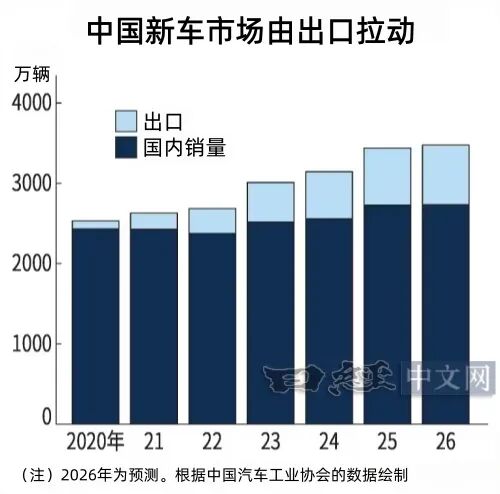
Statistics from the China Association of Automobile Manufacturers show that from January to March 2026, domestic sales decreased by 20% year - on - year, but exports increased by 57%. In addition to the severe domestic demand situation, against the background of the adjustment of preferential measures for new energy vehicles such as EVs, China's new car sales (including exports) are expected to increase by only 1% compared with 2025. Therefore, exploring overseas markets has become increasingly important.
"We will start going global in 2027, and our first stop will be Germany, the most difficult market in the world," Lei Jun, the CEO of Xiaomi, which entered the EV field in 2024, said with high spirits at the Beijing Auto Show on April 24.
Xiaomi established a R & D center in Munich, Germany in 2025. The SUV "YU7 GT" released at the end of May 2026 is the first car in which this center played an important role.
In the huge auto show venue covering an area of 380,000 square meters, the most eye - catching is the booth of BYD, the leading electric vehicle company. Inside a room marked at minus 30 degrees Celsius, there is an EV with a frosted surface.
This is the low - temperature demonstration cabin for BYD's "Blade Battery", which was upgraded in March. It is reported that it only takes about 9 minutes to charge the battery from 10% to 97% of its full capacity, and it only takes about 12 minutes to complete the charging even in an environment of minus 30 degrees Celsius.
BYD plans to set up a total of 6,000 corresponding charging infrastructures overseas by the end of 2026. It will quickly adopt new technologies not only in the domestic market but also overseas to accelerate the expansion of its influence.
Chinese automakers are continuously increasing their market share in Southeast Asia, Europe, South America and other regions, but they have not truly entered the US market. The US prevents Chinese EVs from entering by imposing high tariffs.
However, there are signs of a breakthrough in this situation. Before the opening of the auto show, Sidhu, the Minister of International Trade of Canada, visited Guangdong Province in China and inspected the factories and headquarters of BYD, XPeng Motors and GAC Group.
Canadian Prime Minister Carney announced in January that the tariff on Chinese - made EVs would be reduced to 6.1% on the condition of a maximum of 49,000 vehicles per year. The tariff on Chinese EVs in Canada was 100% in 2024.
Canada's automobile safety standards are relatively close to those of the US. For Chinese automakers, Canada is not only an opportunity to expand the market but also may become an important springboard for exporting to the US.
This article is from the WeChat official account "Nikkei Chinese Net" (ID: rijingzhongwenwang), written by Tianbian Jing and Wakasugi Tomoko. It is published by 36Kr with authorization.