After missing the first wave of projection company listings, Sonoc aims to overtake competitors with its "Xiaolong Series" | Project Report
After decades of deep involvement in the projection industry, from bulbs to single-color lasers, and now to three-color lasers, Zhu Zhun, the chairman of Sonoc, has witnessed the rise and fall of numerous technological routes.
After the Japanese R & D team joined in 2014, Sonoc determined that three-color laser was the ultimate solution for display technology. However, it took a long time. It wasn't until the spring of 2026 that the "Xiaolong Series" pure three-color laser engineering projectors were officially launched.
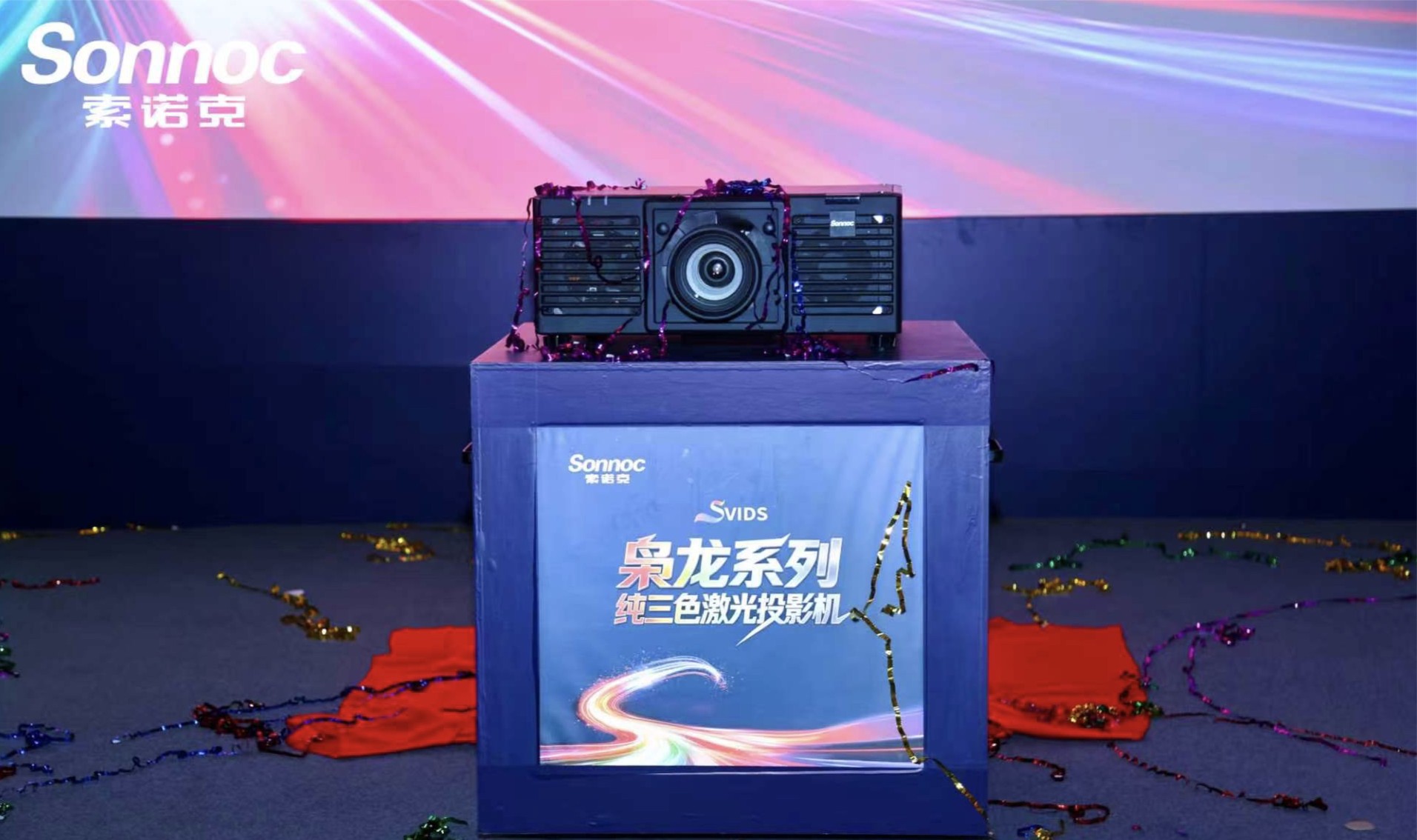
Sonoc Xiaolong Series Pure Three-Color Laser Projectors
"It's not because we were stimulated by anything," Zhu Zhun told 36Kr. "We started researching the commercialization of three-color lasers a long time ago. It's just that the journey has been a bit long."
In the past two years, Sonoc has accelerated the pace of new product and technology implementation, which is due to the changes in the industry landscape: Several leading domestic brands, with the support of capital, have taken the lead in the iteration of new technologies, and even achieved overtaking in some fields.
"That's why we need to seize the window period and quickly transform core technologies into actual products," Zhu Zhun believes. "This is the key opportunity for Sonoc to overtake on the curve."
Sonoc's starting point dates back to 1993 when its parent company, Orient Zhongyuan, was established. Since 1996, Orient Zhongyuan has served as the general agent of Panasonic projection in China for 14 consecutive years. The turning point of the brand's transformation came from an industry crisis: At that time, the industry was often affected by the complex historical relationship between China and Japan, and the company's hundreds of millions of Japanese inventory faced huge risks. Therefore, the management made up its mind to create its own projection brand and take the initiative in development.
In 2015, Sonoc's first self-owned brand projector was officially launched. After years of in-depth development, it now holds more than a hundred optical and related patents, and its high-end engineering projection business has always ranked among the top three in the domestic industry.
Looking back, Zhu Zhun doesn't shy away from his regrets: "We missed the first wave of opportunities to go public on the A-share market in the projection industry. This is a shame, not an honor."
However, he doesn't want to waste time on regret. In 2023, StarNet Ruijie invested in Sonoc. In Zhu Zhun's view, this is not a simple financial investment but an industrial strategic cooperation. StarNet Ruijie is the third-largest network equipment supplier in China. It can offer not only money but also AI underlying capabilities.
"They help us with AI empowerment, and we provide them with solutions for digital studios and light and shadow restaurants," Zhu Zhun said frankly. "Doing basic optical research is very costly, and it's difficult to support it with our own gross profit. Introducing capital is inevitable, but we've been very cautious over the years and haven't blindly introduced pure investors."
Now, with the Xiaolong's leading technology generation and controllable cost, plus the support of industrial capital, he believes that the window for overtaking has opened. And the three-color laser technology is the window to break the situation.
The three-color laser technology is not newly born. Shuji Nakamura, the inventor of the semiconductor laser, won the Nobel Prize in Chemistry for his related research. However, for a long time, two major pain points have restricted its large-scale commercialization: First, the R & D process of green lasers has been lagging behind and has only gradually matured in the past decade; second, the cost has remained high, and the upstream core laser components have long been monopolized by Japanese companies, limiting three-color lasers to niche markets.
The real turning point in the industry came in 2024. Sonoc established a R & D company in Japan and recruited Akihiro Yamakage, a top optical expert from Ricoh. This top expert in the entire optical field has always been optimistic about the future of three-color lasers. With internal accumulation and external talent, the Xiaolong Series was finally launched.
"Three-color lasers have been around for one or two decades. I can't say I'm the first, but I'm indeed the first to truly commercialize it in the engineering field," Zhu Zhun said.
According to him, the core competitiveness of Xiaolong comes from the combination of TRS scanning technology and pure three-color lasers. Zhu Zhun used an intuitive comparison to describe it: "It's like the difference between a VCD and a Blu-ray disc, except that one is a playback device and the other is a display device." In terms of specific data, the color gamut of Xiaolong is twice that of existing mainstream products, and the color brightness can be doubled under the same specifications.
Ordinary consumers may not perceive this level of picture quality difference very well, but it is a rigid demand for professionals. Zhang Lie, a professor at the Academy of Arts & Design, Tsinghua University and an expert in intangible cultural heritage digital display, and Liu Xiao, a well - known director and other industry insiders, all have an extreme pursuit of color reproduction in projection. "In the past, the projected images of projectors often deviated from the original design colors, which professional practitioners simply couldn't accept. Now, Xiaolong can fully meet their strict standards," Zhu Zhun said.
The positioning of the Xiaolong product is very clear: It targets large - scale, high - color - requirement scenarios such as cultural and tourism lighting, museums, halls, etc., and serves directors, artists, and cultural and museum projects that are extremely strict about color reproduction.
The biggest bottleneck for the popularization of three - color lasers in the past was the high price. Sonoc's solution is not to engage in low - end price competition but to break through through two paths: cost reduction through technology and replacement of the domestic supply chain.
On the one hand, relying on self - developed patented scanning technology, it achieves higher picture quality specifications with lower - power hardware and controls the overall cost from the underlying architecture. On the other hand, it has reached in - depth cooperation with HiSilicon. It has achieved technological breakthroughs in two core components: lasers and display chips. The cost of its 14B module is 30% lower than that of similar products from Nichia, and laboratory verification has been completed.
"We don't focus on consumer projectors in the thousand - yuan range, nor do we make ordinary laser TVs. In the high - end home studio field, we only make high - end products with picture quality comparable to that of commercial cinemas."
Currently, AI is reshaping the form and experience of projection products. The Xiaolong Series is equipped with the AIPQ intelligent color adjustment system, which completely replaces the traditional mode of manual color coordinate adjustment by engineers. It relies on AI to autonomously learn samples and automatically complete standardized and personalized color optimization.
"In the past, color adjustment relied on engineers to manually fine - tune frame by frame. Since everyone's visual standards are different, the adjustment effects also varied. Now, AI can autonomously learn a large number of samples. The more data is accumulated, the higher the accuracy of color adjustment will be."
Sonoc has included robot vision interaction in its future layout. Currently, the Japanese company is researching the robot vision collection ability. With a camera, it can capture images, but it lacks the image output ability. "We want to be the 'second eye' of the robot, complete the image output link, and perfect the entire visual interaction closed - loop."
Sonoc's ultimate R & D goal is to achieve non - medium three - dimensional space imaging. Without carriers such as screens, water screens, and gauze screens, it can present a three - dimensional picture only by optical technology. Zhu Zhun said bluntly that once this technology is implemented, it will completely subvert the entire display industry landscape.
Zhu Zhun has designated 2026 as Sonoc's "Year of Overseas Expansion", with an annual overseas sales target of 50 million yuan. The key markets are Southeast Asia, Central Asia along the "Belt and Road", and South Korea.
He analyzed that there are almost no projection manufacturing enterprises in South Korea. In the past, it relied on Japanese and Taiwanese suppliers. Now, Japanese products have lost their price advantage, and Sonoc is more competitive than Taiwanese brands in terms of technology and cost. Coupled with the accelerated implementation of domestic substitution of core components, the time for going global is ripe.
Having witnessed the industry transformation where single - color lasers quickly replaced traditional bulb light sources, Zhu Zhun has a clear prediction of the popularization rhythm of three - color lasers: In the next three years, in high - end scenarios such as high - end home studios, cultural and museum exhibitions, and cultural and tourism lighting, the penetration rate of three - color laser products will exceed 50% - 60%, corresponding to a high - end engineering market scale of about 3 - 4 billion yuan.
"As the domestic supply chain matures and drives the cost down, and the market's demand for high color gamut and high brightness continues to upgrade, the replacement of three - color lasers is an irreversible industry trend."
In terms of funds, Sonoc plans to launch a new round of financing this year. On the one hand, it will connect with state - owned capital for additional investment. On the other hand, it will introduce high - quality market - oriented industrial capital to continuously ensure investment in core technology R & D and core component inventory.