Why does South Korea ask China to build the world's largest 10,000-vehicle giant ship?
Another milestone in the global shipbuilding industry has emerged in China!
Recently, CSSC Guangzhou Shipyard International's No. 1 10,800-vehicle LNG dual-fuel Pure Car and Truck Carrier (PCTC) built for South Korea's HMM Co., Ltd. (Hyundai Merchant Marine Co., Ltd.) went out for sea trials.
This is currently the world's first 10,000-vehicle-class dual-fuel car carrier under construction.
The South Korean shipbuilding industry is known for its strong capabilities.
Why did they choose Chinese shipbuilders this time?
01
Large Capacity and Unique Skills
This 10,000-vehicle carrier that has set a new world record is truly remarkable.
First of all, it's big, extremely big!
The ship has an overall length of 230 meters, a beam of 40 meters, a structural draft of 10.5 meters, and a speed of about 19 knots.
Although the specific tonnage has not been announced, based on data from other similar carriers, the ship's deadweight tonnage should be close to 30,000 tons, and its displacement is around 80,000 tons.
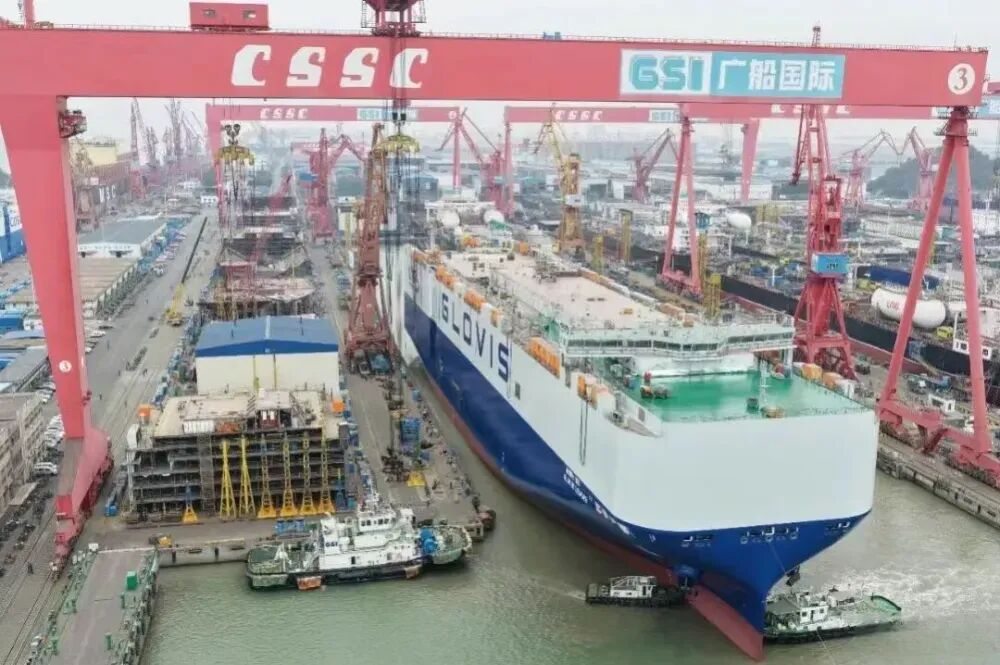
The No. 1 10,800-vehicle LNG dual-fuel car carrier (PCTC) under construction
The "sum" of these data results in an astonishing loading capacity, with a maximum single-ship car-carrying capacity of up to 10,800 vehicles.
Before this, the world's largest car carrier was the "Shenzhen" built by China Merchants Industry Holdings for BYD. It is 219.9 meters long, 37.7 meters wide, and has 9,200 standard loading spaces. It was delivered for use on April 22 last year.
If these cars were lined up end to end, the total length would exceed 50 kilometers, which is equivalent to running 125 laps on a 400-meter standard track.
To accommodate so many cars, the ship's interior is designed with up to 14 car decks, including 5 movable decks that can be flexibly raised and lowered, capable of easily loading various types of vehicles such as electric cars, hydrogen-powered cars, and heavy trucks.

Schematic diagram of the interior of the ro-ro ship, with variable ramps and deck levels
Second, it's environmentally friendly.
This maritime behemoth is not only capable of carrying a large number of cars but also environmentally friendly.
The entire ship uses a dual-fuel propulsion system of fuel oil and LNG, significantly reducing the emissions of sulfur compounds, nitrogen oxides, and particulate matter during navigation.
Moreover, the shaft generator equipped in the propulsion system can generate electricity while the ship is sailing, thus achieving the goal of energy conservation and emission reduction.
It has excellent environmental performance and fully meets the Tier Ⅲ emission standards of the International Maritime Organization.
If the above data are just external manifestations, what's even more exciting is that all the core equipment on the ship is 100% domestically produced.
On this ship, the project team, in cooperation with domestic supporting enterprises, completed the full-chain domestic research and development, from thin-plate welding to the ro-ro system, from green power to the intelligent system, breaking the long-term foreign technological monopoly at one stroke.
It's worth mentioning that car carriers are high-tech and high-value-added ship types, with high construction difficulty and technical content. The buyer of this ship, as mentioned at the beginning, is South Korea's HMM Co., Ltd.
You know, South Korea itself is a major international shipbuilding country, and its order tonnage and comprehensive score have long ranked second in the world - only after China.
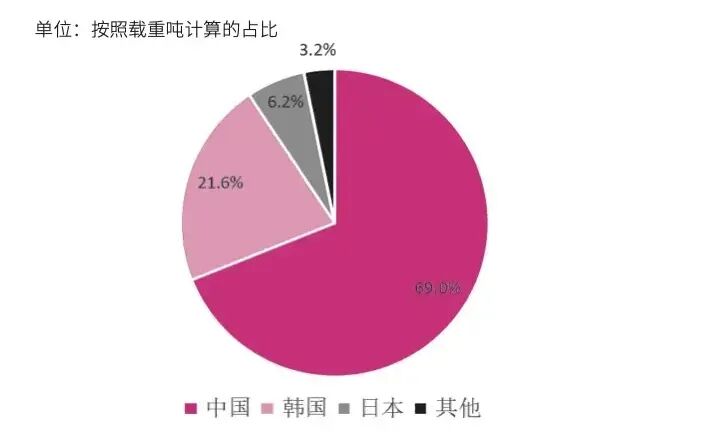
Proportion of order tonnage of major international shipbuilding countries in 2025
South Korea does have the manufacturing capacity for car carriers, but it is at a disadvantage in cost control, and its research and development of new technologies are gradually falling behind.
In the global car carrier manufacturing market, South Korea's share is very low, accounting for only about 3.5%, far lower than China (82.3%) and Japan (14.1%).
Relying on its first-mover advantage in the global shipping industry, South Korean shipowner companies still own about 15.4% of the world's car carriers and are one of the major car shipping countries.
Therefore, South Korean shipping companies like HMM and Eukor are now placing their new ship orders with Chinese shipyards.
02
Building a Giant Ship is No Easy Task
Car carriers are a separate type of ro-ro ship, different from large container ships.
Because the goods transported by the ship are more valuable and require more stability.
To solve the problem of high center of gravity and easy capsizing of the ship, car carriers usually use the method of reducing the ship's own weight to lower the center of gravity and ensure navigation safety, which requires the ship's hull to use relatively thin steel plates.
Generally speaking, in a ro-ro car carrier, the thin-plate usage accounts for more than 40% of the ship's total steel, with more than 300 thin-plate segmental sections. After the segments are welded, they need to be hoisted, spliced, and installed.
China is not short of thin-plate steel, and the domestic production of 4mm and 5mm ultra-thin marine steel plates has long been realized. The difficulty lies in the welding of thin-plate steel.
Contrary to many people's intuitions, the thinner the ship's hull plate, the more difficult it is to weld.
Any welding process will bring structural deformation to the original plate, which will affect the ship's structural strength, safety, and navigation performance.
The error of traditional manufacturing processes is often measured in centimeters. This level of accuracy is a disaster for a 230-meter-long ro-ro ship.
Therefore, its deformation control must be reduced to the millimeter level.
To deal with thin-plate deformation, Guangzhou Shipyard International adopted a combination of traditional and intelligent methods.
First, it innovated in the welding process.
The team adopted the welding wisdom of "butchering an ox skillfully", innovated the welding sequence and segmental division method, and effectively controlled the cumulative stress generated during the welding process. The team also conducted repeated tests and optimizations on parameters such as current, voltage, and speed during welding, forming a set of precise thin-plate welding parameter systems.
There is also an intelligent monitoring system.
The team installed a sensor network called the "digital blood vessels", used a big data model for deformation prediction and early warning, dynamically adjusted the process, and precisely controlled the welding process in real-time.
The team also used the newly put into use "thin-plate printer workshop" to improve welding accuracy.
In 2022, Guangzhou Shipyard International developed an intelligent laser hybrid welding production line with a total length of 390 meters, built to the international top level, compressing the error of thin-plate segmental construction to the millimeter level, reaching the international top level.
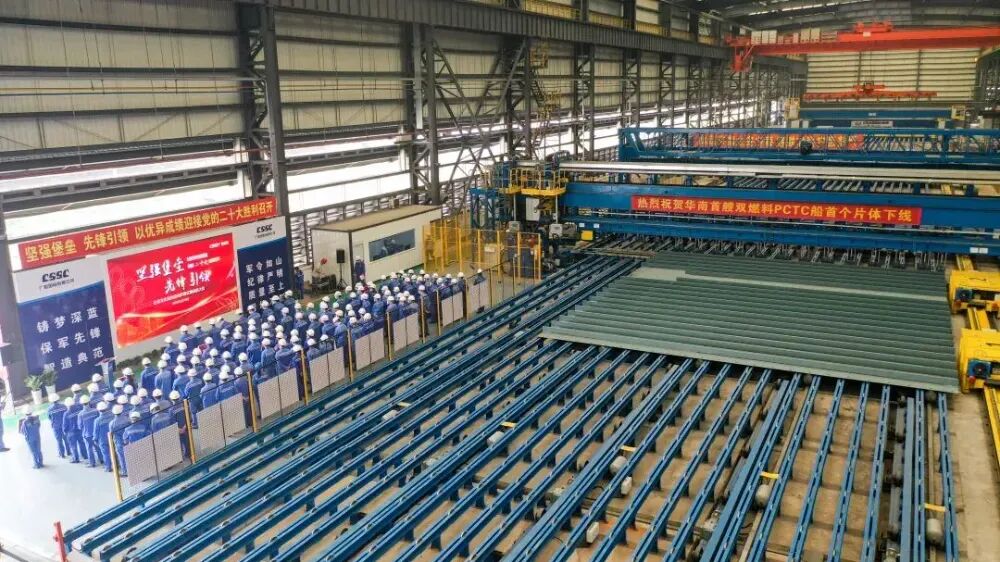
Panoramic view of the "digital and intelligent" workshop
The whole process of shipbuilding is under refined management, including the summary and innovation of traditional experience, the big data real-time monitoring system, and the most advanced "digital and intelligent" workshop. Every link from pre-installation, transportation to final assembly and hoisting of the hull construction is under strict precision control, solving the problem of thin-plate deformation as a whole.
After solving the thin-plate problem, it is also necessary to break the monopoly of the ro-ro system.
The ro-ro equipment is the key equipment for cars to get on and off the ship and adjust their positions flexibly on the ship, including the bow and stern doors for getting on and off the ship, as well as the variable ramp channels and lifting decks for vehicles to move inside the ship.

Schematic diagram of loading cars through the stern door of the ro-ro ship
The technical threshold of these equipment is extremely high, and the number is large. These key equipment have long been monopolized by a few foreign manufacturers.
To solve the bottleneck problem as soon as possible, the project team "attacked" the entire chain of the ro-ro equipment at the same time, launching a charge from the design drawings to the parts manufacturing and then to the system integration, and conducting repeated verification and optimization on every link.
As a leader in the shipbuilding industry, CSSC has a certain ro-ro design ability and has successfully completed the design and matching work of more than 250 sets of ro-ro equipment. The materials and processes fully meet the corrosion-resistant requirements of the marine environment.
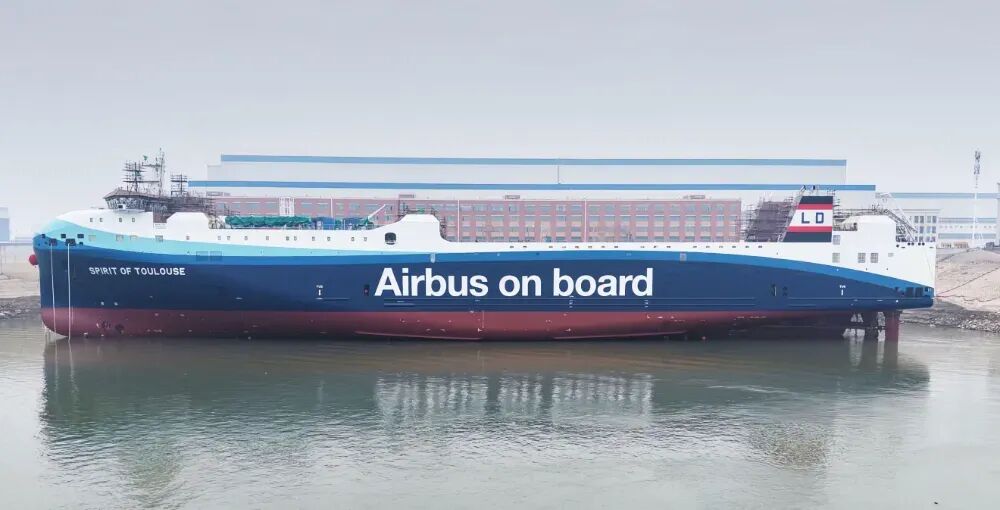
The world's first 6-sail-assisted ro-ro ship built by CSSC Wuchang Shipbuilding for a European shipowner
This time, the built carrier is larger, the ro-ro system is more complex, and it also needs to be integrated with the complex dual-fuel energy system to achieve integrated design and ensure the optimal overall performance.
Without any precedent to follow, the project team innovatively proposed the design of barrier-free channels and optimized three-dimensional layout, used three-dimensional simulation technology to achieve precise and reliable control of the hydraulic system, and also constructed a series of design systems with independent Chinese intellectual property rights.
The benefit of 100% domestic production of the ro-ro system is not only to get rid of foreign control but also to greatly reduce the construction cost.
Once the Chinese shipbuilding industry masters the technology, it also masters the initiative of the supply chain, which can provide a solid equipment foundation for larger strategic goals.
In addition, Chinese shipyards have also achieved independent innovation in green power, intelligence, and shipbuilding management.
Although this carrier uses the currently very mature LNG dual-fuel propulsion system, it still reserves interfaces for ammonia fuel power and methanol fuel power, and the power can be upgraded in the future.
The entire ship is also equipped with an advanced intelligent ship system, realizing the intelligent management of the ship's navigation, engine room, cargo, and other systems, effectively improving the operation efficiency and safety.
During the construction process, Chinese shipyards also explored the planning standards for lean management, optimized the collaborative operation of multiple trades, improved shipbuilding efficiency, coped with complex scenarios such as holiday construction connection, and improved the management ability of the shipbuilding industry.
Backed by the strong domestic supply chain, Chinese shipyards have both technological and cost advantages, as well as the ability to innovate continuously. South Korean shipping companies have to place more and more merchant ship orders with Chinese shipyards.
03
The Great Significance Behind the Giant Ship
The successful sea trial of the 10,000-vehicle giant ship not only makes the shipbuilding industry happy but also makes the new car-making forces even happier.
According to data from the China Association of Automobile Manufacturers, China exported 7.098 million vehicles last year, a year-on-year increase of 21.1%, ranking first in the world for three consecutive years.
In the just-passed first quarter, China exported a total of 2.226 million vehicles, a year-on-year increase of 56.7%.
Among them, 954,000 new energy vehicles were exported, a year-on-year increase of 120%.
With the explosive growth of China's new energy vehicles, the logistics pressure for cars to go overseas is also increasing day by day because the scale of the ro-ro fleet cannot keep up.
As of April 22 last year, there were 839 car carriers in the global car transportation fleet. The top ten shipowners accounted for 461 ships, more than half, but there was not a single Chinese shipowner!
There are two Chinese shipowners within the top 20, with a total of only 30 ships.
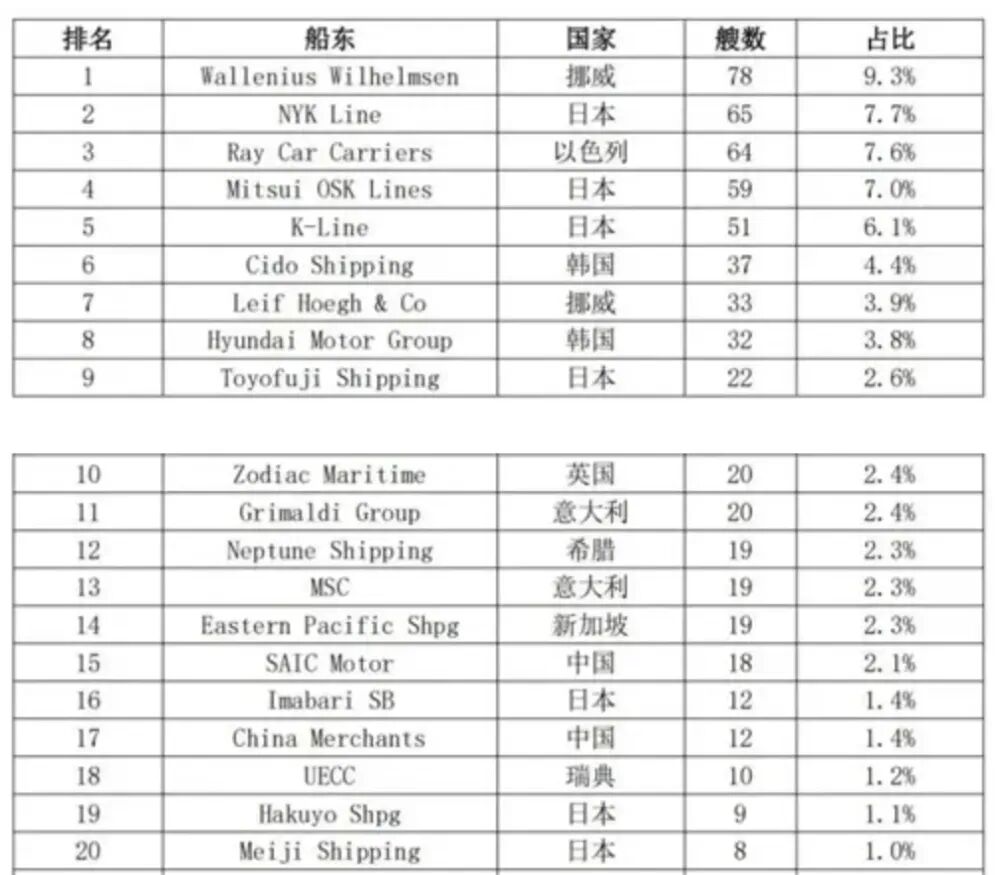
Top 20 global car carrier fleets (by shipowner)
Judging from the countries of the shipowners, about 60% of the global car carrier shipping capacity is controlled by shipping companies in Japan, South Korea, and Europe, and China's shipping capacity only accounts for 7.6%.
The shortage of shipping capacity has directly pushed up the freight rates for cars to go overseas, seriously restricting the global layout of domestic cars.
Before the conflict between the United States and Iran, the daily rent of a ro-ro ship with 6,500 standard parking spaces was as high as $110,000, and the shipowner had absolute pricing power.
Domestic car companies not only have to pay high fees but also face various emergencies such as cabin space being occupied and delivery delays.
The birth of domestic ro-ro carriers is the key to solving this dilemma.
As the leader in domestic cars going overseas, BYD started to build its own fleet in 2022. Currently, the fleet has 8 ro-ro ships with more than 7,000 standard parking spaces, all built in China.
Before the 10,000-vehicle carrier, BYD's "Shenzhen", "Xi'an", and "Jinan" already had a carrying capacity of 9,200 standard parking spaces and were the world's largest LNG dual-fuel car carriers at that time.
