Moutai asks distributors for profits
Author | Xie Yunzi
Editor | Zhang Fan
Investors who have been keeping an eye on the A-share market might have been "startled".
On the evening of April 16th, Kweichow Moutai released its financial report data for 2025. Its revenue reached 172.054 billion yuan, a year-on-year decrease of 1.2%; the net profit attributable to shareholders was 82.32 billion yuan, a year-on-year decrease of 4.53%. This was the first "double decline" for Moutai since its listing in 2001, thus ending its continuous positive growth record over the past two decades.
Affected by this, Kweichow Moutai's stock price once fell below the 1,400-yuan mark at the opening the next day and finally closed down 3.8%, with its market value evaporating nearly 70 billion yuan in a single day.
By simply dissecting the financial report, the company's core product, "Feitian Moutai", managed to maintain its market share. In the previous year, the revenue from Moutai liquor was 146.5 billion yuan, a year-on-year increase of 0.39%.
The series of wines that were once highly anticipated and regarded as the "second growth curve", such as Moutai Prince Wine and Moutai 1935, performed poorly. In 2025, the total revenue from Kweichow Moutai Group's "series of wines" products was 22.275 billion yuan, a year-on-year decrease of 9.76%.
Looking specifically at the fourth quarter, which "significantly fell short of market expectations". During the reporting period, Kweichow Moutai's net profit attributable to shareholders was only 17.693 billion yuan, a year-on-year plunge of 30.3%. Most institutional analyses believe that this was the result of the group's "controlling quantity to maintain price" strategy - that is, Moutai is actively clearing its inventory to ensure a more stable market-oriented reform in 2026.
However, whether it is active or passive, the development logic of the current liquor market has changed. An obvious fact is that even for Kweichow Moutai, the era of easy high growth is over.
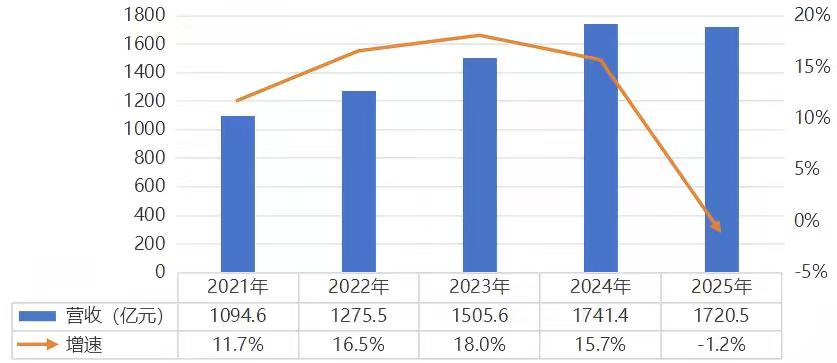
Chart made by 36Kr based on Wind data
Weakening Dealers, Raising Prices, and Regaining Pricing Power
Before releasing this "double decline" annual report, Moutai just announced a price increase. Starting from March 31st, the ex-factory price of the "53-degree, 500-milliliter" Feitian Moutai (hereinafter referred to as Feitian Moutai) was raised from 1,169 yuan per bottle to 1,269 yuan, and the retail price in its self-operated system was adjusted from 1,499 yuan per bottle to 1,539 yuan.
This means that the "1,499-yuan era" of Feitian Moutai, which lasted for 8 years, has come to an end. The direct bearers of the price increase are Moutai's dealers and retailers.
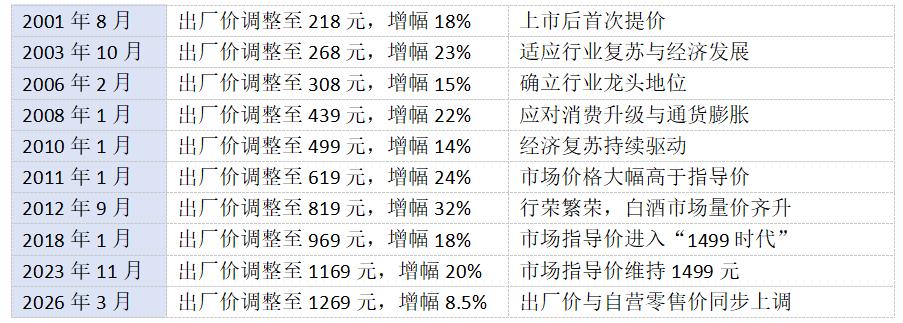
Table made by 36Kr based on public information
In the past, due to the scarcity of Moutai, its products formed a stable profit margin in the circulation process.
Dealers usually obtained goods from the company at the ex-factory price with a certain amount of "allocated goods" (including series of wines) and then resold them to small dealers or retailers at a relatively high "market wholesale price". The successive price increases made consumers finally have to pay a price much higher than the official guidance price to buy core products such as Feitian Moutai.
The worst impact of excessive "financialization" on the brand is that Moutai has completely become a "liquor-making machine", and the terminal price of the products has gotten out of control. There has even been a situation where the price keeps rising despite more regulations.
In 2018, Kweichow Moutai Group clearly stated that dealers were not allowed to increase prices for sales, hoard goods, or drive up prices, nor were they allowed to cooperate with "scalpers" to sell counterfeit products. By 2019, Kweichow Moutai intensified its efforts to "weaken dealers". In that year, it cut more than 600 dealers across the country, and the number of "Moutai liquor" dealers has since stabilized at around 2,100.
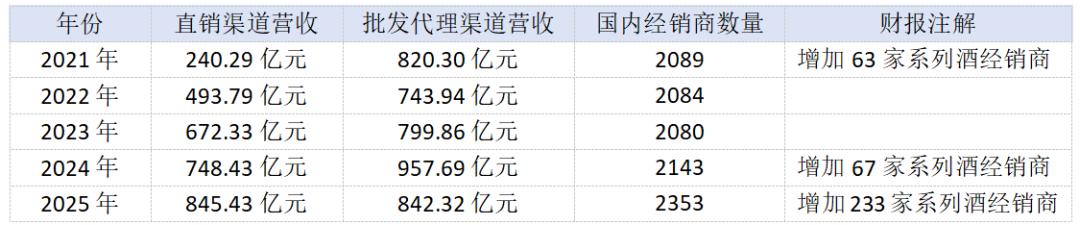
Table made by 36Kr based on financial report data
While rectifying the dealer system, Moutai also began to vigorously develop direct sales channels.
In 2022, the company's official self-operated channel, "i Moutai", was launched, and the power of market pricing gradually shifted from large dealers back to the group.
The financial report shows that from 2022 to 2025, the revenue contributed by "i Moutai" increased from 11.883 billion yuan to 13.031 billion yuan. In 2025, the revenue of the company's direct sales channels, including "i Moutai", accounted for more than 50%, reaching 84.54 billion yuan, exceeding the wholesale agency channels for the first time.
The change in the wholesale price can directly reflect the trajectory of profit transfer.
"Blue Shark Consumption" once reported that the "wholesale price per bottle" of Feitian Moutai once exceeded 3,000 yuan in 2024, and the profit per bottle for dealers was nearly 2,000 yuan. On December 12, 2025, the wholesale price per bottle of Feitian Moutai was 1,485 yuan, and the wholesale price per bottle in the original box was 1,495 yuan, falling below the official guidance price for the first time.
Although the wholesale price of Moutai has rebounded to some extent after this price increase, the profit margin for the circulation channel is still in the range of 300 yuan. And since January this year, Feitian Moutai has been sold regularly on "i Moutai". In the context of weak consumption and rising labor and operating costs, Moutai's dealers are only making meager profits or even incurring slight losses.
"Moutai Is Still Moutai"
So, what happens after regaining the market pricing power?
Judging from the performance in the financial report, the pressure facing Moutai is still quite significant.
Data from the China Alcoholic Drinks Association shows that in 2025, the average inventory turnover days in the liquor industry reached 900 days, and 58.1% of dealers reported a continuous increase in inventory. As the leading enterprise, Moutai has also naturally hoarded a large number of non-standard products.
In the fourth quarter of last year, while protecting the profits of dealers, Moutai's management clearly put forward the concept of "not solely focusing on indicators", actively stopped pressuring the channels to take in goods, and at the same time slowed down the payment collection rhythm of dealers.
From this perspective, Moutai is actively squeezing out market bubbles at the cost of sacrificing short-term interests. However, the sluggish channel sales are still reflected in the company's most core cash flow. In 2025, Kweichow Moutai's cash flow from operating activities decreased by 33.46% year-on-year, dropping sharply from 92.464 billion yuan to 61.522 billion yuan; the inventory at the same period was 61.427 billion yuan, and the inventory turnover days increased to 1,399.15 days.

Table made by 36Kr based on Wind data
Meanwhile, Moutai's sales expenses also increased significantly by 28.6%, reaching 7.253 billion yuan. The financial report explains that a large amount of these expenses was invested in channel construction and digital transformation, which will inevitably affect the company's overall profit level.
In addition, in the secondary market, Moutai's price-earnings ratio is also at a historical low. Since the beginning of 2026, its PE (TTM) has always fluctuated around 21 times. This may indicate that the market no longer has the same high expectations for Moutai's growth potential as before.
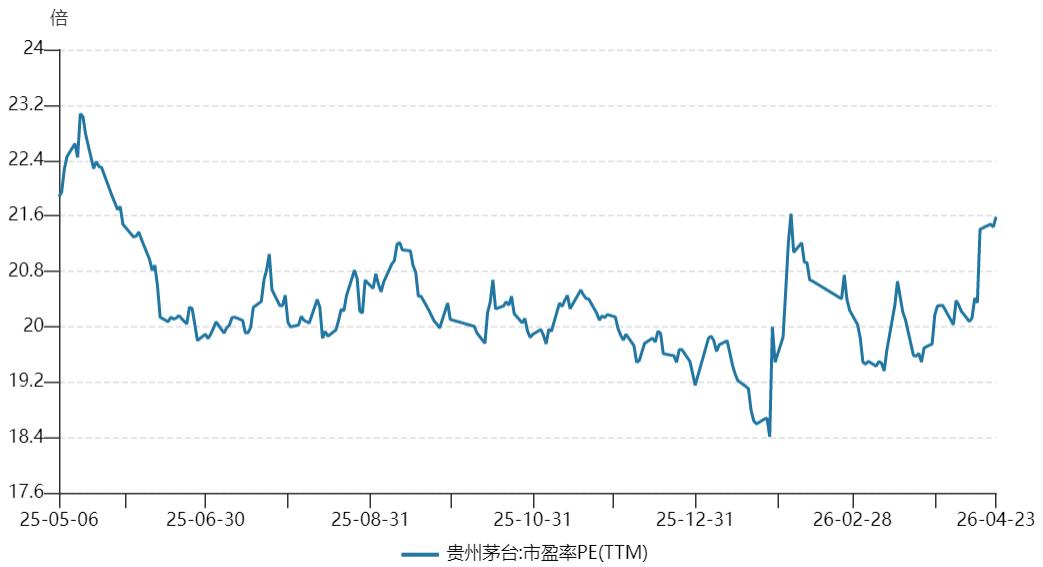
Screenshot from Wind
Regarding whether the high growth of companies representing the young customer group is sustainable, Moutai once launched an ice cream business in a high-profile way for market education. However, last year, Moutai's ice cream division was dissolved. The official response was that "the ice cream business has achieved the goal of cultivating young consumer groups, and it is now in a strategic contraction phase."
The underlying implication seems to be that it is not easy to "entice" young people to buy Moutai.
How to replicate the youth-oriented path of Western spirits such as whisky and vodka in China's liquor market is an old topic. For Kweichow Moutai, transforming from the lofty "national liquor" into a high-end consumer brand that is closer to consumers' lives and more acceptable to the young group requires a reshaping from brand storytelling to consumer resonance.
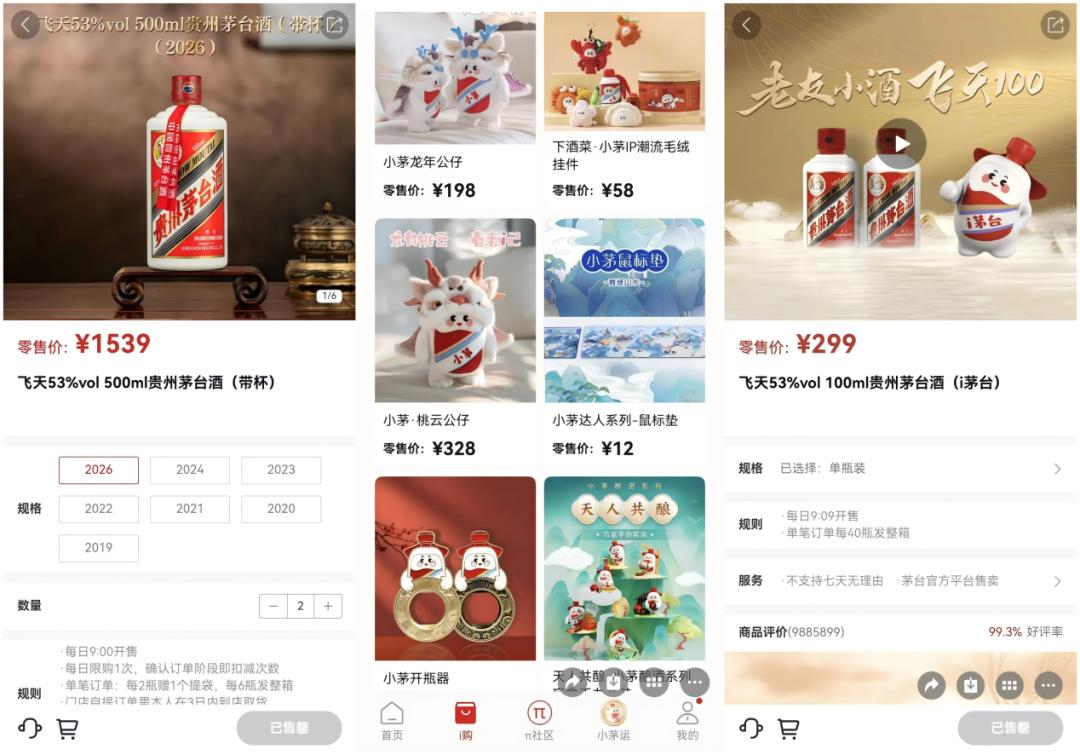
Screenshot from i Moutai APP
But "Moutai is still Moutai".
Not long ago, the famous investor Duan Yongping commented on Moutai's 2025 financial report performance in this way. Like most investment institutions, Duan Yongping also believes that Kweichow Moutai's core competitiveness and ability to return value to shareholders are stable.
Interestingly, while enjoying Moutai's generous dividend returns, Duan Yongping also "unexpectedly" became a "fan" of Pop Mart.
In the liquor industry, under the Matthew effect, there will definitely be a situation where "the strong get stronger and the weak get weaker". Moutai's "industry monopoly" is not just a product of a special era. The scarcity of its products comes not only from the "irreplaceable" core production area in Maotai Town but also from the special production process and the production capacity limitation of the "five-year base liquor aging".
All these have enabled Moutai to fully capture the consumer mindset as the "highest representative of Chinese liquor", and the short-term consumer demand will not fluctuate significantly. According to official sources, in the first quarter of 2026, Moutai's sales exceeded expectations, and the regular Moutai was in short supply.
After regaining the pricing power, Moutai's channel efficiency will become higher. However, in the context of the industry reaching its peak and facing difficulties in youth orientation, it is also difficult for Moutai to "become bigger". The double decline in performance in 2025 will surely become a footnote in the company's development history.
*Disclaimer:
The content of this article only represents the author's views.
The market is risky, and investment should be made with caution. Under any circumstances, the information in this article or the opinions expressed do not constitute investment advice to anyone. Before making an investment decision, if necessary, investors must consult professionals and make decisions carefully. We have no intention of providing underwriting services or any services that require specific qualifications or licenses to engage in for all parties in the transaction.

Scan the code for more information
This article is from the WeChat official account "36Kr Finance". Author: Xie Yunzi Zhang Fan. Republished by 36Kr with authorization.