Raised 3.4 billion in financing, Hangzhou ranks second globally: Engaging in brain-computer interface, the opportunity seems to be worth 3 trillion.
$8 billion in financing has poured into the brain-computer interface field. However, you may not know that the company with the second-highest global financing is not in the United States, but in Hangzhou, China.
It is one of the "Six Little Dragons" in Hangzhou - BrainCo Technologies.
As of the beginning of this year, it has completed approximately $500 million in financing (about 3.4 billion yuan), second only to Neuralink under Elon Musk; its valuation has exceeded 12 billion yuan, making it the first brain-computer interface unicorn in China.
On April 20th, Pencil News visited BrainCo Technologies in Hangzhou to try to answer several questions: The brain-computer interface is being developed by Elon Musk and invested in by Sam Altman. The market is at least $400 billion (3 trillion yuan), but is the technology real? Are the products being used? Can the business make money? Are there still new opportunities?
The key takeaways from the visit are summarized into 8 crucial questions to help you understand: Why is the brain-computer interface so popular, and what are its core opportunities?
01 Why has the brain-computer interface suddenly become popular again?
Let's start with the conclusion: This wave of popularity didn't come out of nowhere. There are actually several forces converging on this point simultaneously.
1. Elon Musk has brought this matter to the forefront.
Elon Musk founded Neuralink in 2016, one and a half years later than BrainCo. However, by 2026, Neuralink had announced mass production.
The significance of this is that previously, the brain-computer interface was more like a laboratory concept. Now, for the first time, it has been continuously brought into the public eye by a "high-profile" person.
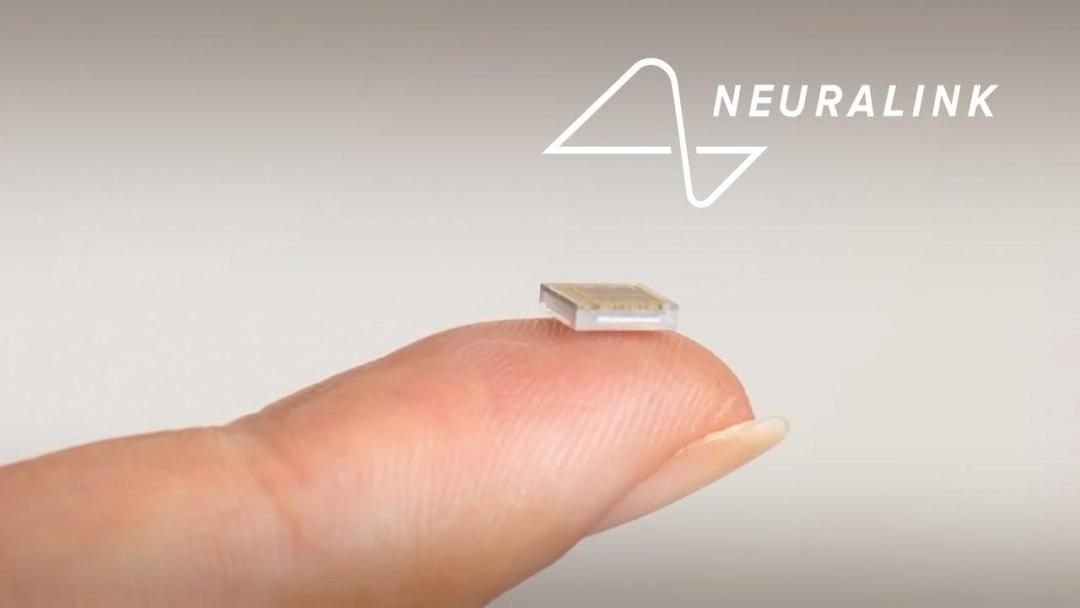
Neuralink's brain-computer interface chip needs to be implanted into the human brain.
2. It's not just Elon Musk; Sam Altman (founder of OpenAI) has also entered the game.
If it were only Elon Musk, it would be understandable. But the problem is, Sam Altman has also joined in.
At the beginning of 2026, he co-founded a brain-computer interface company called Merge Labs, and OpenAI invested $250 million in it.
It's actually quite rare for Elon Musk and Sam Altman to both heavily invest in the same field.
3. The underlying demand is actually a "huge disease category."
Why did they both set their sights on the brain-computer interface? Because it can treat a crucial disease.
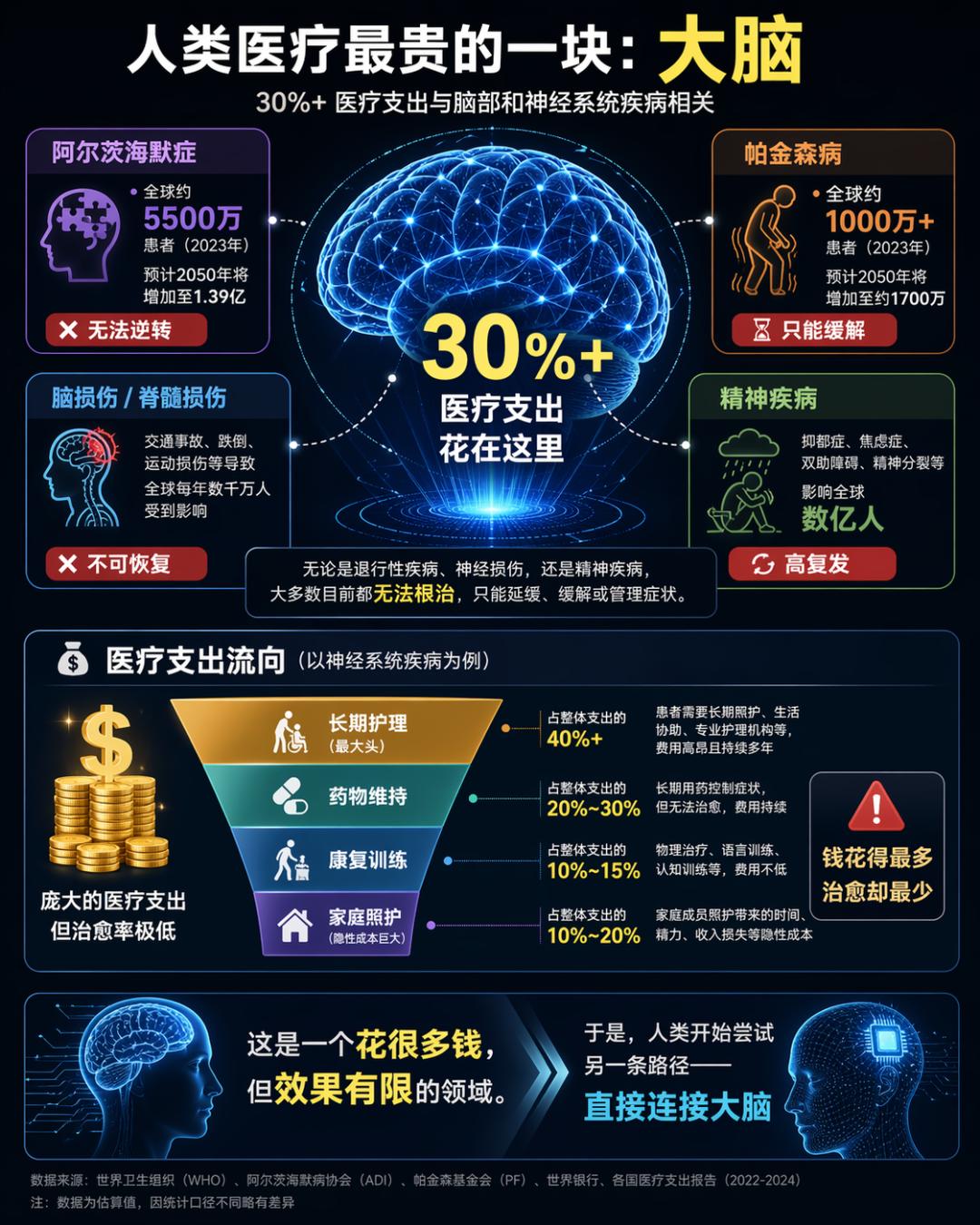
The rigid demand market for brain-computer interfaces
Currently, more than 30% of human medical expenditures are related to brain and nervous system diseases. However, these diseases have one thing in common - many of them "can't be truly cured," such as Alzheimer's, Parkinson's, and nerve injuries...
Drugs can relieve the symptoms, but it's difficult to truly solve the problems. The brain-computer interface is considered to have the potential to fundamentally rewrite these issues.
4. How big is the market? It's almost unimaginably large.
According to a set of data from Morgan Stanley, in the future, the brain-computer interface market in the US medical field alone could reach $400 billion.
This number may not seem very impressive at first glance.
If we say it's roughly equivalent to the annual scale of China's new energy vehicle industry - does it suddenly become more tangible?
5. The popularity is not just hyped by the media; the industry is starting to get busy.
The "popularity" of many industries often only exists in the news. However, this wave of brain-computer interface popularity is different.
BrainCo revealed that in the first quarter of this year, the number of inquiries for cooperation and procurement was five times that of the same period last year.
And last year at the same time, it was already quite popular - "That was when the 'Six Little Dragons' in Hangzhou were at their peak."
6. Even universities are starting to "collectively shift their focus."
During the visit, BrainCo also mentioned a detail: Many domestic universities are now significantly increasing their investment in brain-computer interfaces. People who used to work on robotics, AI, and neuroscience are also shifting towards this field.
This is actually a very typical signal: A new field is starting to attract talent.
02 The first to be changed are 5 million severely disabled people
When many people talk about the brain-computer interface, their first reaction is: future humans, superpowers, and the sci-fi world.
However, the fact is that the first to be changed by this technology are not "future humans," but a group of people you've hardly ever "seen."
1. How many of the 5 million severely disabled people in China have you seen?
One statistic shows that there are approximately 24 million people with physical disabilities in China. Among them, the number of people with amputated hands or feet is close to 5 million.
The question is - how many of them have you seen? Most people would pause for a moment. In our daily lives, whether going to work, taking the subway, or shopping in the mall, we hardly ever see this group of people. In fact, they are hidden from our sight.
2. They stay at home and rarely go out.
Han Bicheng once said, "I've lived in China for 19 years and have hardly ever seen anyone without hands or feet."
To understand this situation, he conducted a rather "primitive" survey: He visited more than 100 families of disabled people without hands and tried to map out their two-week travel routes - just like the movement records on our mobile phones, a series of lines.
As a result, after two weeks, they couldn't draw anything. It wasn't because of insufficient data, but because - there were simply no routes.
The real movement routes of 100 people ended up being just 100 dots. Each dot was in the same place: home.
At that moment, they realized that this group of people wasn't non-existent; they were just trapped at home.
3. The brain-computer interface is liberating them.
Previously, these 5 million people had been staying at home for a long time and needed the care of their family members. In reality, it often means that for one disabled person, at least one family member has to accompany them for a long time, not just a few months, but many years.
Currently, what the brain-computer interface aims to solve is a very basic problem: Can these people go out again?
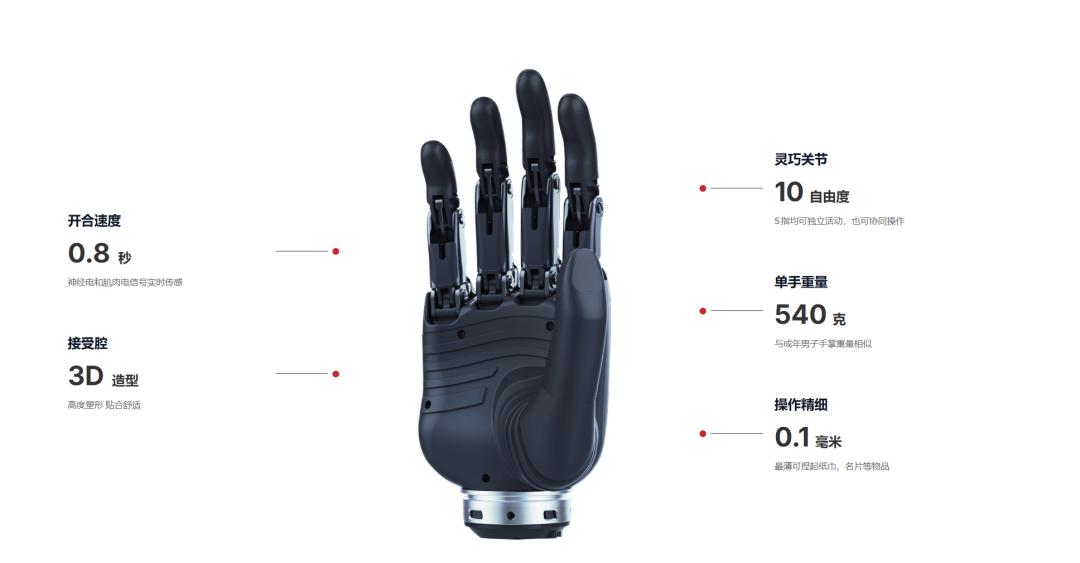
Some of these 5 million people have already started using BrainCo's products, such as intelligent prosthetics for users with forearm and thigh amputations.
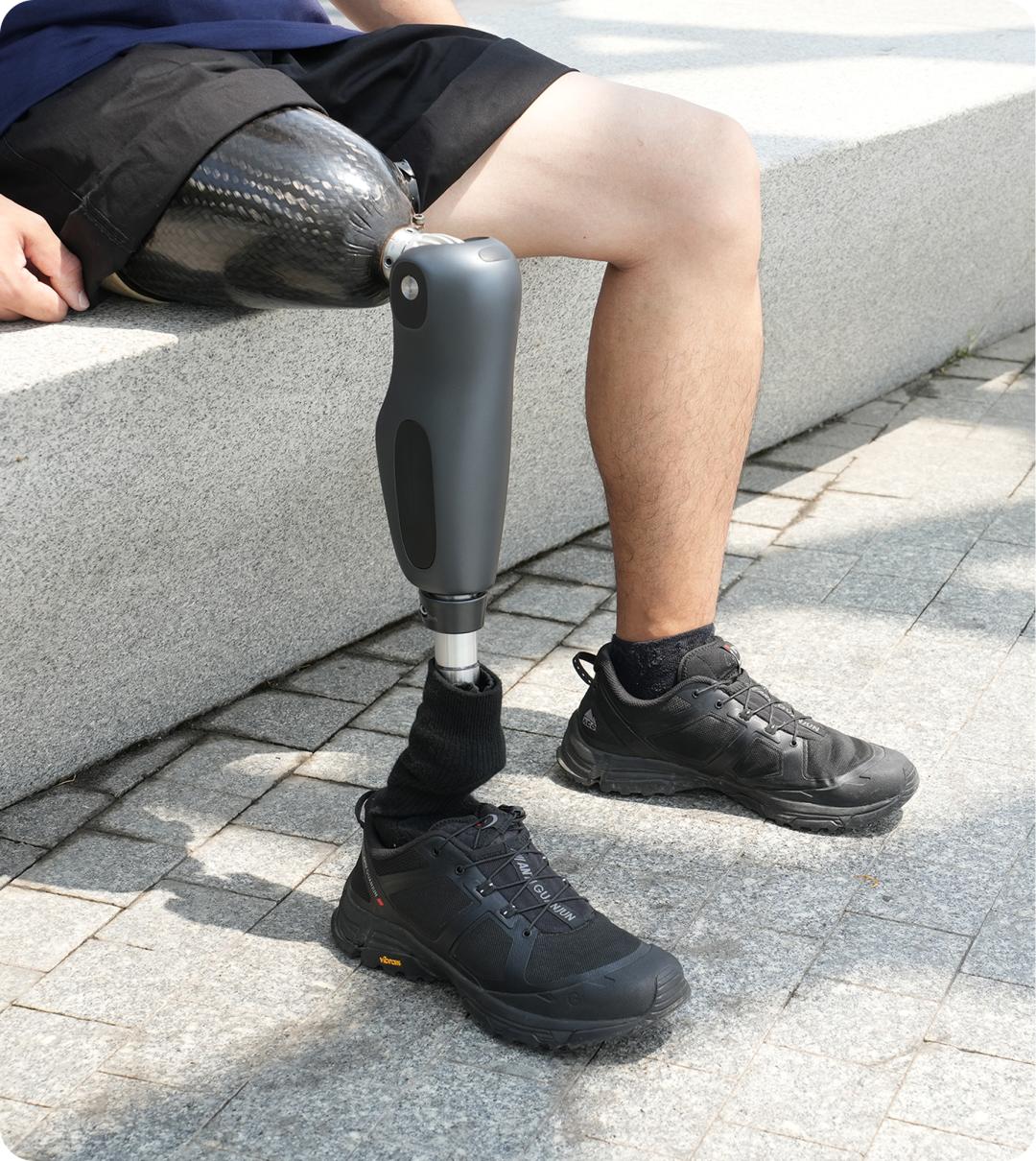
BrainCo's intelligent bionic leg, Ling M3
03 Which route, invasive or non-invasive, will succeed?
The brain-computer interface has multiple technical routes, some requiring surgery and some not.
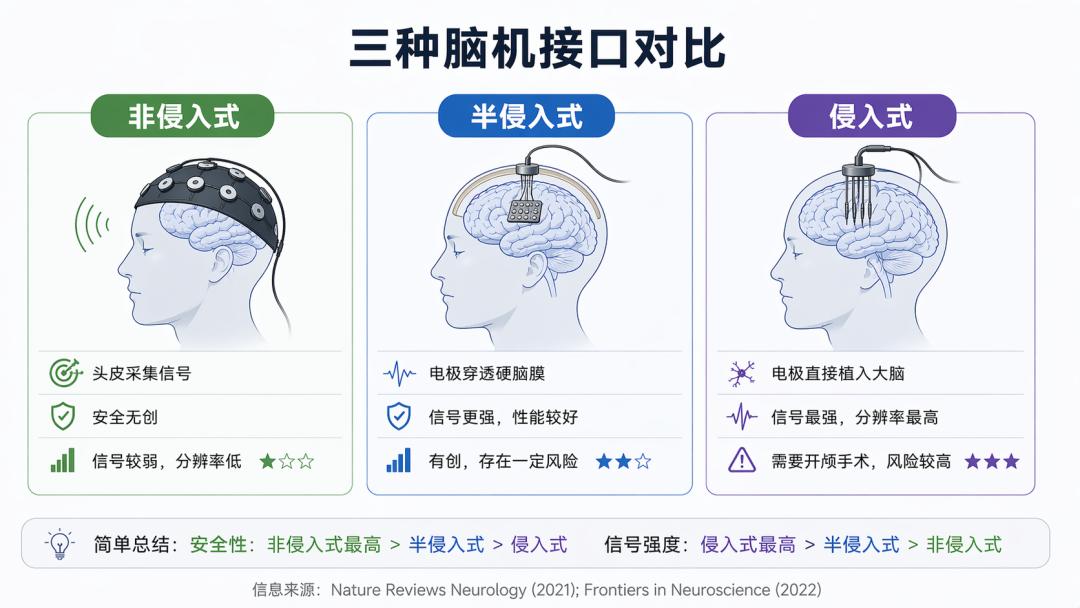
Three technical routes of the brain-computer interface
When many people first hear about the brain-computer interface, they instinctively think that the most direct way to "read the brain" is to implant a chip, which is the invasive method.
However, BrainCo didn't choose this route from the beginning.
1. A doctor risked his life for research.
There is a "radical" true story.
A doctor named Philip Kennedy was very eager to advance brain-computer interface research. However, the problem was that there were too few people willing to undergo craniotomy for the experiment.
Finally, he made a decision: He used himself as the experimental subject. He had his team implant two electrodes into his brain.
58 days later, due to the risk of infection, the two electrodes were removed. Even more surprisingly, as soon as he woke up after the surgery, he walked into the laboratory, talking and recording his brain signals at the same time.
After hearing this story, one can only conclude that this can be used for scientific research, but it's difficult to turn it into a "product that ordinary people are willing to use."
2. In terms of effectiveness, the invasive method is indeed the most powerful.
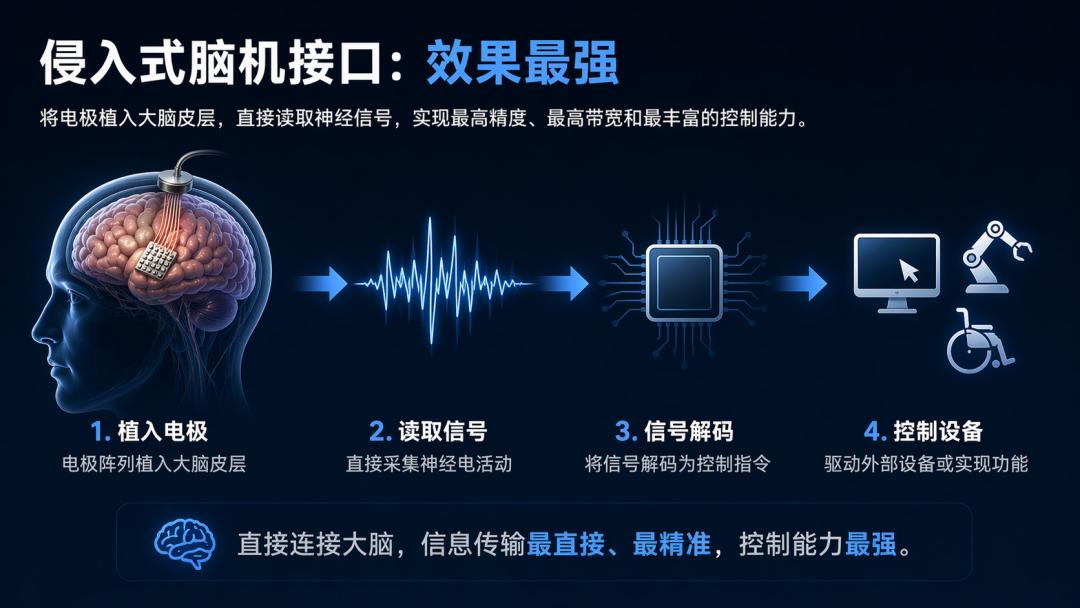
The principle of the invasive brain-computer interface
However, the question is, why do some people still choose the invasive method? Because the effect is really good.
A very easy-to-understand analogy: The invasive method is like listening to a concert in the VIP front row; the non-invasive method is more like listening from outside the venue.
One is clear, and the other is full of noise.
The reason is also very simple: The invasive method directly places the electrodes in the cerebral cortex, which can record the discharge of single neurons, resulting in the cleanest signals. Neuralink (founded by Elon Musk) follows this route.
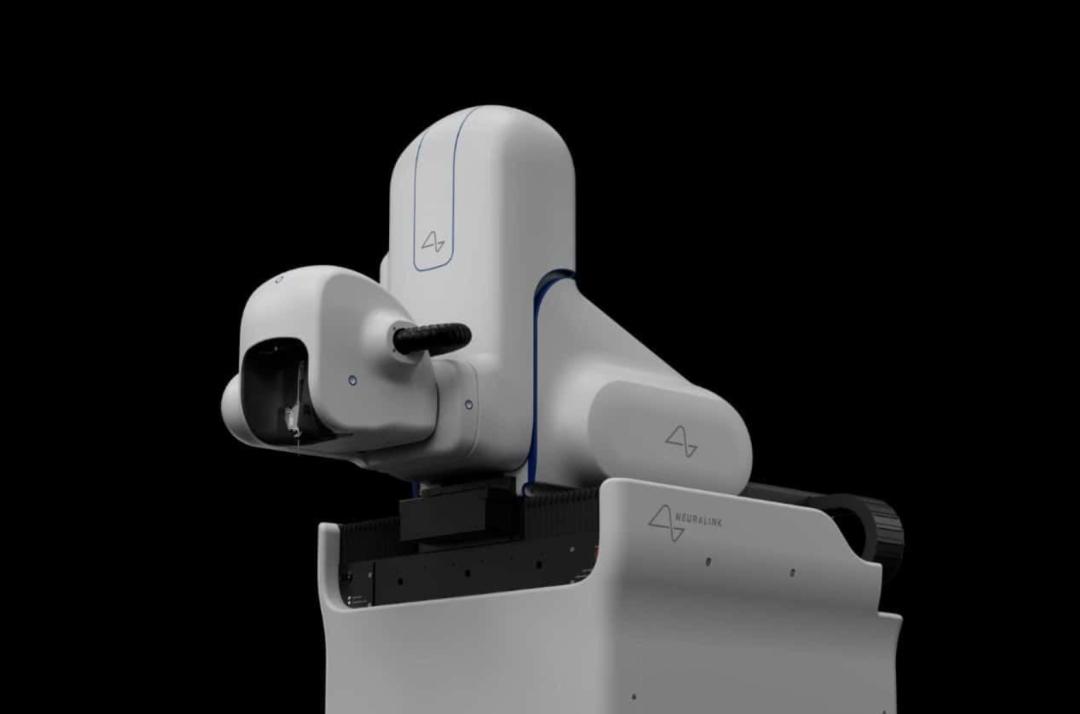
Neuralink's implantation robot
However, the problem is that the human body is not designed for electronic devices.
The internal environment of the human body is actually not suitable for electronic devices to work: there is blood, tissue fluid, and various immune responses.
Over time, a series of problems will arise: bleeding, rejection, electrode breakage, signal attenuation...
Neuralink has not really solved these problems yet.
They have indeed made many engineering optimizations, such as biological casings, wireless charging, and electrode implantation robots.
However, no matter how strong the engineering capabilities are, it doesn't mean that these "fundamental problems" have disappeared.
3. The semi-invasive method seems like a compromise, but it also has its costs.
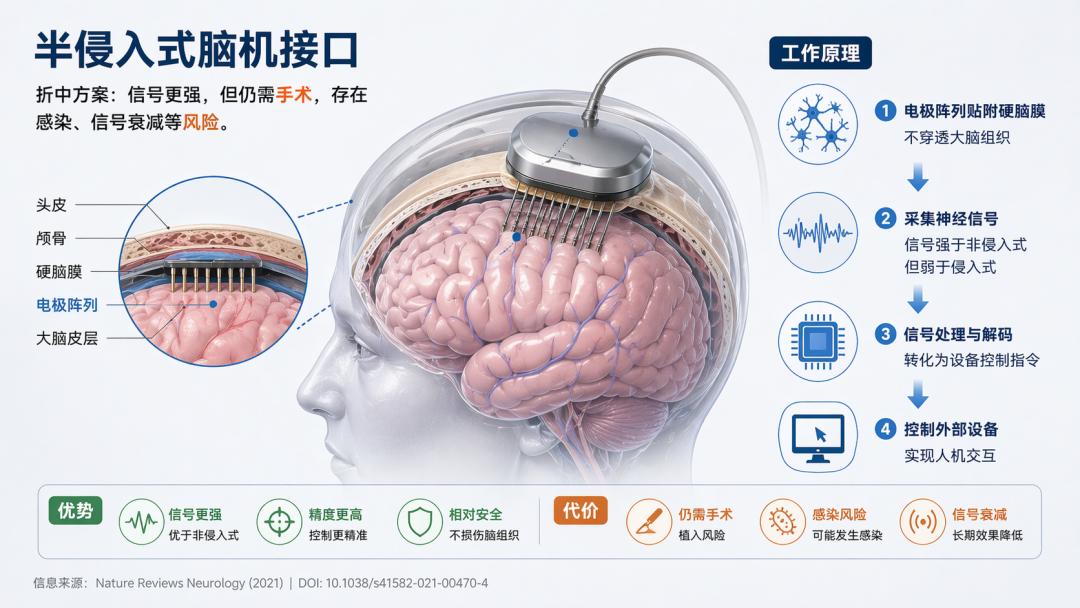
The schematic diagram of the semi-invasive brain-computer interface
Simply put, the semi-invasive method means not directly performing a craniotomy but sending the device near the brain through blood vessels.
It sounds more gentle. However, avoiding one risk will introduce another, such as blood clots.
So, in essence, it's not a "perfect solution," but just a compromise.
4. The non-invasive method is the safest but also the most difficult.
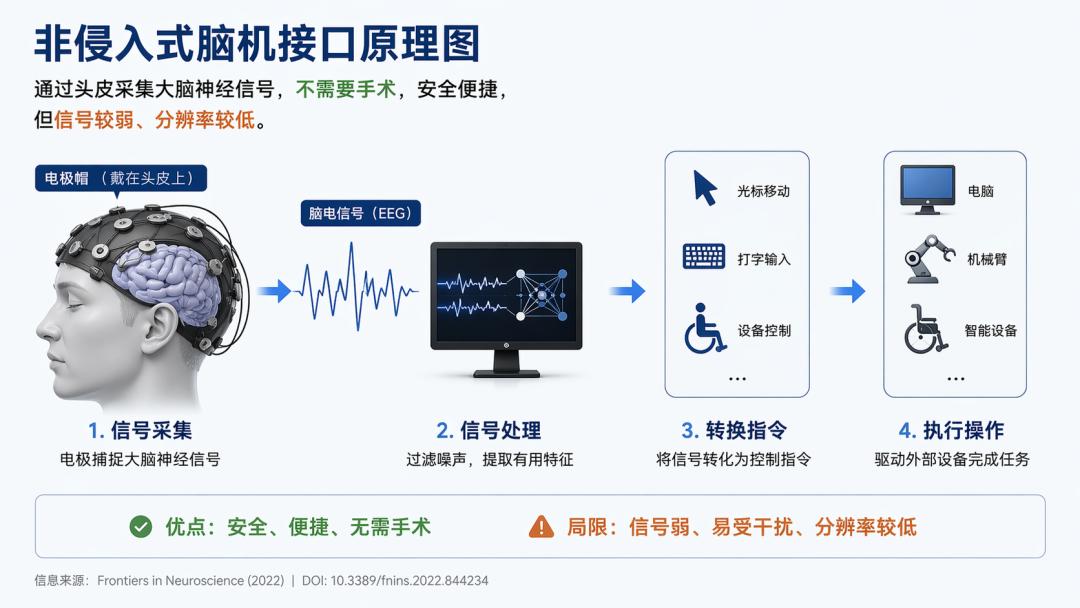
The principle of the non-invasive brain-computer interface
Finally, this is the route currently chosen by BrainCo: the non-invasive method.
The advantages are obvious: no surgery is required, and it can be used by simply wearing it on the head, which is acceptable to ordinary people. However, there are also many problems: the signals are too weak, like trying to capture a very small sound from a long distance.
How difficult is the non-invasive method?
If we summarize it in one sentence: You want to read the brain without surgery. It's like trying to capture the sound of a mosquito flapping its wings from 50 kilometers away.
04 Are people using the brain-computer interface?
Our experience shows that not only are people using it, but they are also using it in their daily lives.
1. A real case: A disabled person who lost both hands at the age of 9.
One day, we watched a video. The person in the video lost both hands when he was 9 years old due to an explosion from a homemade bomb in the village.
The important thing is what happened next: After installing BrainCo's intelligent prosthetic hands, what was he doing? Turning on the computer, pressing the power button, typing on the keyboard, inserting a USB drive, and operating the mouse.
2. It's not just "movable"; it's "usable."
Many people's impression of prosthetics is still limited to "opening and closing." However, this hand is clearly different.
The user in the video said that he can now: work out, lift dumbbells, do lateral pulls, ride a stationary bike, and even write with a brush.
You can think of it as: It's not just "movable"; it has entered the stage of being "usable."