Behind the robots stand many "big tech companies".
The afterglow of the Spring Festival Gala's "breakout" has not faded yet, and the Beijing Yizhuang Humanoid Robot Half - Marathon has pushed the popularity of robots to a new high. However, this time, not only unicorn robot enterprises have gained popularity, but also large - scale technology companies have strongly entered the arena.
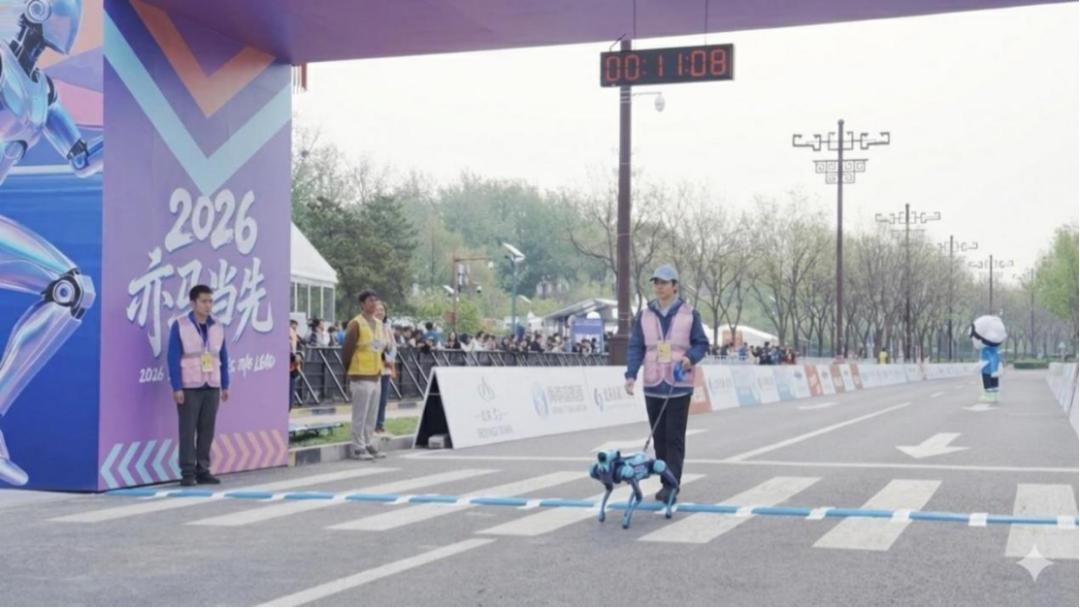
Honor's humanoid robot "Lightning" won the championship in the robot group with a time of 50 minutes and 26 seconds, nearly 7 minutes faster than the world record for the men's half - marathon by humans. The quadruped robot "Tutu" brought by Alibaba's Gaode can independently guide visually impaired people to complete challenges such as dynamic and static obstacle avoidance and passing through narrow passages on urban roads.
All along, large Internet companies have been the "top players" in the robot industry. Since 2014, large companies such as Alibaba, Baidu, Xiaomi, Meituan, and Tencent have frequently "voted with money." In 2025 alone, they invested in robot - related enterprises a total of 62 times.
However, as the robot industry matures, large companies are no longer satisfied with just being investors and have started to get involved directly. From being behind - the - scenes financiers to front - stage protagonists, it means that robots have moved from "concept verification" to "scenario implementation." What large companies are competing for is not only technological leadership but also the ecological niche for the future commercial implementation of robots.
Large Companies "Madly Invest" in Robots
Since last year, the field of embodied intelligence has witnessed an investment boom.
According to the "Embodied Intelligence Development Report (2025)", by the end of 2025, the number of investment events in the field of embodied intelligence and robots in China reached 744, with a total financing amount of 73.543 billion yuan.
Large Internet and technology companies are definitely the core force. According to the "Analysis of the CVC Investment Pattern in the Embodied Intelligence Track in 2025" by IT Juzi, the total number of investment times of 8 core large companies throughout the year reached 62, with the total amount ranging from 1.45 billion to 3.4 billion.
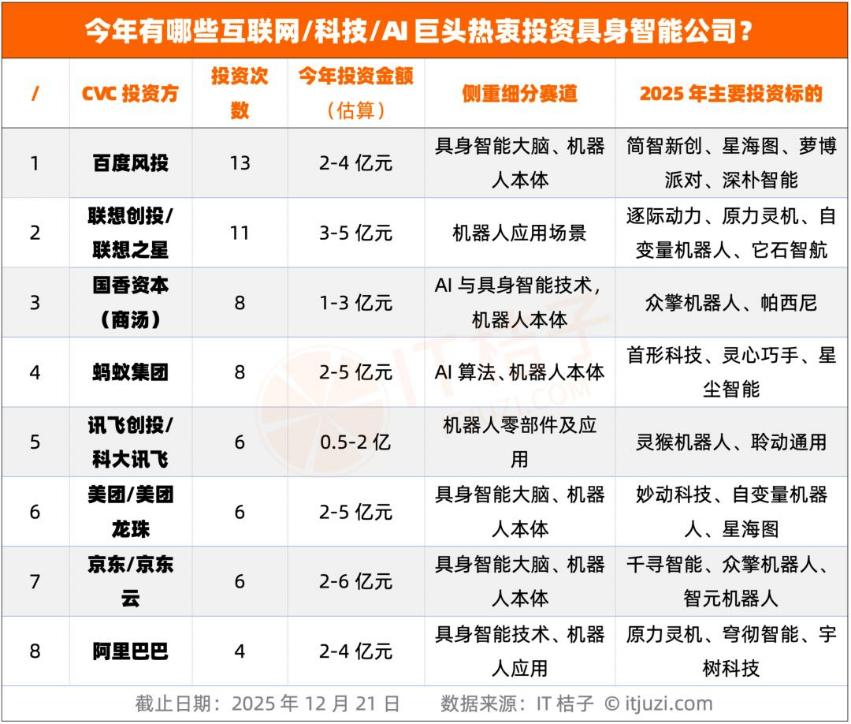
However, large companies' strategic investment in the robot track started much earlier. Since 2014, large companies such as Alibaba, Baidu, Xiaomi, Meituan, and Tencent have been continuously active in the robot track.
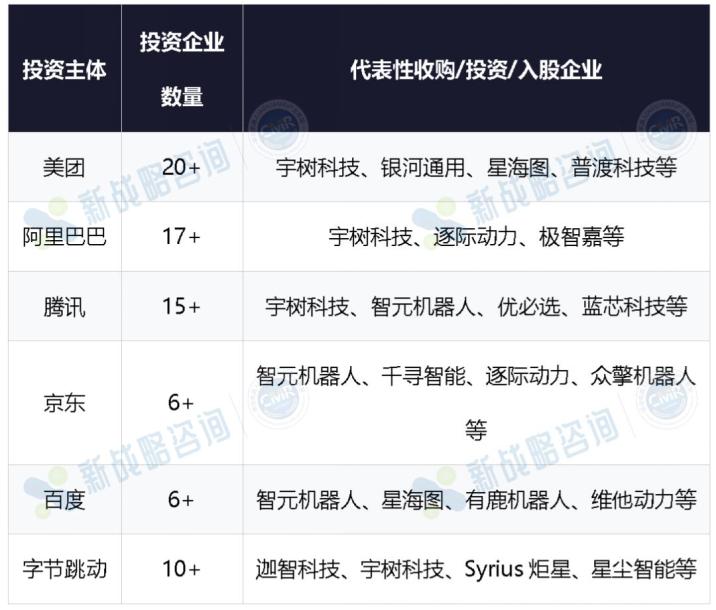
According to the report of "New Strategy Embodied Intelligence", Meituan has invested in the largest number of enterprises, more than 20. Followed by Alibaba (more than 17), Tencent (more than 15), ByteDance (more than 10), and both JD.com and Baidu have invested in more than 6 enterprises.
In addition to large Internet companies, smartphone manufacturers and new - energy vehicle enterprises have also become a force that cannot be underestimated.
Xiaomi and Lenovo have each invested in more than 18 enterprises, SAIC Group has invested in more than 7 enterprises, and NIO and BYD have each invested in more than 4 enterprises. Large companies are "fiercely competing" in the robot track, which has also made large companies "stand behind" star robot enterprises.
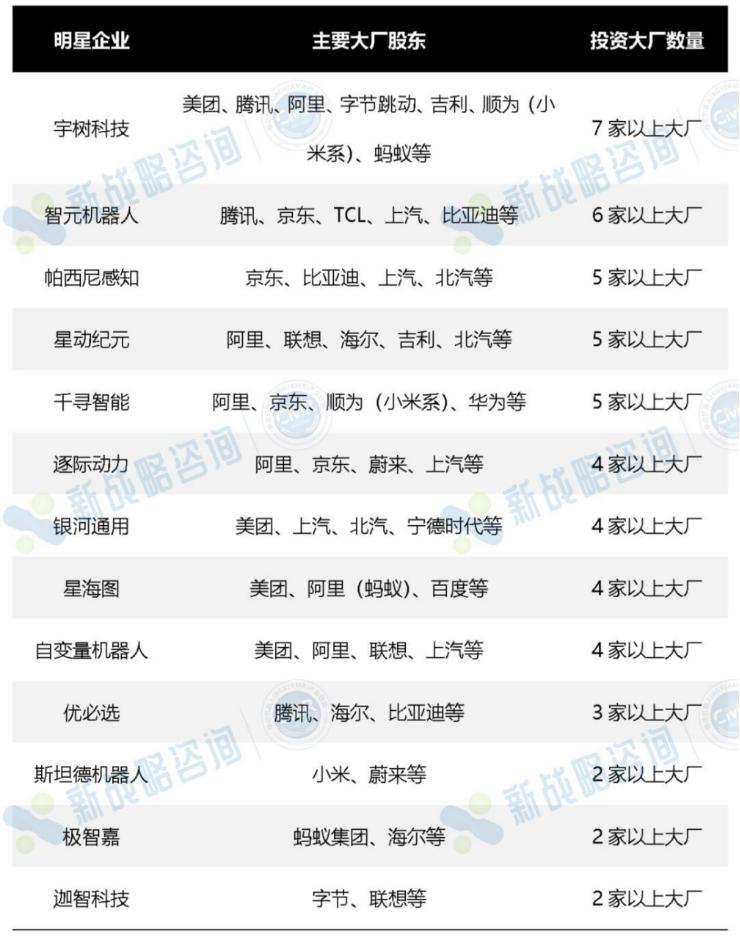
For example, the independent variable robot, which was reported to have completed a nearly 2 - billion - yuan Series B financing in April this year, has received bets from four large companies: Alibaba, ByteDance, Meituan, and Xiaomi. Behind the star unicorn Unitree Technology, there are more than 7 large companies.
Why are large companies so "crazy"? The answer is actually very simple: it's better to invest wrongly in a thousand than to miss one.
In the early years, the technological path of robots had not yet converged. No one knew whether bipedal robots were the optimal solution, and no one knew whether the "brain" of embodied intelligence should be in the cloud or on the robot itself. Facing high R & D costs and long - term verification, the industry was full of uncertainties.
For large companies entering the industry across sectors, the safest strategy is the "horse - racing mechanism", concentrating resources on leading robot enterprises to buy themselves a "ticket" to the future of robots.
However, this is very different from the past Internet investment logic.
In the past, except for early - stage investments, it was rare for large companies with overlapping territories to stand behind the same star application. Because large companies have their own ecological positions, once they make a heavy investment or strategic investment in an enterprise, they will incorporate it into their own territory and provide traffic and resource support. Naturally, the invested enterprises will also take sides.
However, as the competition among large companies shifts from the digital world to the physical world, this rule has been quietly broken - it's not that large companies don't compete anymore, but the direction of competition is different.
In the real world, the traffic logic of large companies will no longer be the decisive factor. As intelligent hardware, robots cannot "survive" only by data and large models. The supply chain, manufacturing capabilities, and implementation scenarios are the keys to shaping the "physical body."
Therefore, large companies in the robot field are no longer "rivals who never meet." Instead, they integrate robot applications deeply into their respective business ecosystems with their own "business genes."
With different implementation paths, the strategic directions of large companies will inevitably diverge. Even if they invest in the same robot enterprise, they are betting on different business futures.
Some "Build Dreams", Some "Create Wealth"
At present, the moves of large companies in the robot track are generally related to their respective strategic goals, industrial experience, and technological accumulation. With different cards in hand, the lessons they need to learn and the paths they need to take will naturally be different.
Some enterprises are moving towards a clear "wealth - creating" direction, regarding robots as tools to solve current business needs first. JD.com and Meituan are representatives of this type of enterprises.
JD.com focuses on the R & D of intelligent products for household scenarios and the application of embodied intelligence technology in the supply - chain scenario. At last year's World Robot Conference, it comprehensively demonstrated the application scenarios of robots in unmanned shelves and logistics scenarios.
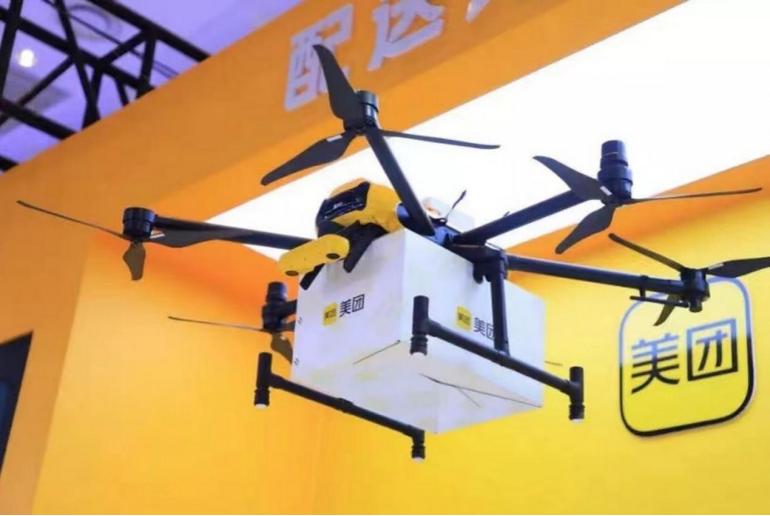
Meituan attaches more importance to the empowerment of robots in retail. Its drones and unmanned vehicles have completed scenario verification in advance:
Meituan's drone food delivery has opened 64 routes, with a cumulative number of orders exceeding 600,000. Meituan's self - developed unmanned delivery vehicles have started regular trial operations in some areas.
According to the calculation of Tianfeng Securities, the total operating cost of a drone within its life cycle is 84,500 yuan, and the monthly cost is about 1,400 yuan, a 75% - 90% reduction compared with the current salary of delivery riders. If applied on a large scale, it can save Meituan tens of billions of yuan in rider costs.
Since the businesses of JD.com and Meituan have a lot of interaction with the real environment, robots don't have to wait for the "perfect form" and can be quickly implemented in specific scenarios and continuously optimized and iterated in daily use.
With the motivation to "create wealth", the business flywheels of this type of players can naturally run faster.
Another type of enterprises is working hard to "build dreams." Starting from their own capabilities, they invest more resources in the software and operating systems of robots to build the underlying infrastructure for the robot era, such as Alibaba, Baidu, ByteDance, and Tencent.
Their plan is very simple. In the context where robots are still "physically strong but mentally slow", for robots to truly understand the world, they need the support of the "brain", and that's what they are going to do.
Alibaba is investing in hardware companies such as Zhujidongli and Xingdong Jiyuan on the one hand, and opening up its own Qianwen large model on the other hand to provide full - stack solutions for robot development.
In February this year, Alibaba's DAMO Academy open - sourced the RynnBrain basic model for embodied intelligent robots, which outperformed many top models in 20 embodied benchmarks.
The recently high - profile Gaode quadruped robot "Tutu" is supported by a complete embodied technology architecture called "ABot", including the physical - world data accumulated by Gaode over the years, two embodied operation base models, ABot - NO and ABot - M0, and the Agent operating system layer ABot - Claw that can continuously organize information, break down tasks, and execute them according to priority.
Baidu, ByteDance, and Tencent have similar ideas, but with different focuses.
Baidu focuses on "technology + ecosystem", using the Baige GPU computing power platform, the Wenxin large model, and Baidu Smart Cloud as the foundation to promote the implementation and application of robots in different scenarios. For example, Baidu Smart Cloud has reached a strategic cooperation with Zhiyuan Robot to build a robot development platform focusing on scientific research and education scenarios.
ByteDance gives full play to its advantages in algorithms and has launched the vision - language - action model Seed GR - 3. Different from the previous VLA models that rely on a large amount of robot trajectory training, GR - 3 can adapt to new tasks with only a small amount of demonstration data, greatly reducing the deployment cost.
In addition, ByteDance has also built interfaces such as the general robot model API and hardware SDK, trying to create a developer ecosystem for embodied intelligence.
Tencent's strategy is more conservative. Ma Huateng has clearly stated that he hopes to be a partner of all robot manufacturers rather than replacing them to make hardware.
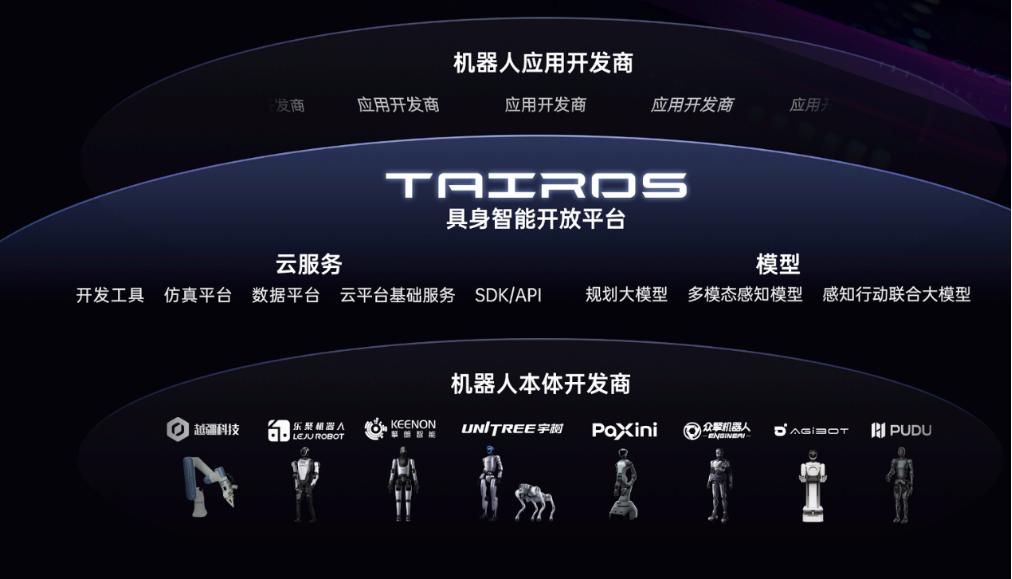
In July last year, Tencent's RoboticsX laboratory released the embodied intelligence open platform Tairos, which is the first domestic embodied intelligence software platform that provides large models, development tools, and data services in a modular way, serving as a link platform between the "body" and the "brain" of robots.
It is worth noting that in addition to Tencent, Alibaba, ByteDance, and Baidu have all started to build robots themselves.
This means that "building the brain" is just the starting point for them to claim their territory. At present, when the technological path of robots has not yet converged, large companies also hope to keep up with the evolution of the technological path through the combination of software and hardware and hold the uncertainty of "building dreams" in their own hands.
The last type of players directly aim at "building humanoid robots", such as "cross - sector players" like XPeng and Xiaomi.
Their supply - chain genes highly overlap with the robot industry, so the transition from "building cars" to "building humanoid robots" is logical.
More importantly, these players already have the ability to mass - produce robots. It is also a cost - effective financial investment to exchange for technology and future "factory entry qualifications" by investing in robot enterprises.
Who Can Win the "Dominance"
It can be seen that in the robot era, the positions of large Internet companies are changing subtly.
They still perform well in model capabilities and scenario data, but they no longer naturally occupy the center of the industry. Instead, they need to develop in synergy with the entire industrial chain.
From the perspectives of capital advantages and algorithm capabilities, large companies still occupy an important position in the robot industrial chain. By opening up large - model capabilities, providing simulation training environments, and outputting cloud - edge collaboration solutions, they have become the "water, electricity, and coal" of the robot industry.
The ceiling of this path is very high, but the uncertainty is also high.
After all, for the infrastructure to truly play its value, it requires the access and use of a large number of robots. Large companies must actively seek cooperation to verify and iterate their platform capabilities in others' production lines and scenarios.
Robot unicorns such as Unitree, Zhiyuan, and Galaxy General will still hold the top position in the robot industry. They are faster in the integration of software and hardware and have their own advantages in hardware or software, which are moats that are difficult to catch up with in the short term.
However, although some enterprises have achieved a commercial closed - loop, selling products is only the first step. How to make robots step off the stage and do practical things and expand more application scenarios is still a common problem faced by the entire industry. This requires large companies to continuously deepen their efforts in underlying technology, ecological standards, and commercial scenarios to jointly open up a breakthrough for the large - scale application of robots.
In addition, cross - sector players with rich supply - chain experience such as Xiaomi and XPeng, as well as enterprises focusing on the vertical supply chain of robots, will accelerate the localization process of core robot components.
After Honor's "Lightning" robot won the championship in the marathon, the stock prices of several suppliers behind it rose immediately, which is a clear signal: the capital market has realized that the end - game of robots depends not only on the whole - machine manufacturers but also on the maturity of the industrial chain.
Therefore, rather than aiming for the grand narrative of leading the industry trend, large companies should find their own ecological niches - either deeply cultivating a certain vertical scenario, becoming industry infrastructure, or becoming an ecological connector. This is a more practical survival strategy.
In the end, the one who can persevere in the long - distance race is not the one who can make the "first investment" or whose robot runs the fastest, but the one who can take the deepest root in the gaps of the industrial chain and cover the widest area.
Different ecological partners need to empower each other to go further together.