Huawei's entry reshuffles the AI smart mirror battle.
With Huawei's entry and the comings and goings of major players, the smart glasses track has entered a life - and - death competition phase amidst the hustle and the cold reality.
The fierce competition in the AI glasses market has welcomed another variable: Huawei.
On April 20th, Huawei released its first HarmonyOS AI glasses. Equipped with a 12 - megapixel ultra - sensitive camera, 0.7 - second AI flash photography, and an in - built Xiaoyi intelligent agent, it supports Alipay payment with just a glance. The starting price is 2,499 yuan. It's not a revolutionary product, but its release means that the smart glasses track has welcomed another player with brand, channel, and ecosystem capabilities.
This adds more pressure to vertical hardware manufacturers like XREAL and Rokid, who are already in a long - drawn - out "battle of a hundred glasses".
Before this, the smart glasses track had already fallen into a strange dichotomy. On one hand, the joint - branded product of Meta and Ray - Ban unexpectedly became a global hit, creating an illusion of a hardware revival. On the other hand, major players like ByteDance and vivo have, after a cool - headed assessment of the input - output ratio, voluntarily hit the pause button.
The different stances of the giants reflect the underlying anxiety in the industry. Smart glasses have yet to experience their "iPhone moment". In the current market, the hype of concepts coexists with the cold reality of business, and it's far from the stage of determining an absolute winner.
However, a consensus has emerged: the threshold has been raised, and the dividends have been diluted. When communication giants like Huawei and Xiaomi elevate the competition from the single - dimensional involution of optical modules to the underlying system ecosystem and offline channel establishment, the industry's margin for error has been sharply compressed.
For small and medium - sized manufacturers trying to grow wildly during the giants' trial - and - error period, the logic of relying solely on supply - chain assembly to boost sales and gain profits is no longer effective. In this new life - and - death competition phase, finding an irreplaceable survival model while avoiding the saturation attacks of major players has become a more urgent task than iterating hardware parameters.
Part.1 The Calculations of Giants and the Anxiety of Small Players: The Hidden 1.0 Under - the - Table Battle Masked by the Entrance Theory
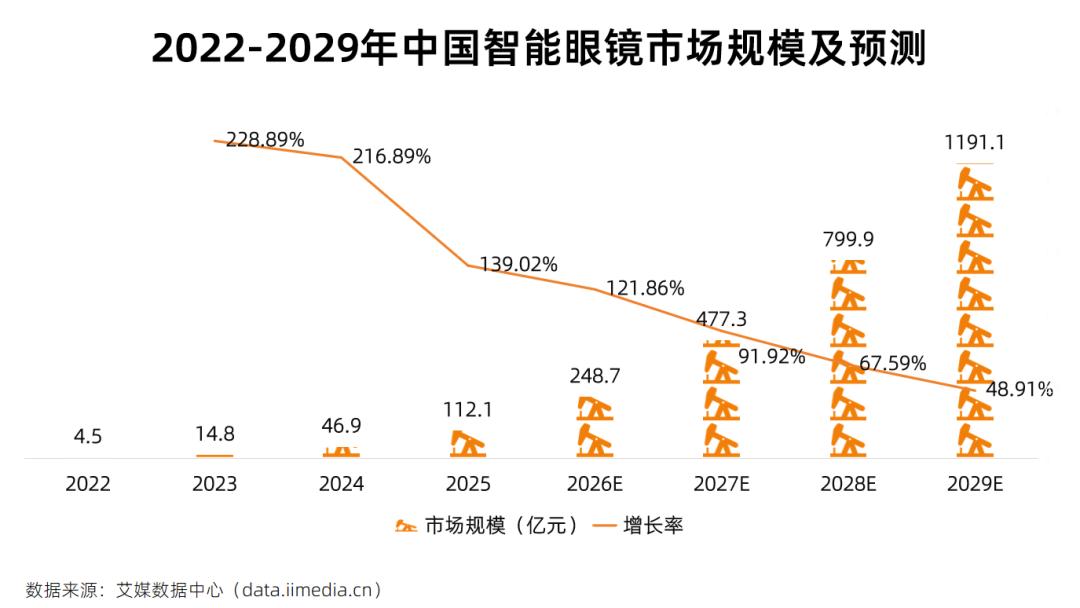
Although iResearch has given an optimistic prediction that "the market size is expected to approach 120 billion yuan by 2029", when you peel back the commercial fabric of the smart glasses track, you'll find that the so - called "battle of a hundred glasses" is actually a game where players with completely different demands are sitting at the same table, playing different games.
There are three forces at the current table.
First are the communication giants represented by Huawei and Xiaomi, with mature supply chains, a large number of stores, and strong brand influence.
Second are cross - border players represented by Alibaba, Baidu, and even Li Auto, who are entering the market with capital and large - model technologies.
Third are vertical hardware manufacturers represented by Thunderbird Innovation, Rokid, and XREAL. They once seized the window period when the giants were still on the sidelines and managed to break into niche markets with extreme single - point breakthroughs.
Outsiders habitually interpret the gathering of these players as a race to capture the next - generation human - machine interaction entrance. However, in the view of senior consumer electronics industry insiders, the "entrance" is often just a narrative guise for packaging. The real calculations of the giants are far more profound than just selling hardware.
In this 1.0 - stage bounded competition, when major players make glasses, they are playing a multiplicative game.
Smart glasses are not isolated profit - making tools but carriers that support and feed back to their core businesses. Alibaba's e - commerce and local - life ecosystem, and Huawei's HarmonyOS "car - home - person" full - scenario ecosystem all need a physical tool that can be constantly attached to users' noses.
More realistically, for major players with large - language models like Wenxin Yiyan or Tongyi Qianwen, glasses are currently the best touchstone for obtaining first - person multi - modal data and testing the implementation ability of AI large models.
However, for vertical players, making glasses is a life - and - death battle with only one option. Shipment volume and profit are their only survival indicators.
This has created a stark contrast within the track. Aggressive giants are investing resources without sparing costs to break into the track, while anxious vertical manufacturers have to face the cash - flow black hole caused by heavy - asset R & D. Every step, from the iteration of optical modules to the development of high - end molds, is burning money.
Take XREAL as an example. Despite its top - tier status, it has accumulated losses of over 2 billion yuan in three years. When major players use their ecosystems to gain an advantage, small and medium - sized players have no choice but to tell stories to capital and seek listing for financing to withstand the cycle.
On the other side of the track, there is extreme calmness. Previously, major players like ByteDance and vivo have suspended related projects based on business calculations. In the current situation where products cannot form an absolute experience difference and are prone to parameter and price involution, stopping losses in time and focusing on the AI software ecosystem or the mobile phone business is a rational strategic contraction.
This chaos, with some players running forward, some retreating, and some holding on, is directly reflected in the currently confusing market - share rankings.
If we use "AI glasses" as the statistical criterion, Omdia data shows that Meta is the global leader, followed by domestic manufacturers Rokid and Xiaomi. If we switch to the "AR glasses" track, XREAL claims to have been the global number one for four consecutive years in its prospectus, and domestic "AR Big Four" like Thunderbird Innovation also rank high. However, according to IDC's broad "smart glasses" criterion, Meta alone accounts for 75.7% of the market share, followed by Xiaomi, Thunderbird, XREAL, and Viture.
The conflicting data caused by different statistical criteria precisely hits the pain point of the industry. Before the market provides a unified aesthetic standard and usage habit, just like it did for smartphones or TWS earphones, there is no absolute winner in the "battle of a hundred glasses".
The current hype is just the giants defining the standards, while small and medium - sized manufacturers are desperately trying to prove their value. It's still a mystery who can survive this long under - the - table battle without a "iPhone moment".
Part.2 Entering the Life - and - Death Competition Phase: The Three - Dimensional Meat Grinder of Product, Ecosystem, and Offline Channels
As the stakes on the table get higher, the smart glasses track has completely bid farewell to the wild era of relying on a single selling point to attract attention and has fully entered a life - and - death competition phase with a very low margin for error.
The core of this competition is brutally folded into a three - dimensional meat grinder: high - frequency product iteration, the construction of ecosystem barriers, and the heavy - asset establishment of offline channels.
First, the "sea of models" tactic is being repeated on the product supply side.
The current smart glasses track is becoming more and more like the smartphone market of many years ago and the current new - energy vehicle market. Whoever can launch high - frequency saturation attacks can forcibly occupy users' minds.
From public information, overseas giants like Meta, Google, and Apple all have plans to launch new - generation hardware this year. In China, in addition to Huawei's significant entry, players like Baichuan Qianwen, XREAL, Thunderbird Innovation, Xiaodu, and Rokid have previously shown their strength at the 2026 Shanghai Home Appliance Exhibition.
In this war of attrition that tests the supply - chain response speed and R & D production capacity, vertical dark - horse players like Rokid have shown strong resilience, but the fatigue of following and cost pressure are also quietly accumulating.
If product iteration is a test of physical strength, then breaking through ecosystem bottlenecks directly exposes the genetic gap between different players.
In terms of ecosystem construction, the capabilities of different players have shown extreme differentiation.
The moats of Internet giants like Alibaba and ByteDance are the closed - loop soft services based on e - commerce, local life, map navigation, and payment. The trump cards of communication giants like Huawei and Xiaomi are the interconnection between the underlying operating system and the "car - home - person" full - scenario hardware matrix.
In contrast, vertical hardware manufacturers like XREAL face a fatal shortcoming: they don't have their own ecosystem genes. Their so - called ecosystems often have to be built on the compromise of accessing the open APIs of major players, such as maps and large models.
In the long - term business logic, the lack of an ecosystem means losing the ability for secondary monetization such as traffic distribution and content commission, which has become an insurmountable moat for vertical players.
However, when the battle spreads to offline retail, the situation presents another strange balance.
Smart glasses are not only 3C digital products but also wearable devices with optometry attributes. Fitting, trying on, face - shape adaptation, and wearing experience determine that they must rely heavily on offline channels.
On this special battlefield, the advantages of the giants have not been fully realized. Although Huawei and Xiaomi have hundreds of thousands of stores, they mainly focus on mobile phones and cars and currently lack professional optometry areas and optometry capabilities. Alibaba has no offline physical stores. The store atmosphere of car companies like Li Auto is naturally incompatible with glasses retail.
This has forced vertical manufacturers to explore different survival rules offline.
Some choose to go all - out. For example, Rokid has set a goal of selling 10 million units by 2028 and has, with high - level execution, completed offline coverage in all 34 provincial - level administrative regions in China. Some choose to use others' strength. Thunderbird Innovation knows that TCL's home - appliance channels cannot be directly reused, so it has tied up with the three major operators, trying to break into the sinking market by offering glasses with phone - bill recharge and bundling cloud services. Players like Meizu, which have lost their traditional offline - store foundation, can only retreat to the online market and get caught in the red - ocean competition of traffic purchase.
The cycle law doesn't lie. When smart glasses become a core opportunity that technology giants cannot afford to miss, the systematic investment of major players will quickly level the hardware threshold.
In this red - ocean game, the survival space of small and medium - sized manufacturers is being squeezed from both the ecosystem and capital aspects by the giants. The window for them to make mistakes is getting smaller.
Part.3 The Low - Threshold Trap and the Search for the "Genius": The Final Breakout of Small and Medium - Sized Players
Compared with the large and complex automotive industry, the smart glasses track is rapidly becoming a low - threshold field. This is not a negative description but an inevitable by - product of the highly mature consumer - electronics supply chain and the rapid unification of industry standards.
As modules, chips, and lenses become more standardized, and even car companies like Li Auto can enter the market, the early players' first - mover advantage in the blue - ocean market is being quickly eroded.
This spill - over effect of the industrial chain is undoubtedly a dangerous trap for small and medium - sized manufacturers. It pulls the competition into a homogeneous red - ocean market and greatly increases the hidden costs of staying in the game.
At this stage, the core of the competition has shifted. It's no longer just about competing in hardware product strength but about who can be the first to establish a viable business model for survival.
Just as the new - energy vehicle industry has given rise to the Huawei Smart Selection and self - research camps, the learning - machine market has split into the teaching - research and hardware camps, and the children's wearable field has produced Genius, which has established an absolute barrier through a closed social network.
For small and medium - sized smart - glasses manufacturers in a difficult position, the crucial question is how to build their own "Genius model" in niche scenarios before the giants fully dominate the market.
Objectively speaking, there have been attempts at tactical breakthroughs in the industry. For example, the cooperation between Rokid and the traditional glasses giant BOLON marks the entry of the industry into the joint - definition era, where technology companies provide algorithms and modules, and traditional optical companies provide channels and brands. However, this is only a transitional stage.
In the eyes of senior consumer - electronics operators, the current core task is still to reduce the high costs of optics and sensors by increasing the scale of ST (manufacturer shipments) and SO (retail activation).
However, from an end - game perspective, the meager profit from hardware is by no means the end. Once AI glasses truly become a permanent visual and voice super - node on people's faces, first - person - perspective navigation, food delivery, payment, and advertising distribution will follow.
By then, the real moat and profit pool will surely belong to the party that controls traffic distribution and transaction commissions, which is exactly what vertical players lack the most.
So, besides competing head - on in the ToC consumer market, do small and medium - sized manufacturers have an alternative? Sinking into the B - end market by avoiding the saturation attacks of major players might be a way out.
Vertical scenarios such as industrial manufacturing, intelligent logistics, and precision medicine have extremely high requirements for equipment customization and adaptability. Although it is full of thorns in non - standard integration, it can provide long - term survival security through customer stickiness and high unit prices.
Looking at the current smart glasses track, the battle between the old and new forces is at a cyclical chaotic point. The sudden push - forward and decisive retreat of the giants are clear signals before the industry reshuffle.
How this "battle of a hundred glasses" will end is still an open - ended mystery today.
However, the laws of business history have proven countless times that in a dividend - rich track full of both gold and thorns, the ones who survive in the end are often not the ones with the most glamorous parameters but the survivors who see through the commercial essence early and build their moats.
This article is from the WeChat official account "TrueView". Author: Laolian, Editor: Yong'e. Republished by 36Kr with permission.