From the perspective of the marathon, the leading window period for embodied intelligence has been significantly compressed.
The marathon has poured cold water on the embodied intelligence industry.
If in the past, capital was willing to believe in the prospects of native manufacturers and was patient with this still-early-stage track, and the audience was also willing to give applause and time for growth to those native players still on the uphill climb; then the truly cruel part of this competition is that it makes everyone clearly see for the first time that industrial competition will not slow down automatically just because you "need more time". Especially when a tech giant like Honor wins the championship in an almost unexpected way, native manufacturers are no longer just facing competition from their peers, but rather a more efficient, more organized, and less emotionally buffered competitive pressure.
In a nutshell, capital may give you time, but big tech companies won't. For the embodied intelligence track, this might be the real starting gun of this competition.
However, the cold water didn't extinguish the spark of embodied intelligence, but rather the "arrogant flames" that were never explicitly stated but had long permeated the corporate genes.
In the past two years, the embodied intelligence track has developed rapidly. There has been a dense influx of financing, valuations have risen rapidly, and the scale of enterprises has also expanded in a short period of time. Along with this, there has been not only confidence and excitement but also an industry sentiment that is not always explicitly stated: every company is proving that it is more advanced in its own narrative. Over time, a subtle distortion has emerged in the track. Everyone has become more and more certain in their own discourse systems, but there has been a lack of a truly public, unified, and cruel enough field to bring these judgments back to the same scale.
When everyone is immersed in their own worlds, the significance of a dark horse becomes particularly important. It has become a necessary condition for the healthy development of the industry. Tech giants are entering the robotics track with unprecedented strength, forcing the buffer space for native robotics companies to narrow. And the competition is no longer just a performance stage but has begun to become an important force in promoting technological iteration and reshaping the industry evaluation system.
The competition really gets exciting after big tech companies enter the arena
In this competition, not only Honor but actually three big tech company cases are worth in-depth exploration.
The first is Honor behind the champion "Lightning". The championship itself is eye-catching enough, but more importantly, it sends a clear signal: the system engineering capabilities, whole-machine optimization capabilities, and supply chain coordination capabilities accumulated in the consumer electronics era have begun to be transferred and manifested in robots. For example, heat management. Thanks to the transfer of excellent heat dissipation technology from consumer electronics products (mobile phones, laptops) to robots, "the motor of the robot is still cold to the touch even after running 21 kilometers," an Honor team member said in an interview.
Honor is not a traditional robotics startup, but precisely because of this, its entry into the field is even more worthy of the industry's attention - it means that robots are becoming a type of product that can be quickly reconfigured by more mature industrial methodologies.
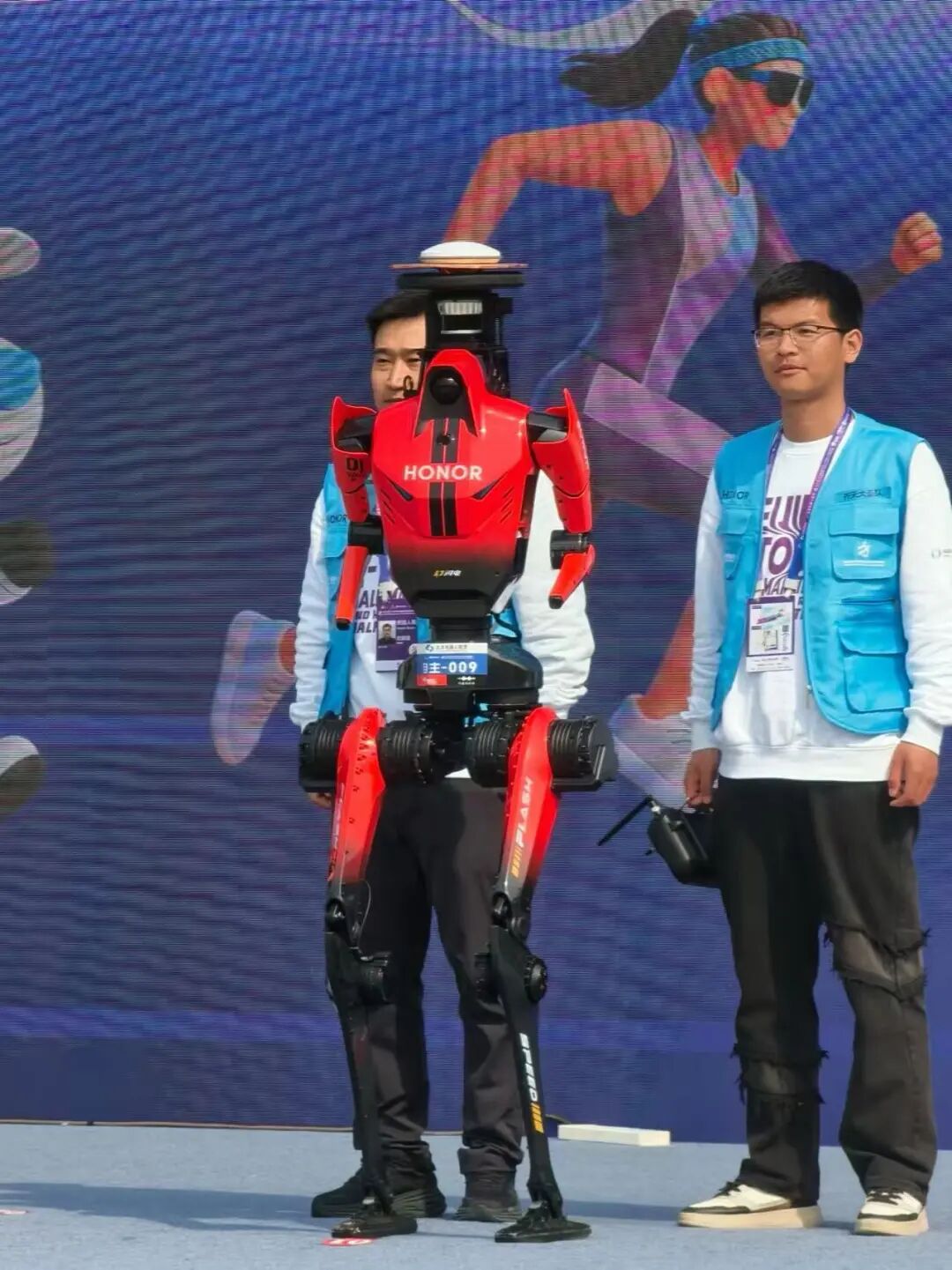
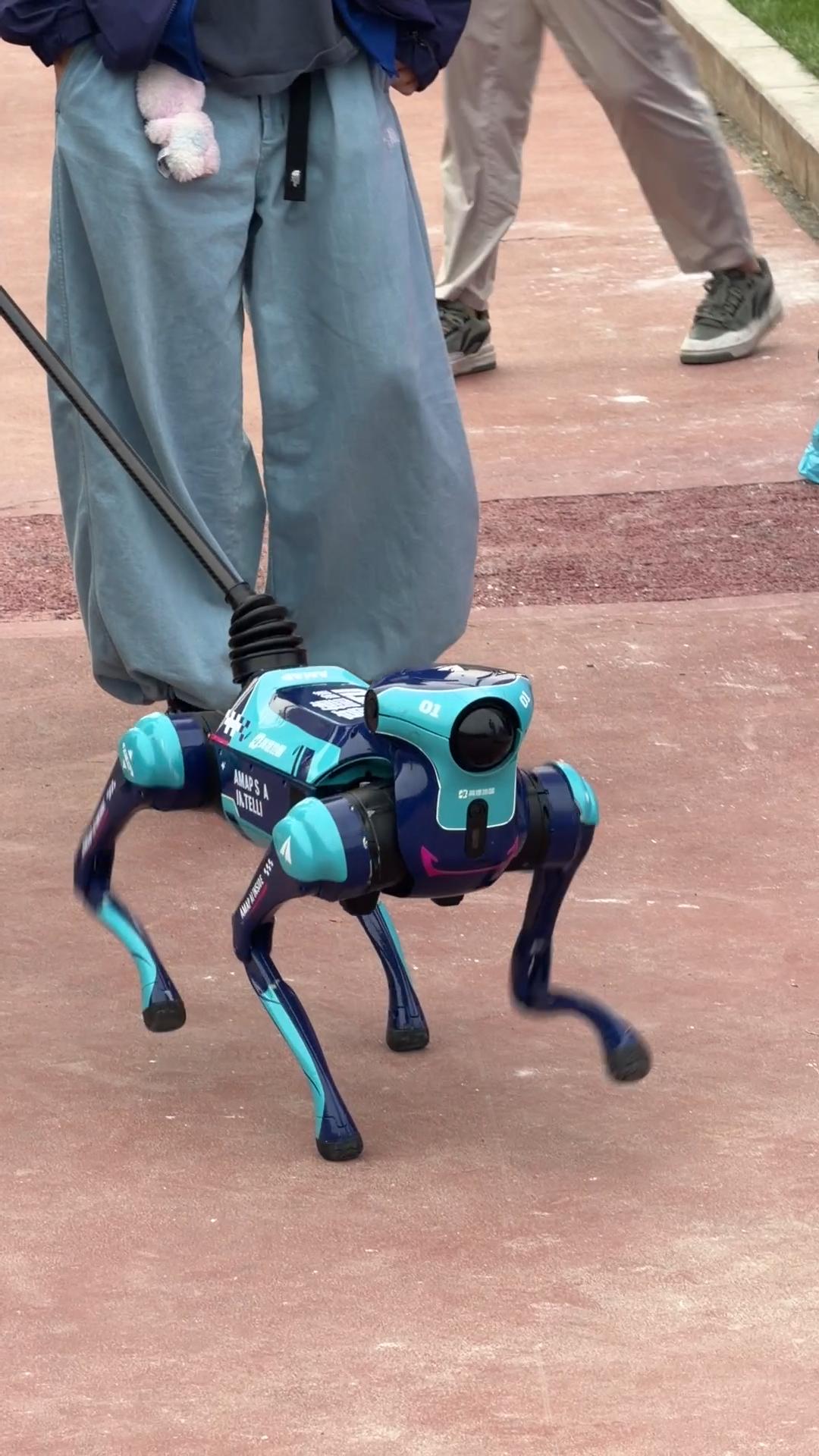
The second is AutoNavi. On the eve of the competition, AutoNavi publicly unveiled its first quadrupedal embodied robot, "Tutu", positioning it as a robot capable of autonomous movement in an open environment and undertaking guide dog tasks. AutoNavi's strongest ability has never been hardware manufacturing but rather two decades of spatio-temporal data accumulation and large-scale map engineering capabilities. When such a data foundation and cognitive ability are transferred to robots, what the outside world sees is not just an additional quadruped in the industry, but rather the natural spillover of the navigation scenario to the embodied scenario. For robots, this transfer of scenario capabilities is often more crucial than simply piling up hardware because it means that the application does not grow from scratch but rather extends from an existing ability system.
The third is JD.com. JD.com not only participated deeply in the competition as a sponsor, deploying "robot ambulances" and maintenance engineer support teams at the supply stations to ensure the completion of the race. At the same time, on April 16th, it released an embodied intelligence data infrastructure covering the entire link of "collection, storage, labeling, training, evaluation, simulation, and testing" and launched self-developed data collection terminals, embodied large models, and a data trading platform. This is JD.com's new move in the field of embodied intelligence after announcing the creation of a data collection scale of tens of millions of hours a month ago. The industry may still be discussing the surface symbol of "buying robots on JD.com", but the truly terrifying thing is not at the retail end. Instead, JD.com has systematically transferred its capabilities in logistics, supply chain, real scenarios, and data organization into the robotics industry.
Looking at these three cases together, we can see a logic that has not been fully discussed before: perhaps the barriers of today's embodied intelligence startups, especially the ontology barriers, need to be reexamined.
This does not mean that the ontology is unimportant. Of course, the ontology is important, and there are also engineering thresholds, which involve a whole set of complex system engineering such as motion control, material technology, structural design, and whole-machine reliability. However, the problem is that in the stage when the industry is not yet finalized, many capabilities are not as difficult to obtain as imagined. "Once the supply chain is understood, some hardware capabilities can be quickly supplemented through external integration; modules can be purchased, solutions can be pieced together, and even if the cost is a bit higher, it's okay to get on board first," this is the consensus reached by the Embodied Intelligence Research Society when communicating with the business leader of an upstream battery manufacturer. What is truly difficult to replicate is the ability to enter the scenario first, generate data first, and accumulate know-how first.
That is to say, what is most worth discussing at present is not "who can make a robot first" but rather "who can put a robot into a real scenario first, use it, run it, and collect data from it". Because once there is a scenario, data will flow back; once there is continuous data flow, scarce know-how will emerge; and once the know-how is formed, subsequent cost reduction, iteration, and large-scale production will truly have a foothold. When big tech companies enter the arena, and those leading enterprises with big tech company strategies, in essence, are all competing for this link: use existing capabilities to enter the scenario first, then let the scenario feed back the technology, and finally solidify the technology into new barriers.
Therefore, the real entry of big tech companies this time is not just about participating in the competition but also about rewriting the competition mode of the track.
The absence of a dark horse is actually a misfortune for the industry
When the outside world watches the competition, they always tend to ask why there is a dark horse, who the dark horse is, and what the dark horse means. However, for an industry still in the early uphill stage, what is more worthy of attention is not the appearance of a dark horse but rather the absence of one.
From a communication perspective, the absence of a dark horse means that the competition lacks drama. But from an industrial perspective, it means the lack of something more important - the possibility for latecomers to rewrite the pattern, the ability for new technology routes to break through the old order, and the opportunity for engineering organizational capabilities to make a leap in a short period of time.
A truly vibrant industry should be constantly challenged, impacted, and reevaluated. If the leading players on the track are always the established ones, the ability boundaries are not refreshed for a long time, and latecomers find it difficult to break through, it actually indicates that the competition intensity in this industry is not high enough, there are not enough variables, and the industrial evolution is not sufficient.
Therefore, the appearance of a dark horse in today's humanoid robot track is almost an inevitable event. Because this is an industry that is far from being finalized, the routes have not converged, and the ability structure is far from being solidified. There is still room for redefinition in every link, such as control algorithms, motion ontology, perception systems, energy management, whole-machine reliability, and system scheduling. Whoever suddenly gets it right in one of these links, whoever suddenly shortens the iteration cycle in engineering collaboration, and whoever smooths out the seemingly trivial problems before the competition will have the opportunity to quickly emerge from the marginal position.
In other words, a dark horse is not an exception to the track order but rather a proof that the track is still young. What is truly worth worrying about is not that someone suddenly wins but rather that no one can suddenly win anymore. The former indicates that the industry is still alive and evolving rapidly; the latter means that the pattern is solidified in advance, and the entire industry begins to lose its flexibility.
To put it more bluntly, if the champions are always the same familiar faces, this track will lose some of its vitality.
That's why what is truly worth observing in this competition is not the single champion itself but rather why dark horses keep emerging, the underlying industrial conditions that support the emergence of dark horses, and how the enterprises we are most familiar with will change as a result.
The time left for native enterprises to take it slow is disappearing
This is exactly why the Yizhuang Humanoid Robot Half Marathon this year is likely to be a turning point.
In the past, the industry was in a relatively relaxed stage. The immaturity of technology could be explained by the fact that the routes were still being explored; the instability of products could be explained by the need for further refinement before mass production; and falling behind others could always be attributed to the fact that time was on one's side, believing that as long as one continued to accumulate resources and fight a long-term battle, one would eventually wait for the industry to take off. That was a typical early-stage track mentality: everyone was still near the starting line, and it seemed that there was still a chance even if one was a bit slower.
But from today on, such space is rapidly narrowing.
The reason is simple. When a tech giant like Honor can transfer the high-efficiency R & D system, whole-machine system engineering capabilities, and supply chain coordination capabilities formed in the consumer electronics era to robots, the competition logic of the track has changed. What embodied enterprises are competing for is no longer just the possession of cutting-edge concepts, financing stories, or a long enough timeline, but rather who can quickly compress these resources into real and visible product capabilities.
In the past, an important premise for the capital market to invest in native manufacturers was that this was still an early-stage track. Native robotics companies understood the ontology better, were more proficient in motion control, and were more familiar with the engineering details that were difficult for outsiders to replicate. Therefore, people were willing to believe that they would eventually succeed. The public had a similar mindset. Facing an industry that was just starting out, people were naturally more tolerant and willing to accept its immaturity, mistakes, and slowness.
However, the entry of big tech companies has precisely broken this gentle narrative.
Big tech companies have no obligation to wait for an industry to mature slowly, and they will not slow down their progress just because native manufacturers are still growing. On the contrary, once they confirm the direction, they often use a stronger organizational density, a more mature industrial system, and more direct resource mobilization capabilities to quickly compress the process that originally took several years to climb.
The reason why Honor's victory in this competition shocked the industry is not only because it won but also because it reminded all native manufacturers in an almost "unannounced" way: you think you are still in the growth window, but others may have already started to shrink it.
A very typical example is heat dissipation. In the past, many people liked to talk about the "brain", control, and motion algorithms when discussing robots. However, once they enter a long - time, high - load, and extreme - condition scenario like a marathon, the system engineering details such as heat dissipation will be infinitely magnified. It is no longer a behind - the - scenes issue but will directly affect the battery life, stability, motion performance, and whole - machine reliability. It is precisely these details that have shown the "system engineering capabilities" so vividly on the publicly visible track for the first time.
This has a direct meaning for native enterprises: in the future, what is left for them is no longer simply "waiting for the industry to mature" but rather having to quickly convert R & D investment, organizational efficiency, technology routes, and engineering capabilities into real, visible, comparable, and verifiable product capabilities.
In other words, the industry will no longer tolerate "taking it slow" indefinitely. Time is still important, but it no longer naturally favors a particular player. For those enterprises with weak technology, low organizational efficiency, and insufficient engineering capabilities, time may even become a burden. Because when big tech companies can quickly replicate, verify, and enter the market, if native enterprises still hope to "wait it out until the industry matures", they may find that what they wait for is not their own opportunity but rather that others have completed the first round of harvesting.
Capital can believe in the long - term prospects, but it also needs to see the path in the end. The audience can give time for growth, but their patience will ultimately be reshaped by stronger, more stable, and more mature product experiences. In a sense, a dark horse like Honor is completing an industry education in advance: this track is entering a real competition, and real competition never talks about sentiment but only about delivery.
Therefore, what this competition really changes is not just the scoreboard but also the corporate mindset. It forces everyone to re - recognize a problem: future competition is no longer just about "whether you have an ideal" and selling expectations, but rather about having barriers that at least cannot be easily crushed by big tech companies.
The competition is becoming a propeller for the industry and a major reconciliation
Actually, the previous text has been talking about the possible changes at the enterprise level, but the last point must return to the competition itself.
Because these two competitions have increasingly clearly proven that the competition is not just a display stage but is becoming an important propelling mechanism for the industry. It can propel enterprises and directions; it can magnify advantages and mercilessly expose weaknesses; it is both the result of industrial progress and is in turn becoming a driving force for industrial progress.
From the results, this is already very obvious. From last year to this year, the competition has continuously attracted more teams to participate, expanding from more than 20 to more than 100. This is itself the result of the continuous amplification of the "demonstration effect". The larger the competition, the stronger the influence; the stronger the influence, the more enterprises it can attract; after more enterprises enter, the competition intensity further increases, which in turn makes the competition more valuable. Thus, the competition is no longer just a one - time event but has begun to form a benign self - driving mechanism: the industry accelerates because of the competition, and the competition is continuously magnified because of the industry.
From the perspective of the competition system, it has also begun to play the role of a "technology steering wheel". This year, the competition grouped autonomous navigation and remote control and used different weighting coefficients. In essence, it is sending a clear signal to the industry: in the future, what is important is not just finishing the race but also finishing it autonomously. Autonomous navigation has gradually changed from an additional bonus item to a value orientation.
Looking further along this line, why can't the next competition go a step further? For example, full - autonomous battery swapping, or completing the whole course with less external intervention, or even further testing dynamic path decision - making and complex environment adaptation. Seemingly just a rule adjustment, in fact, it is using the most specific and public way to highlight the key points for the next stage of technological iteration in the industry.
What is even more thought - provoking is that the influence of the competition is spreading along the industrial chain. Around the competition, energy replenishment, maintenance, replacement parts, sensors, structural parts, manufacturing collaboration, and communication collaboration are all forming a new industrial operation mode. JD.com's role in the competition's support system and the support from supply chain partners such as Yinshi Robotics, BlueDot Touch, and Hesai are all very typical samples of mature industrial operations. It also shows that today's robot competitions are no longer just a competition between robot enterprises but are increasingly like a public joint exercise of the entire industrial chain.
And this is precisely the deepest meaning of the competition: it has begun to become the unified yardstick for the embodied intelligence industry.
In the past, there was no unified voice in the track. Each enterprise could claim that its route was the most advanced, its technology was the most leading, and its solution was the most special. However, due to the lack of a public, unified, and comparable evaluation system, many judgments remained at the enterprise's self - description level. You said you were fast, I said I was more stable; you said you were more autonomous, I said I was more intelligent. There was no real common coordinate system between each other, and the industry was always in a hazy state of "mutual disbelief".
However, the emergence of the competition is breaking this haze. It